
You probably remember the basics from your early education: a bee pollinates a flower, and eventually the flower turns into a fruit or vegetable. We harvest it, we eat it, we say, “Yum!”
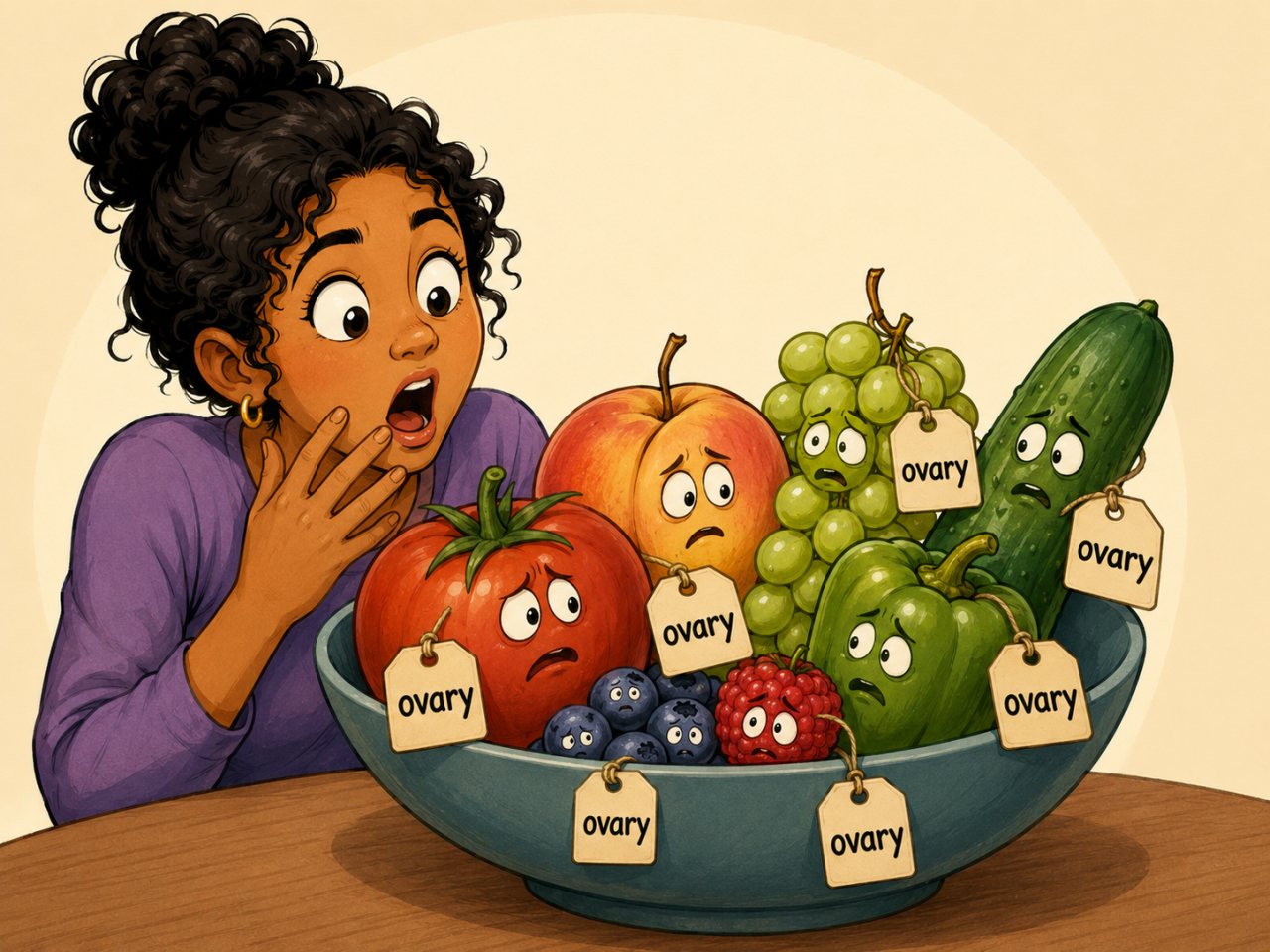
But did you realize that you’ve been eating OVARIES all this time? 😳
If you reach back into the dusty cobwebs of your memory, you may recall that pollen comes from the male parts of a flower and gets transferred to the female parts.
And just like in female humans, the egg is tucked away inside an ovary. More precisely, the egg is inside an ovule, which sits inside the ovary. After fertilization, that egg develops into a plant embryo, while the entire ovule develops into what we call a seed.
Yes, when you eat seeds, you are eating structures containing plant embryos. But that’s another scandal for another time. [Now updated! See The Bread and Cereal Aisles Implicated in Ongoing Fruit Scandal!]
Meanwhile, the ovary around those developing seeds begins to grow, too. Its walls thicken and mature into the fleshy fruit surrounding the seeds.
Plants, unfortunately, cannot get up and walk to the neighboring lot to plant their offspring. So flowering plants have evolved an impressive assortment of ways to disperse their seeds. Some fruits fly. Some float. Some hitchhike on fur.
And some essentially say, “Eat me.”
Those fruits become colorful, fragrant, fleshy, sweet, or otherwise attractive to animals, which eat them and may carry or deposit the seeds somewhere else. Humans, naturally, joined in on this arrangement and eventually started adding whipped cream.
In fact, a lot of familiar things you eat develop from flower ovaries: tomatoes, peppers, peaches, cucumbers, grapes, bean pods, pea pods, and blueberries.
And hold onto your hats for this one...
When you eat a raspberry or blackberry, you aren’t eating just one ovary.
You’re eating a whole collection of them.
Each of those little bumps is a separate fruit unit, called a drupelet, produced from one of the multiple ovaries in a single flower.
We will deal with why a raspberry is apparently several fruits wearing a disguise in another scandal. [Continue the investigation: why raspberries aren't berries.]
So congratulations! I now dare you to eat a grape, peach, tomato, or raspberry and not think about the fact that your snack began as a flower’s ovary.
The Real Story
Flowers aren’t just decorations plants produce to make gardens pretty and florists profitable. They are the reproductive structures of flowering plants, or angiosperms.
A typical flower has several sets of parts. Sepals protect the developing flower bud, while petals often help attract pollinators. The reproductive business happens farther in.
The male structures are the stamens. Each stamen usually consists of a slender filament topped by an anther, where pollen is produced.
The female reproductive structure includes the stigma, style, and ovary. The stigma receives pollen, the style connects it to the ovary, and tucked safely inside that ovary are one or more ovules. Each ovule contains an egg cell.
After a pollen grain reaches a compatible stigma, it grows a pollen tube down through the style toward an ovule. Sperm cells travel through that tube, and one ultimately fertilizes the egg. The fertilized egg develops into an embryo, while the ovule develops into a seed.
And then the ovary gets involved.
As the seeds develop, the ovary matures into the fruit surrounding them. The ovary wall develops into the pericarp, the fruit wall. Depending on the plant, different layers of that wall can become soft and fleshy, dry and papery, leathery, or even hard.
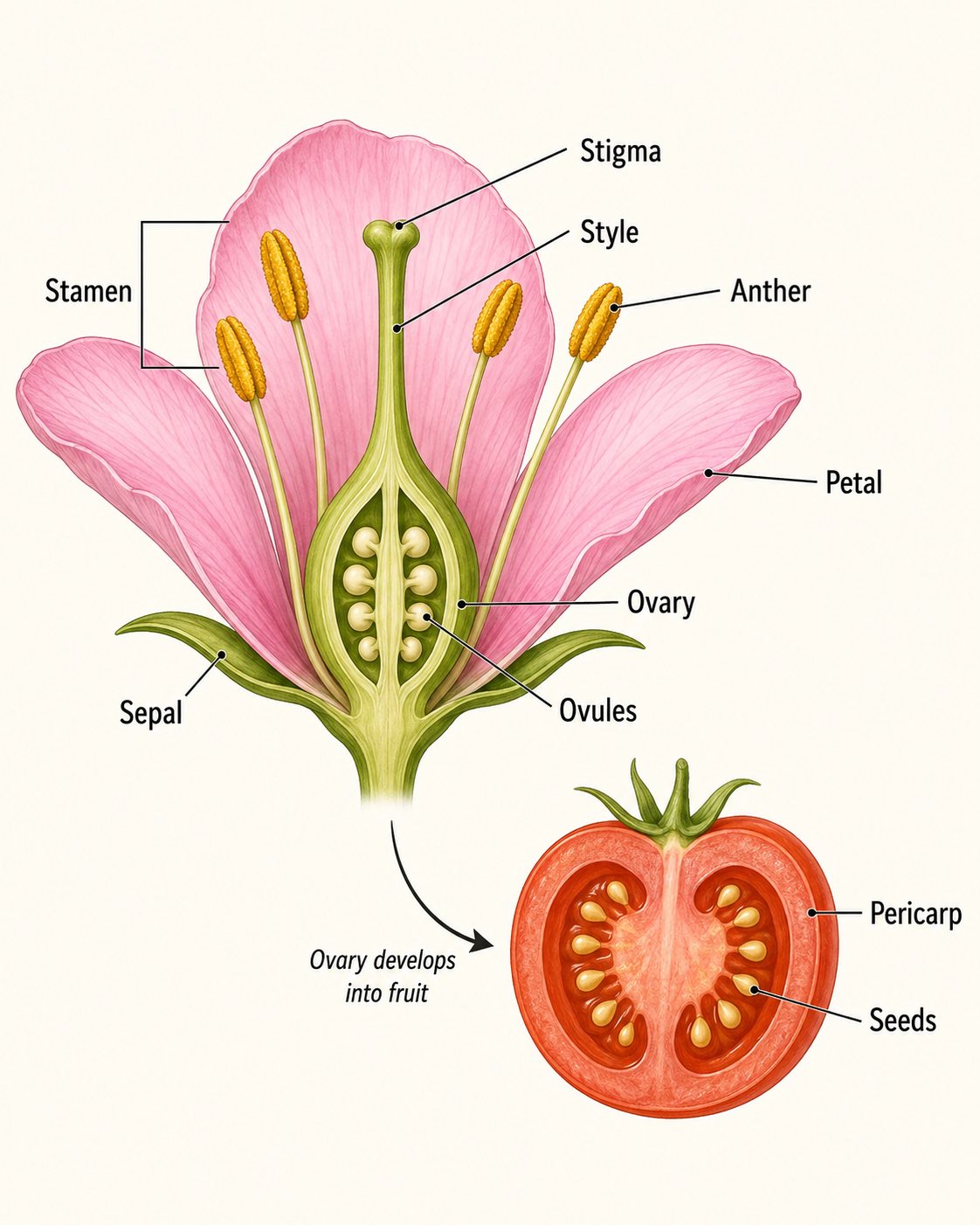
So when you bite into a grape, tomato, pepper, peach, cucumber, blueberry, or countless other fruits, you are eating an organ that began as the flower’s ovary.
Some foods we casually call vegetables are ovaries too. A green bean or pea pod, for example, is a fruit that developed from a flower ovary, with the beans or peas themselves developing from the ovules inside it. Culinary categories were apparently established without consulting the botany department.
Fruits do more than give plants somewhere to store their seeds. They can also help those seeds get away from the parent plant. Some fruits are carried by wind or water. Others cling to passing animals. And many fleshy fruits attract animals that eat them and then transport or deposit the seeds elsewhere.
That arrangement has worked spectacularly well with humans, who now cultivate entire orchards and fields of plants specifically because we enjoy eating their mature reproductive structures.
Raspberries and blackberries take the scandal one step further. A single flower contains multiple ovaries, and each one develops into one of the little fleshy units, called drupelets, that make up the finished raspberry or blackberry.
Why does that mean a raspberry isn't actually a berry, while some foods nobody calls berries technically are?
That's another scandal. [Continue the investigation: What the heck is a berry?]
And because botany refuses to let anything remain simple, not every fruit is made exclusively from the ovary. Some plants recruit additional flower tissues into the finished product.
That is also another scandal. [Continue the investigation: Fruits made from more than ovaries.]
For now, the important thing is this: flowers aren't merely followed by fruits. In many cases, the ovary of the flower becomes the fruit.
Which means that peach cobbler, tomato sauce, cucumber salad, guacamole, blueberry muffins, and a considerable portion of the produce aisle have been serving up plant ovaries all along.
Enjoy your lunch.
Sources
-
32.2 Pollination and Fertilization
Clark, M. A., Douglas, M., & Choi, J. (2018). “32.2 Pollination and Fertilization.” Biology 2e. OpenStax, Rice University.
Why this source matters: Best source for the reproductive sequence. Supports pollen-tube growth and fertilization, development of the fertilized ovule into a seed, and development of ovarian tissues into the fruit.
-
26.3 Angiosperms
Clark, M. A., Douglas, M., & Choi, J. (2018). “26.3 Angiosperms.” Biology 2e. OpenStax, Rice University.
Why this source matters: Supports basic flower anatomy, including stamens, carpels, ovaries and ovules, and provides the useful raspberry example showing multiple ovaries within one flower.