
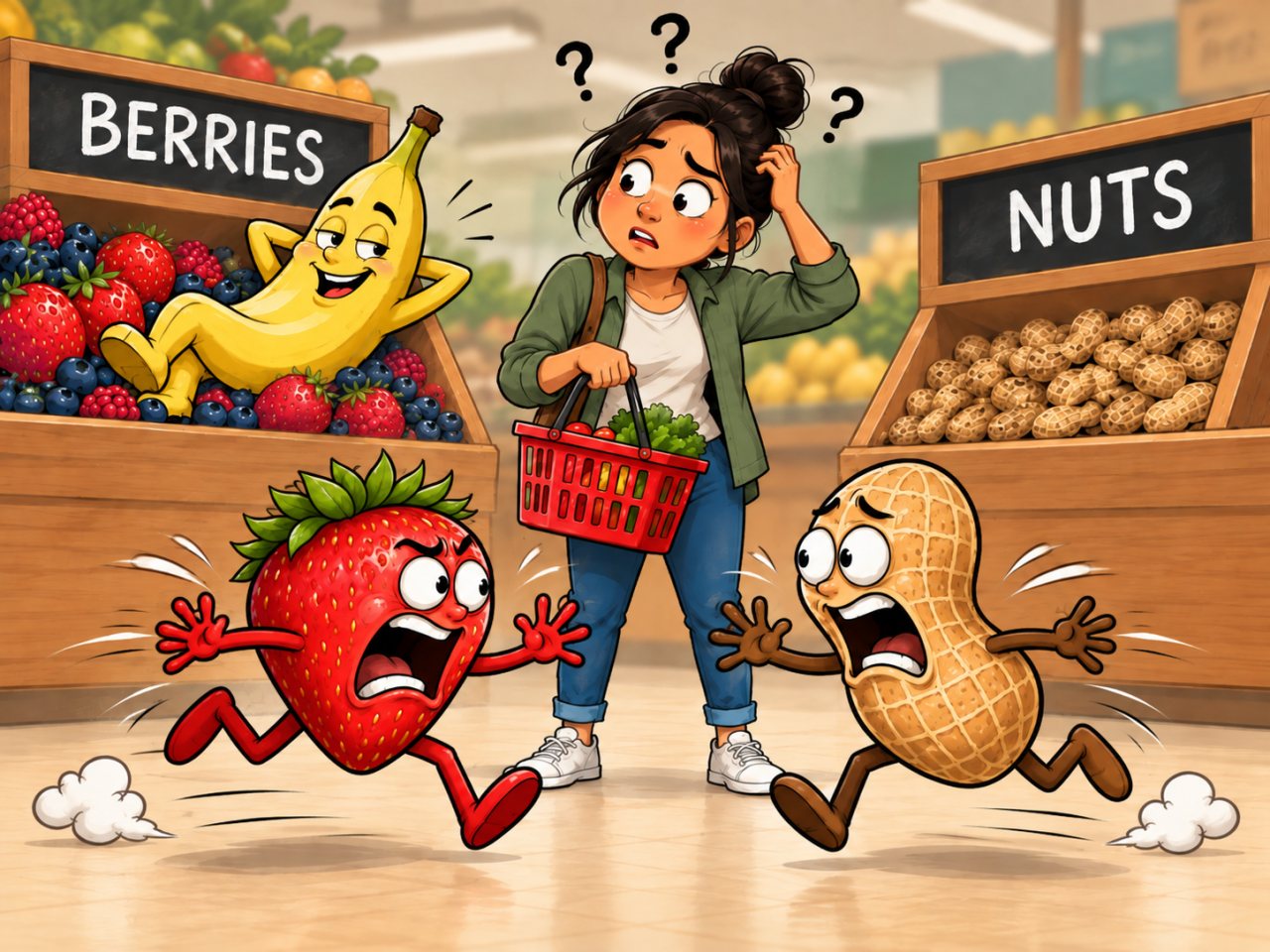
We've all heard the debate at some point: is a tomato a fruit or a vegetable? Well, it turns out the answer depends entirely on whether you're asking a produce manager, a culinary expert, or a plant scientist.
And since I'm a scientist, I'm going with the science.
So yes, a tomato is a fruit.
And actually, a tomato is a BERRY.
But we're coming to that. 😜
As we covered in a previous article [You've Been Eating Ovaries Your Whole Life!], a lot of things we eat, including some foods we casually call “vegetables,” are actually fruits that developed from a flower's ovary.
But once you start asking plant scientists what kind of fruit something is, things get weird fast.
Neither a raspberry nor a blackberry is actually a berry. They're aggregate fruits, produced from one flower with multiple ovaries.
A strawberry isn't a berry either. It's an aggregate accessory fruit, meaning tissues outside the ovaries also contribute to the part we eat.
Apples are accessory fruits too.
When multiple flowers in an inflorescence contribute to one larger fruit structure, you get a multiple fruit. Pineapples are a familiar example, and so are figs, which we recently discussed in another article [Fig More Abundant in Protein Than Originally Thought!].
Sometimes we don't even wait for fruit.
We just eat the flowering structures.
Broccoli and cauliflower are largely immature flower clusters, while artichokes are harvested flower buds.
Then there are peanuts.
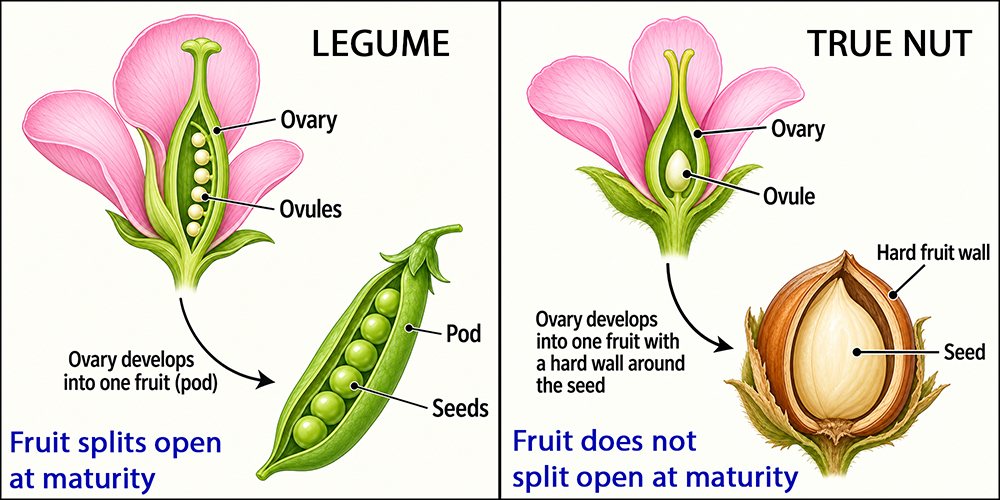
A peanut is a legume, meaning its fruit is a pod containing seeds. That puts peanuts in the same general fruit category as beans and peas.
And peanuts are definitely NOT nuts.
A true botanical nut is a dry fruit with a hard fruit wall that stays closed at maturity. Acorns, chestnuts, and hazelnuts are familiar examples.
Underground foods aren't any simpler.
A carrot, beet, radish, or sweet potato is enlarged root tissue.
A potato is a stem tuber.
A sweet potato, despite the name, is a tuberous root.
Onions and garlic are bulbs, built largely from modified fleshy leaves surrounding a short stem.
When we eat asparagus shoots, we're eating young stems.
When we eat celery stalks, we're actually eating leaf stalks, or petioles.
Thank goodness lettuce, spinach, and cabbage are keeping things simple.
If you thought you were eating leaves, you were correct. 😂
Confused yet?
Let's review.
Peanut? Not a nut. It's a legume.
Strawberry? Not a berry. It's an aggregate accessory fruit.
Raspberry? Not a berry. It's an aggregate fruit.
Pineapple? Not an apple. It's a multiple fruit.
Banana and tomato?
Both berries.
What the hell is a berry, you ask?
Well... that's our next plant scandal. Stay tuned!
The Real Story
The confusion begins because “vegetable” is not a precise botanical category.
In cooking, we tend to classify foods by flavor and use. Tomatoes, cucumbers, peppers, green beans, and squash are commonly treated as vegetables because they appear in savory dishes. Plant scientists classify them according to the structures from which they develop. From that perspective, all of those examples are fruits because they develop from flower ovaries.
That does not mean everything in the produce aisle is secretly a fruit. We eat almost every major part plants manufacture: roots, stems, leaves, flowers, fruits, and seeds.
A carrot, beet, radish, or sweet potato is primarily root tissue. A potato, however, is not a root at all. It is an enlarged underground stem tuber. Those little potato “eyes” give the game away: they are buds associated with stem nodes, which are structures roots do not have. Sweet potatoes are different again. Their swollen storage organs are tuberous roots, not stem tubers.
Onions and garlic use another strategy. Their bulbs consist largely of fleshy modified leaves surrounding a short, compressed stem. Ginger takes yet another route: the part we eat is a rhizome, a horizontal underground stem.
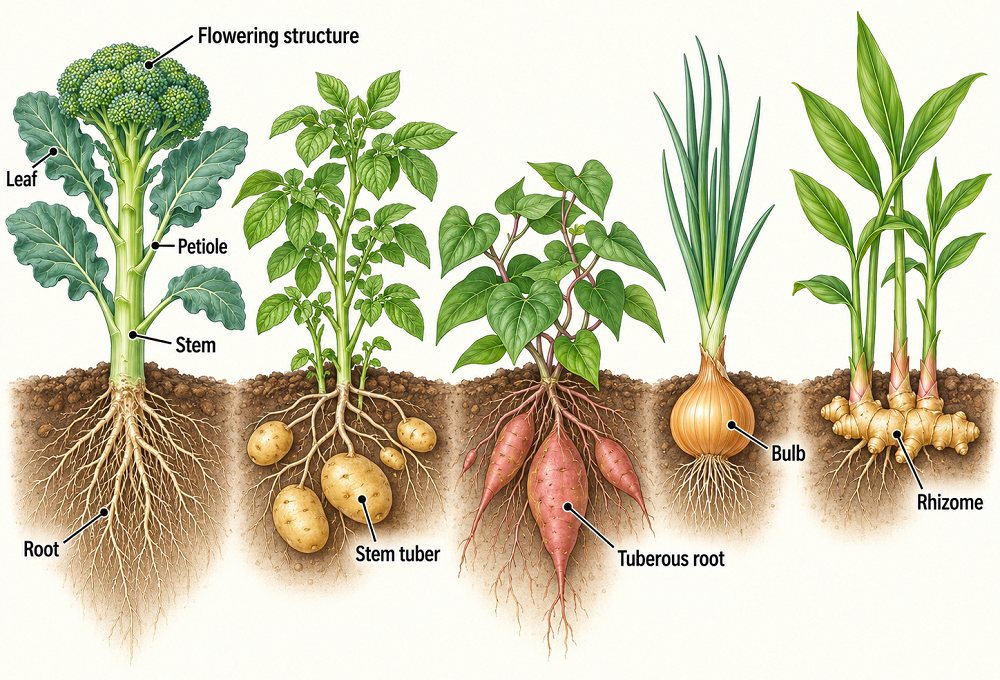
Above ground, asparagus gives us young stems, while the familiar “stalk” of celery is actually mostly a petiole, the stalk that attaches a leaf blade to the stem. Lettuce and spinach really are leaves, while cabbage is essentially a compact mass of leaves surrounding a short stem. Broccoli and cauliflower are largely immature flowering structures, although the edible portions also include stem tissue. Artichokes are harvested flower buds before they open.
And then we arrive at fruits, where plant classification apparently removes the safety rails.
One Flower Does Not Always Equal One Fruit
The simplest case is a simple fruit, which develops from one ovary in one flower. Tomatoes, peaches, beans, and true nuts all fit somewhere within this enormous category, although they belong to very different fruit subtypes.
But a single flower can contain multiple separate ovaries. When those ovaries mature together into one structure, the result is an aggregate fruit.
That is what happens in raspberries. Each little bump is a tiny fruit called a drupelet, derived from one of the flower's many ovaries. A raspberry therefore looks like one fruit but is actually an aggregate of many little fruits.
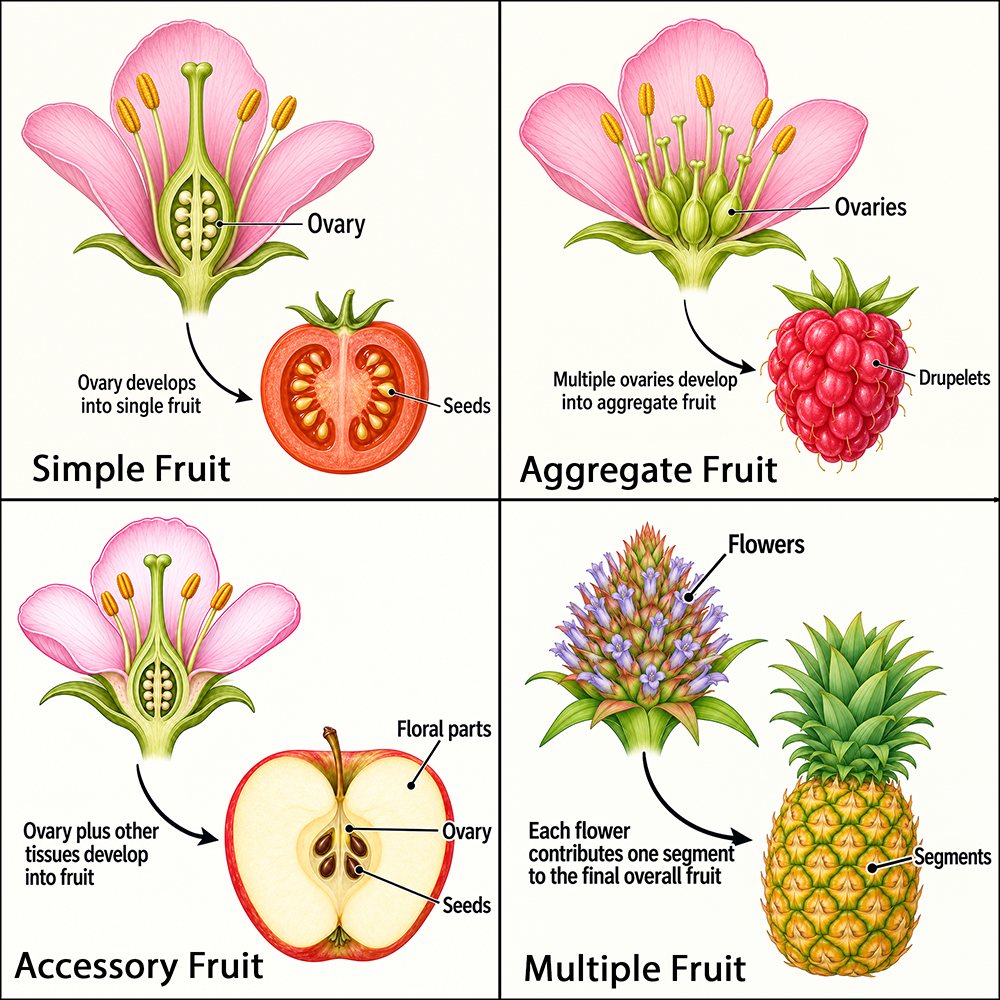
A strawberry adds another layer of botanical chaos. Its many tiny surface structures are individual dry fruits called achenes, each produced from an ovary. Much of the juicy red tissue we think of as “the strawberry” comes instead from the enlarged floral receptacle.
That makes the strawberry an aggregate accessory fruit: aggregate because one flower contributes many ovaries, and accessory because non-ovarian flower tissue contributes substantially to the structure we eat. These classification terms can overlap rather than functioning as mutually exclusive boxes.
Apples are accessory fruits too. Their familiar fleshy portion includes substantial tissue derived from floral structures surrounding the ovary rather than from the ovary alone.
Then Several Flowers Get Involved
A multiple fruit goes in the opposite direction: instead of one flower contributing several ovaries, many flowers in an inflorescence contribute to one combined fruit structure.
Pineapple is the classic example. Each of those patterned sections on its exterior traces back to one flower in the original inflorescence. Figs are multiple fruits as well, despite looking nothing like pineapples.
So:
Aggregate fruit: one flower, many ovaries.
Multiple fruit: many flowers joining the finished product.
Plant scientists did not name these categories with grocery shoppers in mind.
And a Peanut Still Isn't a Nut
Peanuts are legumes. A legume is a type of dry fruit, usually a pod, that contains seeds. Beans and peas belong to the same general fruit category. What we call the “peanut” is the seed inside that pod.
A true botanical nut, by contrast, is itself a fruit: typically a dry, indehiscent fruit with a hard fruit wall that does not split open at maturity and usually contains one seed.
Acorns, chestnuts, and hazelnuts are familiar true nuts. Many foods we casually call nuts, including peanuts and almonds, are botanically something else.
And then there are berries.
Plant scientists use berry for a particular kind of fleshy fruit, not simply for something small, sweet, and suitable for yogurt.
That is why tomatoes are berries.
Bananas are berries.
Raspberries are not berries.
Strawberries are very definitely not berries.
And if that seems like the moment the produce aisle has finally abandoned all reason, don't worry.
That's our next plant scandal.
Sources
-
32.2 Pollination and Fertilization
Clark, M. A., Douglas, M., & Choi, J. (2018). “32.2 Pollination and Fertilization.” Biology 2e. OpenStax, Rice University.
Why this source matters: Main source for fruit development and broad fruit classification. Supports simple, aggregate, multiple, and accessory fruits; raspberry, pineapple, strawberry, apple, beans, and nuts; and the distinction between dehiscent and indehiscent dry fruits.
-
Chapter 1: Basic Botany
Dinius, P. Washington State University Extension. “Chapter 1: Basic Botany.” The Pacific Northwest Gardener’s Handbook: Growing for the Future.
Why this source matters: Supports the vegetative-organ distinctions, especially potato as an underground stem tuber, potato eyes as stem buds/nodes, and onions as bulbs composed largely of modified fleshy leaves surrounding a compressed shoot.
-
Types of Fruit
University of New Hampshire Cooperative Extension. Types of Fruit.
Why this source matters: Particularly useful for the article's headline claims. Supports tomato as a berry, peanut as a legume, acorn as a true nut, raspberry as an aggregate fruit, and the distinction among simple, aggregate, and multiple fruits.
-
The Commercial Storage of Fruits, Vegetables, and Florist and Nursery Stocks
Gross, K. C., Wang, C. Y., & Saltveit, M. (Eds.). (2016). The Commercial Storage of Fruits, Vegetables, and Florist and Nursery Stocks. Agriculture Handbook No. 66. U.S. Department of Agriculture, Agricultural Research Service, Washington, DC.
Why this source matters: Useful supporting source for the “what plant part are you eating?” section. Provides commodity and plant-structure information supporting examples such as roots, tubers, rhizomes, bulbs, stems, petioles, leaves, and flowering structures. The handbook is a peer-reviewed USDA Agriculture Handbook and was completely revised in 2016.