
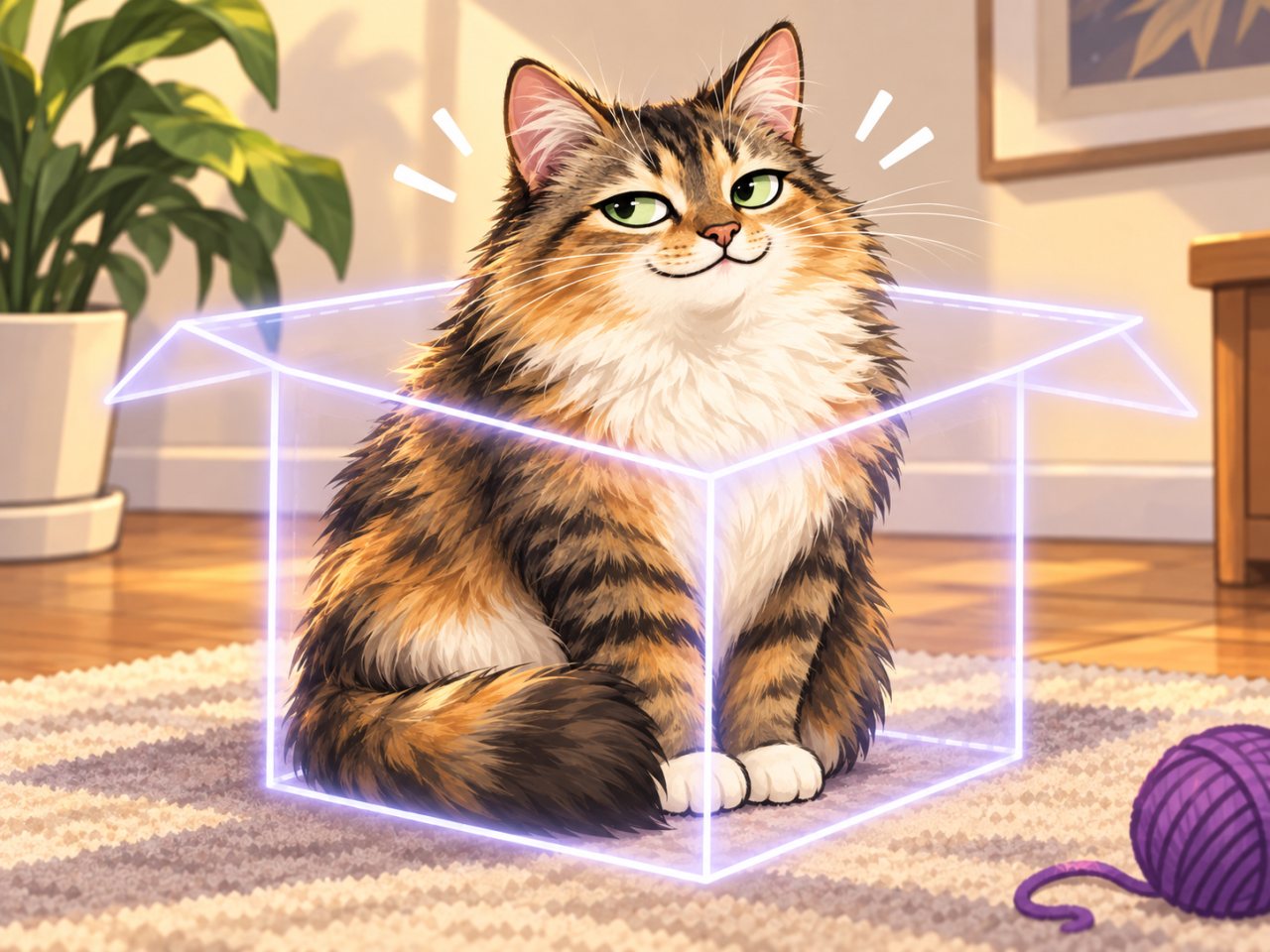
This is Millie. I hijacked Momma’s keyboard again. 🐾
Humans remain deeply confused about furniture.
They buy soft beds. Cushioned beds. Heated beds. Beds with raised edges, orthopedic foam, washable covers, and price tags that suggest someone has made a terrible financial decision.
Then they leave a cardboard box on the floor.
Obviously, I choose the box.
Recently, Momma placed one directly beside a perfectly acceptable fluffy bed and seemed surprised when I climbed into the cardboard instead. I do not understand what part of this required investigation. One was a bed. The other was a box.
Veni. Vidi. Corrugavi.
I came. I saw. I corrugated.
Unfortunately, humans have now discovered that our standards may be even more flexible than previously suspected. Apparently, some cats will sit inside squares or rectangles made only from tape. Others will choose a square whose edges are not actually drawn at all.
At this point, I feel compelled to clarify that we are not lowering our standards.
We are expanding the definition of acceptable real estate.
The humans, naturally, have decided this requires science.
The Real Story
Cats really do seem to get something useful from enclosed spaces.
In shelter studies, domestic cats given access to hiding boxes show lower signs of stress and adapt more quickly to unfamiliar surroundings than cats without a place to hide. In one study of newly admitted shelter cats, the cats with hiding boxes reached low stress scores by about the third day, while the cats without boxes took much longer to settle.
A later study found evidence beyond behavior alone. Cats housed with a hiding box had lower concentrations of fecal glucocorticoid metabolites, hormones associated with physiological stress, than cats housed without that enrichment. They also ate more food, and shy cats spent more time in the box than bolder cats did.
That fits with older work showing that stressed cats try harder to conceal themselves. Hiding appears to be one way cats cope when their surroundings feel unfamiliar or unpredictable.
So a cardboard box offers something a plush bed may not: a defined, partially enclosed space where a cat can reduce exposure to the rest of the environment. The walls provide concealment and limit the directions from which something can approach. A box may also provide warmth and physical contact along the body, but the strongest experimental evidence is for the value of the box as a hiding place and stress-reducing refuge.
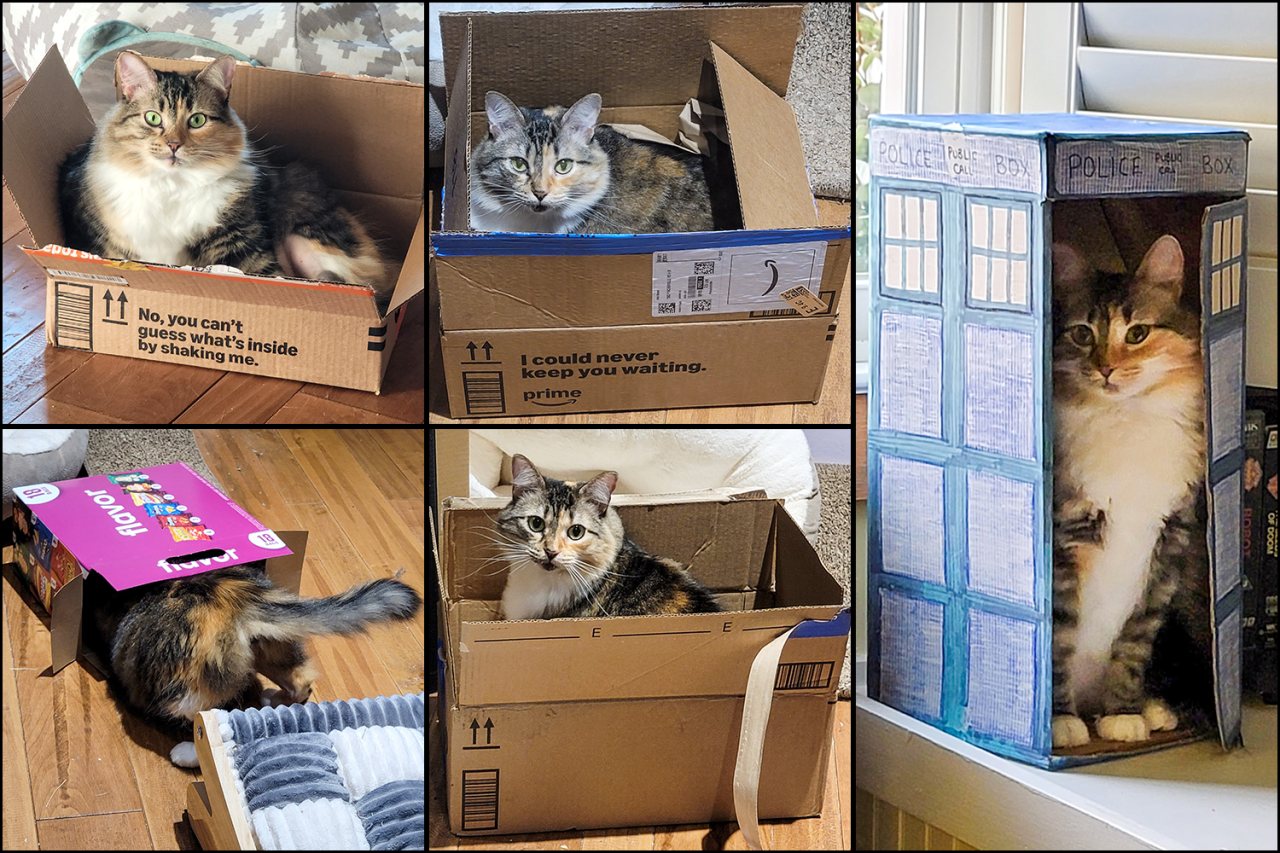
That explains a cat climbing into a cardboard box.
It does not explain why some cats will sit inside a square or rectangle made from tape on the floor
There are no walls. There is no roof. There is no concealment. The “box” is merely a boundary drawn on a flat surface.
And then scientists made the problem worse.
The Box That Isn’t There
In 2021, researchers used cats’ tendency to occupy box-like spaces to test whether they could perceive a visual illusion called a Kanizsa square.
A Kanizsa square contains no actual square outline. Instead, four incomplete circles, often described as Pac-Man shapes, are arranged so that their missing wedges face inward. The visual system interprets the arrangement as the corners of a square and fills in edges that are not physically present.
Humans see the imaginary square.
Apparently, cats do too.
Researchers recruited cat owners to conduct the experiment at home. Each cat was presented with pairs of stimuli that included a real square outline, a Kanizsa square, and a control arrangement in which the same pieces were rotated so that they no longer created the illusion of a square. Owners recorded the trials while following standardized instructions designed to reduce the possibility that they were accidentally directing the cats toward one choice.
More than 500 cats and owners initially entered the project, although only 30 completed all of the required trials. Of those 30 cats, nine chose at least one of the shapes by sitting or standing inside it for at least three seconds. Among those selections, cats chose the Kanizsa illusion about as often as the real square and more often than the control arrangement.
In other words, when the pieces created the appearance of a square, the cats treated that invisible boundary much more like an actual square than like the visually similar control.
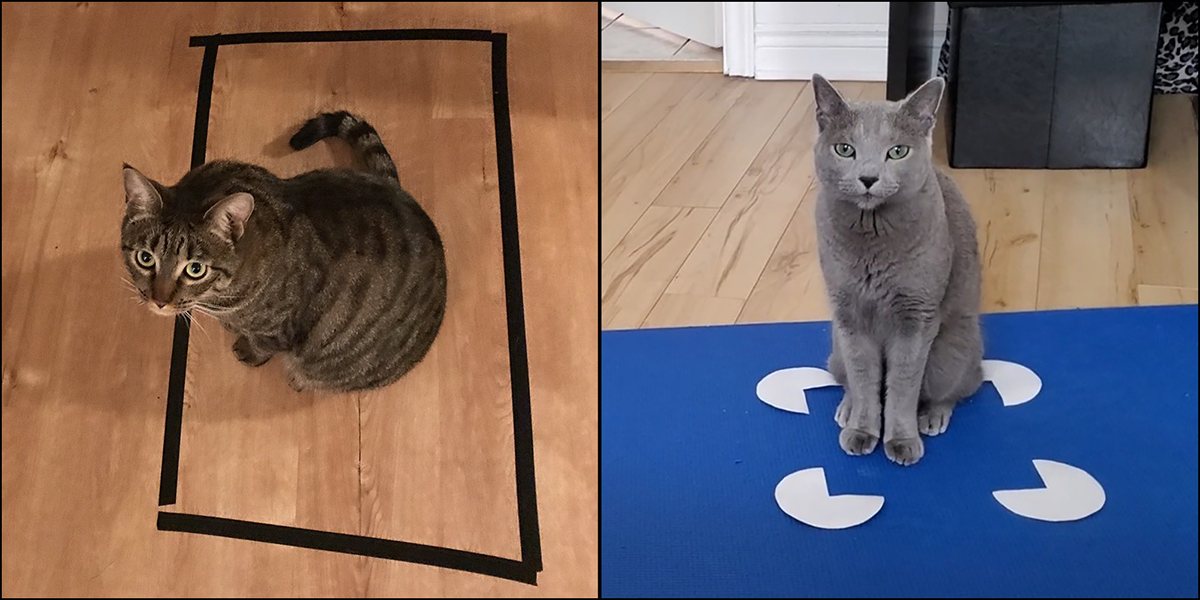
That does not mean scientists have discovered an irresistible universal “sit here” button for every cat. The sample that actually completed the experiment was small, and most cats in the final group did not choose any stimulus at all. The study was also conducted through citizen science in people’s homes rather than under tightly controlled laboratory conditions. The authors themselves noted that the result should be replicated with larger samples and controlled experiments.
But the result fits with much older evidence that cats can perceive subjective contours, the visual edges created by an illusion rather than by an actual line. In 1988, researchers trained cats to discriminate figures defined by subjective contours, providing direct experimental evidence that feline visual systems can perceive boundaries that are not physically drawn.
So Millie’s cardboard obsession and a cat sitting in a Kanizsa square may involve two overlapping but distinct pieces of feline biology.
A real box can provide a useful hiding place and help a cat feel secure.
A flat square cannot.
But once the visual system identifies something as a bounded region, some cats apparently decide that this is still perfectly acceptable territory for occupation.
Walls: preferred.
Tape: acceptable.
Imaginary edges constructed entirely by the visual system: Apparently also acceptable.
Cats have standards.
They are simply not the standards humans expected.
Sources
-
Will a hiding box provide stress reduction for shelter cats?
Vinke, C. M., Godijn, L. M., & van der Leij, W. J. R. (2014). Will a hiding box provide stress reduction for shelter cats? Applied Animal Behaviour Science, 160, 86–93.
Why this source matters: Supports the claim that newly admitted shelter cats provided with hiding boxes showed lower Cat-Stress-Scores and acclimated more rapidly than cats without boxes.
-
Effects of the provision of a hiding box or shelf on the behaviour and faecal glucocorticoid metabolites of bold and shy cats housed in single cages
Ellis, J. J., Stryhn, H., & Cockram, M. S. (2021). Effects of the provision of a hiding box or shelf on the behaviour and faecal glucocorticoid metabolites of bold and shy cats housed in single cages. Applied Animal Behaviour Science, 236, 105221.
Why this source matters: Provides physiological support for the stress-reduction effect of hiding boxes. Cats with hiding boxes had lower fecal glucocorticoid metabolite concentrations and greater food intake; shy cats used the boxes more.
-
If I fits I sits: A citizen science investigation into illusory contour susceptibility in domestic cats (Felis silvestris catus)
Smith, G. E., Chouinard, P. A., & Byosiere, S.-E. (2021). If I fits I sits: A citizen science investigation into illusory contour susceptibility in domestic cats (Felis silvestris catus). Applied Animal Behaviour Science, 240, 105338.
Why this source matters: This is the key paper for the taped-square/Kanizsa-square portion. Cats selected the Kanizsa illusion similarly to a real square and more often than the control, although participant attrition left only 30 cats completing all trials and nine that selected at least one stimulus.
-
Cats see subjective contours
Bravo, M., Blake, R., & Morrison, S. (1988). Cats see subjective contours. Vision Research, 28(8), 861–865.
Why this source matters: Earlier controlled behavioral evidence that cats perceive figures defined by subjective contours rather than requiring physically drawn edges. Useful independent support for the visual-perception part of the story.