

Dung fungus has a problem.
Many species, particularly in the Pilobolaceae family, rely on passage of their spores through the gut of a herbivore as part of their normal life cycle before the spores can germinate in fresh dung.
Why is that a problem, you ask? Well... many animals avoid eating their own dung. Or anybody else’s dung, for that matter.
So this tiny little fungus has to get its spore-filled packet away from the poop it grows on and onto fresh, yummy vegetation that will actually be eaten by another passing herbivore, like a cow.
The solution?
Chuck those babies as far as you can throw them.
And these tiny little fungi can throw their offspring pretty far. No joke.
One Pilobolus species can launch its spore-filled packet at speeds of up to 13 meters per second, with acceleration around 21,000 times gravity, sending it as far as 2.5 meters, or about 8 feet, away!
Did I mention they were TINY?
Most of them are less than ONE CENTIMETER tall, yet they can yeet their offspring up to 8 feet away!
Let's put that into human terms for comparison: if a 2-meter-tall person (about 6 ½ feet tall) could throw something the same number of body lengths, they’d be launching it about 500 meters, or more than five football fields away.
Now that’s scandalous.
And the fungi accomplish this amazing feat without building up some absurdly massive internal pressure. Instead, they use a super-cool controlled pressure-release system powered by ordinary fungal turgor pressure.
So this amazing little fungus has its own unique life cycle:
Step 1: Grow on poop.
Step 2: Fire children at insane speeds towards nearby grass.
Step 3: Wait for grazing cow.
Repeat. 😂
The Real Story
Pilobolus is a tiny dung-loving fungus with a very specific reproductive problem: its spores need to get off the dung pile and onto nearby vegetation, where they can be eaten by a grazing herbivore. After passing through the animal’s digestive tract, the spores are excreted in fresh dung, where the fungus can grow again.
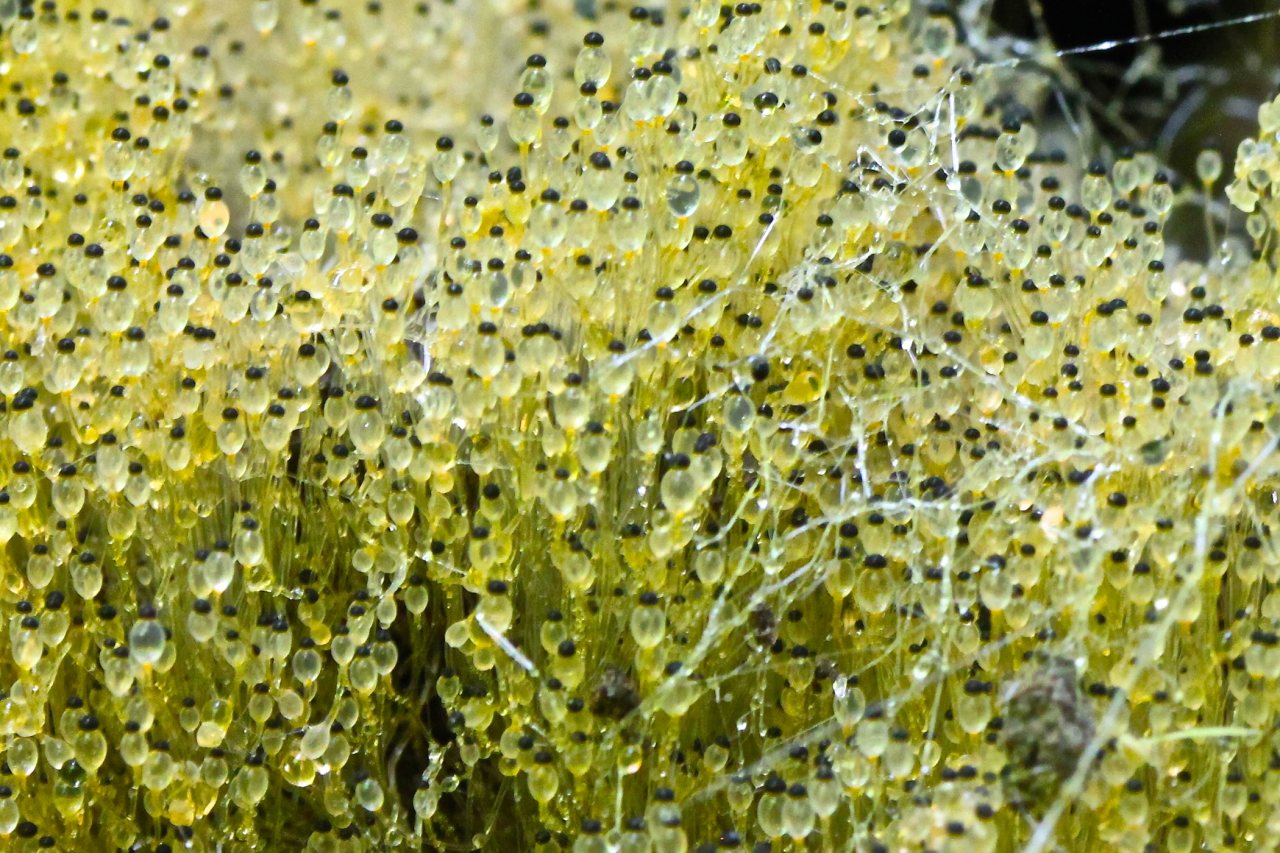
To solve that problem, Pilobolus builds one of the more ridiculous launch systems in nature.
At the tip of a slender stalk, called a sporangiophore, the fungus forms a swollen, fluid-filled vesicle topped by a dark sporangium, a capsule packed with spores. In Pilobolus kleinii, a single sporangium can contain tens of thousands of spores.
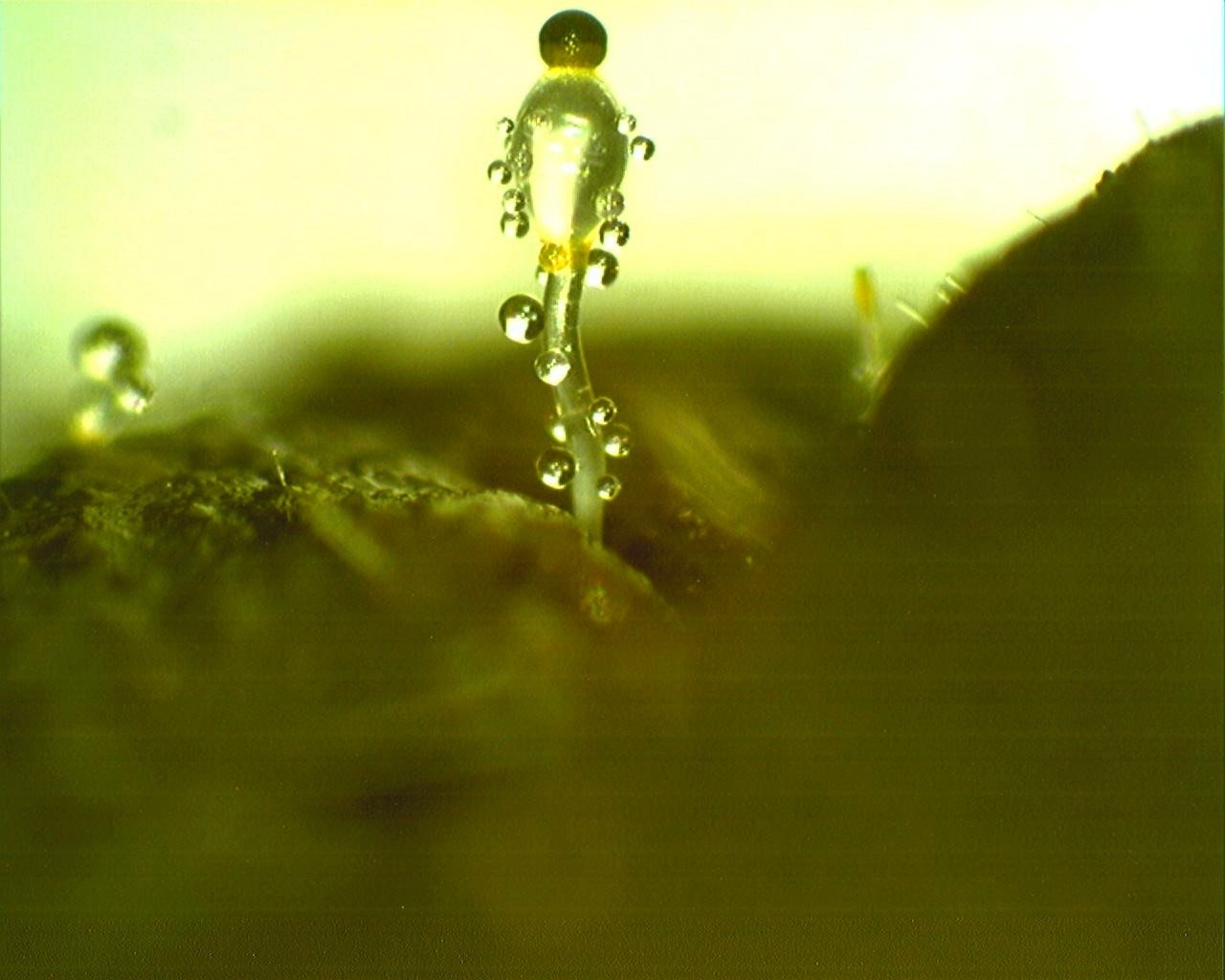
The fungus then uses osmosis to draw water into the vesicle, increasing its internal hydrostatic, or turgor, pressure. When the pressure reaches a critical level, the sporangium breaks free and is blasted away by a jet of cell sap. In P. kleinii, the internal pressure is about 0.55 MPa, roughly 5.5 atmospheres above ambient pressure.
That tiny pressure cannon is surprisingly powerful.
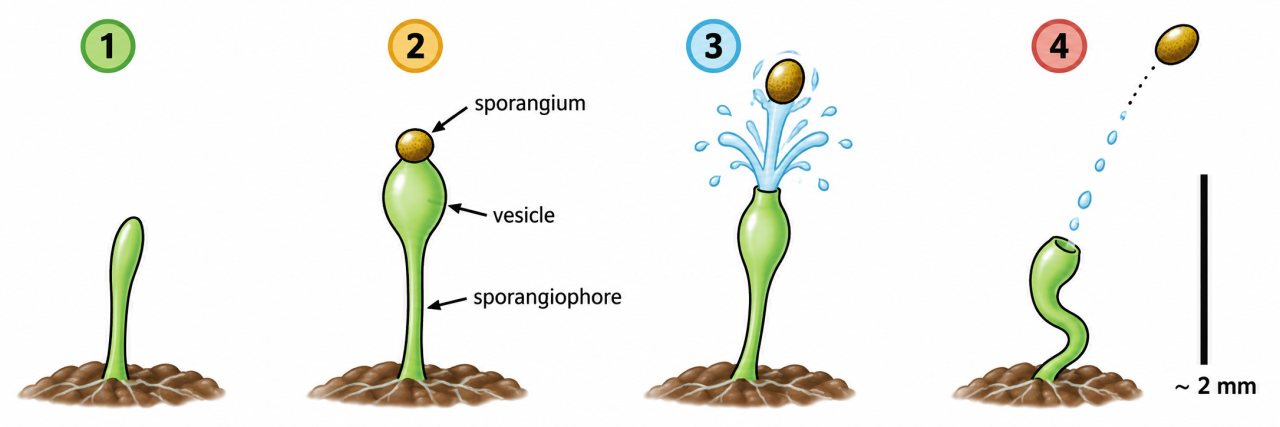
Ultra-high-speed video measurements of P. kleinii recorded launch speeds ranging from 2 to 13 meters per second, with a median of about 9 m/s. Peak acceleration reached about 210,000 m/s², or roughly 21,000 times the acceleration due to gravity. The sporangium can travel as far as about 2.5 meters, or roughly 8 feet.
That range matters because microscopic fungal projectiles are strongly affected by air resistance. Tiny spores lose speed almost immediately, so dung fungi that need to reach vegetation have evolved especially forceful launch systems to overcome that drag and escape the still air close to the dung surface.
The launch is impressive, but the pressure behind it is not extraordinary by fungal standards. Researchers found that the turgor pressures driving these explosive discharges are in the same general range found in ordinary fungal cells. The trick is not some impossible internal pressure chamber. It is the rapid, controlled release of stored pressure through a tiny biological structure.
And Pilobolus does one more clever thing before firing: the spore-producing structure is phototropic, meaning it bends toward light. That helps aim the sporangium away from the dung and toward open vegetation, improving the odds that the spores land somewhere a grazing herbivore might actually eat them.
So the cannon is not random fungal overkill.
It is a beautifully engineered solution to a very specific reproductive challenge:
Get off the poop. Reach the grass. Get eaten. Return to fresh poop.
Sources
-
The Fastest Flights in Nature: High-Speed Spore Discharge Mechanisms among Fungi
Yafetto, L., Carroll, L., Cui, Y., Davis, D. J., Fischer, M. W. F., Henterly, A. C., Kessler, J. D., Kilroy, H. A., Shidler, J. B., Stolze-Rybczynski, J. L., Sugawara, Z., & Money, N. P. (2008). The fastest flights in nature: High-speed spore discharge mechanisms among fungi. PLoS ONE, 3(9), e3237.
Why this source matters: Primary source for the directly measured P. kleinii launch speeds of 2–13 m/s, peak acceleration of about 210,000 m/s² (~21,000 g), 2.5 m maximum range, hydrostatic-pressure mechanism, and the finding that ordinary fungal turgor pressures are sufficient to power the launch.
-
Shooting Mechanisms in Nature: A Systematic Review
Sakes, A., van der Wiel, M., Henselmans, P. W. J., van Leeuwen, J. L., Dodou, D., & Breedveld, P. (2016). Shooting mechanisms in nature: A systematic review. PLoS ONE, 11(7), e0158277.
Why this source matters: Supports the detailed Pilobolus mechanism: water uptake, fluid-filled vesicle, critical pressure around 0.55 MPa, cell-sap jet, launch distance, and estimates that a P. kleinii sporangium contains roughly 30,000–90,000 spores.
-
Pilobolus umbonatus NRRL 6349 v1.0
U.S. Department of Energy Joint Genome Institute. Pilobolus umbonatus NRRL 6349 v1.0.
Why this source matters: Supports the coprophilous life cycle: sporangia are shot toward light onto vegetation, adhere after landing, spores pass through the gastrointestinal tract of a herbivore ungerminated, and then germinate after excretion in fresh dung.