
You know when someone tells you to take more vitamin C? Usually if you have a cold, but also if you’re hoping to avoid scurvy on a long sea voyage.
Humans get vitamin C through our diets or supplements because we cannot make it ourselves.
But that’s not normal!
Your cats and dogs can make their own vitamin C. There’s no need to force Fluffy or Fido to drink orange juice. And most other mammals can make their own vitamin C, too.
So what happened?
No, it was not a conspiracy to sell more orange juice and supplements.
Humans and other haplorhine primates, including apes, monkeys, and tarsiers, inherited a BROKEN GENE for the enzyme that performs the final step in vitamin C synthesis (GULO). Strepsirrhine primates, including lemurs and lorises, still retain a functional gene, which helps place the loss after the haplorhine and strepsirrhine lineages split. Comparative genetic analyses estimate that the primate GULO gene that we have became nonfunctional roughly 60 million years ago.
Basically, in humans and many of our primate relatives, the vitamin C factory closed down, but we still carry the old broken equipment around in our genome.
Meanwhile, the equipment and vitamin C factory are still working just fine in your cats and dogs.
And then there are guinea pigs.
Guinea pigs also lost the ability to make vitamin C, but their GULO gene broke independently, through a separate evolutionary event estimated at roughly 14 million years ago. Their broken gene is not simply the same ancestral breakdown inherited by primates.
That’s why pet guinea pigs also need enough vitamin C in their diets.
So the next time someone tells you to make sure you’re getting enough vitamin C, you can thank the broken equipment still sitting around in your genes for your need to do so.
The Real Story
Most mammals do not need vitamin C in their diets because they can make it themselves. Starting with glucose, a series of enzymatic reactions eventually produces L-gulonolactone. The final enzymatic step depends on L-gulonolactone oxidase, or GULO. Animals with a functional GULO gene can complete the pathway and synthesize their own vitamin C.
Humans cannot.
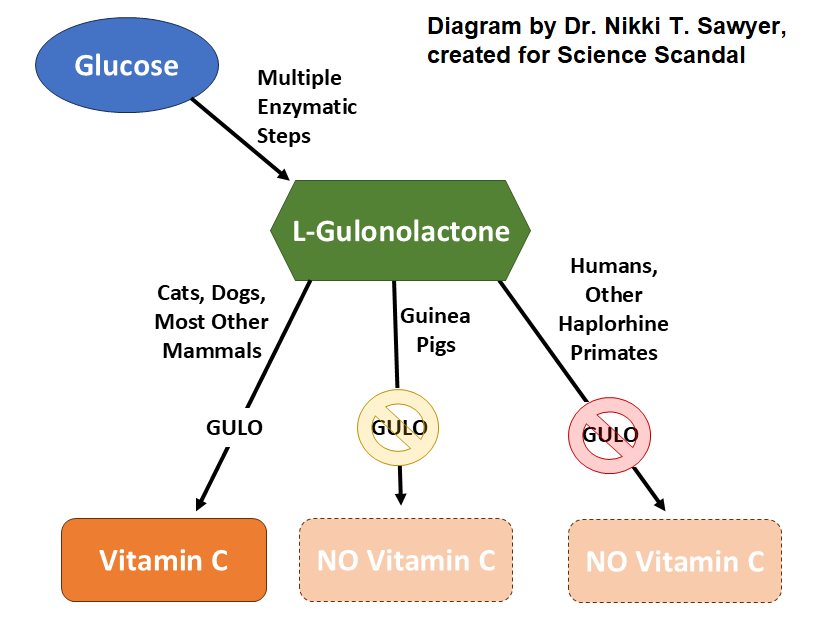
We still carry remnants of the GULO gene, but ours is a pseudogene, a damaged descendant of a once-functional gene that no longer produces working GULO enzyme. Other haplorhine primates carry related nonfunctional GULO sequences, while strepsirrhine primates such as lemurs retain functional GULO. Comparative genetic evidence therefore places the loss in the ancestry leading to haplorhine primates, after their lineage separated from strepsirrhines. Modern genomic comparisons find conserved mutations and other sequence features across haplorhine GULO pseudogenes, consistent with inheritance from a common ancestor rather than the gene independently breaking in every species.
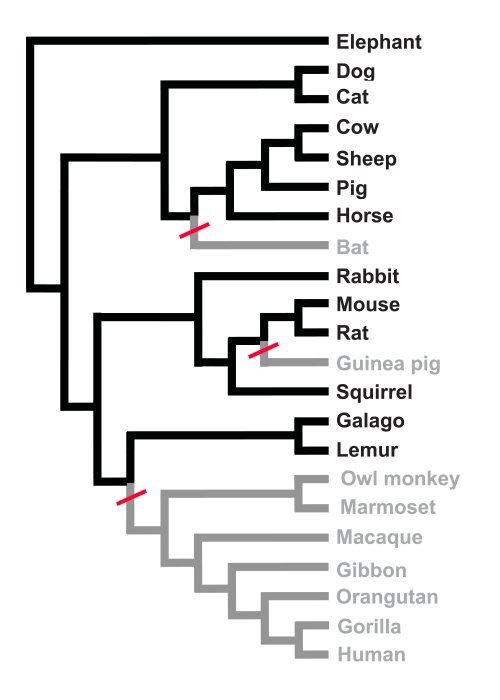
Cats and dogs took a different path: they retained functional GULO and still manufacture vitamin C internally. In fact, vitamin C synthesis appears to be the ancestral mammalian condition. The unusual trait is ours: several mammalian lineages have independently lost an ability their ancestors possessed.
And that is where guinea pigs make the genetics especially interesting.
Guinea pigs also cannot make their own vitamin C, and they too carry a nonfunctional GULO gene. But their genetic damage is different from the damage found in primates. Comparative analyses show that the primate and guinea pig genes accumulated different disruptions, indicating that GULO stopped functioning independently in the two lineages. Earlier sequence comparisons estimated the loss at roughly 61 million years ago in anthropoid primates and 14 million years ago in guinea pigs. Newer genomic work continues to support separate mammalian GULO pseudogenization events while refining what is known about the surviving gene fragments.
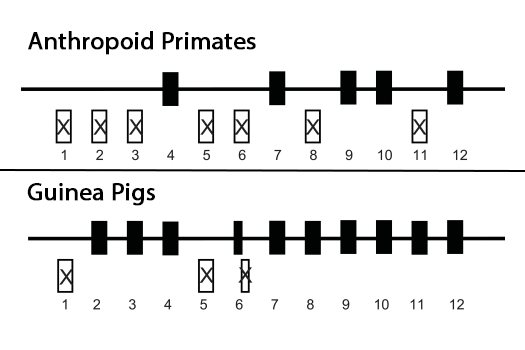
So humans and guinea pigs ended up with the same nutritional requirement by different genetic routes.
For humans and our haplorhine relatives, the broken machinery is part of a shared inheritance. Guinea pigs independently shut down their own version of the factory. Cats and dogs, meanwhile, never closed theirs.
Once GULO stopped working, vitamin C had to come from somewhere else. Species that cannot synthesize enough vitamin C must obtain it through their diets, and prolonged deficiency can eventually produce scurvy. Vitamin C is required for several biological processes, including reactions necessary for normal collagen formation.
The broken GULO sequences lingering in our genomes therefore do more than explain why humans need dietary vitamin C. They preserve a record of evolutionary history: shared genetic damage where common ancestry predicts it, functional machinery in lineages that retained it, and a different genetic breakdown in a lineage that lost the same ability independently.
Sources
-
The Genetics of Vitamin C Loss in Vertebrates
Drouin, G., Godin, J.-R., & Pagé, B. (2011). The genetics of vitamin C loss in vertebrates. Current Genomics, 12(5), 371–378.
Why this source matters: Primary review source for the evolutionary loss of vitamin C synthesis in vertebrates. Supports the shared GULO loss in the primate lineage, the independent loss in guinea pigs, estimated timing of those losses, and comparative GULO gene structure. Figures 3 and 4 from this paper are also used in the article under the paper’s Creative Commons license, with modifications noted in the image metadata.
-
Conservation of a Chromosome 8 Inversion and Exon Mutations Confirm Common Gulonolactone Oxidase Gene Evolution Among Primates, Including H. Neanderthalensis
Mansueto, A., & Good, D. J. (2024). Conservation of a chromosome 8 inversion and exon mutations confirm common gulonolactone oxidase gene evolution among primates, including H. neanderthalensis. Journal of Molecular Evolution, 92(3), 266–277.
Why this source matters: Recent comparative-genomics source supporting shared evolutionary history of the nonfunctional GULO pseudogene among haplorhine primates and functional GULO among examined strepsirrhines. Useful as a modern genomic cross-check of the common-ancestry interpretation of the primate GULO loss.
-
The evolution of vitamin C biosynthesis and transport in animals
Duque, P., Vieira, C. P., Bastos, B., & Vieira, J. (2022). The evolution of vitamin C biosynthesis and transport in animals. BMC Ecology and Evolution, 22, 84.
Why this source matters: Broad evolutionary review of vitamin C biosynthesis across animals. Supports the role of GULO in the final step of vitamin C synthesis and places the primate and guinea pig losses within the larger pattern of repeated independent losses of vitamin C biosynthesis across animal lineages.