
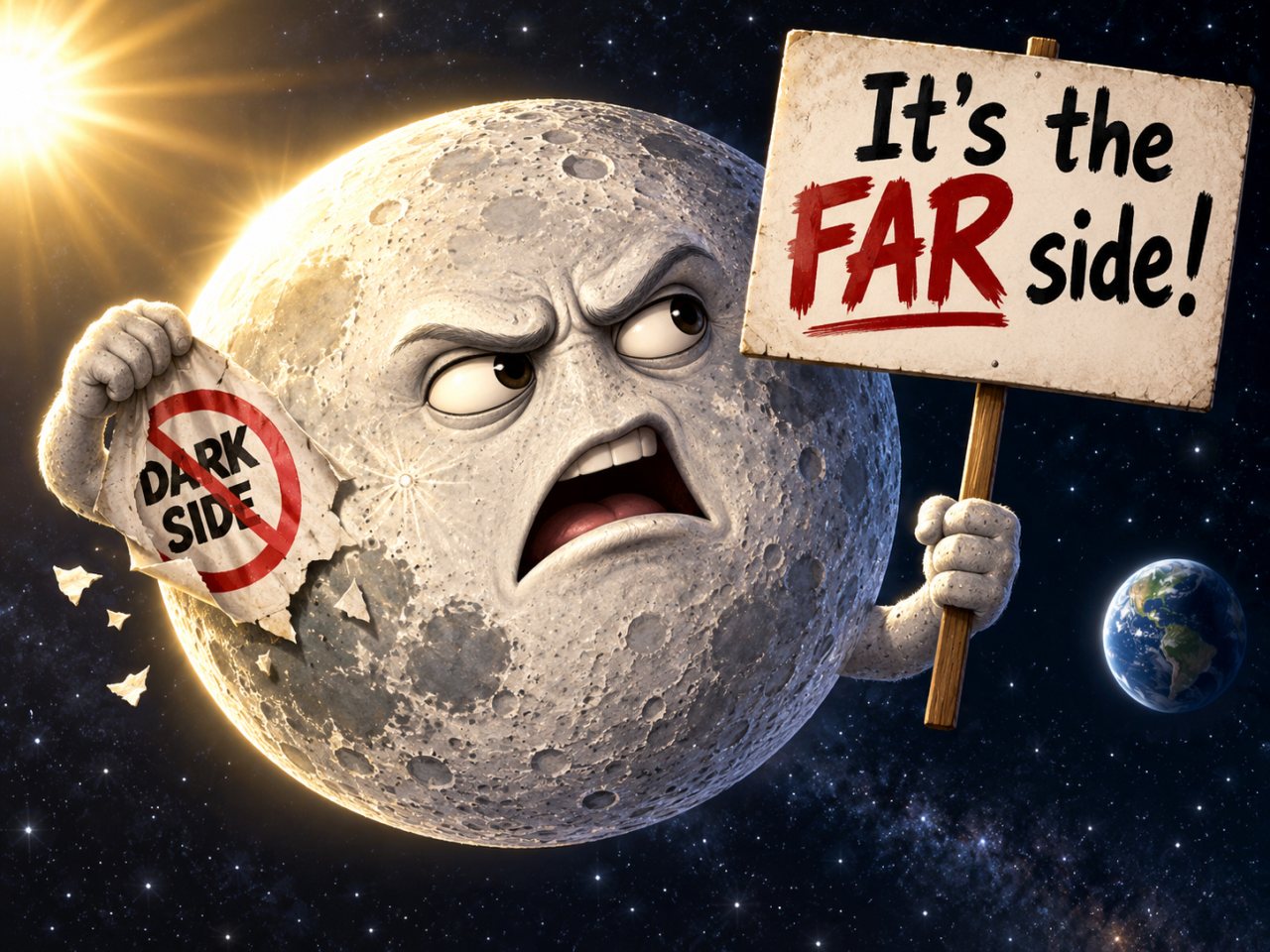
Pink Floyd has some explaining to do!
Or maybe not.
The phrase “dark side of the moon” was already appearing in print by the early 1800s. And back then, “dark” could mean something more like unknown, hidden, or unseen, not necessarily “never illuminated.”
And for most of human history, the other side of the Moon really was hidden from us.
That’s because the Moon is tidally locked to Earth, meaning roughly the same hemisphere always faces our planet. From Earth’s surface, we simply cannot turn around and peek at the other side.
So far, so good.
The problem came later, when “dark” started sounding less like “mysterious and unseen” and more like “there is no light over there.”
And that is where the Moon’s reputation went off the rails.
Because the side we cannot see from Earth absolutely DOES get sunlight. It spends plenty of time brightly illuminated. It is not sitting in perpetual darkness.
So, to summarize the historical progression:
-
Humans always see roughly the same lunar hemisphere from Earth.
-
The unseen hemisphere becomes mysterious.
-
People call it the “dark side,” with dark meaning hidden or unknown.
-
Later generations understandably start interpreting “dark” as “no sunlight.”
-
Pink Floyd turns the phrase into cultural bedrock in 1973.
-
Astronomers spend the next half-century muttering, “FAR SIDE. We meant FAR side.”
And now, thanks to lunar missions, we have pictures of the far side.
Spoiler: it’s not dark.
The Real Story
The Moon does not have a permanently dark side.
What it has is a near side and a far side.
The near side is the hemisphere that generally faces Earth. The far side generally faces away from us. That happens because the Moon is tidally locked to Earth: it rotates once on its axis in about the same amount of time that it takes to complete one orbit around our planet. As the Moon travels around Earth, it keeps roughly the same face pointed toward us.
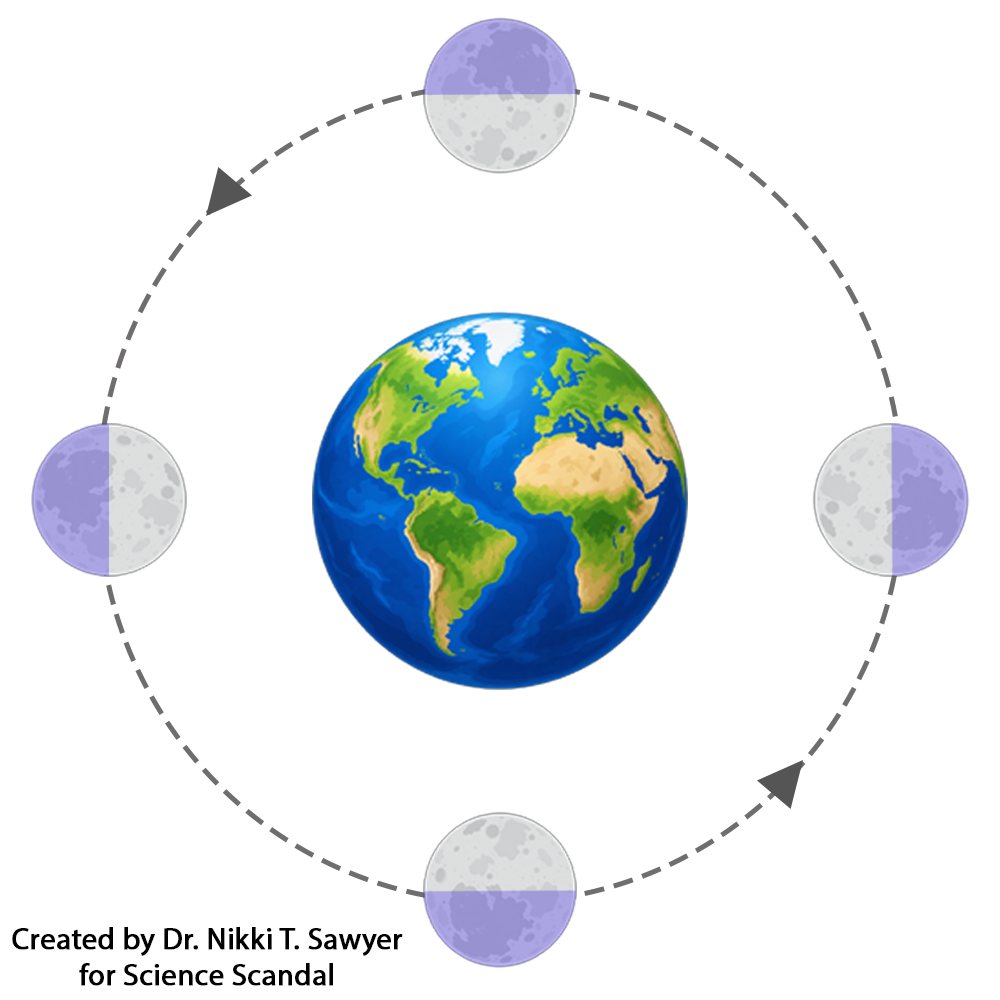
But tidal locking to Earth does not mean the Moon keeps the same face pointed toward the Sun.
Sunlight sweeps across the lunar surface as the Moon moves through its orbit. At full moon, the near side is mostly illuminated and the far side is mostly experiencing night. Around new moon, the arrangement is essentially reversed: the near side is mostly dark while much of the far side is in sunlight.
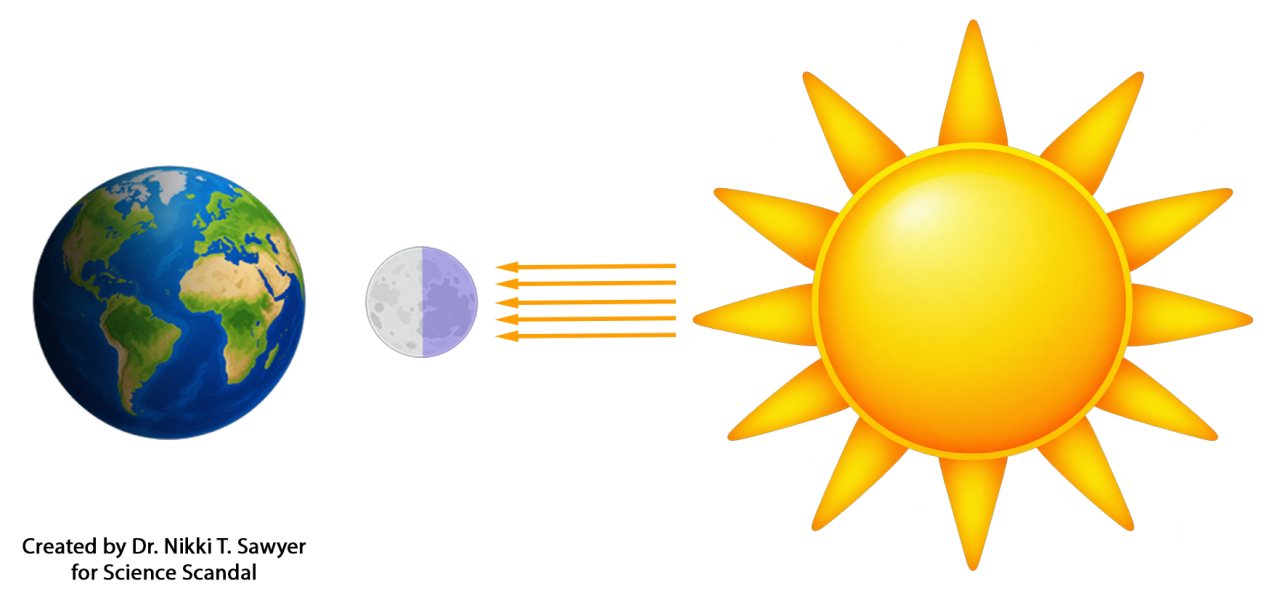
A complete lunar day, measured from one sunrise to the next at the same location, lasts about 29.5 Earth days. Away from the poles, that means a location on the Moon typically experiences roughly two weeks of daylight followed by roughly two weeks of darkness.
The Moon itself actually completes one rotation relative to the distant stars in about 27.3 days. The solar day is longer because, while the Moon is orbiting Earth, the Earth-Moon system is also moving around the Sun. The Moon has to rotate a little farther before the Sun appears in the same place in its sky again.
So why did the far side remain such a mystery?
Because tidal locking really does keep it largely hidden from observers on Earth. Humans did not get their first photographs of the lunar far side until the Soviet Luna 3 spacecraft passed behind the Moon in 1959. Modern spacecraft have since mapped it in extraordinary detail.
There is, however, one final lunar twist.
Although there is no permanently dark side of the Moon, there really are places on the Moon that never receive direct sunlight.
Near the lunar poles, the Sun remains very low on the horizon. Deep crater floors and other depressions can therefore remain in permanent shadow because their rims block the Sun year-round. These permanently shadowed regions are extraordinarily cold, and some contain water ice that can survive because direct sunlight never reaches it.
So the “dark side of the Moon” does not exist.
But the Moon does have some extremely dark local real estate.
Sources
-
Tidal Locking
National Aeronautics and Space Administration. Tidal Locking. NASA Science, Earth’s Moon.
Why this source matters: Primary source for the explanation of synchronous tidal locking. NASA states that the Moon rotates once on its axis during each orbit around Earth, keeping its far side largely hidden from terrestrial observers.
-
Top Moon Questions
National Aeronautics and Space Administration. Top Moon Questions. NASA Science, Earth’s Moon.
Why this source matters: Supports the distinction between the Moon’s approximately 27.3-day orbit and the approximately 29.5-day cycle from one equivalent Sun-Moon geometry to the next. NASA explains that the extra time results because Earth and the Moon are simultaneously moving around the Sun.
-
Is the “Dark Side of the Moon” Actually Dark?
Whitten, Jennifer. “Is the ‘Dark Side of the Moon’ Actually Dark?” Smithsonian National Air and Space Museum, August 16, 2024.
Why this source matters: Useful supporting source for the central misconception and historical context. It explicitly explains that the far side is not permanently dark and notes that humans first saw it when the Soviet Luna 3 spacecraft photographed it in 1959.
-
Direct evidence of surface exposed water ice in the lunar polar regions
Li, S., Lucey, P. G., Milliken, R. E., Hayne, P. O., Fisher, E., Williams, J.-P., Hurley, D. M., & Elphic, R. C. (2018). Direct evidence of surface exposed water ice in the lunar polar regions. Proceedings of the National Academy of Sciences of the United States of America, 115(36), 8907–8912.
Why this source matters: Primary peer-reviewed source supporting the closing section on permanently shadowed lunar polar regions and the presence of surface-exposed water ice within some of them. The paper reports direct spectral evidence of water ice in permanently shadowed regions near both lunar poles.