The year was 1674.
The place was Delft in the Dutch Republic.
Humanity had absolutely no idea how crowded the place actually was.
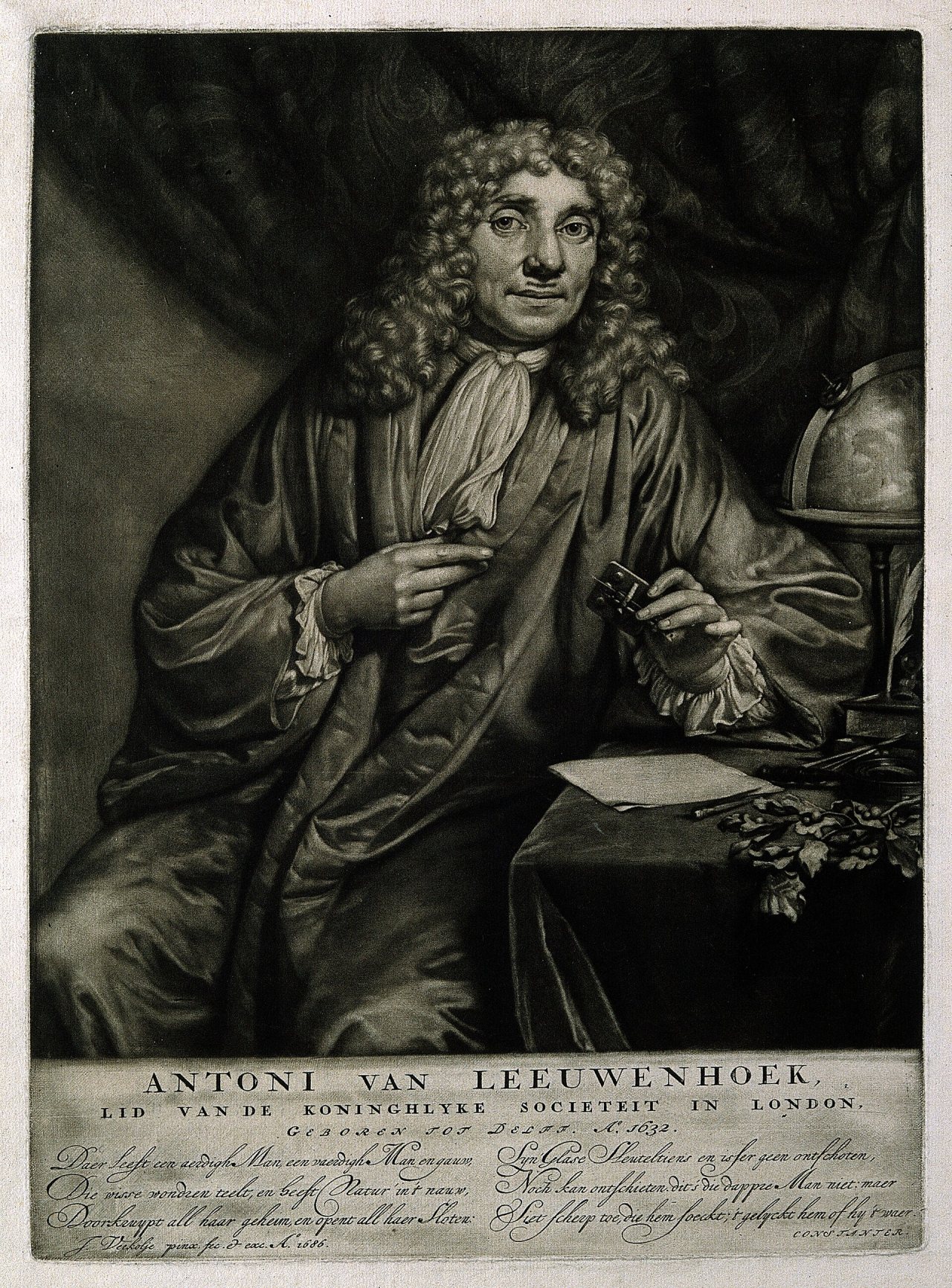
Antonie van Leeuwenhoek had spent years making tiny, extremely powerful single-lens microscopes. He had originally been interested in magnification for practical things such as examining textiles.
Then, as scientists are prone to do when handed a new way to look at things, he apparently began pointing it at everything.
Hair. Blood. Teeth. Water.
And that last one turned out to be a problem.
Well... not a problem so much as a big surprise.
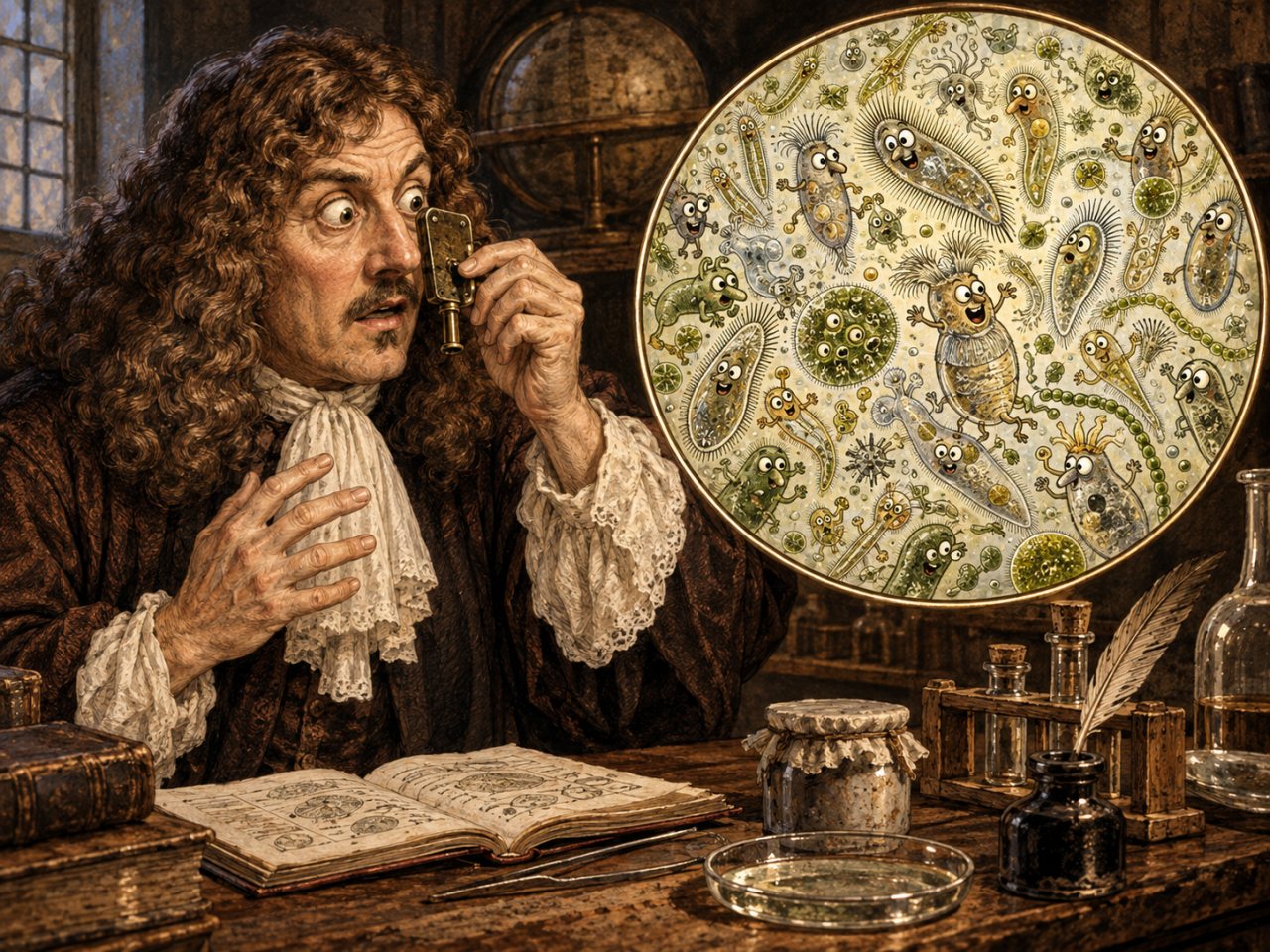
In 1674, Van Leeuwenhoek examined water and discovered that what looked perfectly ordinary to the naked eye was apparently hosting an entire microscopic population.
Tiny things were moving around in there.
He called them “wee animalcules” - tiny animals.
Which, to be fair, was a perfectly reasonable name when you have just discovered living things nobody knew existed and the microbiology department will not be founded for another couple of centuries.
By 1676, Van Leeuwenhoek was writing to the Royal Society in London about the astonishing little creatures he was seeing. Eventually, his observations would help earn him recognition as one of the fathers of microbiology.
Today, we know that many of his “animalcules” were single-celled organisms such as protozoa and bacteria.
Van Leeuwenhoek did not know this.
Nobody did at the time.
Before microscopes revealed this world, humans had no concept of bacteria, protozoa, or entire ecosystems made of organisms too small to see.
Van Leeuwenhoek looked at a drop of water and discovered that “nothing” had actually been extremely crowded.
The Real Story
Antonie van Leeuwenhoek did not invent the microscope, and he was not the first person to use one to examine living material. Robert Hooke had already published Micrographia in 1665, including microscopic observations of molds. What Leeuwenhoek accomplished was different: his remarkably effective single-lens microscopes allowed him to see living organisms so small that no one had ever documented them before.
In September 1674, Leeuwenhoek wrote to the Royal Society describing what its archive now identifies as protozoa in stagnant water. Through his microscope, apparently ordinary water contained tiny organisms moving through a world that was completely invisible to the naked eye.
Then things got even smaller.
In a famous letter dated October 9, 1676, Leeuwenhoek described several different kinds of “animalcules” that he found while examining pepper-infused water, as well as rainwater, well water, moat water, seawater and river water. The Royal Society’s archive identifies five kinds of microorganisms in that letter and notes that at least one was probably bacterial. His observations were published in English in Philosophical Transactions the following year.
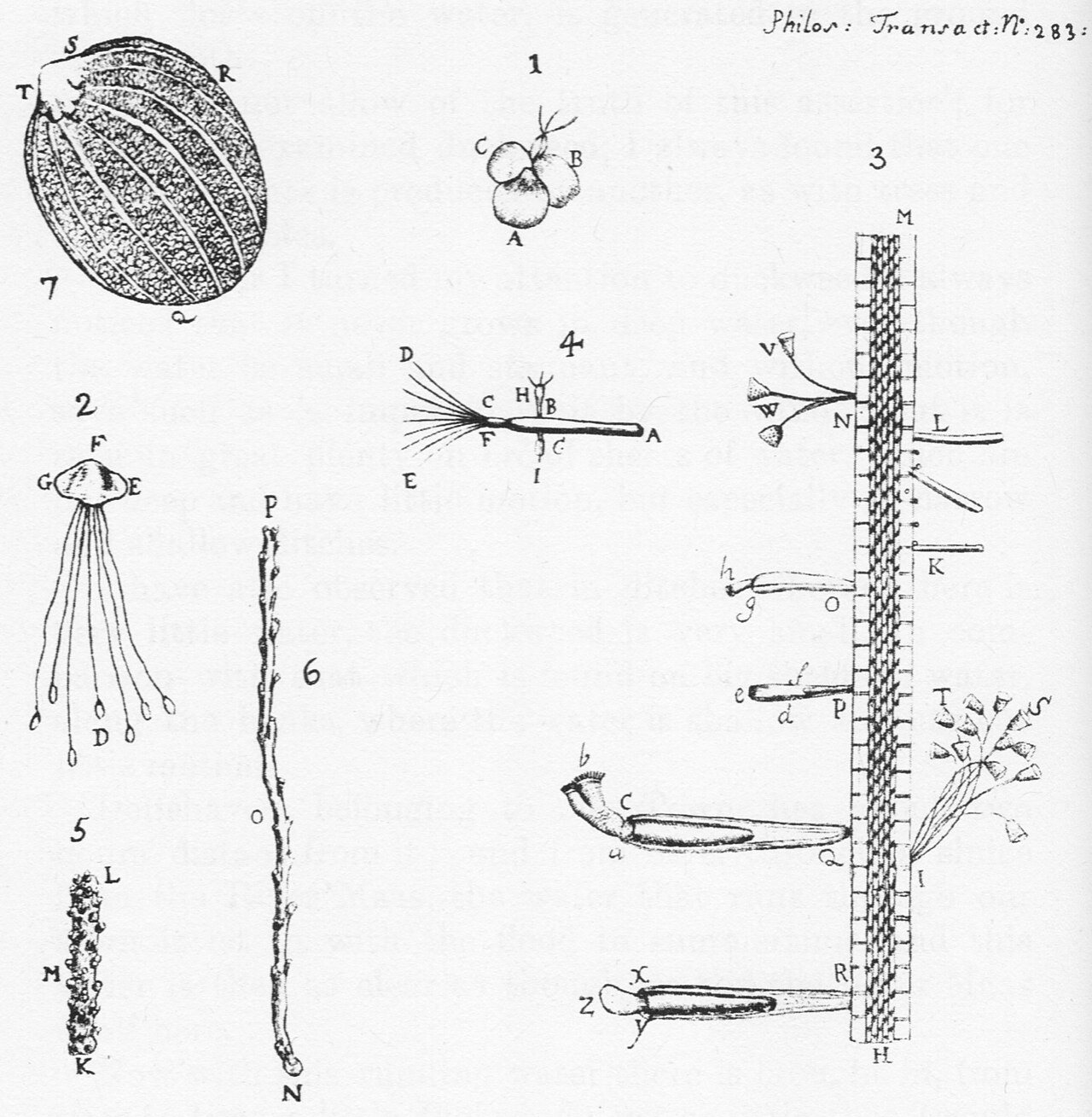
Today, we can place Leeuwenhoek’s observations into biological groups he could not have known existed. Some of the larger organisms he observed were single-celled eukaryotes traditionally described as protozoa or protists. Others were bacteria, organisms vastly smaller than the already-tiny creatures he had reported earlier. His microscopes had effectively extended the known size range of living things into an entirely new realm.
The word “animalcules” therefore makes much more sense in its historical setting than it does today. Leeuwenhoek was not incorrectly classifying bacteria as members of the animal kingdom using modern taxonomy. He was describing tiny, moving living things at a time when concepts such as bacteria, protists and even single-celled organisms had not yet become established biological categories.
And he did not stop with pond water. Over the following years Leeuwenhoek examined an astonishing assortment of materials, eventually describing microorganisms from many different environments, including material from the human mouth. His correspondence with the Royal Society became one of the foundations on which the new science of microbiology would eventually be built.
Humans had lived alongside microorganisms for our entire existence.
We had eaten them, inhaled them, carried them on our bodies, hosted them inside ourselves and depended on them ecologically.
We just didn’t know they were there.
Then Leeuwenhoek looked through a tiny lens and found the crowd.
Sources
-
Letter, from Antoni van Leeuwenhoek to Henry Oldenburg, dated at Delft
van Leeuwenhoek, A. (1674). Letter from Antoni van Leeuwenhoek to Henry Oldenburg, dated at Delft, 7 September 1674. The Royal Society Archives, EL/L1/7. Related publication in Philosophical Transactions, 9(108), 178.
Why this source matters: Primary archival source for Leeuwenhoek’s 1674 observations. The Royal Society catalogue specifically describes this letter as containing observations of protozoa in stagnant water.
-
Letter, from Antoni van Leeuwenhoek to Henry Oldenburg, dated at Delft
van Leeuwenhoek, A. (1676). Letter from Antoni van Leeuwenhoek to Henry Oldenburg, dated at Delft, 9 October 1676. The Royal Society Archives, EL/L1/22. Related publication: “Observations, communicated to the publisher by Mr. Antony van Leewenhoeck…” Philosophical Transactions, 12(133), 821.
Why this source matters: Primary archival source for the famous 1676 animalcule observations. The Royal Society describes Leeuwenhoek’s discovery of five kinds of microorganisms in pepper-infused water and his examinations of rain, well, moat, sea and river water; at least one described form may have been bacterial.
-
Suddenly I See: How Microscopes Made Microbiology Possible
Haavitsa, V. American Society for Microbiology. (2022). Suddenly I See: How Microscopes Made Microbiology Possible. ASM.org.
Why this source matters: Modern overview supporting Leeuwenhoek’s role in the first microscopic observations of bacteria, his use of self-built single-lens microscopes, his term for the tiny organisms he observed, and the historical relationship between his work and Robert Hooke’s earlier microscopy.
-
Antony van Leeuwenhoek: tercentenary of his discovery of bacteria
Porter, J. R. (1976). Antony van Leeuwenhoek: tercentenary of his discovery of bacteria. Bacteriological Reviews, 40(2), 260–269.
Why this source matters: Peer-reviewed historical review focused specifically on the 300th anniversary of Leeuwenhoek’s observation of bacteria. Useful for verifying his place in the history of bacteriology rather than relying solely on modern popular summaries.