
As you know from my Vinnie Sugarbeak articles, I run a massive hummingbird feeding operation every summer. With sugar water. Lots of sugar water.
Which inevitably leads to... ants.
And I am continually amazed at how you can notice a single lone ant, and then seemingly minutes later, there is an organized line of a gazillion ants stealing the sugar water.
Somehow this little ant finds the sugar water and then races back to the colony to spread the word. And then a “casual snack discovery” turns into a “small-scale logistical miracle.”
One ant becomes several. Several become dozens. Dozens become gazillions. And soon there is a full-scale interstate between the ant nest and the sugary jackpot, with workers hurrying back and forth as if somebody had just announced a limited-time liquidity event.
Fred arrives late, naturally.
“I’m helping!” he declares, as his sisters rush past like tiny caffeinated freight carriers.
“You found the sugar?” one asks.
“No,” says Fred.
“You marked the route for us?”
“No.”
“You worked in recruitment?”
“No.”
The female worker gives him an appropriately exasperated side-eye and grabs another load of sugar.
Fred straightens his tie.
“I’m executive oversight.”
Another sister walking past immediately grumbles, “No. You’re not.”
The Real Story
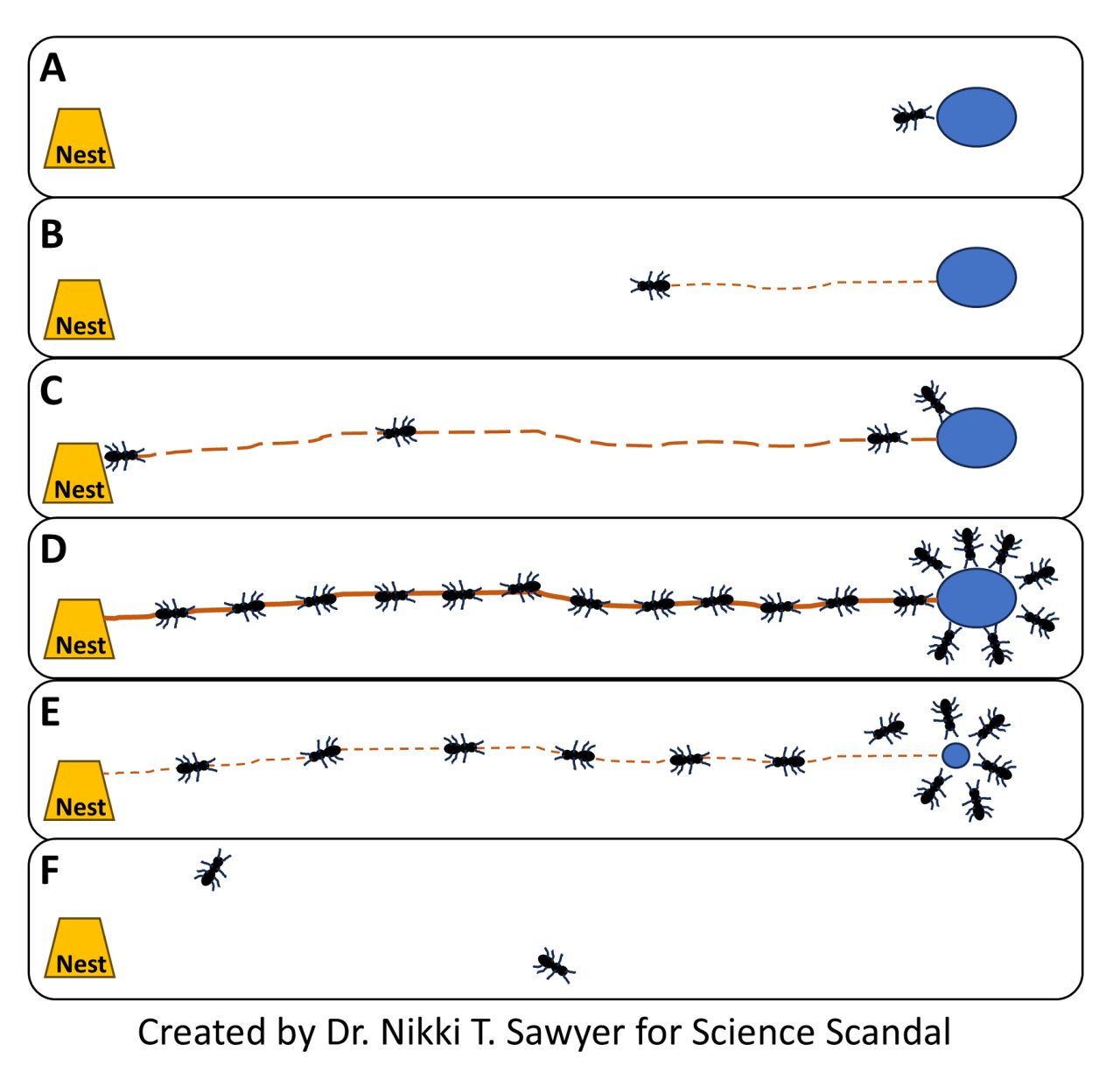
The first important thing to know is that the lone ant you see wandering around is not necessarily lost. Many ant species send out individual workers that search for food, and once one of those scouts finds a worthwhile resource, she can help recruit nestmates to it. In species that use trail pheromones, the successful forager lays chemical signals along the route between the food and the nest. Other workers that encounter that trail are more likely to follow it toward the food.
That is how one ant can apparently become an interstate of ants.
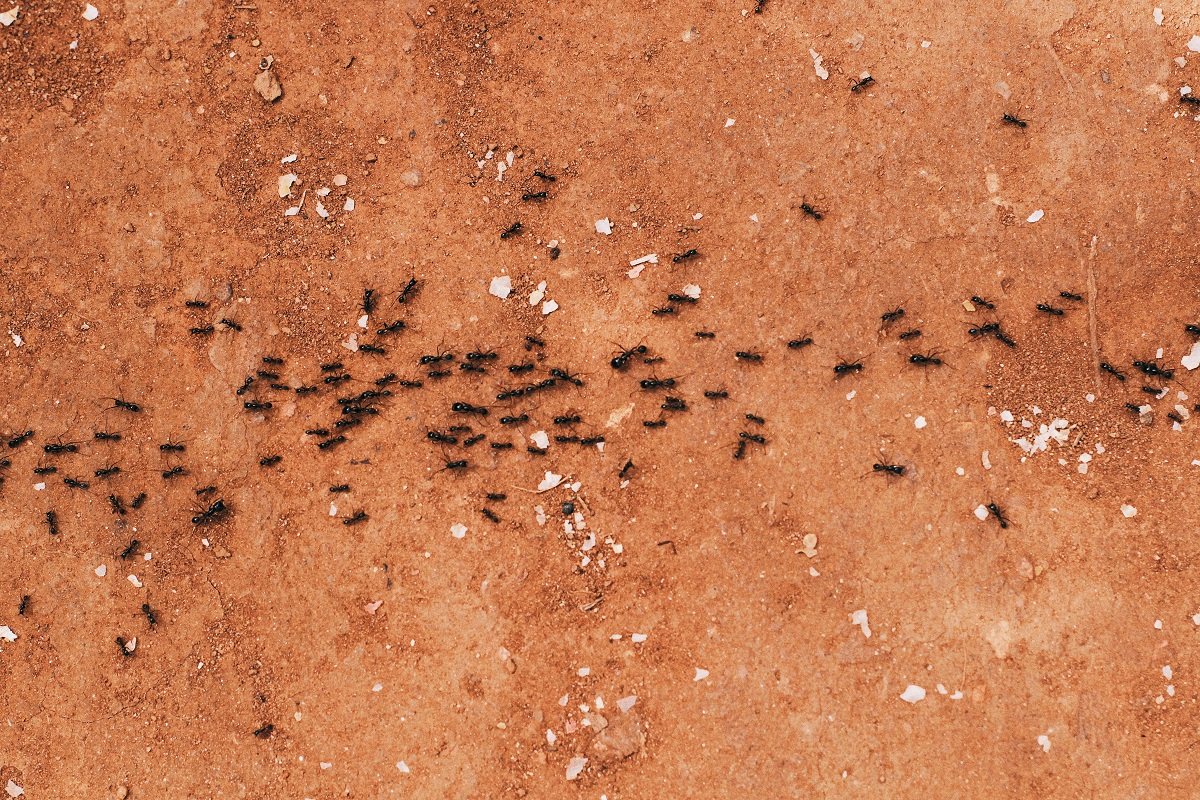
The key is positive feedback. A successful ant returns from the food source and reinforces the chemical trail. Recruited workers follow it, find the food, and may add more pheromone of their own. A stronger trail attracts still more workers, which strengthens the trail further. The result can be a very rapid buildup of traffic even though no ant is coordinating the operation from headquarters.
The system can also help a colony decide which food source is worth exploiting. In experiments with Pharaoh’s ants, workers who were offered sugar solutions of different concentrations usually concentrated more of their foraging effort on the more profitable feeder. Stronger recruitment toward a good resource can therefore shift more of the colony’s available workforce in that direction.
Ants can also collectively settle on efficient routes without anyone measuring the distance. In pheromone-based systems, a shorter route can be completed more quickly, so ants traveling it return and reinforce it sooner. That route can therefore accumulate pheromone faster than a longer alternative. As more ants preferentially follow the stronger trail, the difference becomes amplified until much of the traffic is concentrated on the more efficient path. This kind of self-organized route selection helped make ant foraging a classic model for distributed problem-solving.
But the chemical trail is not the whole story. Ant navigation can also involve individual memory and landmarks. Research with the common black garden ant, Lasius niger, has shown that ants can use both pheromone information and visual landmarks when relocating a familiar food source. More broadly, trail pheromones can work together with information an individual ant has learned about its surroundings rather than replacing memory entirely.
That helps explain why a scout can look so purposeful after finding food. She is not merely following a smell laid down by somebody else. Depending on the species and situation, she may be combining learned route information, landmarks, chemical cues, and repeated experience to get back to the resource efficiently. Ant navigation systems vary enormously across species, so there is no single universal “ant GPS.”
The system is also capable of changing its mind. Strong positive feedback is excellent for mobilizing a workforce quickly, but it can make a colony reluctant to abandon an established trail. Ant colonies therefore also use forms of negative feedback. Experiments with Lasius niger, for example, found that crowding at a food source can help redirect workers toward a better alternative when conditions change. In other species or situations, reduced trail reinforcement and pheromone decay can also allow an old route to lose influence once a resource is no longer worthwhile.
So the apparent overnight construction of an ant superhighway is not the result of a single tiny traffic engineer. It emerges from many workers following relatively simple rules: search, remember, recruit, follow, reinforce, and adjust.
The colony gets an efficient supply line.
Fred gets there eventually. Or not.
Sources
-
Trail Pheromones: An Integrative View of Their Role in Social Insect Colony Organization
Czaczkes, T. J., Grüter, C., & Ratnieks, F. L. W. (2015). Trail pheromones: An integrative view of their role in social insect colony organization. Annual Review of Entomology, 60, 581–599.
Why this source matters: Broad review of trail pheromone systems in ants and other social insects. Supports the explanations of recruitment, positive and negative feedback, interaction between pheromone trails and individual memory, and the fact that trail systems vary substantially among species.
-
From nonlinearity to optimality: pheromone trail foraging by ants
Sumpter, D. J. T., & Beekman, M. (2003). From nonlinearity to optimality: pheromone trail foraging by ants. Animal Behaviour, 66(2), 273–280.
Why this source matters: Primary experimental and modeling study using Pharaoh’s ants, Monomorium pharaonis. Supports nonlinear positive feedback in pheromone recruitment and the colony-level allocation of workers toward more profitable sugar sources.
-
Combined use of pheromone trails and visual landmarks by the common garden ant Lasius niger
Evison, S. E. F., Petchey, O. L., Beckerman, A. P., & Ratnieks, F. L. W. (2008). Combined use of pheromone trails and visual landmarks by the common garden ant Lasius niger. Behavioral Ecology and Sociobiology, 63(2), 261–267.
Why this source matters: Primary research on route relocation in Lasius niger. Supports the point that ants can use visual landmarks as well as pheromone trails when returning to a known food location.
-
Negative Feedback Enables Fast and Flexible Collective Decision-Making in Ants
Grüter, C., Schürch, R., Czaczkes, T. J., Taylor, K., Durance, T., Jones, S. M., & Ratnieks, F. L. W. (2012). Negative feedback enables fast and flexible collective decision-making in ants. PLOS ONE, 7(9), e44501.
Why this source matters: Primary experimental and modeling study in Lasius niger. Supports the role of negative feedback, especially crowding, in allowing colonies with strong pheromone-based recruitment to redirect workers when a better food source becomes available.