
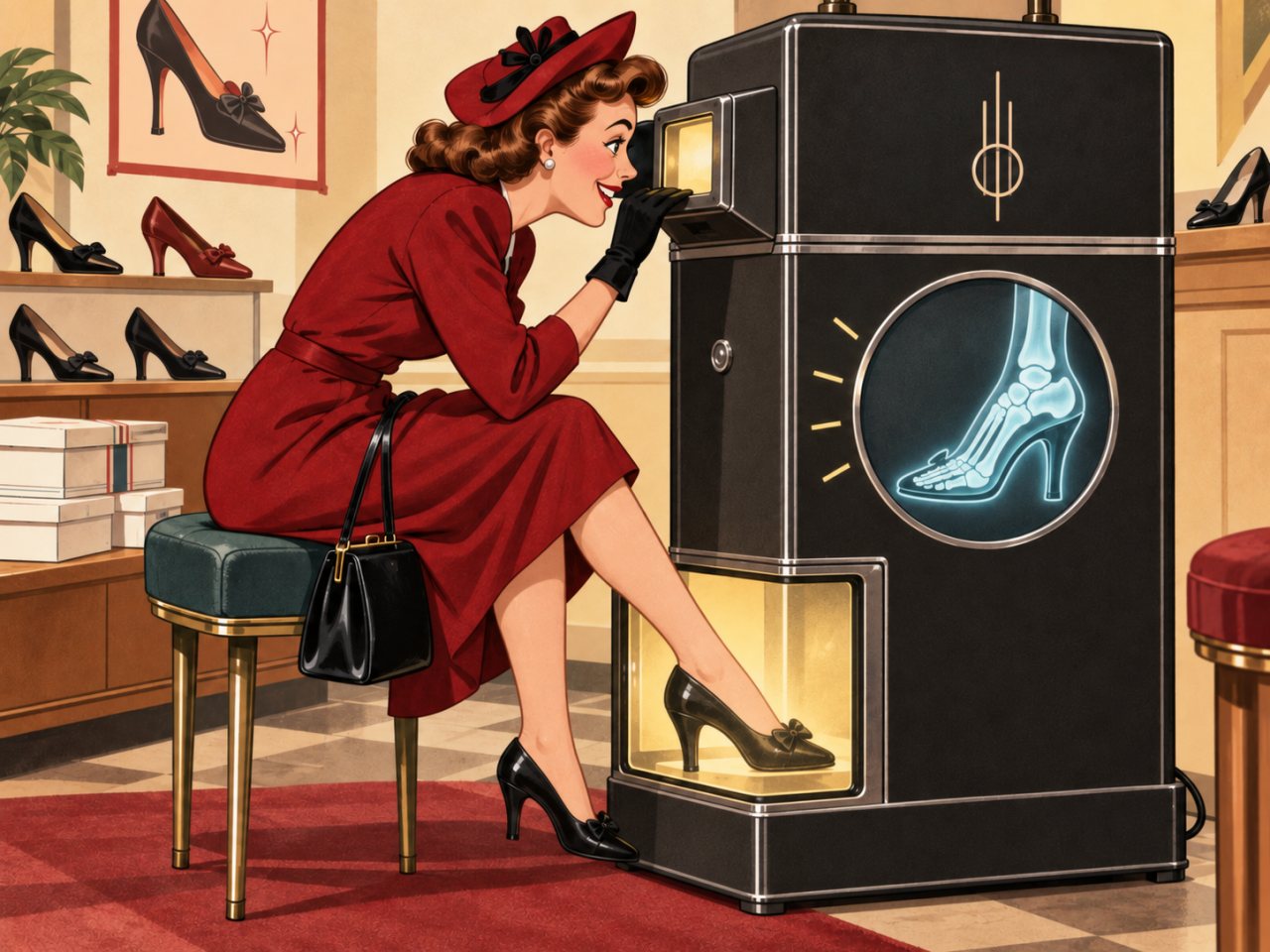
Imagine this: A shoe salesman approaches you. “Step right up, Madam, and kindly place your child’s foot into the radiation box. We’ll get you the perfect fit for your child’s foot!”
Seems crazy, right? But this actually happened!
Machines called shoe-fitting fluoroscopes were quite popular from roughly the mid-1920s through the 1950s in both North America and Europe.
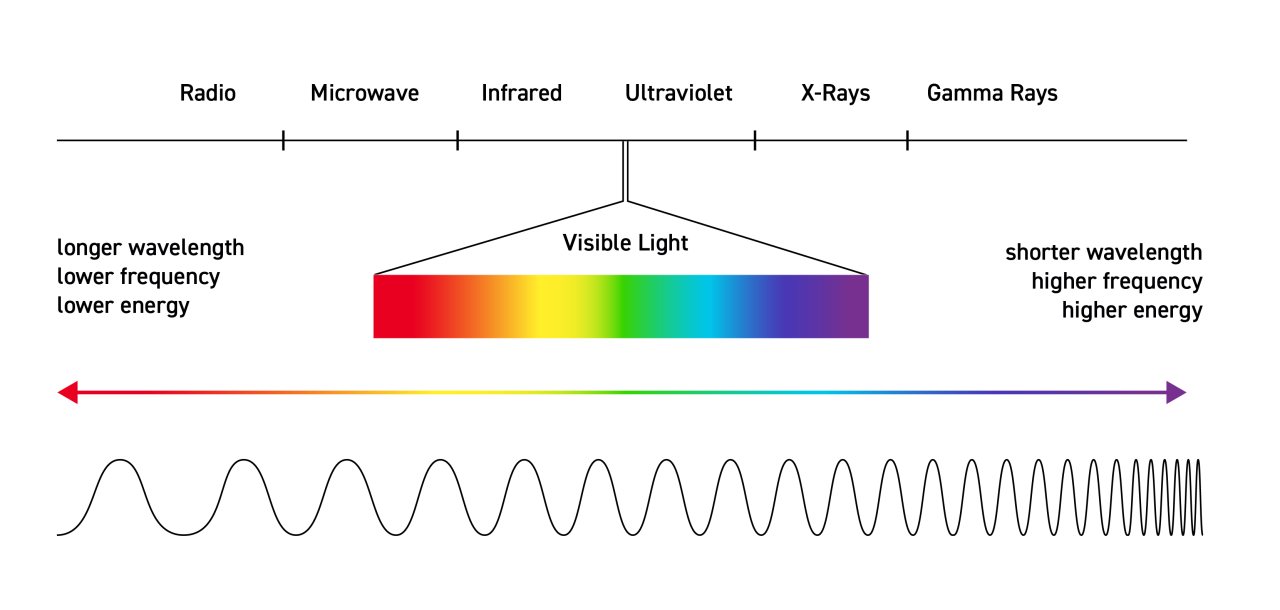
X-rays had been discovered and studied since the late 1800s. An X-ray is a type of high-energy electromagnetic radiation that can penetrate materials to differing degrees depending on composition, thickness, and density.
Because X-rays cannot pass as easily through bone tissue as they can through soft body tissues, X-rays quickly became a means for seeing the bones inside the human body.
And then someone, it’s still debated exactly who was first, decided that this would be a good way to sell shoes! Really. They took a revolutionary technology capable of looking through the human body and turned it into a way to sell more shoes.
And apparently kids especially loved looking at their toe bones. Because of course they did. They are KIDS.
The dangers of radiation weren’t completely unknown at the time. In fact, concerns about radiation injury had existed for decades, and by the late 1940s researchers were specifically measuring the exposure produced by shoe-fitting fluoroscopes and warning about repeated exposure in children and occupational exposure in shoe-store employees.
But the machines continued to be used because they were convenient, impressive to customers, useful for marketing, and only gradually brought under tighter regulation. The problem was that the benefit of looking at your toe bones while buying shoes turned out to be pretty trivial compared with the unnecessary exposure to ionizing radiation.
Eventually, professional warnings, regulations, insurance pressure, and outright bans helped push the machines out of shoe stores. In the United States, Pennsylvania became the first state to ban them in 1957, and by around 1960 they had largely disappeared there, although limited use persisted longer in some other countries.
So, if history has taught us anything from this scandal, it’s that we should be more careful with new technology before introducing it as a marketing gimmick to sell more shoes!
The Real Story
Shoe-fitting fluoroscopes were real X-ray machines adapted for retail shoe stores. A customer, often a child, stood with their feet inside the shoes and placed them into an opening near the bottom of the cabinet. The machine directed X-rays upward through the feet and shoes toward a fluorescent screen, allowing the customer, parent, and salesperson to view the bones inside the shoes. Many machines even had three viewing ports so all three could admire the skeletal spectacle at once.
The physics was the same basic principle used in medical X-ray imaging. X-rays are a form of ionizing electromagnetic radiation. When an X-ray beam passes through the body, different tissues attenuate, or reduce, the beam by different amounts. Dense bone absorbs or scatters more X-rays than surrounding soft tissues, creating contrast that makes the bones visible. In fluoroscopy, the transmitted X-rays are converted into a continuously visible image rather than a single photograph.
In a shoe-fitting fluoroscope, however, that legitimate imaging technology was being used for a decidedly nonmedical purpose. Retailers promoted the machines as a scientific way to judge how well shoes fit, particularly children's shoes. They were also impressive sales tools: customers could literally look inside their own feet while trying on a new pair of shoes. Historical research has found that these machines became prominent in shoe stores across North America and Europe from the mid-1920s through the 1950s.
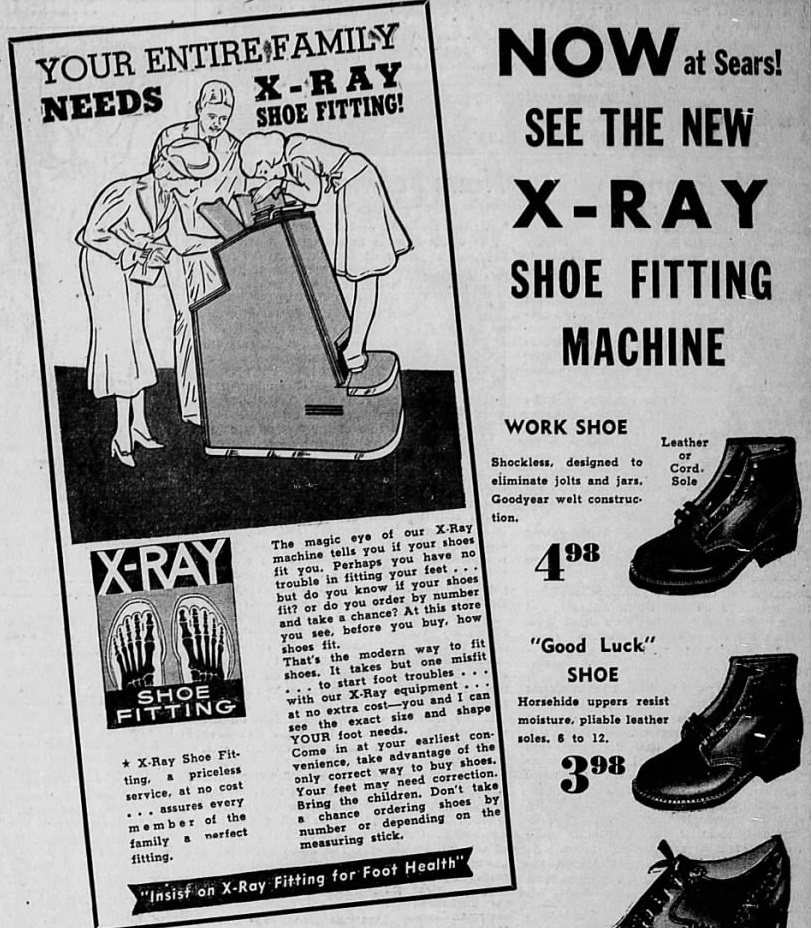
The problem was that the X-rays did not stop being ionizing radiation simply because they had been moved into the footwear department.
Measurements published in 1949 showed that radiation exposures from shoe-fitting fluoroscopes varied widely between machines. Charles R. Williams measured radiation delivered to customers' feet as well as leakage and scattered radiation that could reach clerks and other people nearby. The concern was especially relevant in stores specializing in children's shoes, where repeated fittings could mean repeated exposures.
A companion paper published the same year warned about several possible injuries from uncontrolled use, including interference with normal foot development in repeatedly exposed children, radiation burns to customers' feet, and chronic exposure to the blood-forming tissues of store employees working near poorly shielded machines.
Another study published in 1950 reached a similarly uncomfortable conclusion. Measurements from different machines showed wide variation in both direct and stray radiation, with some exposures exceeding contemporary proposed safety standards. The authors argued that procedures offering questionable benefit should not expose the public to unnecessary ionizing radiation.
Regulation followed gradually rather than all at once. Safety standards appeared in the 1940s, professional organizations issued warnings in the early 1950s, and individual jurisdictions began restricting who could operate the machines. Pennsylvania became the first U.S. state to ban shoe-fitting fluoroscopes in 1957. By around 1960, regulation, professional opposition, and pressure from insurance companies had largely driven them out of American shoe stores, although limited use persisted longer elsewhere.
The strange part of the story is that the machines were never fake science. The X-rays were real. The fluoroscopy was real. The bones on the screen were real.
What became difficult to defend was using all that very real physics to answer a question that could usually be solved by asking, “Do the shoes fit?”
Sources
-
Baring the Sole: The Rise and Fall of the Shoe-Fitting Fluoroscope
Duffin, J., & Hayter, C. R. R. (2000). Baring the Sole: The Rise and Fall of the Shoe-Fitting Fluoroscope. Isis, 91(2), 260–282.
Why this source matters: Best historical source for the rise, marketing, technology, geographic spread, public attitudes, and decline of shoe-fitting fluoroscopes. Supports the mid-1920s-through-1950s timeframe and the argument that the machines were used both as fitting devices and sales tools.
-
Radiation Exposures from the Use of Shoe-Fitting Fluoroscopes
Williams, C. R. (1949). Radiation Exposures from the Use of Shoe-Fitting Fluoroscopes. New England Journal of Medicine, 241(9), 333–335.
Why this source matters: Contemporary primary measurements of customer foot dose, leakage radiation, and scattered radiation around shoe-fitting fluoroscopes. Especially useful for establishing that actual exposures varied considerably among machines.
-
Potential Dangers in the Uncontrolled Use of Shoe-Fitting Fluoroscopes
Hempelmann, L. H. (1949). Potential Dangers in the Uncontrolled Use of Shoe-Fitting Fluoroscopes. New England Journal of Medicine, 241(9), 335–336.
Why this source matters: Companion article discussing possible radiation injuries from uncontrolled shoe-fluoroscope use, including repeated exposure in children, burns, and chronic occupational exposure among store employees.
-
Medical X-ray Imaging
U.S. Food and Drug Administration. Medical X-ray Imaging.
Why this source matters: Authoritative modern source for the basic physics used in the article: X-rays are ionizing radiation; internal structures absorb or scatter the beam differently; the transmitted pattern forms the image; fluoroscopy produces continuous X-ray imaging.