
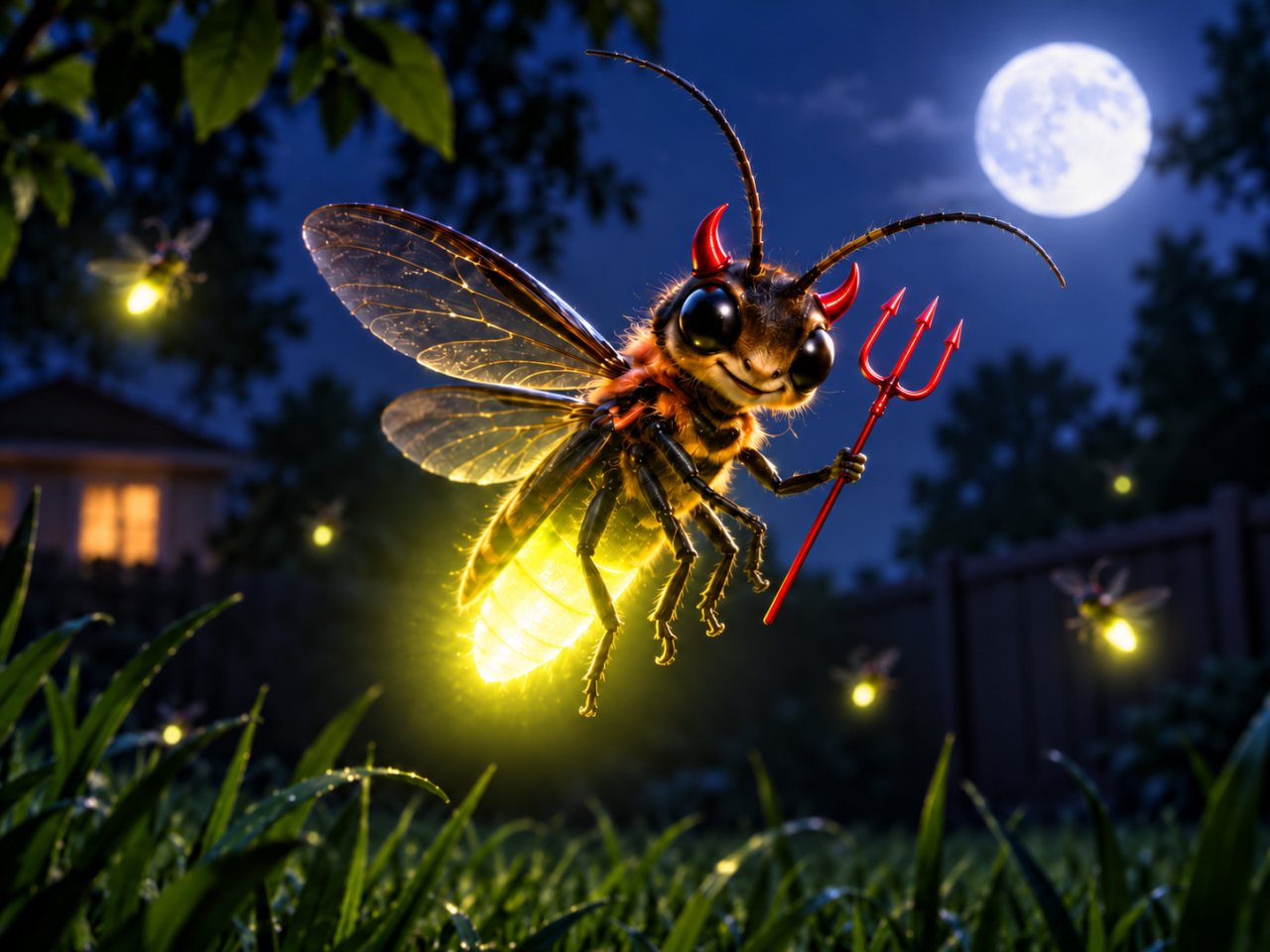
As a resident of Georgia, I get to see fireflies light up the backyard every summer, or as I called them growing up, lightning bugs. It's one of the few things I actually like about a Georgia summer.
But did you know that those little blinking lights are produced using substances called luciferin and luciferase? After, you know, LUCIFER? 😳
Yes, it's true! But before you call the exorcist on the wonderful little fireflies, let's take a closer look.
Lucifer is actually a Latin term meaning light-bearer or light-bringer, from lux for light and ferre for bearing or carrying. Long before it became popularly associated with Satan or the devil, the word was used for the morning star, Venus.
So when French scientist Raphaël Dubois was studying bioluminescence in the late 1880s, he coined the terms luciferin for the light-producing substance and luciferase for the enzyme involved in the reaction, drawing on that original meaning of “light-bearer.” Those terms are now used broadly for light-producing substrates and enzymes in many different bioluminescent organisms, not just fireflies.
And these are actually very cool molecules!
Luciferase is the enzyme that acts on luciferin to ultimately produce light. The reaction also requires oxygen and is powered by adenosine triphosphate, or ATP, the familiar cellular energy molecule used by all known living organisms.
Fireflies have co-opted this fascinating bit of chemistry to produce the flashes of light they use in communication and courtship. Cool, right?
So the next time you watch a firefly blink on and off on a hot, humid summer night, think about the chemical reactions taking place inside its abdomen: luciferin, luciferase, ATP, and oxygen working through a tiny molecular chain reaction that ends in one brief, enchanting flash.
The Real Story
Fireflies produce their glow through bioluminescence, the production of light by a chemical reaction inside a living organism. In fireflies, the key players are a small light-producing molecule called luciferin and an enzyme called luciferase.
The reaction begins when luciferase binds luciferin and ATP in the presence of magnesium. ATP is used to activate luciferin, producing an intermediate called luciferyl adenylate and releasing pyrophosphate. Molecular oxygen then reacts with the luciferyl adenylate through a series of enzyme-catalyzed steps that produce oxyluciferin in an electronically excited state, along with AMP and carbon dioxide.
That excited state is where the light comes from. When oxyluciferin relaxes back to its lower-energy ground state, the excess energy is released as a photon of visible light. In other words, the firefly is converting chemical energy into light at the molecular level.
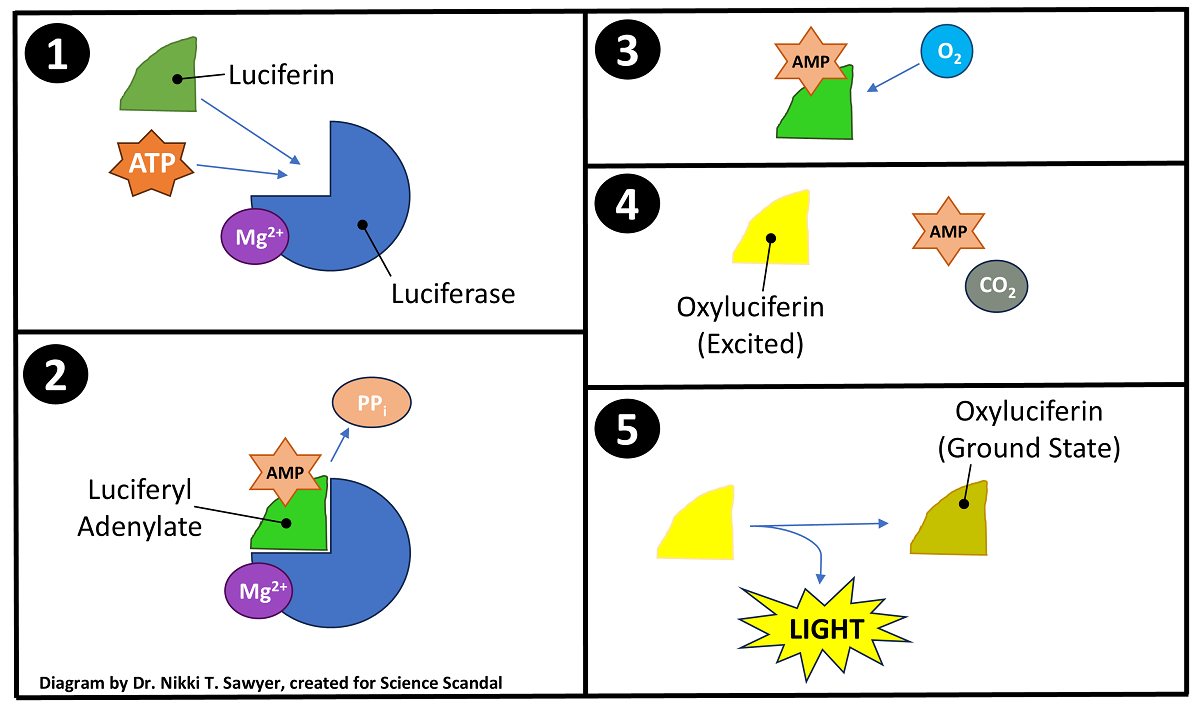
1) Luciferase binds luciferin and ATP in the presence of Mg²⁺.
2) Luciferase uses ATP to form luciferyl adenylate, releasing pyrophosphate (PPᵢ).
3) Oxygen reacts with the luciferyl adenylate.
4) The reaction produces electronically excited oxyluciferin, along with AMP and CO₂.
5) As oxyluciferin returns to its ground state, it releases visible light. Diagram by Dr. Nikki T. Sawyer, created for Science Scandal.
The ominous names have a much less sinister history than they sound. French physiologist Raphaël Dubois investigated bioluminescence in the late nineteenth century using extracts from luminous organisms. His experiments showed that light production depended on two components: a heat-stable substance, which he called luciferin, and a heat-sensitive component, which he called luciferase. The names came from Lucifer in its older Latin sense of “light-bearer” or “light-bringer.”
Those words are now used much more broadly. “Luciferin” refers generally to a light-producing substrate, while “luciferase” refers to an enzyme that catalyzes a bioluminescent reaction. Importantly, there is not one universal luciferin–luciferase system shared by every glowing organism. Bioluminescence has evolved multiple times, and different organisms can use very different chemistry to make light.
For fireflies, the chemistry became part of an elaborate communication system. In many species, flashes are used during courtship, with males and females exchanging species-specific patterns of light. In some well-studied Photinus fireflies, females even use characteristics of male flash displays when choosing mates. Firefly light can also serve other functions, including warning predators that the insects are chemically defended.
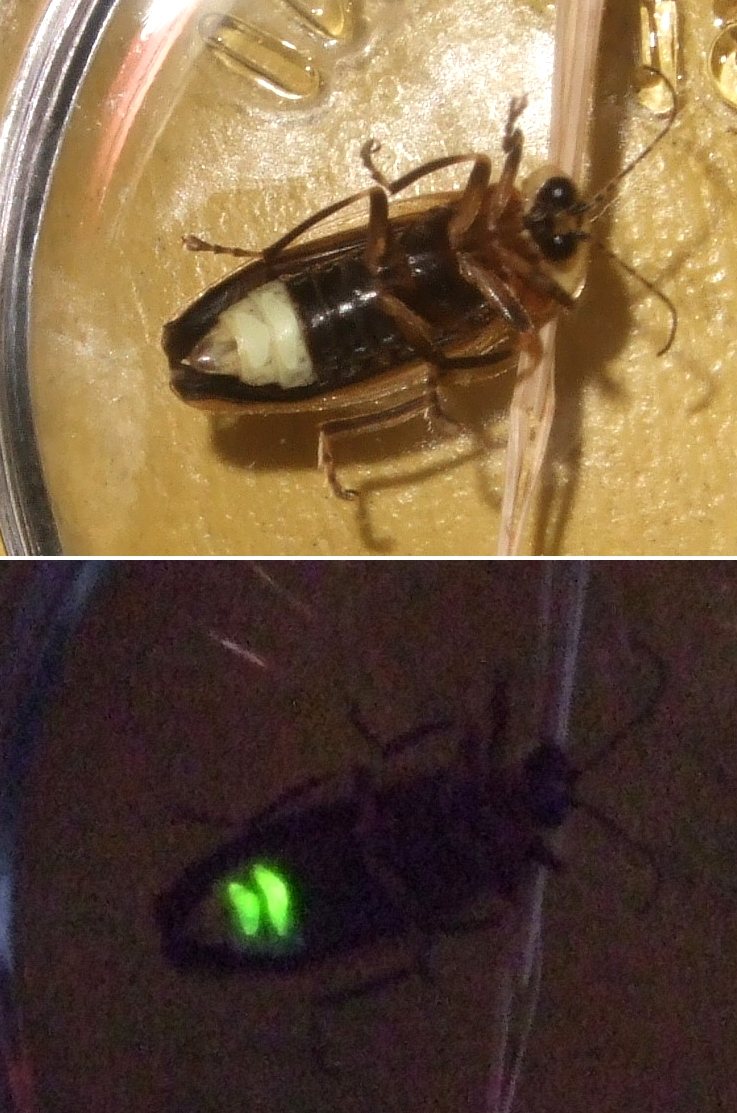
So that flicker drifting across a summer yard is doing a lot more than looking pretty. It is the visible endpoint of an ATP-dependent chemical reaction, a communication signal, and the reason an innocent little beetle ended up carrying around some of the most suspiciously named molecules in biochemistry.
Sources
-
Firefly luciferase: an adenylate-forming enzyme for multicatalytic functions
Inouye, S. (2010). Firefly luciferase: an adenylate-forming enzyme for multicatalytic functions. Cellular and Molecular Life Sciences, 67, 387–404.
Why this source matters: Supports the ATP/Mg²⁺ requirement, luciferyl-adenylate formation, oxygen-dependent oxidation, excited oxyluciferin, and photon emission.
-
Current Status of Research on Fungal Bioluminescence: Biochemistry and Prospects for Ecotoxicological Application
Stevani, C. V., Oliveira, A. G., Mendes, L. F., Ventura, F. F., Waldenmaier, H. E., Carvalho, R. P., & Pereira, T. A. (2013). Current Status of Research on Fungal Bioluminescence: Biochemistry and Prospects for Ecotoxicological Application. Photochemistry and Photobiology, 89(6), 1318–1326.
Why this source matters: Useful for the historical development of bioluminescence terminology and the broader context of luciferin/luciferase naming.
-
Flash Signal Evolution, Mate Choice, and Predation in Fireflies
Lewis, S. M., & Cratsley, C. K. (2008). Flash signal evolution, mate choice, and predation in fireflies. Annual Review of Entomology, 53, 293–321.
Why this source matters: Supports species-specific flash signaling, sexual selection, female mate choice in Photinus, and defensive/predator-related functions of firefly light.