
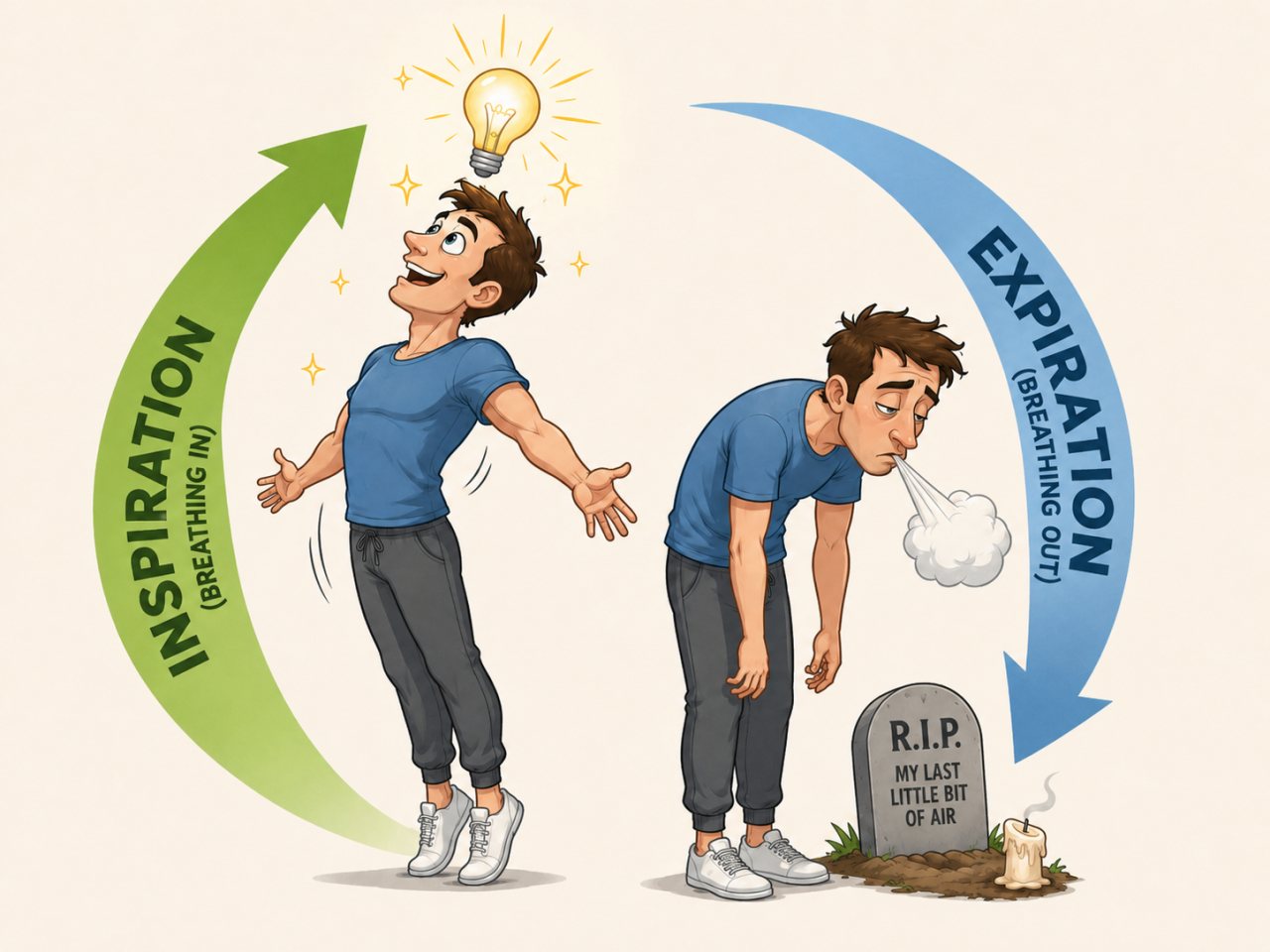
Humans are routinely inspiring! And humans are routinely expiring!
This sounds either uplifting or macabre, depending on which sentence you read first.
But the respiratory system would like you to know that both inspiration and expiration are routine processes that are a normal part of breathing.
In everyday language, inspiration sounds motivational. I like to think I inspire millions of people to be more curious about science.
Expiration sounds fatal. John Doe expired from a heart attack.
But in anatomy and physiology, they just mean air in and air out. When I breathe in, I inspire. When I breathe out, I expire.
To make matters worse, and to cause A&P students additional consternation, the English language also gave us inhalation and exhalation. Because apparently one perfectly functional pair of words to describe breathing was not enough.
Therefore:
Breathing Air In = Inspiration = Inhalation
Breathing Air Out = Expiration = Exhalation
We got into this mess partly because Latin gave medical terminology more than one family of words associated with breathing.
The older classical terminology comes from Latin spirare, “to breathe”:
in- + spirare → inspiration → breathe in
ex- + spirare → expiration → breathe out
The other word family comes from Latin halare, also associated with breathing:
ex- + halare → exhalation → breathe out
Inhalation came later, essentially creating the matching opposite for exhalation.
Which raises an even stranger question: how did words built from roots meaning “to breathe” come to mean either a mental spark or sudden burst of creativity... or the end of something?
The answer is hiding in the history of the words themselves. To inspire originally carried the idea of something being “breathed into” someone, especially divine or creative influence. To expire could mean to breathe out one’s last breath, which rather efficiently explains how it became associated with death and, eventually, anything reaching its end. And now everything from milk to coupons to driver’s licenses gets its own tiny scheduled death.
In any case, billions of people are expiring right now.
Most of them will inspire again within seconds.
The Real Story
In respiratory physiology, inspiration means breathing air into the lungs, while expiration means breathing air back out. Together, these repeated movements make up pulmonary ventilation, the mechanical process that moves air between the atmosphere and the lungs.
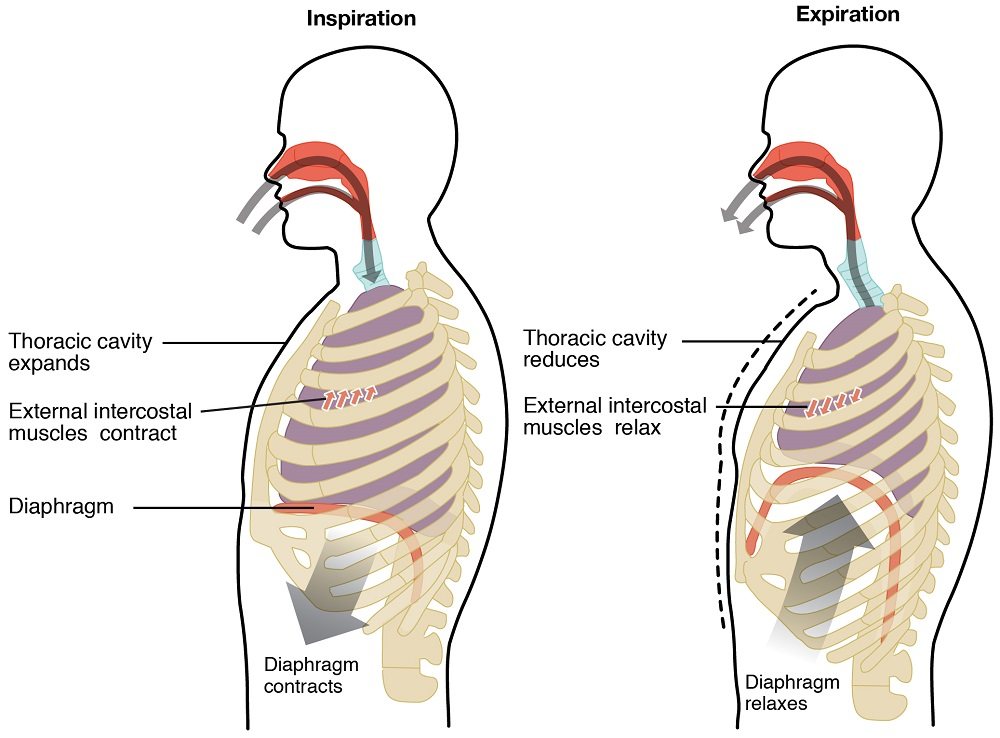
During quiet inspiration, the diaphragm contracts and moves downward, while the external intercostal muscles help expand the rib cage. This increases the volume of the thoracic cavity and expands the lungs with it. As lung volume increases, pressure inside the alveoli falls slightly below atmospheric pressure, so air moves down the pressure gradient and into the lungs.
This pressure-volume relationship is an example of Boyle’s law: when the volume available to a gas increases, its pressure decreases, assuming the other relevant conditions remain essentially constant. Your respiratory muscles therefore do not “pull” air into the lungs directly. They change the volume of the thorax, which changes pressure, and atmospheric pressure does the rest.
Expiration during quiet breathing is considerably lazier.
At rest, the diaphragm and inspiratory muscles relax. The lungs and chest wall recoil toward their resting positions, thoracic and lung volume decrease, and alveolar pressure rises slightly above atmospheric pressure. Air then flows out of the lungs. In other words, quiet inspiration requires muscle contraction, while quiet expiration is largely passive.
That changes when breathing becomes more demanding. During exercise, forceful coughing, blowing, sneezing, or other situations requiring greater ventilation, expiration can become an active process. Abdominal muscles and expiratory intercostal muscles can contract to reduce thoracic volume more forcefully and push additional air out. Likewise, deeper or more forceful inspiration can recruit additional accessory muscles beyond those used during ordinary resting breaths.
One important distinction: ventilation is not the same thing as respiration in every sense of that word. Ventilation describes the physical movement of air into and out of the lungs. Once that air reaches the alveoli, oxygen and carbon dioxide still have to diffuse between the lungs and blood, and those gases then have to be transported between the lungs and tissues. Breathing is therefore the opening act in a much larger respiratory production.
So when an A&P instructor announces that inspiration is active and expiration is usually passive, nobody is being philosophical.
They are describing muscle contraction, elastic recoil, pressure gradients, and airflow.
You have probably inspired and expired several times while reading this article.
Congratulations.
Your ventilation appears to be functioning.
Sources
-
Physiology, Respiratory Drive
Brinkman JE, Toro F, Sharma S. Physiology, Respiratory Drive. StatPearls. National Center for Biotechnology Information.
Why this source matters: Clinical physiology overview supporting the basic respiratory cycle: inspiration begins with contraction of the diaphragm and external intercostals, expansion of the thorax lowers alveolar pressure, and quiet expiration occurs largely through relaxation and elastic recoil.
-
Physiology, Transpulmonary Pressure
Neupane K, Jamil RT. Physiology, Transpulmonary Pressure. StatPearls. National Center for Biotechnology Information.
Why this source matters: Supports the pressure-volume mechanics of ventilation, including the application of Boyle’s law, passive expiration, elastic recoil, and recruitment of abdominal/intercostal muscles during forceful expiration.
-
Looking for inspiration: new perspectives on respiratory rhythm
Feldman JL, Del Negro CA. Looking for inspiration: new perspectives on respiratory rhythm. Nat Rev Neurosci. 2006 Mar;7(3):232-42.
Why this source matters: Review article supporting the mechanical roles of the diaphragm and external intercostal muscles during inspiration and the largely passive nature of expiration at rest.
-
Sleep awakens active expiration
O'Halloran KD. Sleep awakens active expiration. J Physiol. 2018 Aug;596(15):2947-2948.
Why this source matters: Supports the distinction between passive expiration during quiet resting breathing and active expiration when respiratory demand increases, with recruitment of abdominal expiratory muscles.