
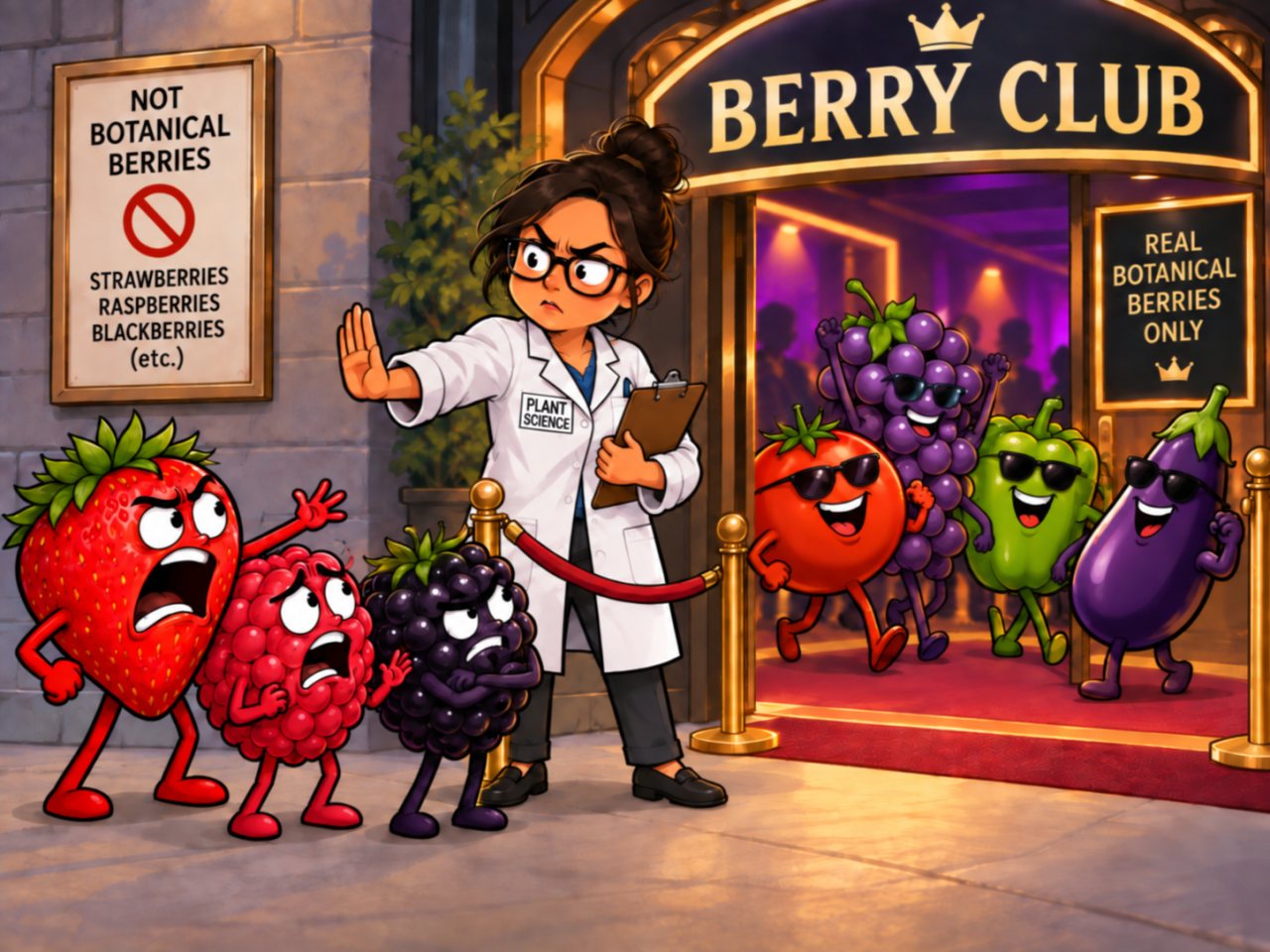
Let's recap. We've covered that fruits develop from ovaries. We've also covered the fact that the produce aisle is full of misleadingly named items.
And we left that last article asking, “What the hell is a berry anyway?”
Now it's time for the long-awaited answer.
As a reminder, a simple fruit develops from a single ovary in a single flower.
A BERRY is a simple fruit in which the ovary wall matures into a fleshy pericarp surrounding the seeds.
Tomatoes are berries.
Grapes and bananas are berries.
Peppers and eggplants are berries.
Believe it or not, a blueberry is also a berry!
Although many other fruits with “berry” in their names are NOT berries in the botanical sense.
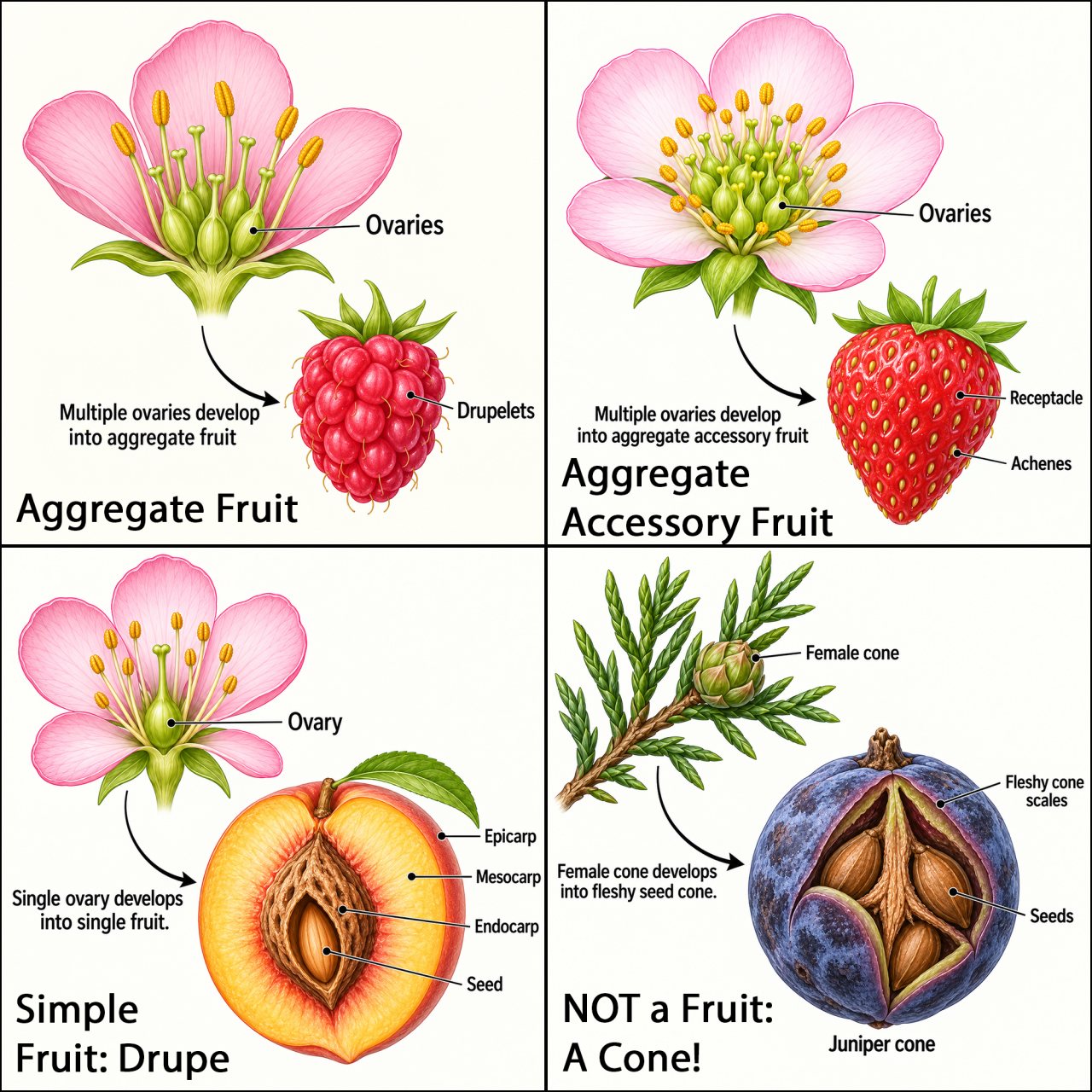
Raspberries and blackberries develop from multiple ovaries in a single flower, which disqualifies them from the berry club.
Strawberries go even further. They involve multiple ovaries, and the red fleshy part you think of as “the strawberry” didn't actually develop from the ovary at all.
So strawberries are doubly disqualified.
In other words, to qualify as a botanical berry, the fruit has to develop from a single ovary and remain fleshy rather than turning into a dry fruit or forming a hard stone around the seed.
If the inner layer of the fruit wall hardens into a pit, as it does in apricots, cherries, olives, peaches, plums, and mangoes, you have a drupe.
If the mature fruit dries instead, as in legumes and true nuts, then it belongs to a different fruit category entirely.
A berry keeps things fleshy.
And a juniper berry?
It isn't even from an angiosperm!
Junipers are conifers. Their so-called “berries” are actually fleshy cones.
So yes:
The juniper berry is basically a pine cone in disguise. 😜
The Real Story
The ordinary meaning of berry and the botanical meaning of berry are only loosely acquainted.
In everyday language, we tend to use berry for fruits that are small, juicy, colorful, and easy to scatter over cereal. Plant scientists classify them differently. They look at how the fruit develops from the flower and what happens to the ovary wall as the fruit matures.
A botanical berry is a simple fleshy fruit that develops from a single ovary in one flower. As that ovary matures, its wall becomes the pericarp, the fruit wall.
The pericarp can be divided into three layers:
-
Exocarp: the outermost layer
-
Mesocarp: the middle layer
-
Endocarp: the innermost layer
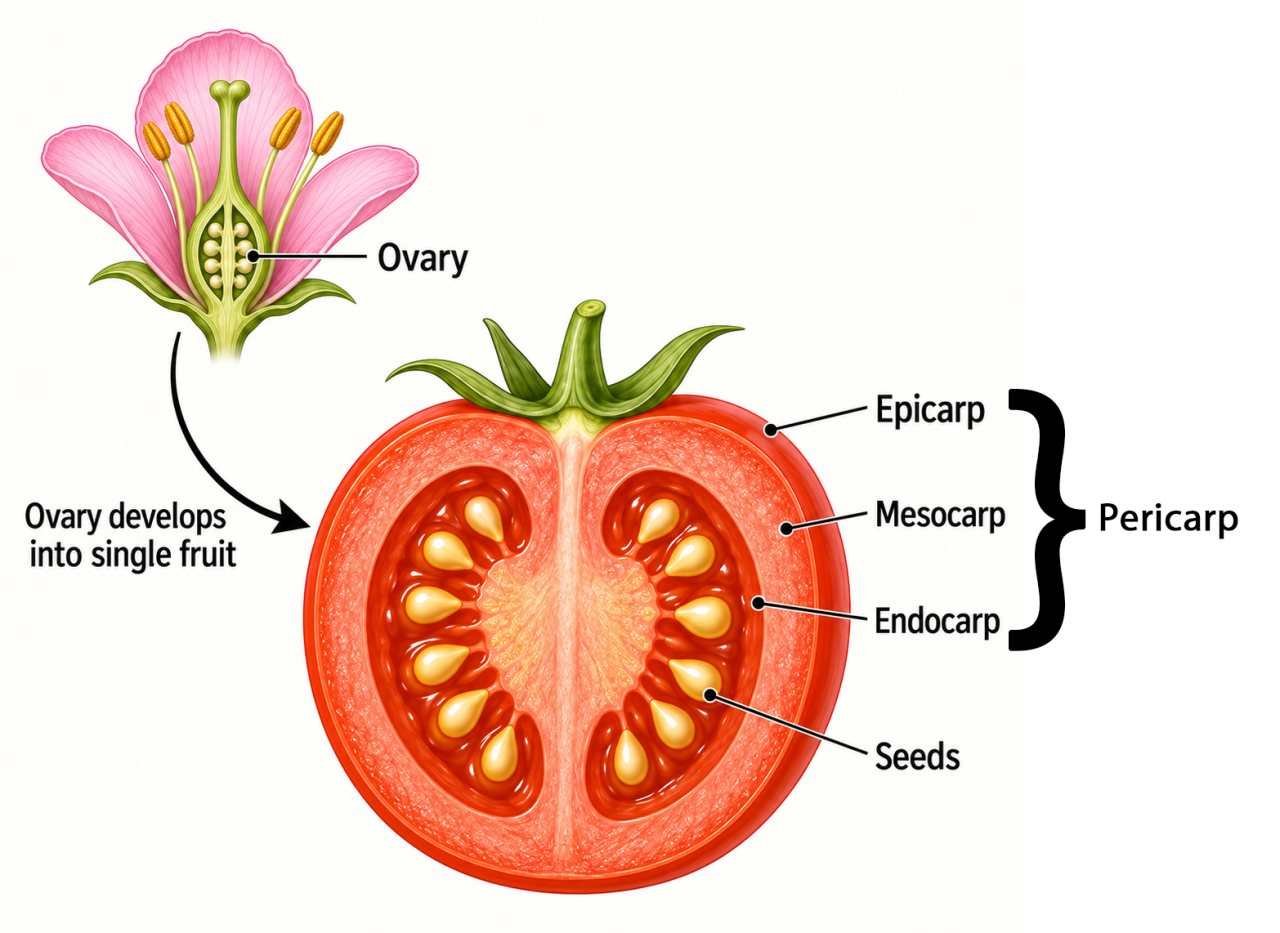
In a typical berry, those layers remain relatively soft and fleshy rather than forming a hard stone around the seed. That is why tomatoes, grapes, blueberries, peppers, eggplants, and bananas all qualify as berries.
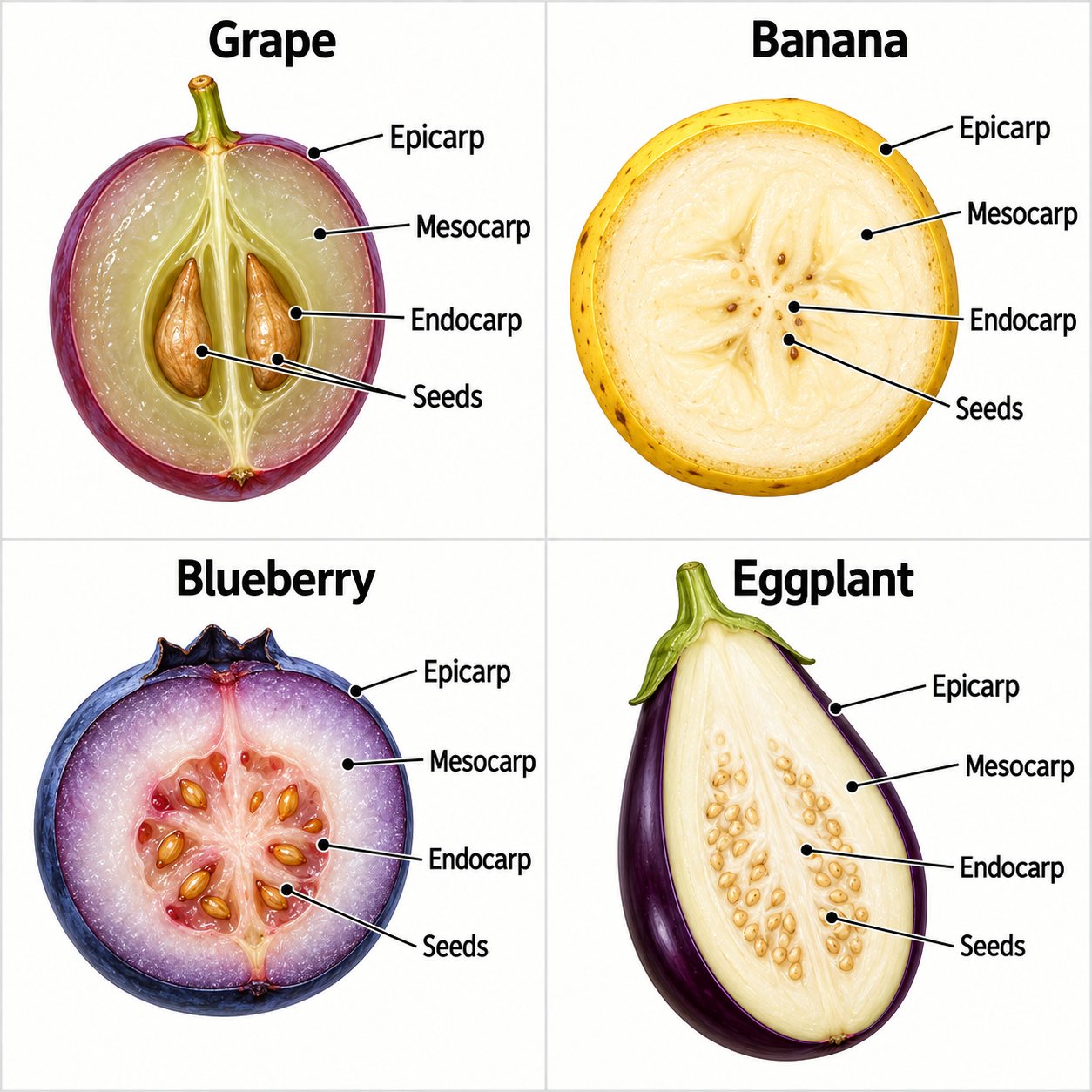
The banana is especially useful because it exposes why seed number alone cannot define a berry. Wild bananas can produce seeds, but most edible cultivars develop fruit parthenocarpically, meaning the ovary grows into fruit without fertilization and the resulting bananas are largely seedless. They are still berries because their developmental origin and fruit structure fit the berry type.
Why Raspberries and Blackberries Fail the Test
Raspberries and blackberries look much more “berry-like” to us than tomatoes or bananas, but they are built differently.
Their flowers contain multiple separate ovaries. Each ovary develops into a tiny fleshy fruit called a drupelet. All those drupelets cluster together into the structure we recognize as a raspberry or blackberry.
That makes them aggregate fruits, not botanical berries.
So a raspberry is not one berry.
It is essentially a committee of tiny fruits all stuck together.
Strawberries Are Even Worse
Strawberries fail the berry test in two different ways.
First, a strawberry flower has many ovaries, so it does not produce one simple fruit from one ovary.
Second, the juicy red tissue that most people think of as “the strawberry” is not primarily ovary tissue at all. It develops from the enlarged receptacle, the part of the flower that supported the ovaries.
The small structures scattered across the outside of the strawberry are the actual fruits. Each one is an achene containing a seed.
That makes the strawberry an aggregate accessory fruit, not a botanical berry.
Why Peaches and Cherries Aren’t Berries Either
Peaches, cherries, plums, apricots, olives, and similar fruits also develop from a single ovary, so at first glance they seem like they should qualify.
But their pericarp develops differently.
The outer layer forms the skin, the middle layer becomes fleshy, and the inner layer, the endocarp, hardens into a stone or pit around the seed.
That makes these fruits drupes, not berries.
So the difference is not simply “fleshy versus not fleshy.”
It is what the different layers of the ovary wall become.
Some Berries Get Their Own Special Names
Plant classification, naturally, was not content to stop there.
Some fruits are berry-derived forms with specialized structures.
Citrus fruits such as oranges, lemons, limes, and grapefruits are hesperidia, modified berries with a leathery outer rind and juice-filled internal structures.
Cucumbers, pumpkins, squash, zucchini, and watermelons are pepos, another specialized berry type with a thicker or leathery outer rind.
So yes, once again, the grocery store's categories and plant morphology are operating under entirely different management.
And Then There’s the Juniper “Berry”
At least tomatoes, bananas, and blueberries are fruits from flowering plants.
Junipers do not even get that far.
Junipers are conifers, not angiosperms. They do not produce flowers or true fruits. Their so-called “berries” are actually fleshy seed cones formed from fused cone scales.
Which means the final insult is complete:
A strawberry is not a berry.
A raspberry is not a berry.
A banana is a berry.
A tomato is a berry.
And a juniper berry is not even a fruit.
It is a pine cone in disguise.
Sources
-
8.1 Fruit Morphology
The Science of Plants. “8.1 Fruit Morphology.” University of Minnesota Libraries Publishing.
Why this source matters: Primary morphology source. Supports fleshy vs. dry pericarp, berry structure, tomato/grape/blueberry as berries, raspberry as aggregate fruit, drupe structure, and specialized berry types including pepos and hesperidia.
-
What makes a berry a berry?
University of California Agriculture and Natural Resources, Napa County Master Gardeners. (2024). “What makes a berry a berry?”
Why this source matters: Supports the distinction between botanical and common-language berries; raspberries, blackberries, and strawberries as non-berries; strawberries as aggregate fruits with achenes; bananas, tomatoes, eggplants, and blueberries as botanical berries; and citrus/pepo subtypes.
-
Banana Growing in the Florida Home Landscape
Balerdi, C.F., Crane, J. H. University of Florida IFAS Extension. Banana Growing in the Florida Home Landscape. Publication MG040.
Why this source matters: Supports banana fruit as a berry and the important nuance that edible cultivars commonly develop parthenocarpically without pollination, producing seedless fruit. This source is useful for avoiding the misleading claim that all botanical berries must contain multiple mature seeds.
-
Juniperus horizontalis, creeping juniper
Gucker, C. U.S. Forest Service, Fire Effects Information System. “Juniperus horizontalis, creeping juniper.”
Why this source matters: Supports the juniper ending. Describes female cones whose scales fuse into fleshy, berry-like cones containing seeds, confirming that juniper “berries” are cones rather than angiosperm fruits.