

This is Millie. I have once again taken control of Momma’s keyboard because apparently humans require feline supervision.
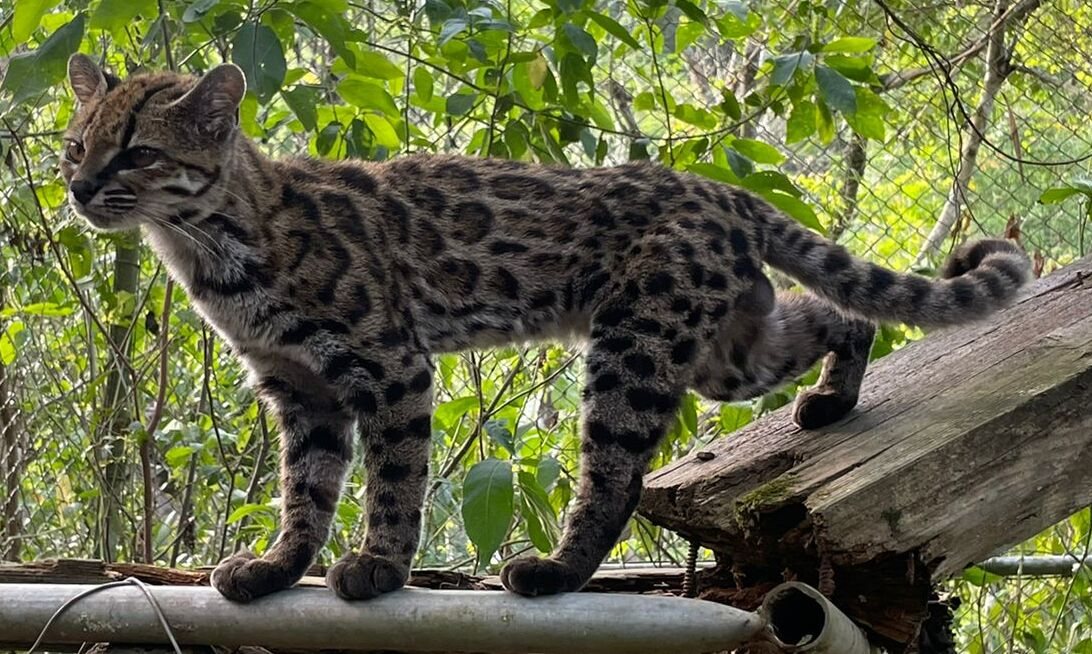
A man in Bolivia found a tiny spotted kitten near the forest and took him home because he thought he was a domestic cat.
I have reviewed the photographs.
I would like to know exactly which part of that animal was supposed to resemble me.
The spots? No.
The face? Absolutely not.
The overall expression of someone who might remove part of your hand if dinner is late? Again, not seeing the resemblance.
Scientists eventually performed the sort of investigation the human in question apparently skipped and discovered that the “weird house cat” belonged to an entirely different species.
His name is now Leopardus tilcayo.
I am Felis catus.
Please update your records accordingly.
Oh...
Momma says I should also mention that this is apparently the first new living cat species formally described by science in more than a century. She seems very excited about that.
Personally, I think the more pressing issue is that dinner is due tonight at the usual time.
New species or not, some standards remain inviolate.
The Real Story
The animal now known as Leopardus tilcayo belongs to the South American tiger-cat group, a cluster of small spotted wild cats in the genus Leopardus.
For a long time, that group looked taxonomically much simpler than it actually was.
The problem is that tiger cats are cryptic species: different evolutionary lineages can look similar enough that appearance alone may not reliably reveal where one species ends and another begins. Even photographs and field observations can leave scientists lumping distinct animals together under the same name.
That is exactly what happened here.
In 2017, biologist Paola Nogales-Ascarrunz was contacted by a wildlife sanctuary in Bolivia about what staff described as a “weird cat.” The animal had originally been found as a kitten near a forest and taken home by a local man who believed he had found an unusual domestic cat. After about a year, it became increasingly obvious that his new pet was something much wilder, and the cat was transferred to a sanctuary.
At first, Nogales-Ascarrunz thought the animal was probably a known tiger cat, Leopardus tigrinus. But its appearance did not quite match the forms described from neighboring regions. The Bolivian animal had a small face, short rounded ears, long whiskers, and large irregular rosettes across its coat. That mismatch helped trigger a much deeper investigation.
The research team eventually analyzed complete genomes from 38 individuals in the genus Leopardus, including 26 tiger cats and eight museum specimens. Those historical samples were especially valuable because they allowed the scientists to compare living animals with material tied to older taxonomic records and geographic populations.
The genomic results showed that what had once been treated much more simply is actually a complex of five distinct tiger-cat species.
One of them had never previously been proposed as a separate species at all.
That cat is now Leopardus tilcayo.
Genetic analysis suggests that the L. tilcayo lineage separated from its closest tiger-cat relatives roughly 1.4 million years ago. The study also described a new tiger-cat subspecies from the Peruvian Yungas, Leopardus tigrinus antisuyo.
The newly recognized tilcayo is tiny even by wild-cat standards. The best-known living male measures about 46 centimeters (18 inches) from head to body and weighs around 1.4 kilograms, or roughly three pounds, making him smaller than the average domestic cat.

And despite having now received a formal scientific name, the species remains remarkably mysterious.
Researchers currently have information from only a very small number of living individuals and a limited set of camera-trap records. Preliminary observations suggest that small rodents may form part of the diet and that the cats may be more active at night, but basic questions about their population size, geographic range, reproduction, behavior, and ecology remain unanswered.
Why One New Name Matters
Taxonomy can sound like scientists arguing over labels, but splitting one supposedly widespread species into several smaller-range species can have major conservation consequences.
If five distinct species have been hiding underneath one broad name, each individual species may occupy a much smaller range and contain a much smaller population than conservation assessments previously assumed.
The International Union for Conservation of Nature currently assesses tiger cats under a simpler taxonomy. Researchers have shared the new findings with the IUCN so the newly resolved lineages can eventually be evaluated separately. A species that appeared relatively widespread when grouped with several others may turn out to face substantially greater risk when considered on its own.
That concern is especially important for L. tilcayo, which is known from Bolivia's Yungas cloud forest, an ecosystem under pressure from deforestation, agriculture, fires, mining, and habitat fragmentation.
The discovery is also a reminder that cryptic biodiversity is not confined to tiny insects or obscure microorganisms.
Even mammals.
Even carnivores.
Even cats can remain taxonomically hidden in plain sight until genetics forces everyone to update the family tree.
Millie would like it noted that she could have told you they were different.
Sources
-
Phylogenomics and museomics reveal five distinct species of tiger cats in South America
Lescroart, J., Nogales-Ascarrunz, P., Cassatt-Johnstone, M., Bonilla-Sánchez, A., Charão Sartor, C., Angulo, F., Ramirez, J. L., Rosa de Oliveira, L., Gomes de Oliveira, T., Shapiro, B., Aliaga-Rossel, E., Svardal, H., & Eizirik, E. (2026). Phylogenomics and museomics reveal five distinct species of tiger cats in South America. Current Biology, 36.
Why this source matters: Primary source for the genomic analysis, the 38-individual dataset, the five-species tiger-cat classification, the formal description of Leopardus tilcayo, the new Peruvian subspecies, museum-genome analysis, and the taxonomic/conservation implications.
-
Meet the First New Cat Species Discovered in 100 Years
Bittel, J. (2026, September 17). Meet the first new cat species discovered in 100 years. National Geographic.
Why this source matters: Best source for the narrative history of the sanctuary animal: the local man finding the kitten near a forest, initially believing it was domestic, keeping it for about a year, and the subsequent involvement of Paola Nogales-Ascarrunz. Also provides detailed context on the animal's appearance, the development of the genetic investigation, local naming, size, and broader significance of the discovery.
-
New cat species identified in Bolivia, first in over a century
Serafinko, M. (2026, September 17). New cat species identified in Bolivia, first in over a century. Reuters.
Why this source matters: Supports the conservation section, including the IUCN reassessment issue, threats to the Yungas ecosystem, the limited current ecological knowledge of L. tilcayo, estimated size and weight, and the approximate 1.4-million-year lineage divergence.