
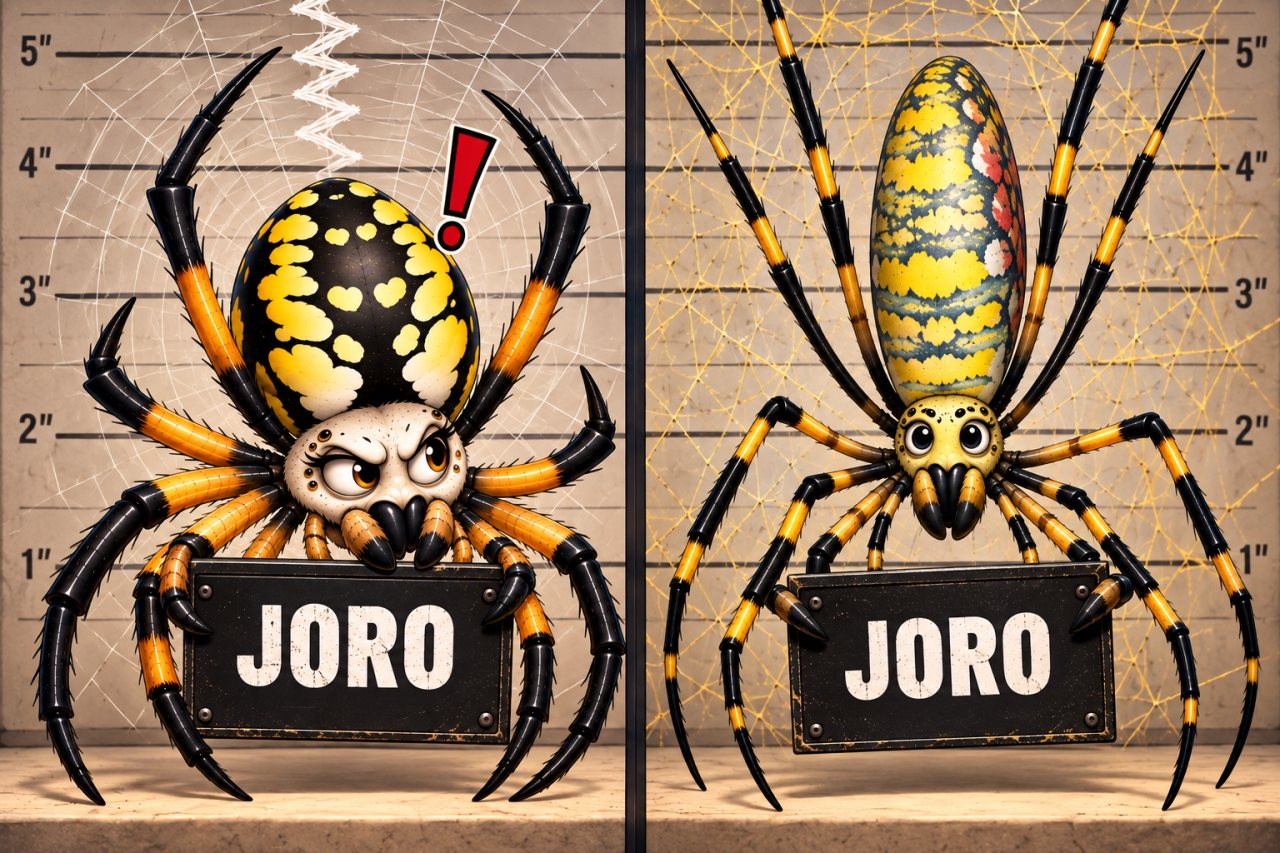
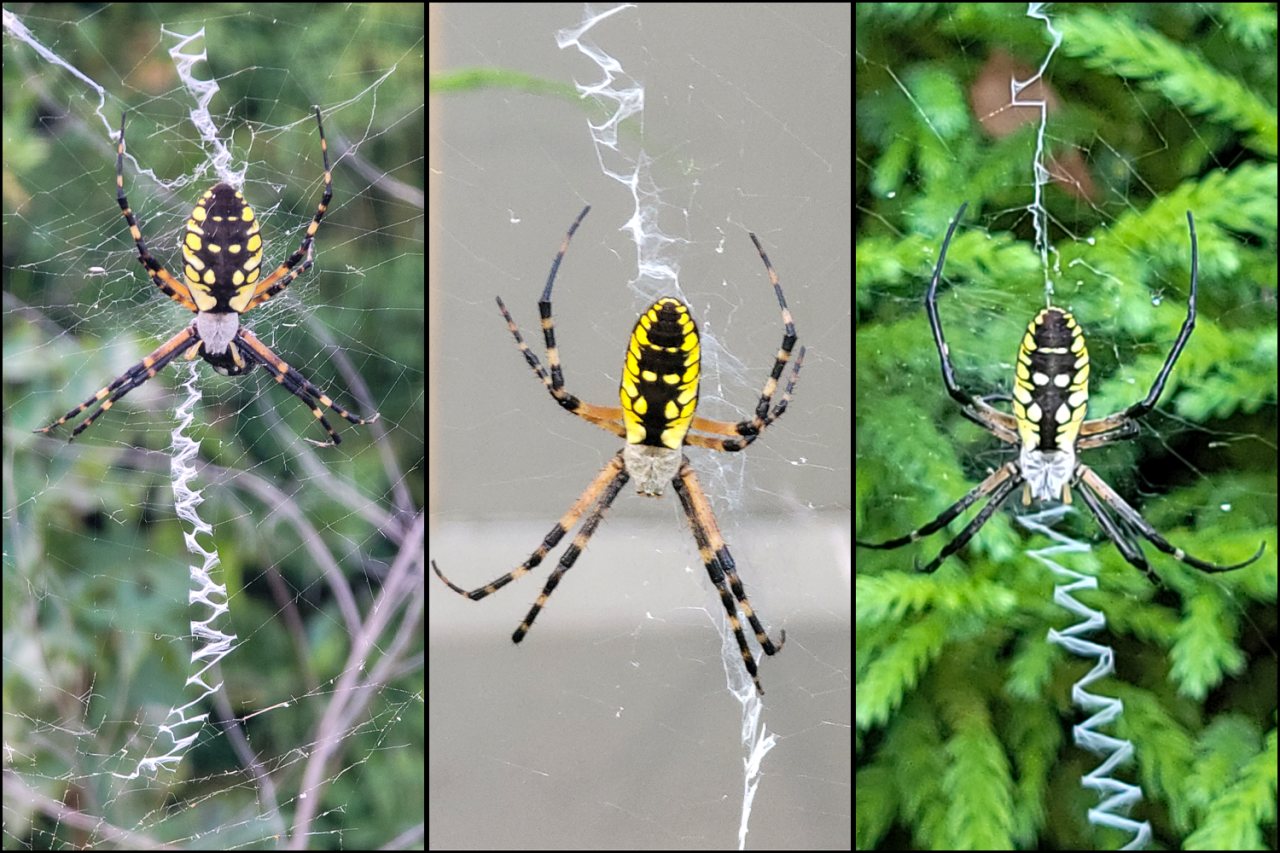
As a website builder myself, I enjoy looking for Sylvie the yellow garden spider in my garden every late summer and fall. She’s never disappointed me with her beautiful large web and gorgeous zig-zagged stabilimentum.
But then the Joro spiders invaded Georgia.
And this year, I had a hard time locating Sylvie.
I did NOT, however, have a hard time finding approximately a million Joros.
Then I overheard people talking about the “damn Joros” and wanting to eradicate them, and I started to worry.
Because to the untrained eye, Sylvie could easily be mistaken for a Joro spider.
And Sylvie, who provides wonderful pest-control services in my garden by trapping flies, mosquitoes, and other flying insects, could be in real danger of being lumped in with the invaders.
So I got together with Sylvie to put together a guide for telling yellow garden spiders from Joro spiders.
And good news: not only did I finally locate Sylvie this week, but I also found two of her sisters!
The Real Story
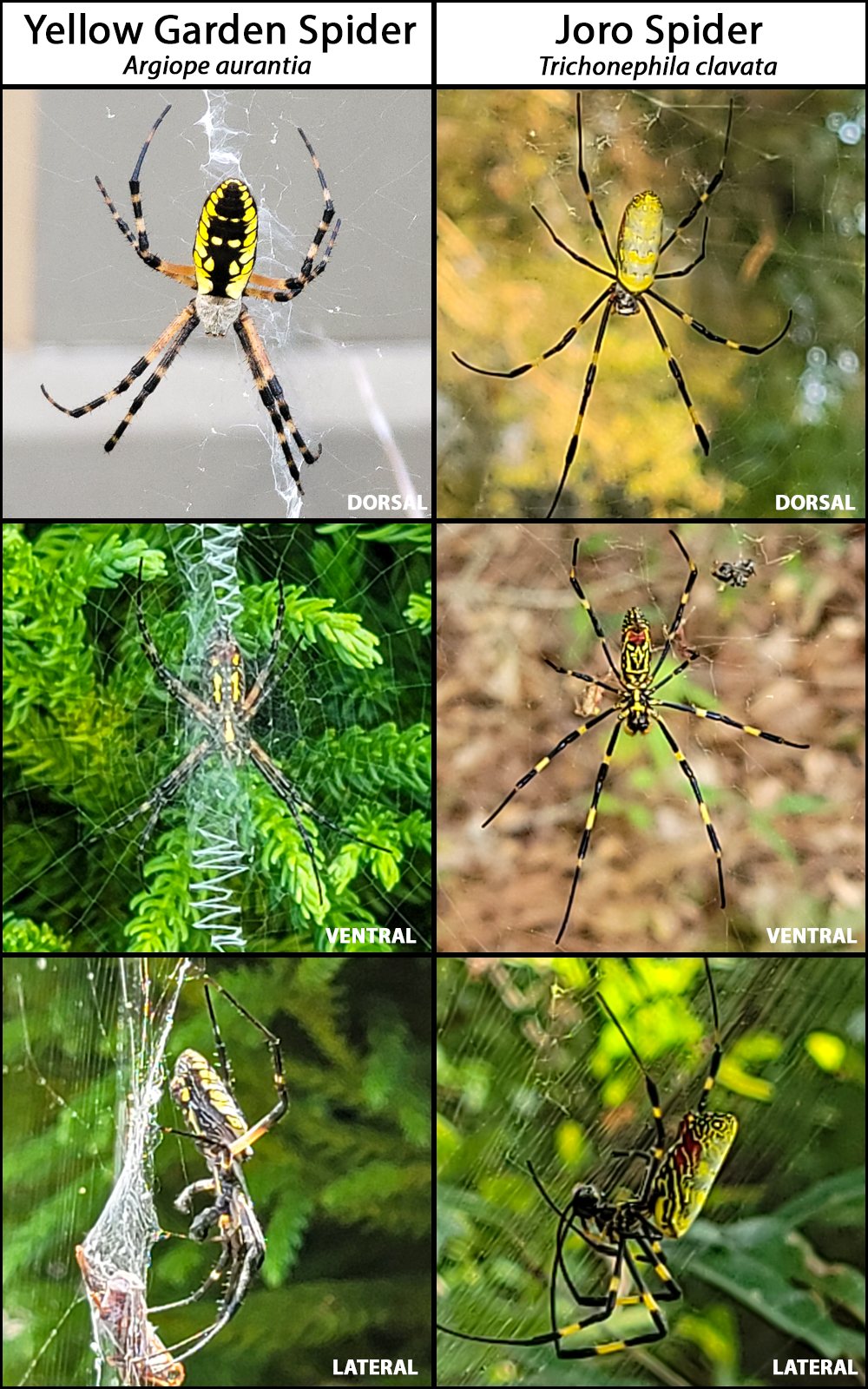
Sylvie is a yellow garden spider, Argiope aurantia, a native North American orb-weaver. Her new neighbors are Joro spiders, Trichonephila clavata, an East Asian species first confirmed in North America in 2014, when specimens were documented in northeastern Georgia. Both are large, conspicuous orb-weaving spiders, both can display dramatic combinations of yellow and black, and both become especially noticeable toward the end of summer.
That is more than enough resemblance to get an innocent garden spider dragged into a Joro identification crisis.
The first rule is therefore simple:
Do not identify either spider from one feature alone.
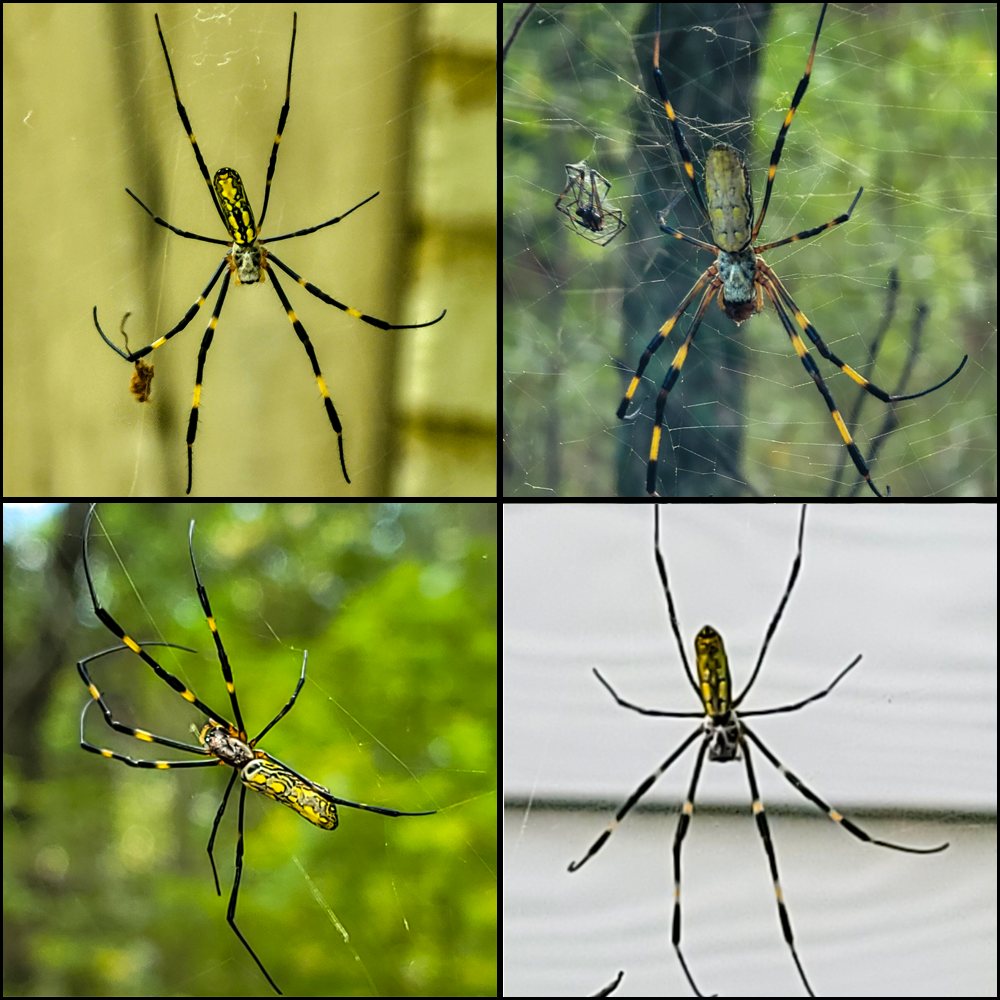
A mature female Joro is often described as having a bright yellow abdomen crossed by broad silver, gray-blue, bluish-green, or teal bands, with long black legs marked with yellow or orange. The underside usually includes conspicuous red markings. Those descriptions are accurate for many mature females, and they are useful identification features. But they are not a magic barcode. The original North American description notes variation in the markings and leg coloration, and current University of Georgia (UGA) guidance emphasizes that immature Joros are considerably less colorful and may be difficult to distinguish from other web-building spiders.
That matters in the real world because people do not wait until every female spider has reached perfect textbook maturity before noticing them.
Joros hatch in spring, grow through the summer, and mature during late summer and early fall. UGA reports that immature spiders can look much less distinctive and only gradually acquire the colors usually shown in identification guides.
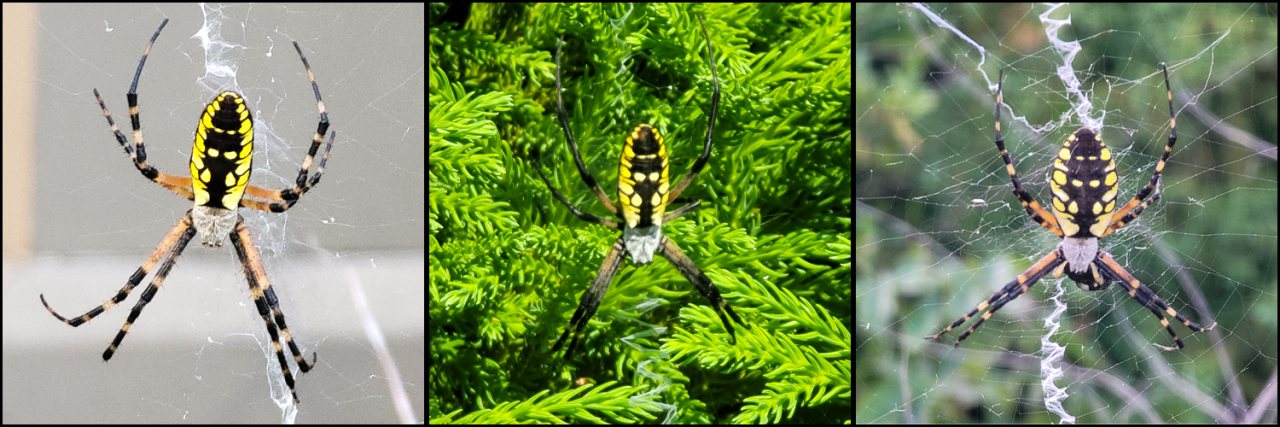
Yellow garden spiders can vary too, but mature female Argiope aurantia usually present a fairly distinctive overall package: a broad, relatively compact abdomen patterned with striking yellow or orange markings against black, a silvery or whitish cephalothorax, and an orb web that frequently contains the conspicuous vertical zigzag of dense white silk known as a stabilimentum. Argiope aurantia is so strongly associated with that zigzag that “writing spider” is one of its common names.
Look at the web, not just the spider
The web can provide some of the best supporting evidence.
A yellow garden spider builds a recognizable orb web, often with the dense white zigzag stabilimentum running through its center. Joros also build orb webs, but mature females produce golden silk and can construct enormous webs spanning many feet, sometimes supported by anchor lines extending far between trees or structures. UGA describes the mature Joro web as one of its most striking characteristics.
That means a spider sitting in a relatively clean orb with an obvious white zigzag is giving you a very different collection of clues from a long-legged spider occupying a sprawling golden web complex.
There is an important caution here, though: the stabilimentum is a clue, not an ID card. Its presence is strongly associated with yellow garden spiders, but stabilimenta vary in size and form, and not every web will necessarily display the most spectacular textbook zigzag at every moment. Research on Argiope has shown substantial variation in stabilimentum construction.
Check the spider’s proportions
Body proportions can help too.
Female Joros tend to have an elongated abdomen and extremely long legs, giving them a more stretched-out appearance. Mature yellow garden spiders tend to look stockier and more compact by comparison. Joro females commonly have long black legs with yellow-orange bands, while yellow garden spiders also have patterned legs, especially before full maturity. Leg pattern therefore helps as part of the overall picture, but again, it should not be promoted to sole deciding feature.
And do not use size as your primary test.
Adult female Joros can become very large, but so can female yellow garden spiders, and comparing individuals of different ages can completely reverse the expected size relationship. UGA notes that immature Joros begin the season tiny and grow throughout summer, while adult female A. aurantia may reach roughly 14–28 mm in body length depending on the source and population. A fully grown Sylvie can therefore easily be larger than a younger Joro sitting twenty feet away.
In other words:
“This one is bigger” is not taxonomy.
See several spiders? Pay attention
Another useful clue is company.
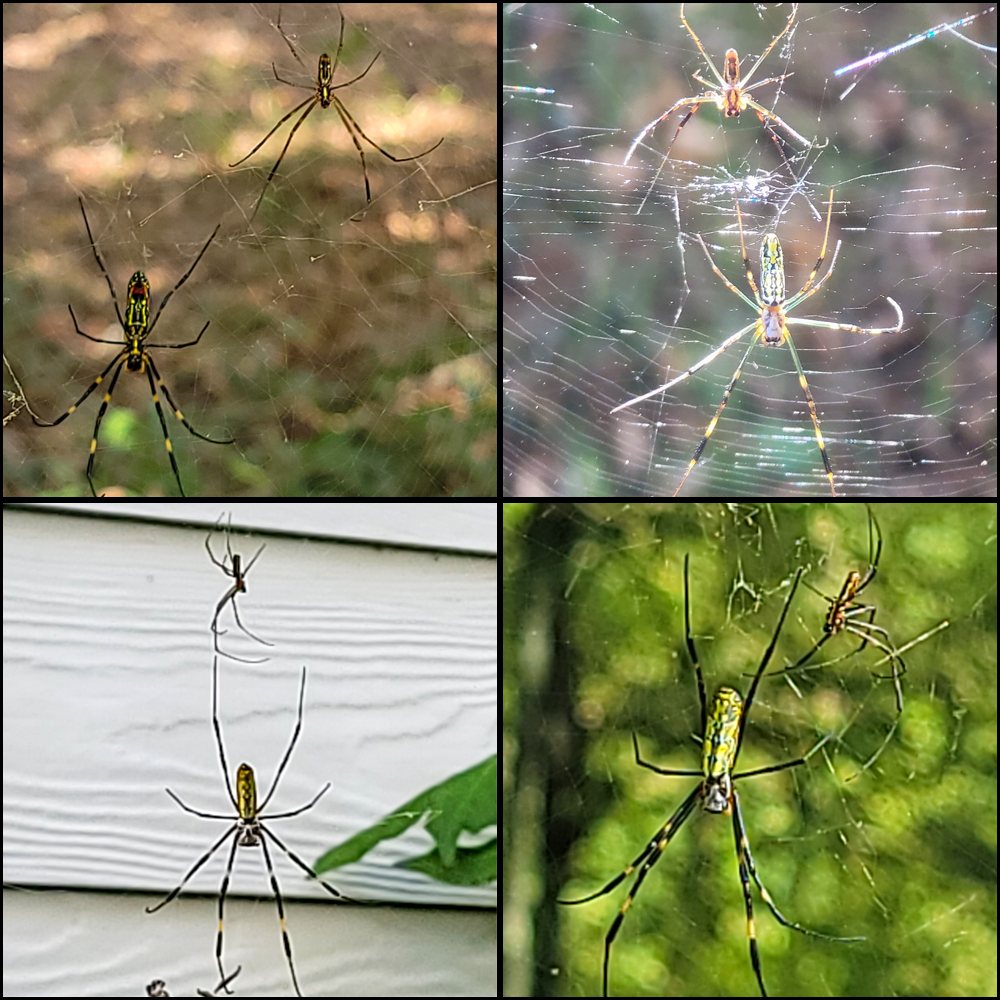
Female Joros are dramatically larger than males. Mature males are small, brownish, and much less conspicuous, and they frequently inhabit a female’s web. UGA researchers report that close inspection of a Joro web may reveal one or more males, and they have observed as many as ten males associated with a single female’s web!
So if you see a large yellow-and-black spider accompanied by one or several much smaller spiders within the same web system, that substantially strengthens the Joro hypothesis.
It does not prove it.
A Joro can absolutely be found alone, and spiders of other species may occupy neighboring or connected webs. The absence of tiny companions does not rule out Joro, and the presence of another spider should not override every other feature. But as part of the entire evidence package, multiple spiders clustered within a Joro-style web complex are a very useful field clue.
There is one more large yellow spider in the lineup
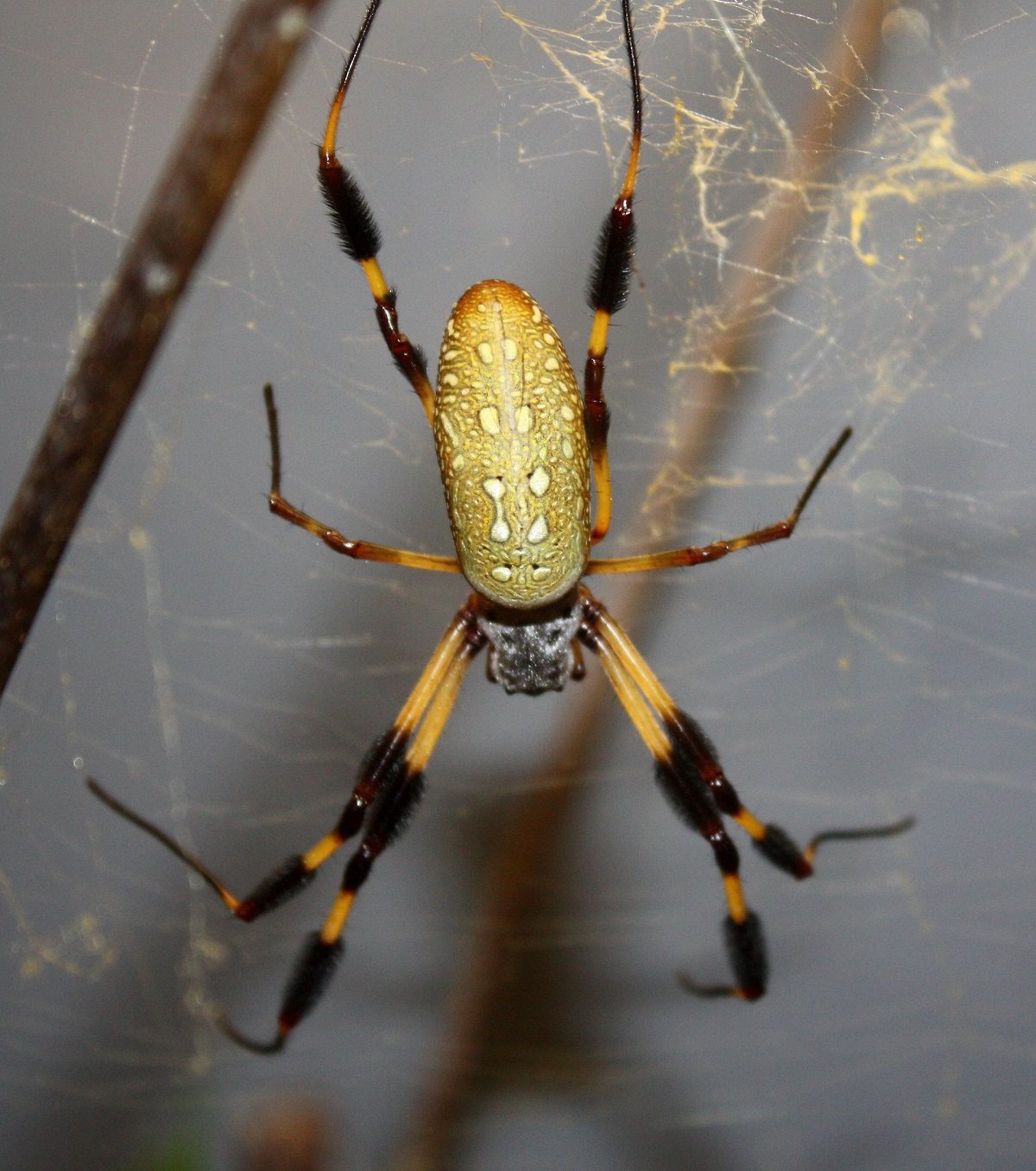
The native golden silk orb-weaver, Trichonephila clavipes, can also be confused with Joros. It has an elongated body and large golden web, making it a particularly convincing look-alike. One useful distinction is on the legs: female golden silk orb-weavers have conspicuous dark, brush-like hair tufts on several pairs of legs. Joros lack those characteristic leg tufts. Their abdominal patterns also differ, with golden silk orb-weavers tending toward yellow-orange coloration with silvery spots rather than the typical Joro banding.
That is another reason identification works best as pattern recognition across several traits, rather than a game of “spot the yellow spider.”
Put the clues together
For a large yellow-and-black orb-weaver in Georgia, look at the whole scene:
Yellow garden spider clues: a broader, more compact-looking abdomen; bold black-and-yellow patterning; silvery cephalothorax; a relatively straightforward orb web; and especially a conspicuous white zigzag stabilimentum.
Joro clues: a more elongated body and very long legs; yellow-and-dark dorsal patterning that may or may not look like the perfect blue-green-banded textbook female; red markings visible from below in mature females; a large golden and often extensive web; and sometimes one or more tiny males sharing the female’s web.
Golden silk orb-weaver clue: a Joro-like elongated form and golden web, but conspicuous brushy tufts on the legs.
And then remember that age, sex, season, posture, viewing angle, lighting, and individual variation all alter what you actually see. Current UGA material specifically notes variation in juvenile Joro color patterns, and the original description of the North American population records variation even among the traits used to describe adults.
That is why the safest rule is also the simplest:
Don’t hunt for one magic feature. Real spiders are messier than infographics, so use the whole animal and the whole web.
Sylvie would appreciate the due process.
Sources
-
Joro Spider: Trichonephila clavata
Wallace, R. D., Hoebeke, E. R., & Schmidt, J. (2026). Joro Spider: Trichonephila clavata. University of Georgia Cooperative Extension, Circular 1273.
Why this source matters: Primary practical identification source for the article. Supports mature female and male coloration, sexual size dimorphism, native East Asian origin and Georgia detection, Joro look-alikes, yellow garden spider stabilimentum, variation among juvenile Joros, seasonality, and the observation that one or more males commonly inhabit a female Joro’s web. Particularly important because the 2026 revision explicitly states that juvenile Joros show varying color patterns and may resemble other spiders.
-
Managing Joro Spiders in the Landscape
Joseph, S. V., & Schmidt, J. (2026). Managing Joro Spiders in the Landscape. University of Georgia Cooperative Extension, Circular 1289.
Why this source matters: Supports the seasonal progression from immature to mature Joros, the warning that immature spiders are less colorful and difficult to differentiate from other web spiders, adult female coloration, male appearance, golden silk, and the enormous size and long support strands of mature webs. This is especially useful for explaining why identification advice must work before every female reaches textbook adult coloration.
-
Nephila clavata L. Koch, the Joro Spider of East Asia, Newly Recorded from North America (Araneae: Nephilidae)
Hoebeke, E. R., Huffmaster, W., & Freeman, B. J. (2015). Nephila clavata L. Koch, the Joro spider of East Asia, newly recorded from North America (Araneae: Nephilidae). PeerJ, 3, e763.
Why this source matters: Original peer-reviewed report confirming Joros in North America from specimens collected in northeastern Georgia in 2014. Provides detailed morphological descriptions and explicitly identifies Argiope aurantia as a large orb-weaver that can be confused with Joros, distinguishing it by its black background with yellow/orange abdominal markings and circular web with a central zigzag stabilimentum. The paper uses the older genus combination Nephila clavata; the currently accepted name is Trichonephila clavata.
-
The Jorō Spider (Trichonephila clavata) in the Southeastern U.S.: An Opportunity for Research and a Call for Reasonable Journalism
Chuang, A., Deitsch, J. F., Nelsen, D. R., Sitvarin, M. I., & Coyle, D. R. (2023). The Jorō spider (Trichonephila clavata) in the southeastern U.S.: An opportunity for research and a call for reasonable journalism. Biological Invasions, 25, 17–26.
Why this source matters: Peer-reviewed review of Joro biology and establishment in the southeastern United States. Supports mature female coloration while explicitly noting variation in markings and leg coloration, very strong sexual size dimorphism, large golden webs, seasonal development, and the need to avoid sensationalized treatment of the species.
-
Yellow Garden Spider, Writing Spider Argiope aurantia (Lucas) (Arachnida: Araneae: Araneidae)
Griffith, T. B., & Gillett-Kaufman, J. L. (2026). Yellow garden spider, writing spider Argiope aurantia (Lucas) (Arachnida: Araneae: Araneidae). EDIS, #EENY-743.
Why this source matters: Detailed biological reference for Argiope aurantia. Supports its yellow-and-black appearance, silver-haired cephalothorax, sexual and developmental differences, distinctive stabilimentum, orb-web behavior, habitat, and predation on flying insects. Useful for keeping the article from being Joro-heavy and making sure Sylvie gets her own proper biology.