
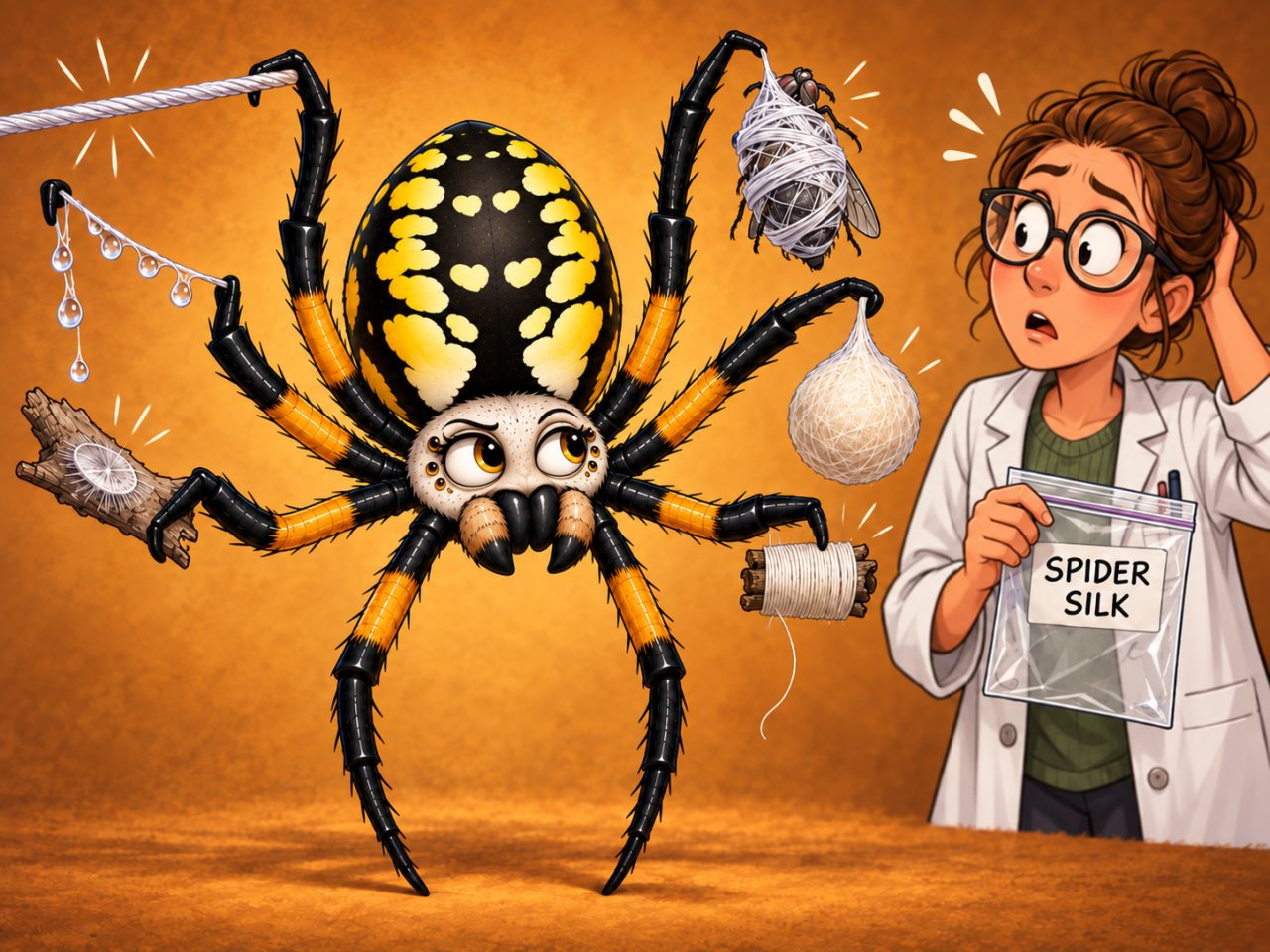
Someone stands beside Sylvie’s web, admiring her handiwork.
VISITOR: Your spider silk is amazing!
SYLVIE: Which one?
VISITOR: What? [gestures at the web] Isn’t this all the same silk?
SYLVIE [horrified]: No! Absolutely not! I can make a bunch of specialized protein fibers. You humans just lump them all into a single “silk” category.
Sylvie turns around and waves the spinnerets at the end of her abdomen.
SYLVIE: I can make support cables, wrapping material, and insect-retention equipment. I have a whole specialized materials department in here!
VISITOR: You make all that yourself? No subcontractors?
SYLVIE: Of course not! I am the architect of this entire composite construction project! [gestures at web]
VISITOR: But… if there isn’t just one kind of “spider silk,” then what about all that stuff I see saying spider silk is stronger than steel?
SYLVIE: That’s what you get for browsing the interwebs instead of coming to the main web source: ME! [sighs] Different types of silk have different mechanical properties. You humans just want to mash strength, toughness, extensibility, elasticity, and density into one giant materials-science casserole.
SYLVIE: Now begone! You’re blocking the path the flies take to my web!
The Real Story
Sylvie was right to object.
“Spider silk” sounds like one material, but orb-weaving spiders manufacture a portfolio of protein-based materials with different compositions, structures, and jobs. Some fibers form the frame and radii of a web. Others contribute to the capture spiral. Still others serve as attachment cement, prey-wrapping material, or protection for eggs. In well-studied orb-weavers, these materials are produced by different silk glands and are associated with different silk proteins and secretions.
And that makes spider silk a beautiful example of the point from our earlier gene-expression story: proteins do the work.
Silk is fundamentally a protein. Its major structural proteins belong to a spider-specific family called spidroins. Like other proteins, spidroins are chains of amino acids. The exact amino-acid sequence matters because it influences how sections of the protein interact, organize, and pack together in the finished fiber. Repetitive regions rich in particular amino-acid motifs can form different molecular structures, including tightly ordered beta-sheet-rich regions and less ordered, more flexible regions. Those arrangements help give silk its unusual combinations of stiffness, strength, stretchiness, and toughness.
The important point is that protein sequence is only part of the story.
A spider does not simply synthesize a spidroin and squirt out a finished thread.
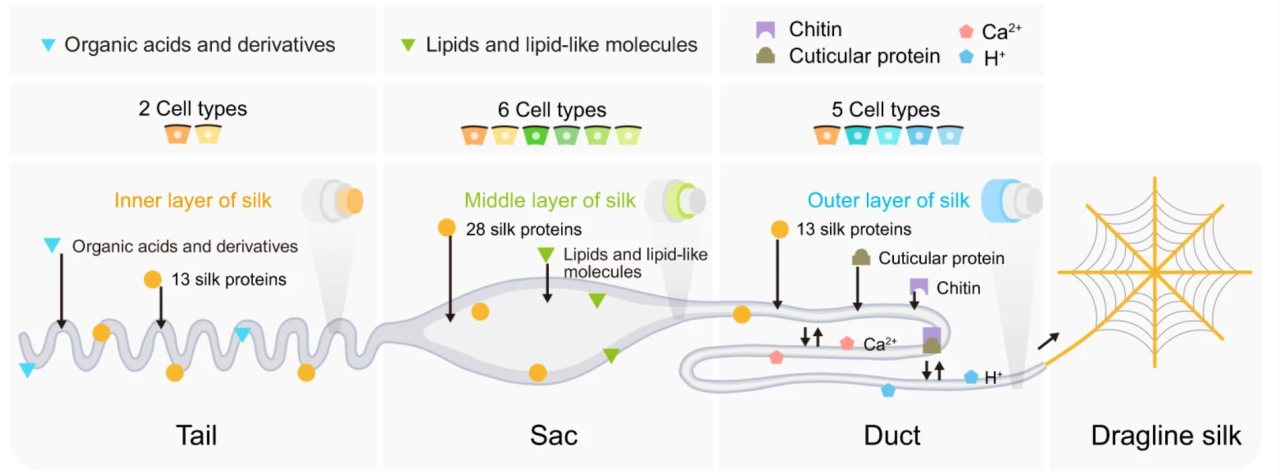
The proteins are produced and stored at high concentration inside specialized abdominal silk glands. As they move through the gland and spinning duct, changes in the chemical environment, concentration, molecular alignment, and mechanical forces help transform a soluble protein mixture into an organized solid fiber. A 2023 molecular atlas of dragline-silk production in the Joro spider, Trichonephila clavata, found that different regions of the major ampullate gland perform different molecular jobs during this manufacturing process.
That study was performed in a Joro spider, not in Sylvie herself, so the exact molecular details should not automatically be assumed to be identical in Argiope aurantia. But the broader lesson applies beautifully: silk properties emerge from both the proteins being made and the biological process that turns those proteins into fibers.
Sylvie really does have a materials department in her abdomen!
One spider, several materials
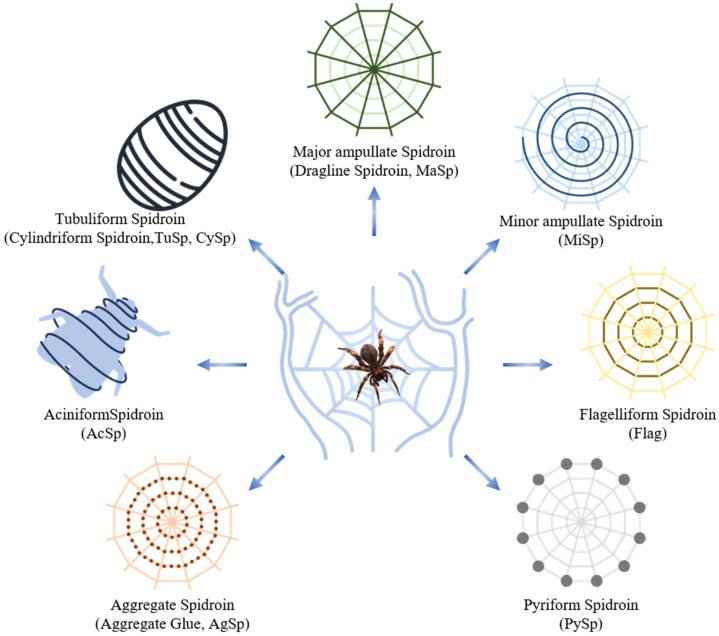
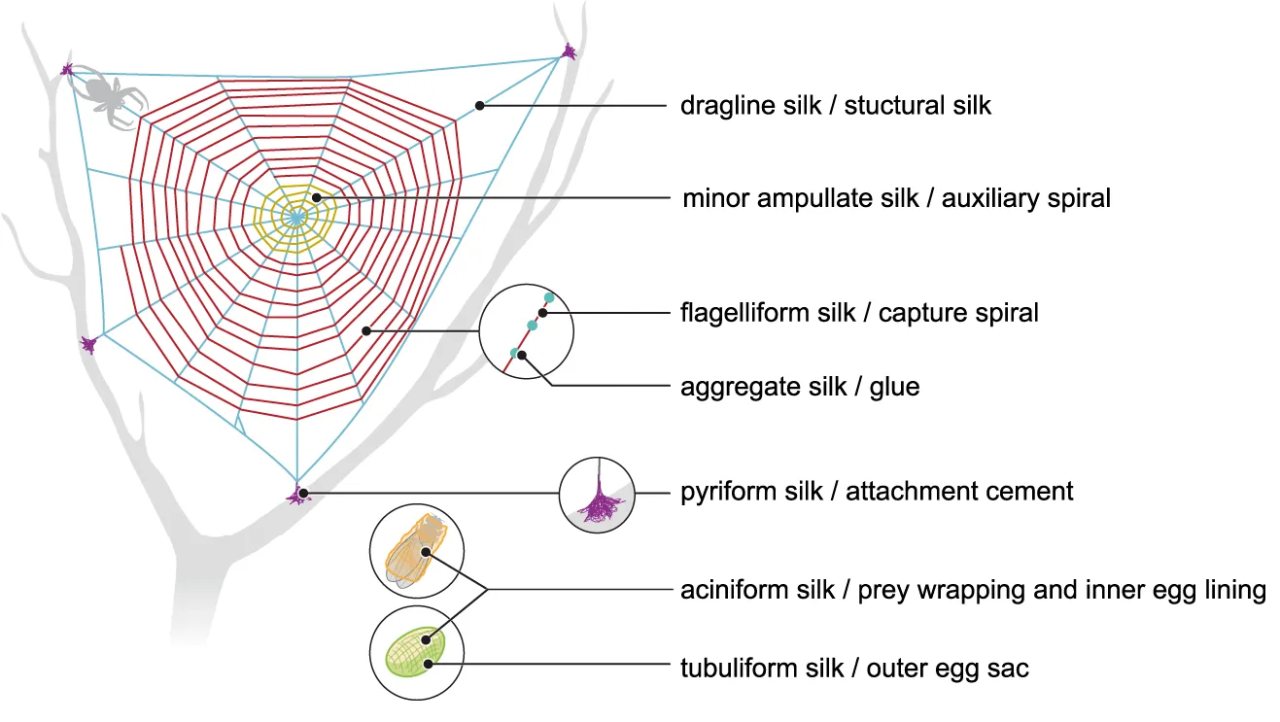
Orb-weaving spiders can possess several specialized gland systems. A typical orb-weaver may use:
Major ampullate silk for draglines, the outer frame of the web, and radial threads.
Minor ampullate silk during web construction, including temporary or auxiliary spirals.
Flagelliform silk as the highly extensible core of the capture spiral.
Aggregate-gland secretions as the sticky coating placed onto capture threads.
Pyriform silk as attachment material that fastens threads to one another or to surrounding surfaces.
Aciniform silk for tasks such as prey wrapping and, in some species, parts of egg-case construction or web decorations.
Tubuliform or cylindriform silk for protective egg-case material.
Yellow garden spiders (like Sylvie) belong to the orb-weaving genus Argiope, and molecular work on Argiope species confirms that their silk systems are anything but simple. In A. aurantia specifically, major ampullate spidroin genes are strongly expressed in the major ampullate gland, while other silk-associated gland types, including flagelliform, aggregate, tubuliform, aciniform, and pyriform types, are also represented in the broader spinning apparatus.
That does not mean every gland produces one chemically pure protein and nothing else. Gene-expression studies have shown that silk glands can express multiple spidroins, and the protein recipes can be more complicated than the older one-gland/one-protein picture suggested.
So even “seven silks” is better understood as a useful functional framework than seven identical factory lines with one ingredient each.
Why would Sylvie need so many?
Because different jobs demand different mechanical behavior.
A structural thread holding a web together does not face the same problem as a capture thread trying to stop and retain a flying insect.
This is where the phrase “stronger than steel” starts causing trouble.
“Strong” is not one universal materials-science score.
Strength describes how much stress a material can tolerate before failing.
Extensibility describes how far it can stretch before breaking.
Elasticity describes how much deformation it can recover from after the force is removed.
Toughness describes how much energy the material can absorb before it breaks.
Density describes how much mass is packed into a given volume. Density matters when comparing materials because silk is extraordinarily lightweight relative to metals.
Those properties can trade off against one another. A very strong material may not stretch much. A highly extensible material may deform enormously before breaking. A tough material succeeds because it can absorb a large amount of energy before failure, which may come from a useful combination of strength and extensibility.
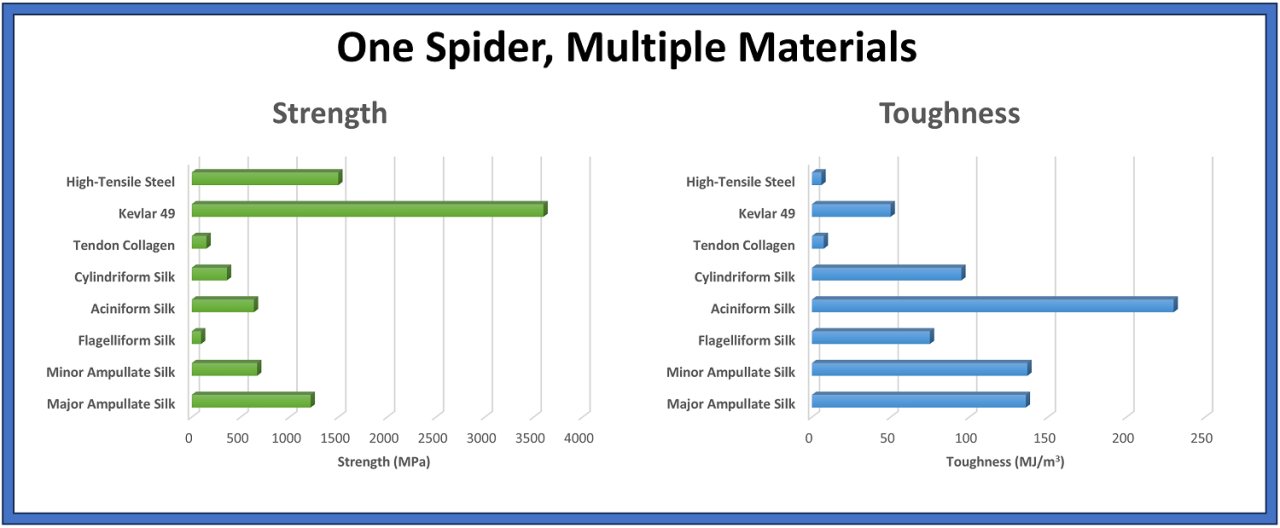
That is why saying simply that “spider silk is stronger than steel” is incomplete.
Which silk?
Which steel?
Are we comparing tensile strength, toughness, stiffness, elongation before failure, or performance relative to weight?
Some spider dragline silks do have tensile strengths in the same general range as high-strength steels while being far less dense, and they can combine that strength with substantially greater extensibility. But the headline comparison hides the very thing that makes spider silk interesting: different silks occupy different places in materials-property space.
The web is a composite structure
A web therefore works less like a fishing net made from one uniform thread and more like a structure assembled from materials chosen for particular tasks.
Major ampullate silk provides much of the structural framework and radial support. Capture spirals employ far more extensible fibers and adhesive components designed to deform and retain prey rather than simply behave like rigid cables. In Argiope aurantia, the sticky capture thread itself is a composite: paired flagelliform fibers form the core, while aggregate-gland material coats them and reorganizes into adhesive droplets.
So when an insect hits the web, it is not encountering one magical substance that is simultaneously maximally strong, maximally stretchy, maximally sticky, and perfect at everything.
It is encountering an engineered system of different materials working together.
That is also why we should save the detailed “how does the web actually stop a flying insect?” question for a future Sylvie investigation. The web’s geometry and the nonlinear behavior of its threads play important roles in controlling damage and distributing mechanical loads, but that is its own scandal.
Why humans still struggle to copy it
Researchers have spent decades trying to manufacture artificial spider silk because the combination of low weight, strength, extensibility, toughness, and biological compatibility is enormously attractive.
Making the protein is only one hurdle.
Scientists can use engineered organisms to produce recombinant spider-silk proteins, but turning those proteins into fibers that consistently reproduce the mechanical performance of natural silk is much harder. Natural spiders control protein concentration, molecular alignment, solution chemistry, duct geometry, shear forces, and post-spin processing as part of one integrated biological manufacturing system. Artificial spinning approaches therefore increasingly try to imitate not only the protein sequence, but also the conditions under which spiders turn protein solutions into fibers.
In other words, scientists can copy the recipe and still miss the manufacturing process.
Sylvie would probably call that a rookie mistake.
Her web is not made from a single miraculous thread.
It is a multi-material structure assembled from specialized protein-based fibers and adhesives, produced by an animal carrying an entire microscopic materials factory inside her abdomen.
“Spider silk” is convenient shorthand.
Sylvie still considers it suspiciously vague.
Sources
-
The Nephila clavipes genome highlights the diversity of spider silk genes and their complex expression
Babb, P. L., Lahens, N. F., Correa-Garhwal, S. M., Nicholson, D. N., Kim, E. J., Hogenesch, J. B., Kuntner, M., Higgins, L., Hayashi, C. Y., Agnarsson, I., & Voight, B. F. (2017). The Nephila clavipes genome highlights the diversity of spider silk genes and their complex expression. Nature Genetics, 49, 895–903.
Why this source matters: This genome study demonstrates the extraordinary diversity of spider silk genes and shows that different orb-weaver silk glands express distinct combinations of spidroins. It also provides a clear functional overview of major ampullate, minor ampullate, flagelliform, pyriform, aciniform, tubuliform, and aggregate silk systems.
-
Rapid molecular diversification and homogenization of clustered major ampullate silk genes in Argiope garden spiders
Baker, R. H., Corvelo, A., & Hayashi, C. Y. (2022). Rapid molecular diversification and homogenization of clustered major ampullate silk genes in Argiope garden spiders. PLOS Genetics, 18(12), e1010537.
Why this source matters: This primary study is especially valuable because it includes Argiope aurantia, Sylvie’s species. It shows substantial diversity among major ampullate spidroin genes in garden spiders and confirms strong expression of these dragline-silk genes in the major ampullate gland. It also illustrates that even one major silk category can involve a surprisingly complex family of related proteins.
-
A molecular atlas reveals the tri-sectional spinning mechanism of spider dragline silk
Hu, W., Jia, A., Ma, S., Zhang, G., Wei, Z., Lu, F., Luo, Y., Zhang, Z., Sun, J., Yang, T., Xia, T., Li, Q., Yao, T., Zheng, J., Jiang, Z., Xu, Z., Xia, Q., & Wang, Y. (2023). A molecular atlas reveals the tri-sectional spinning mechanism of spider dragline silk. Nature Communications, 14, 837.
Why this source matters: Using the Joro spider Trichonephila clavata, this study shows that dragline-silk production involves a spatially organized major ampullate gland with distinct tail, sac, and duct regions. It supports the article’s central point that high-performance silk emerges from a biological manufacturing process, not merely from making a silk protein and pushing it through an opening.
-
Physicochemical Property Variation in Spider Silk: Ecology, Evolution, and Synthetic Production
Blamires, S. J., Blackledge, T. A., & Tso, I.-M. (2017). Physicochemical property variation in spider silk: Ecology, evolution, and synthetic production. Annual Review of Entomology, 62, 443–460.
Why this source matters: This review explains how spider-silk properties arise from multiple levels, including gene expression, gland chemistry, molecular organization, spinning conditions, and environmental influences. It is particularly useful for avoiding the misconception that a silk’s mechanical behavior can be predicted from protein sequence alone.
-
Nonlinear material behaviour of spider silk yields robust webs
Cranford, S. W., Tarakanova, A., Pugno, N. M., & Buehler, M. J. (2012). Nonlinear material behaviour of spider silk yields robust webs. Nature, 482, 72–76.
Why this source matters: This paper connects silk’s nonlinear mechanical behavior with whole-web performance. It supports the distinction among strength, extensibility, and energy absorption and explains why the mechanical behavior of silk matters at the level of the entire web rather than only the individual fiber.
-
Progress and Trends in Artificial Silk Spinning: A Systematic Review
Koeppel, A., & Holland, C. (2017). Progress and trends in artificial silk spinning: A systematic review. ACS Biomaterials Science & Engineering, 3(3), 226–237.
Why this source matters: This review surveys efforts to manufacture artificial silk fibers and explains why reproducing natural spider-silk performance requires more than producing recombinant silk proteins. Spinning conditions and fiber formation are central parts of the engineering problem.