
I think everyone has heard of DNA, genes, and genetics. But if you're still a little fuzzy on how those things actually work, then this story is for you.
All living things use DNA. If you remember our virus discussion, you might remember us saying that some viruses use RNA instead, but viruses are not generally considered to be living things, as we also discussed in that previous scandal.
DNA contains the master instructions for running cells.
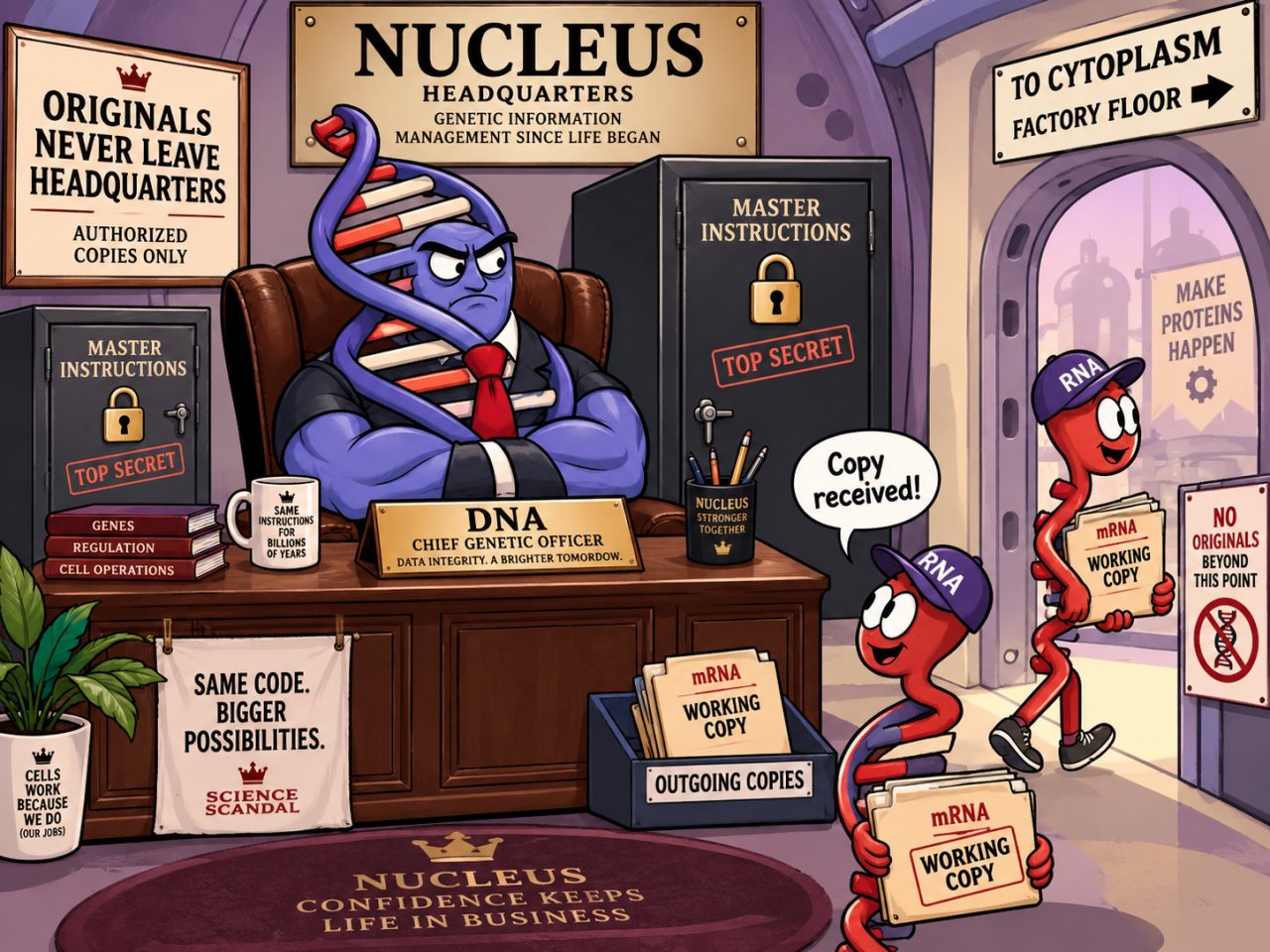
Imagine DNA as the corporate bigwig in its office on the top floor of the company building. It knows EVERYTHING about how the company should be run.
But... it also doesn't like to leave the office.
In eukaryotic cells, that "office" is the nucleus. And much of the cell's work takes place OUTSIDE of the nucleus in the cytoplasm - the factory floor, so to speak.
So how does that work?
DNA is good at delegating.
The instructions contained in DNA can be transcribed into RNA. Some RNA molecules then leave the head office and head out to the factory floor, where they can direct different cellular activities.
Sometimes the RNA stays as RNA and just starts doing work itself.
A lot of the time, though, the RNA is a type known as "messenger RNA", or mRNA. mRNA carries copied genetic instructions to ribosomes - the little factory-floor workers that make proteins.
And then the proteins go off and do the work.
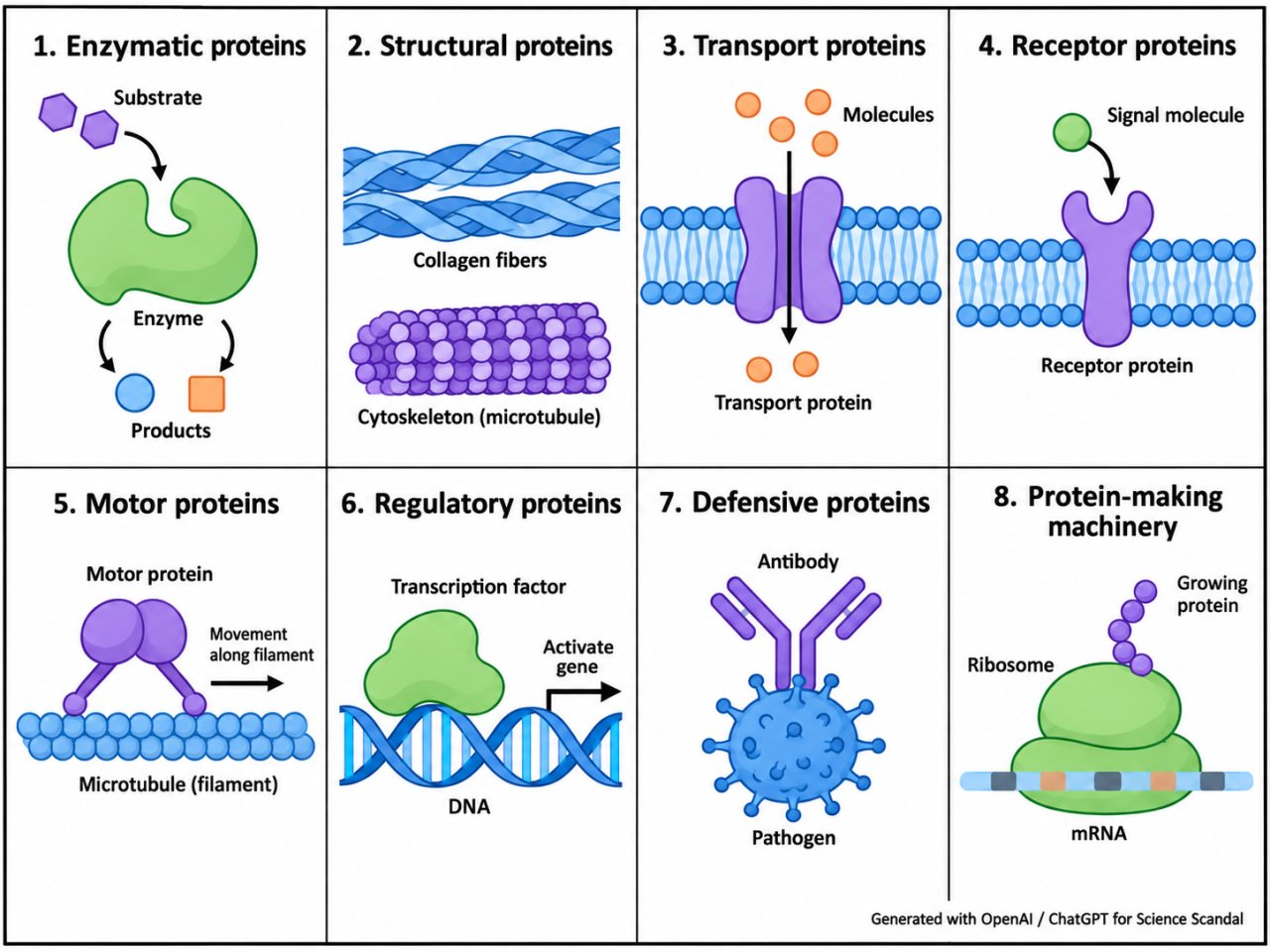
In fact, biology textbooks often call proteins the "workhorses" of the cell because they have so many different jobs. They can act as enzymes. They can provide structural support. They can transport materials. They can receive or carry signals. They can help cells move, communicate, divide, defend themselves, and generally keep the entire operation from collapsing.
But the genetic instructions to make those proteins started with DNA. In the head office it refuses to leave. Where it guards the master files, only allowing copies of the instructions that have been approved for use at any given time.
And how does the cell decide which instructions get copied and when?
That's another scandal....
The Real Story
The basic flow of genetic information in cells is often summarized as:
DNA → RNA → Protein
That pathway is known as the central dogma of molecular biology.
DNA stores genetic information in the specific sequence of its nucleotides. A gene is a region of DNA that contains information used to produce a functional product. For many genes, that product is ultimately a protein. For others, the RNA itself is the final functional product.
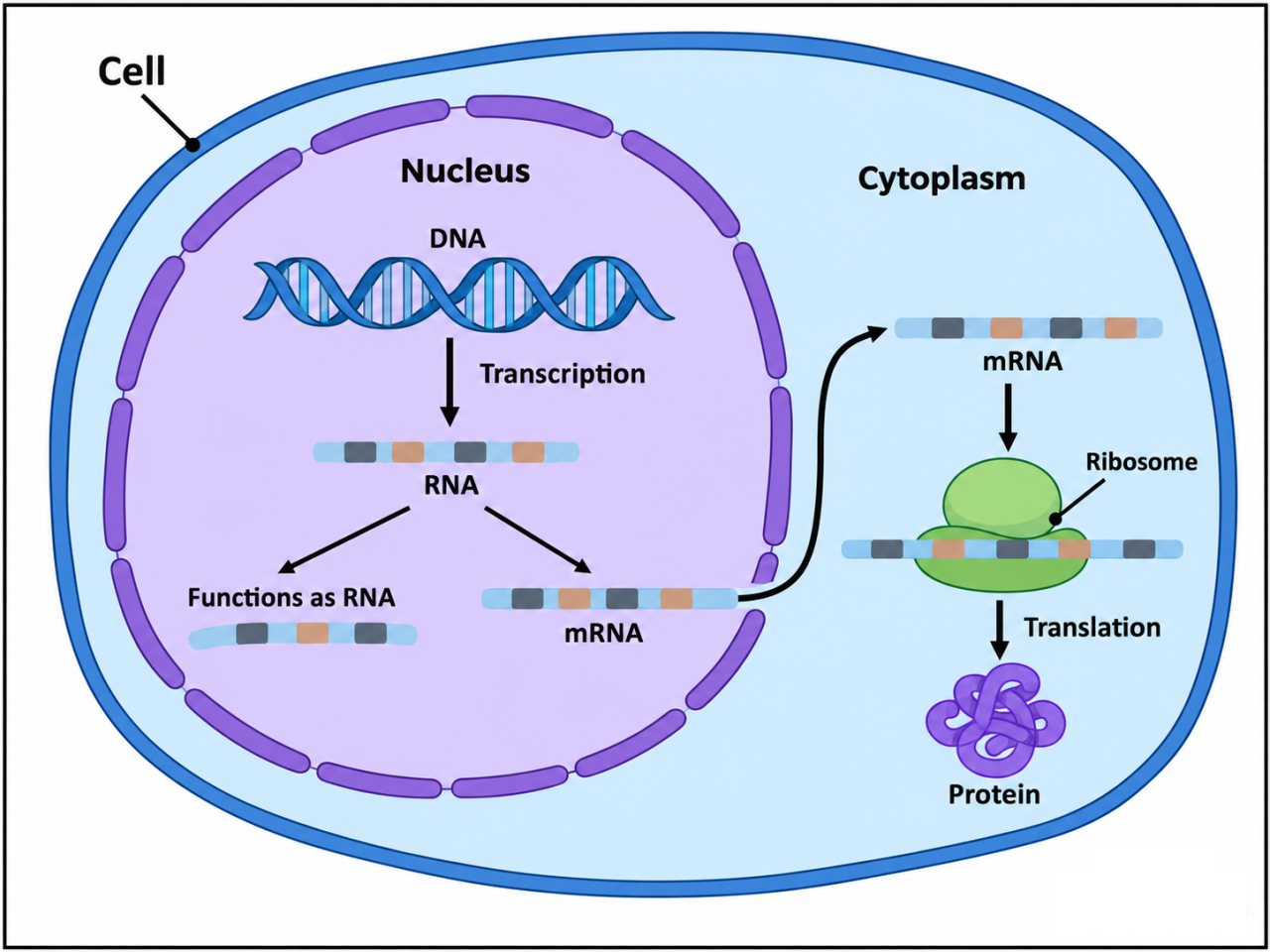
The first major step in this process is transcription.
During transcription, a particular region of DNA is used as a template to build a complementary RNA molecule. An enzyme called RNA polymerase moves along the DNA strand and assembles the RNA molecule according to the sequence of the DNA template. In other words, the information stored in DNA is copied (transcribed) into a chemically similar yet different form.
For protein-coding genes, the important working copy is messenger RNA, or mRNA.
In eukaryotic cells, newly made RNA is usually processed before a mature mRNA leaves the nucleus. That processing can include adding protective modifications to the ends of the RNA and removing internal sequences through splicing. We will save the full splicing scandal for another day.
Once mature mRNA reaches the cytoplasm, the next major step is translation.
Translation takes place on ribosomes, large molecular complexes made of RNA and proteins. The ribosome reads the nucleotide sequence of the mRNA three bases at a time. Each three-base sequence, called a codon, corresponds to a particular amino acid or a start or stop signal. Transfer RNA molecules help match those codons with the correct amino acids, allowing the ribosome to assemble an amino-acid chain in the proper order to create a specific protein.
That amino-acid chain then folds, and in many cases is further modified, to become a functional protein.
Proteins perform an enormous range of cellular jobs. Some act as enzymes that speed chemical reactions. Others provide structure, move materials, receive signals, transport molecules, generate movement, regulate other cellular processes, or form part of the machinery that builds still more molecules.
But RNA is not merely a temporary courier between DNA and protein.
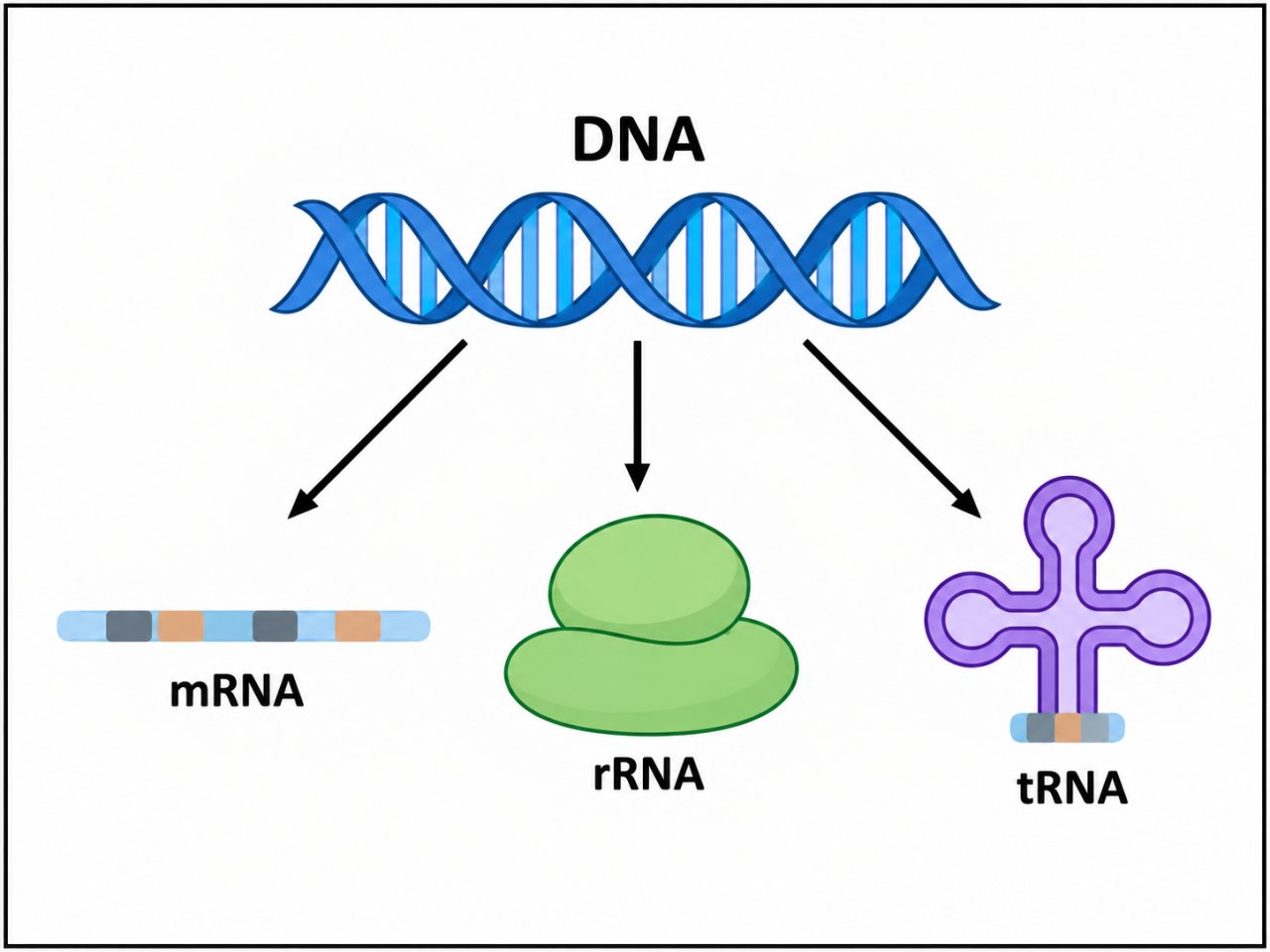
Some genes produce functional RNAs that are never translated at all. Ribosomal RNA (rRNA) forms an essential part of ribosomes themselves. Transfer RNA (tRNA) helps deliver amino acids during translation. Other RNAs participate in RNA processing, regulation, chromosome maintenance, and additional cellular functions. So while DNA → RNA → protein is an extremely useful foundation, not every RNA molecule is simply waiting to become a protein.
And this is the same cellular production system that viruses exploit.
As we saw in our earlier virus scandal, viruses do not carry a complete protein-making factory of their own. They bring genetic instructions into a host cell and depend on the host's cellular machinery, including ribosomes, to manufacture viral components. The machinery is normal. The unauthorized order from the virus is the problem.
So the simplified chain remains enormously useful:
DNA stores the information.
RNA carries or uses copied information.
Proteins perform much of the cell's work.
The next question is how a cell decides which genes get copied in the first place.
And that is where the bureaucracy begins. In an upcoming scandal...
Sources
-
How Cells Read the Genome: From DNA to Protein
Alberts, B., Johnson, A., Lewis, J., Raff, M., Roberts, K., & Walter, P. (2002). How cells read the genome: From DNA to protein. In Molecular Biology of the Cell (4th ed.). Garland Science.
Why this source matters: Core source for the overall DNA-to-RNA-to-protein pathway, transcription and translation, and the important exception that some genes produce functional RNA rather than protein.
-
Transcription
National Human Genome Research Institute. (2026). Transcription. Talking Glossary of Genomic and Genetic Terms. National Institutes of Health.
Why this source matters: Provides a concise authoritative definition of transcription as making an RNA copy of a gene's DNA sequence and explains the movement of mRNA from nucleus to cytoplasm in humans and other complex organisms.
-
Translation
National Human Genome Research Institute. (2026). Translation. Talking Glossary of Genomic and Genetic Terms. National Institutes of Health.
Why this source matters: Provides the authoritative definition of translation and supports the explanation that ribosomes read mRNA information to assemble amino acids into proteins.
-
RNA Synthesis and Processing
Cooper, G. M. (2000). RNA synthesis and processing. In The Cell: A Molecular Approach (2nd ed.). Sinauer Associates.
Why this source matters: Supports the article's distinction among messenger RNA, ribosomal RNA, transfer RNA, and other functional RNAs, as well as RNA processing and the role of mRNA as the template for protein synthesis.