
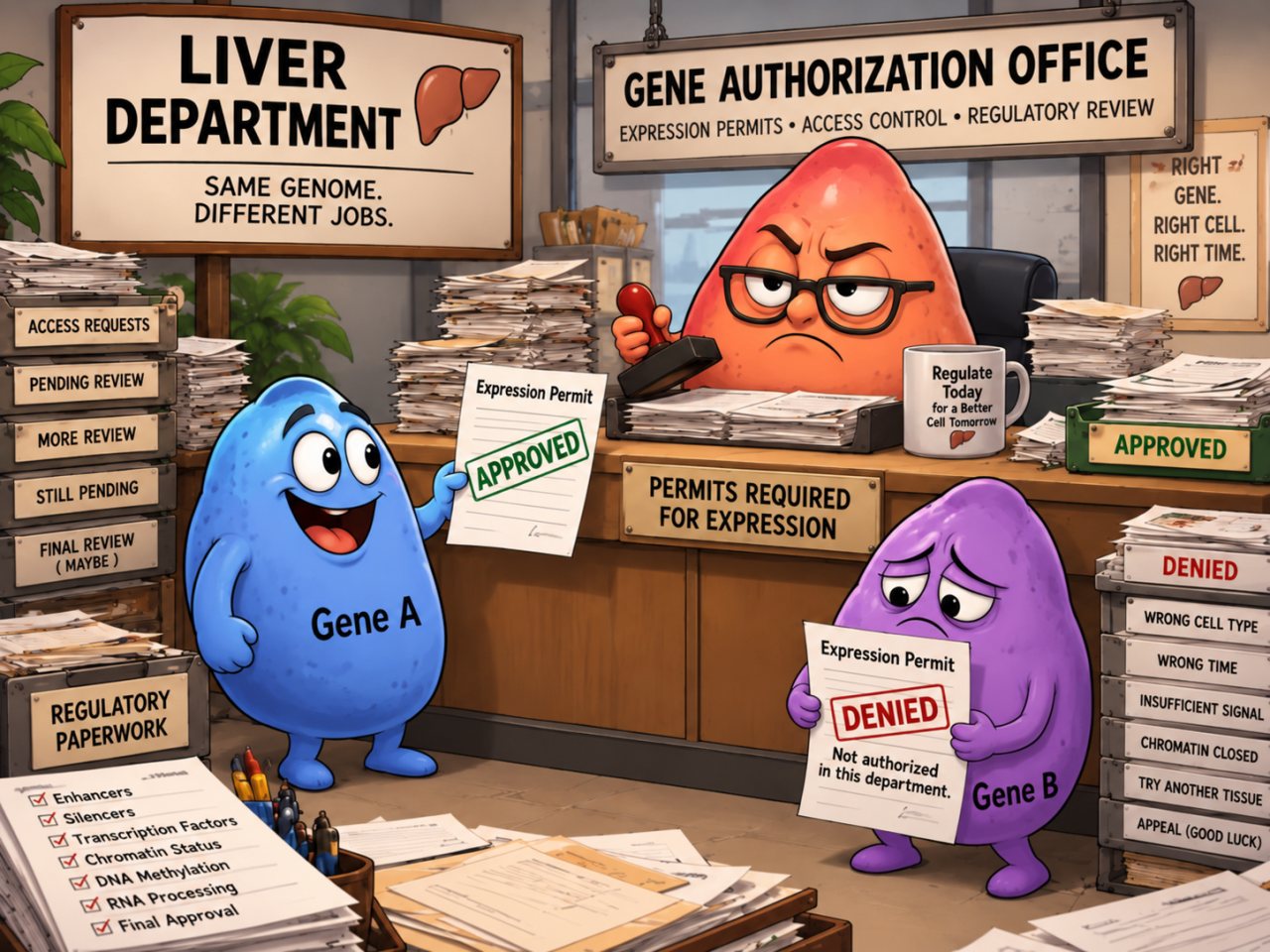
Most nucleated cells in your body contain essentially the same DNA. Basically the same giant instruction manual.
So how can a brain cell (called a neuron) and a liver cell look and act so differently?
The answer lies with upper management.
You see, although a neuron and a liver cell work for the same company (your body), they have very different jobs. And very different jobs require very different sets of instructions.
Your DNA sequence is like the enormous corporate policy manual that nobody has time to read from cover to cover. The genes are individual standard operating procedures, or SOPs, buried inside that larger manual.
Enter the bureaucracy.
Inside a cell, a particular gene may need to be transcribed into RNA, sometimes as the first step toward making a protein. If you need a refresher on how DNA is transcribed into RNA and how RNA can lead to protein production, see “Confidential Genetic Files Never Leave Headquarters!”
But whether that happens, when it happens, where it happens, and how much gets produced depends on layer after layer of regulation.
A bureaucracy of sorts.
Promoters are the official cover sheets marking where particular SOPs begin and where the transcription machinery needs to assemble.
Transcription factors are supervisors with specialized access badges. Different supervisors recognize different regulatory sites and can help approve, encourage, discourage, or block particular instructions.
Silencers are the regulatory equivalent of giant REQUEST DENIED notices coming down from above.
Enhancers are remote managers that somehow increase your department's productivity despite working three floors away.
Chromatin determines whether the relevant section of the policy manual is sitting open on somebody's desk or packed away inside a filing cabinet.
DNA methylation and other chemical modifications can help influence whether those files stay accessible, become easier to use, or remain tucked away.
And the bureaucracy does not end once a gene has been transcribed.
RNA processing is another department that receives the newly copied instructions, edits and processes them, and may even produce different final versions.
Then, after all that, you finally get gene expression: the production of a functional RNA or, for many genes, a protein.
So while a neuron and a liver cell work for the same company and possess essentially the same giant policy manual, they do not operate with the same access permissions.
The liver department has certain filing cabinets open, certain supervisors on duty, and certain instructions flagged for heavy use: detoxification enzymes, metabolic proteins, plasma proteins, and so forth.
The neuron department has a different set of cabinets open and different regulatory staff authorizing genes involved in electrical signaling, synapses, neurotransmission, and neuronal structure.
Same giant policy manual.
Different departments.
Different SOPs approved for use.
All to ensure your neurons aren't trying to detoxify alcohol.
Or that your liver cells aren't trying to encode memories.
The Real Story
Most nucleated cells in your body contain essentially the same genome, but they do not use all of those genes in the same way. A neuron needs proteins for electrical signaling, neurotransmitter release, synaptic communication, and maintaining its elaborate cellular structure. A liver cell needs a very different collection of enzymes and proteins for metabolism, detoxification, nutrient processing, and secretion.
The difference comes largely from gene regulation: the cellular systems that control when, where, and how much a gene is expressed.
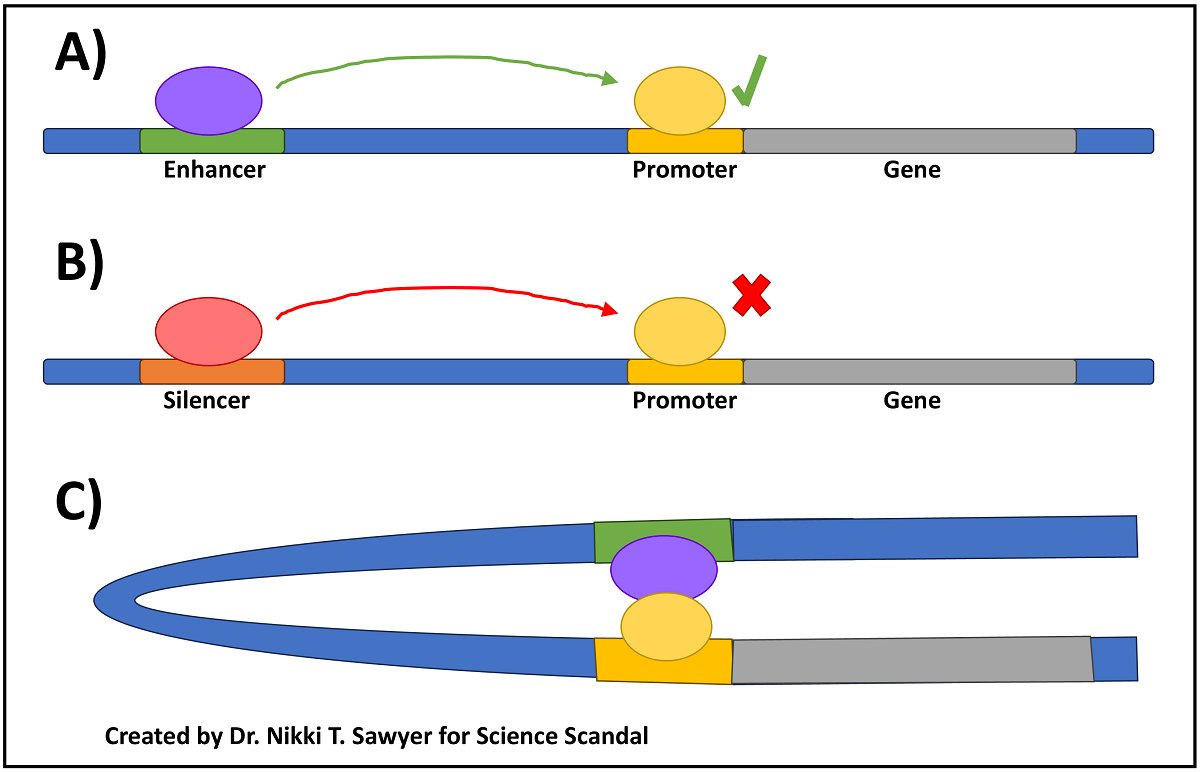
For a protein-coding gene to be used, its DNA is first transcribed into RNA. That process begins around a regulatory region called a promoter, located near the beginning of the gene. Proteins called transcription factors recognize particular DNA sequences and help recruit, stabilize, stimulate, or inhibit the machinery responsible for transcription. Because different cell types contain different combinations and amounts of transcription factors, the same genome can produce very different patterns of gene expression depending on the cell type.
Promoters are only part of the regulatory system. Other stretches of DNA can act as enhancers, increasing transcription when the appropriate regulatory proteins bind to them. Enhancers do not even have to sit directly beside the gene they regulate. Some are located thousands, or sometimes much farther, away along the DNA sequence.
That works because DNA inside the nucleus is not stretched out in a straight line. It folds into an elaborate three-dimensional structure. Regions that are far apart when you read the DNA sequence from one end to the other can be brought close together in physical space, allowing enhancer-associated regulatory machinery to influence a gene's promoter. The exact mechanisms of enhancer-promoter communication remain an active area of research, but the three-dimensional organization of the genome is an important part of that regulation.
Cells also have ways to reduce or suppress transcription. Regulatory DNA elements, including silencers, can recruit proteins that repress gene activity. And regulation is rarely a simple ON/OFF switch. A gene may be expressed strongly, weakly, temporarily, only after a particular signal, or only in certain cell types or developmental stages.
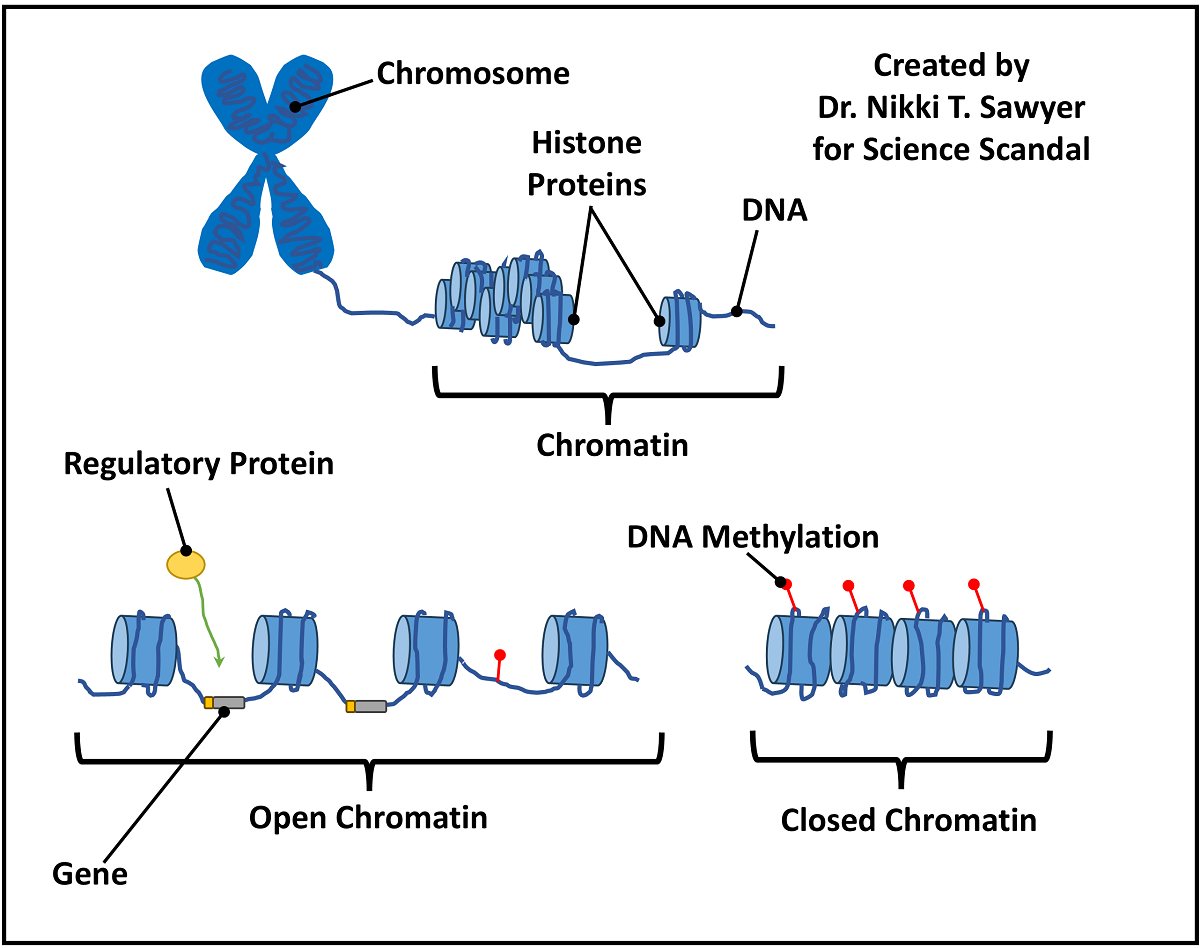
There is another layer of control before the transcription machinery can even reach the DNA. In the nucleus, DNA is wrapped around proteins called histones and packaged into chromatin. Some chromatin regions are relatively accessible to transcription factors and other regulatory proteins, while others are much less accessible. Cells can alter that organization through chromatin-remodeling systems and chemical modifications of DNA and histone proteins.
One of those modifications is DNA methylation, the addition of methyl groups to particular DNA bases. Depending on where it occurs and the surrounding genomic context, DNA methylation can be associated with changes in gene activity, including transcriptional repression. Histone modifications can also change the regulatory environment surrounding a gene. These mechanisms are part of epigenetic regulation: changes in the way the genome is used that do not require changing the underlying DNA sequence itself.
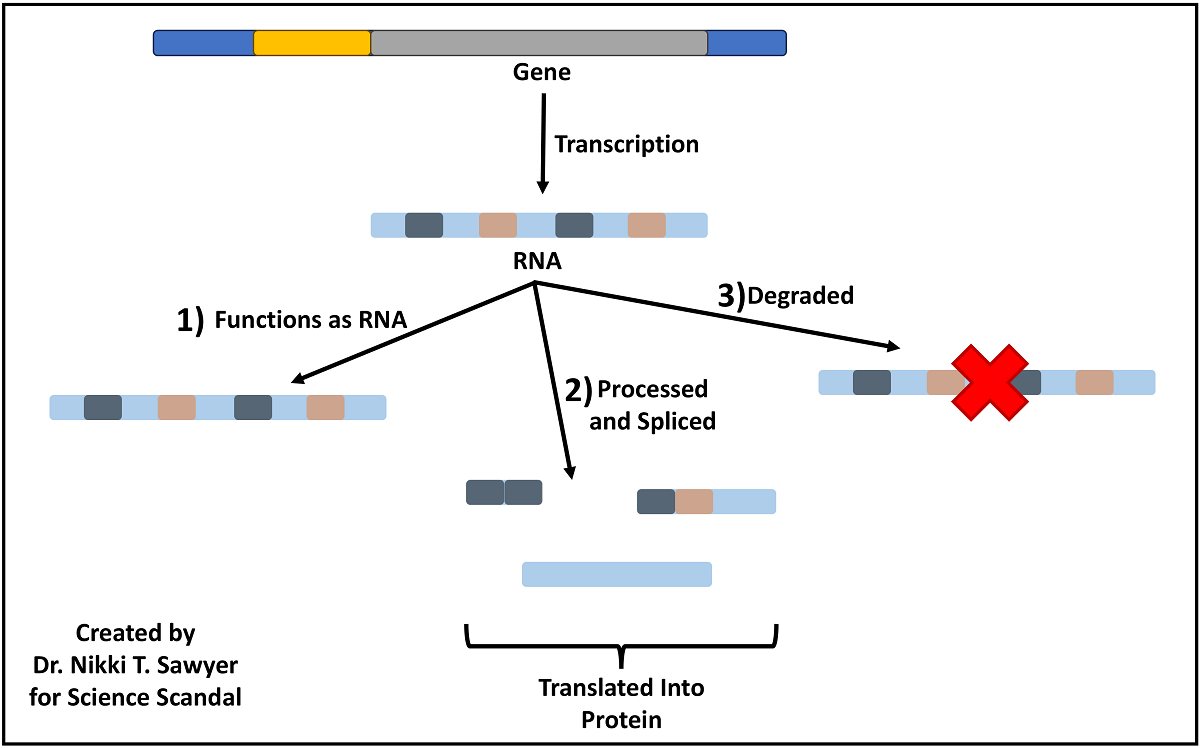
And transcription is not the end of the bureaucracy. Newly produced RNA can be processed, spliced, stabilized, transported, degraded, or regulated in other ways before a final functional RNA or protein appears. Gene expression can therefore be controlled at multiple stages.
That is how two cells can carry essentially the same enormous genetic instruction manual while behaving as if they were issued completely different job descriptions. The DNA sequence provides the available instructions. Gene regulation determines which instructions a particular cell actually uses, when it uses them, and how heavily it relies on them.
Same genome.
Different departments.
A truly unreasonable amount of paperwork.
Sources
-
Gene Regulation
National Human Genome Research Institute. (2026). Gene Regulation. Talking Glossary of Genomic and Genetic Terms. National Institutes of Health.
Why this source matters: Provides the authoritative introductory definition of gene regulation as control over the timing, location, and amount of gene expression and identifies regulatory proteins and DNA modification as important mechanisms.
-
16.4 Eukaryotic Transcription Gene Regulation
Clark, M. A., Douglas, M., & Choi, J. (2018). 16.4 Eukaryotic transcription gene regulation. In Biology 2e. OpenStax, Rice University.
Why this source matters: Provides textbook-level background on promoters, general and specific transcription factors, enhancers, transcriptional repressors, and differential control of eukaryotic gene expression.
-
16.3 Eukaryotic Epigenetic Gene Regulation
Clark, M. A., Douglas, M., & Choi, J. (2018). 16.3 Eukaryotic epigenetic gene regulation. In Biology 2e. OpenStax, Rice University.
Why this source matters: Supports the discussion of chromatin accessibility, nucleosomes, histone modification, DNA methylation, and regulation of transcription without alteration of the underlying DNA sequence.
-
Enhancer Function in the 3D Genome
Razin, S. V., Ulianov, S. V., & Iarovaia, O. V. (2023). Enhancer function in the 3D genome. Genes, 14(6), 1277.
Why this source matters: Peer-reviewed review supporting the article's explanation that enhancers can regulate distant promoters and that three-dimensional genome organization helps bring regulatory elements into functional proximity. The paper also emphasizes that the precise mechanisms of enhancer-promoter communication remain an active research area.