
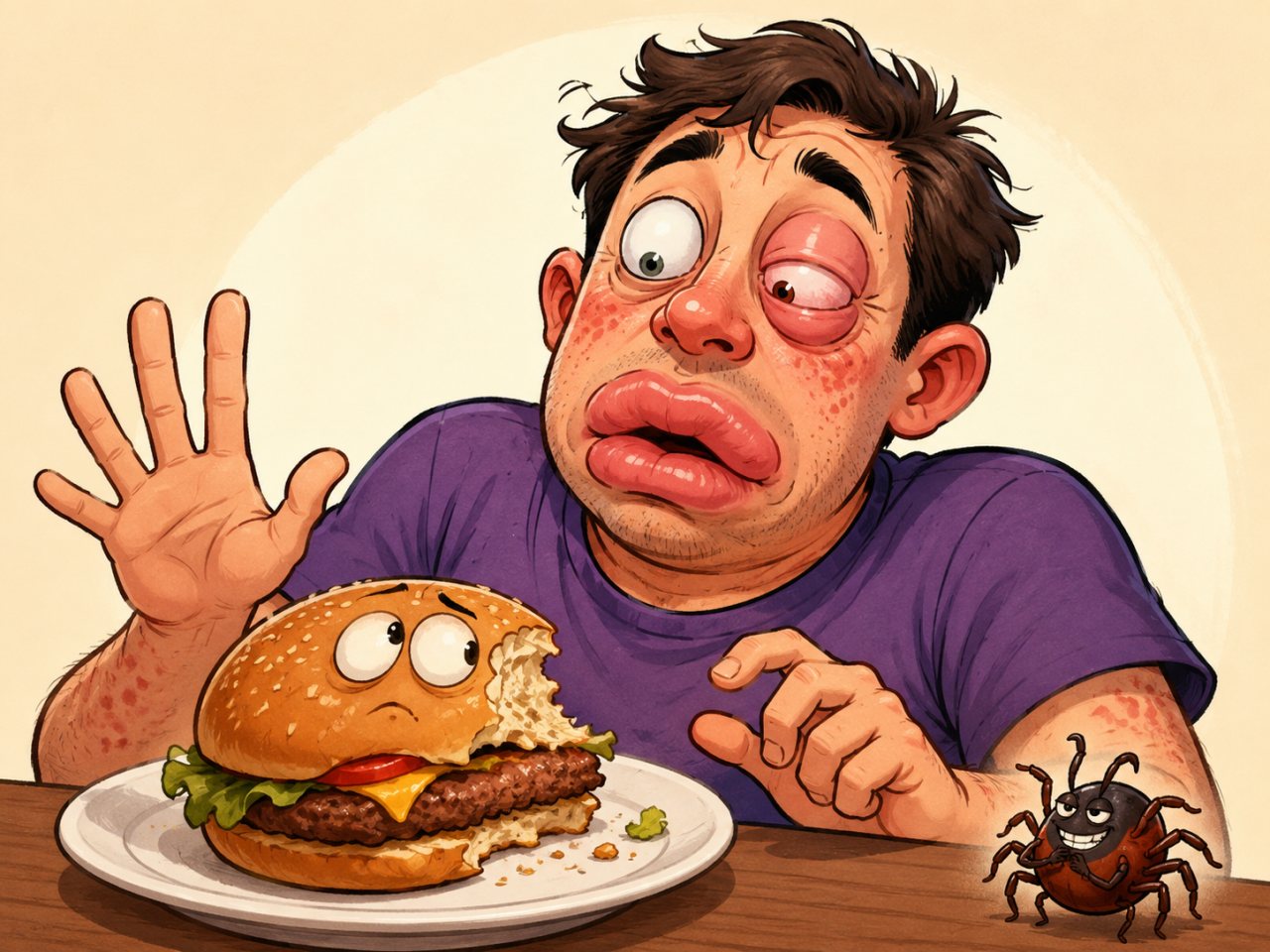
The scene is set: an unsuspecting hiker wanders through the woods and picks up a tiny, eight-legged hitchhiker.
The tick sinks in its mouthparts and injects saliva containing a sugar found naturally in most mammals, but not in humans. That sounds harmless enough. It is only a sugar molecule, after all.
But the tick is about to turn this harmless sugar into a molecular weapon.
The tick delivers it through damaged skin, surrounded by a biochemical cocktail designed to manipulate the immune system. The victim’s defenses take one look at the suspicious delivery method and start assembling counterweapons, readying the SWAT teams, and pressing buttons marked:
PLEASE DEVELOP AN ALLERGY.
Over the following weeks, the immune system prepares specialized defenses against the mammalian sugar. The tick eventually disappears, leaving no forwarding address and no indication that it has fundamentally altered its victim’s relationship with dinner.
Then, sometime later, the victim eats a freshly grilled hamburger.
The beef naturally contains the same mammalian sugar. Because the sugar travels through the body alongside digested fats, it can take hours to reach the bloodstream in sufficient quantities to attract attention.
But the immune system has not forgotten.
Its sentries spot the familiar molecular signature and sound the alarm:
“IT’S THE TICK THING AGAIN! DEPLOY THE CAVALRY!”
The victim is ambushed hours after dinner by hives, severe stomach pain, swelling, or even a life-threatening allergic reaction. The hamburger takes the blame.
The tick, meanwhile, is long gone and presumably laughing somewhere in the underbrush.
The Real Story
Alpha-gal syndrome is an unusual food allergy that can develop after a tick bite. The allergen is not a protein, as it is in most food allergies. It is a carbohydrate called galactose-alpha-1,3-galactose, mercifully shortened to alpha-gal.
Alpha-gal is found naturally in most mammals, including cows, pigs, sheep, and deer. Humans do not produce it. Ordinarily, eating foods that contain alpha-gal does not cause a problem. After certain tick bites, however, the immune system may begin treating this harmless mammalian sugar as a dangerous invader.
In the United States, alpha-gal syndrome is most strongly associated with the lone star tick. When the tick feeds, it injects saliva containing alpha-gal and a complex mixture of substances that help it remain attached, prevent blood from clotting, and manipulate the immune response around the bite. In some people, that encounter leads to the production of a type of antibody called immunoglobulin E, or IgE, directed against alpha-gal.
Those IgE antibodies attach to immune cells called mast cells and basophils. The cells are now primed to react if they encounter alpha-gal again.
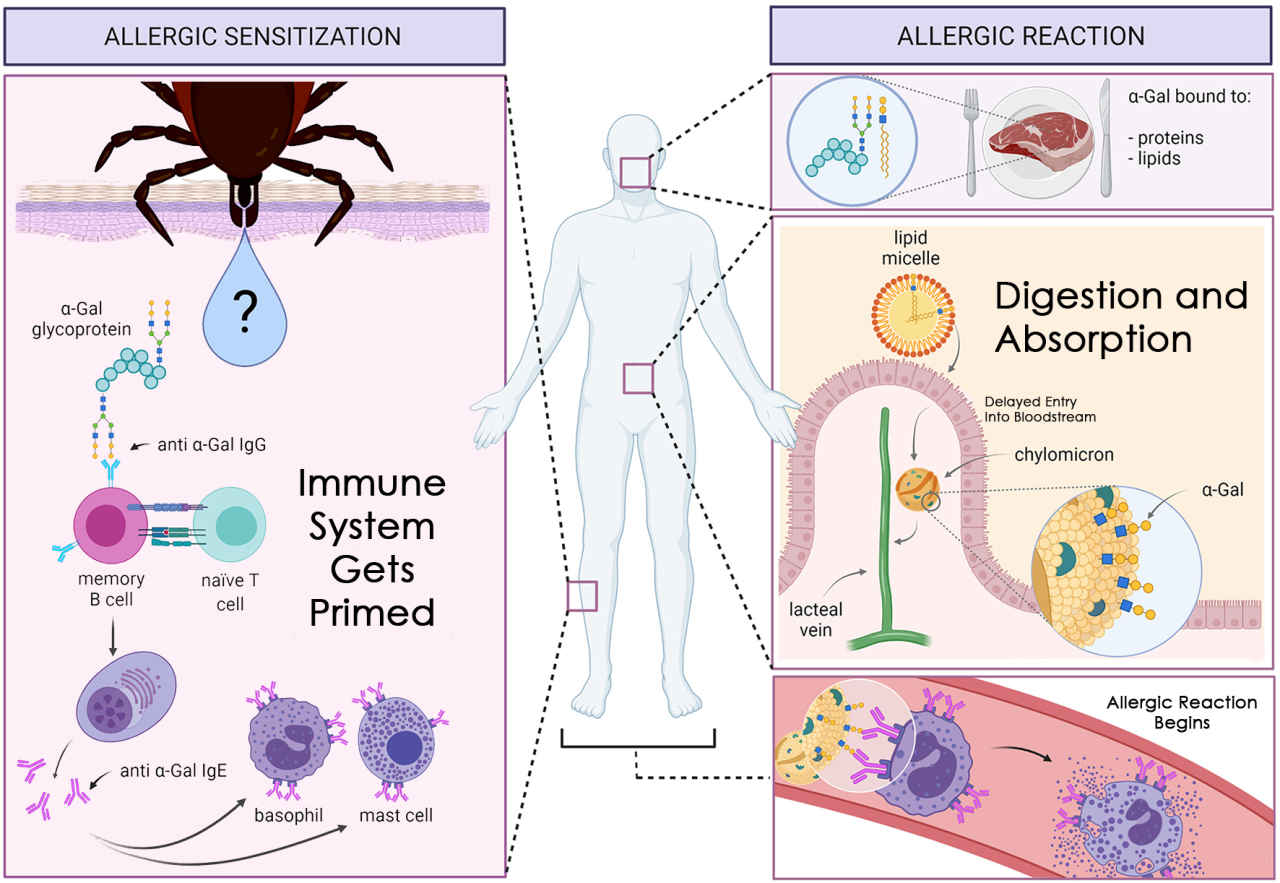
That second encounter may arrive in the form of beef, pork, lamb, venison, or another mammalian meat product. When alpha-gal reaches the bloodstream, it can bind to the waiting IgE antibodies and activate the immune cells. They release histamine and other inflammatory chemicals, producing symptoms that may include hives, itching, swelling, stomach pain, nausea, vomiting, diarrhea, breathing difficulty, dizziness, or potentially life-threatening anaphylaxis.
The reaction is especially difficult to identify because it often begins several hours after the food was eaten. Most food allergies cause symptoms within minutes, but alpha-gal is frequently carried on fat-containing molecules that must be digested, absorbed, and transported before reaching the bloodstream. This slower journey helps explain why someone may eat a hamburger at dinner and not become ill until the middle of the night.
By then, the tick is long gone, the meal seems too distant to be suspicious, and the victim may have no idea that a tiny arachnid has quietly renegotiated the terms of their relationship with mammals.
Sources
-
The Immunology of Alpha-Gal Syndrome: History, Tick Bites, IgE, and Delayed Anaphylaxis to Mammalian Meat
Platts-Mills, T. A. E., Gangwar, R. S., Workman, L., & Wilson, J. M. (2025). The immunology of alpha-gal syndrome: History, tick bites, IgE, and delayed anaphylaxis to mammalian meat. Immunological Reviews, 332(1), e70035.
Why this source matters: Current comprehensive review supporting the article’s central explanation: tick bites can induce alpha-gal-specific IgE, sensitization develops over subsequent weeks or months, and later ingestion of mammalian products can produce allergic reactions delayed by several hours. Also supports the distinction between established clinical findings and mechanisms that remain under investigation.
-
Tick Saliva and the Alpha-Gal Syndrome: Finding a Needle in a Haystack
Sharma, S. R., & Karim, S. (2021). Tick saliva and the alpha-gal syndrome: Finding a needle in a haystack. Frontiers in Cellular and Infection Microbiology, 11, 680264.
Why this source matters: Supports the discussion of alpha-gal in tick saliva, the immune-modulating properties of tick salivary secretions, and the association between tick feeding and alpha-gal-specific IgE sensitization. Particularly useful for the Fine Print because the authors emphasize that the underlying immune mechanism remains incompletely understood.
-
Only α-Gal Bound to Lipids, but Not to Proteins, Is Transported Across Enterocytes as an IgE-Reactive Molecule That Can Induce Effector Cell Activation
Román-Carrasco, P., Lieder, B., Somoza, V., Ponce, M., Szépfalusi, Z., Martin, D., et al. (2019). Only α-Gal bound to lipids, but not to proteins, is transported across enterocytes as an IgE-reactive molecule that can induce effector cell activation. Allergy, 74(10), 1956–1968.
Why this source matters: Experimental study supporting the leading explanation for the delayed reaction. The researchers found that lipid-bound alpha-gal crossed an intestinal-cell model and could activate IgE-mediated effector cells, whereas protein-bound alpha-gal did not behave the same way. Supports careful wording that slower digestion and transport of lipid-associated alpha-gal may help explain the delay rather than claiming that the mechanism is completely settled.