
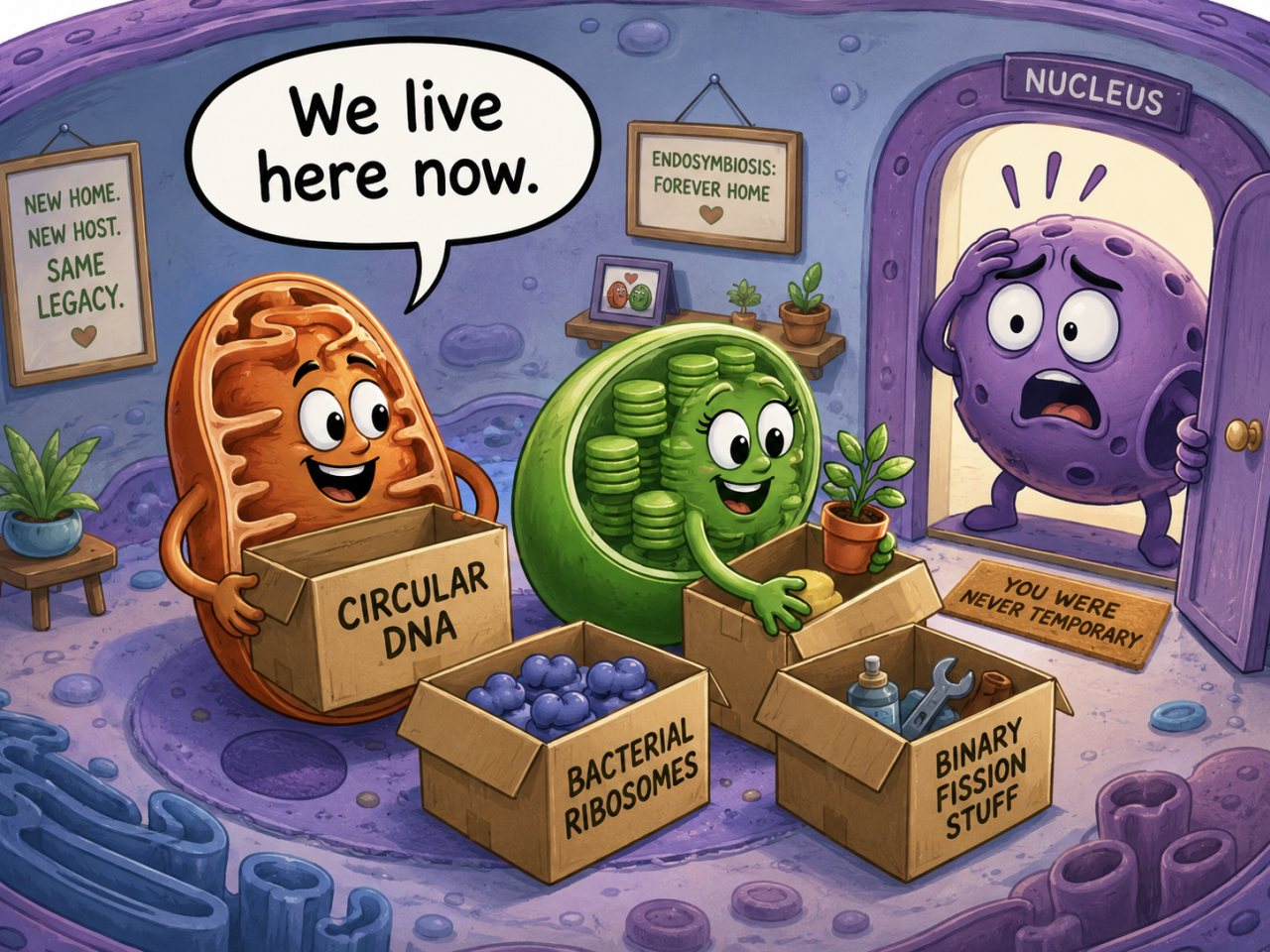
We all learned in school that mitochondria are the little power plants inside our cells, while chloroplasts are the light-catching organelles that let plants and algae turn sunlight into usable chemical energy.
But sources have now confirmed something considerably more scandalous:
Both organelles are descendants of bacterial squatters that moved in and never left!
Imagine inviting Uncle George over for tea, only to discover several weeks later that Uncle George has changed his mailing address, rearranged the spare bedroom, and apparently now lives there.
So how do we know mitochondria and chloroplasts descended from once-free-living bacteria?
Because they forgot to throw away their old bacterial IDs.
They still carry some remarkably suspicious evidence: their own circular DNA, bacterial-style ribosomes, double membranes, and the ability to reproduce by dividing in a bacteria-like process called binary fission. Their inner membranes also retain several biochemical features that resemble those of bacteria.
And then investigators found the really incriminating evidence:
They have their OWN DNA.
Unlike the vast majority of structures inside a eukaryotic cell, mitochondria and chloroplasts retain small genomes completely separate from the much larger collection of DNA stored in the nucleus.
Over evolutionary time, however, they did not keep all of it.
Many genes that once belonged to the ancestral bacteria were transferred to the host cell’s nuclear genome. Today, mitochondria and chloroplasts depend heavily on proteins encoded by nuclear genes and imported back into the organelles.
But apparently they refused to hand over everything.
More than a billion years later, both still maintain a small stash of genetic material of their own.
Records confirm that these former bacterial residents have been keeping DNA off the books for an extremely long time.
Fortunately, unlike Uncle George, the new residents eventually became extraordinarily useful.
The ancestor of mitochondria provided the host cell with highly efficient energy production. The ancestor of chloroplasts brought photosynthesis into the partnership. Over immense stretches of evolutionary time, host and resident became so dependent on one another that the former bacteria stopped being independent organisms at all.
They became organelles.
Today, mitochondria are essential components of almost all eukaryotic lineages, while chloroplasts and related plastids are fundamental to plants and algae.
The nucleus was last heard grumbling about a billion years of unpaid back rent.
The Real Story
Mitochondria and chloroplasts are not ordinary cellular compartments.
They are the descendants of bacteria that entered into ancient partnerships with other cells and, over enormous stretches of evolutionary time, became permanent parts of them. This idea is known as the endosymbiotic theory. Mitochondria trace their ancestry to bacteria related to the alphaproteobacteria, while chloroplasts trace theirs to cyanobacteria, the group of bacteria capable of oxygen-producing photosynthesis.
The basic idea is that an ancestral host cell engulfed a bacterium but did not digest it. Instead, the bacterium survived inside the host. If both partners benefited, that relationship could persist and become increasingly integrated over generations. Eventually, the former bacterium became so dependent on the host, and the host so dependent on it, that the two were no longer separate organisms in any practical sense.
The evidence for that bacterial ancestry is still visible today.
Mitochondria and chloroplasts contain their own genetic systems, separate from the DNA stored in the cell nucleus. Their ribosomes and ribosomal RNA are more closely related to bacterial versions than to the ribosomes used in the surrounding eukaryotic cell. They also reproduce by growth and division rather than being manufactured from scratch by the cell.
Both organelles are also surrounded by multiple membranes, another clue consistent with an ancient engulfment event. In mitochondria, the inner membrane carries much of the machinery used for cellular respiration. Chloroplasts likewise possess their own elaborate internal membrane systems for photosynthesis.
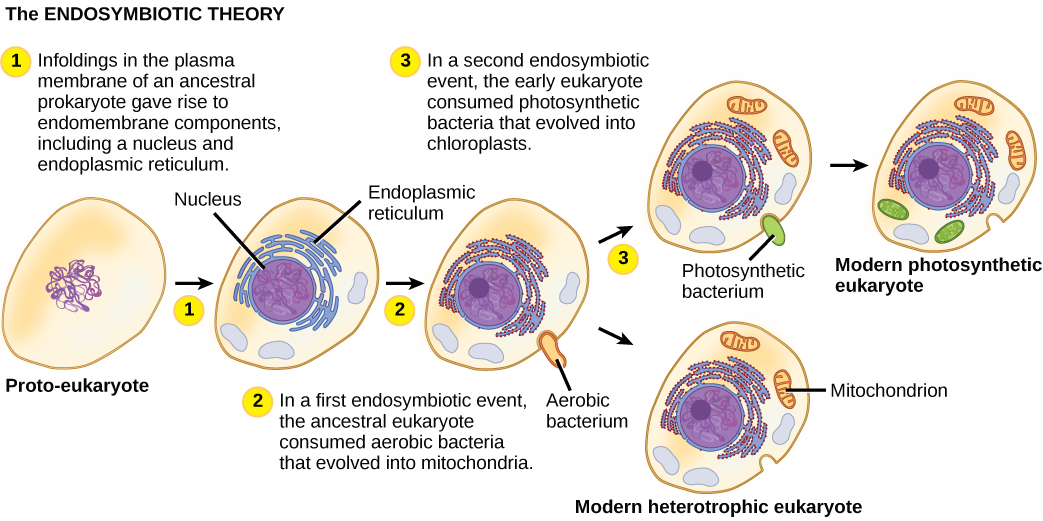
But the genomes inside modern mitochondria and chloroplasts are only tiny remnants of what their bacterial ancestors once possessed.
After the original endosymbiotic partnerships formed, many genes were either lost completely or transferred into the host cell’s nuclear genome. Today, most of the proteins needed by mitochondria and chloroplasts are encoded by nuclear genes, produced elsewhere in the cell, and then imported back into the organelles. Their remaining genomes contain only a small fraction of the genes found in free-living bacterial relatives.
So mitochondria and chloroplasts are not just organelles that happen to contain some DNA.
Their DNA is part of a much larger evolutionary fingerprint showing that major pieces of the modern eukaryotic cell were assembled through ancient biological partnerships.
The bacteria moved in.
They gave up most of their independence.
And more than a billion years later, they are still carrying a few pieces of identification from their old lives. 😜
Sources
-
The economics of organellar gene loss and endosymbiotic gene transfer
Kelly, S. (2021). The economics of organellar gene loss and endosymbiotic gene transfer. Genome Biology, 22, 345.
Why this source matters: Supports the endosymbiotic origins of mitochondria and chloroplasts, the dramatic reduction of their ancestral bacterial genomes, and the transfer of many organellar genes into the host nuclear genome.
-
Why chloroplasts and mitochondria retain their own genomes and genetic systems: Colocation for redox regulation of gene expression
Allen, J. F. (2015). Why chloroplasts and mitochondria retain their own genomes and genetic systems: Colocation for redox regulation of gene expression. Proceedings of the National Academy of Sciences, 112(33), 10231–10238.
Why this source matters: Supports the fact that mitochondria and chloroplasts retain their own genomes and genetic systems, while many ancestral genes were transferred to the nuclear genome. Also useful for explaining why the remaining organellar DNA is an evolutionary remnant rather than an isolated curiosity.
-
Chloroplasts and Other Plastids
Cooper, G. M. (2000). Chloroplasts and other plastids. In The Cell: A Molecular Approach (2nd ed.). Sinauer Associates.
Why this source matters: Accessible textbook source supporting the shared features of chloroplasts and mitochondria, including their endosymbiotic origins, independent genetic systems, and replication by division.