
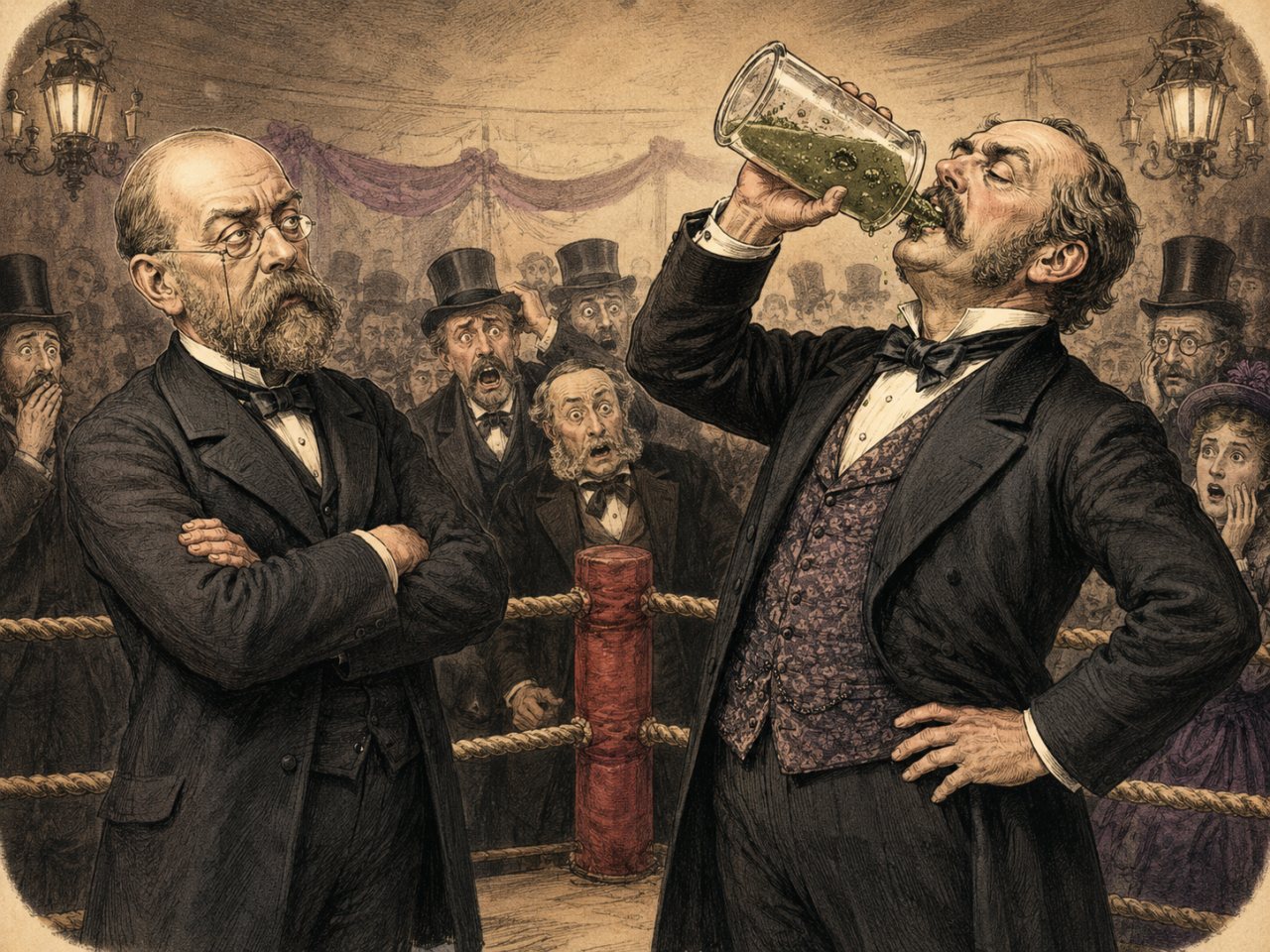
It was a germ-theory showdown.
In one corner was Robert Koch, champion of the rapidly advancing idea that specific microbes cause specific infectious diseases.
In the other was Max von Pettenkofer, who agreed that microbes existed but insisted that the pathogen alone could not explain who became sick, where epidemics occurred, or why. Environmental conditions, he argued, were essential.
The pathogen in question: Vibrio cholerae, the bacterium that causes cholera.
And cholera is not a disease anyone should normally volunteer to acquire. It can cause profuse watery diarrhea, leading to severe dehydration and death with alarming speed.
Pettenkofer nevertheless believed that the cholera bacterium had to interact with particular environmental conditions, especially soil and groundwater, before it could produce an epidemic.
So on October 7, 1892, the 74-year-old scientist decided there was really only one reasonable way to settle this argument.
He drank the bacteria.
And because Koch's research had shown that stomach acid could kill cholera bacteria, Pettenkofer wasn't about to let his own digestive system ruin the experiment.
First, he swallowed sodium bicarbonate to neutralize his stomach acid.
Then he drank a broth containing live cholera bacteria.
One imagines the scientific method quietly backing toward the door.
Yes, you read that correctly. Pettenkofer deliberately disabled one of his body's defenses and swallowed a cholera culture on purpose because he had a point to prove.
And then...
He did not develop the devastating case of cholera his opponents might have expected.
He did, however, develop diarrhea a couple of days later, and cholera bacteria multiplied in his intestines and appeared in his stool. Pettenkofer interpreted his relatively mild illness as support for his theory.
History was considerably less impressed.
Koch was right that Vibrio cholerae is the causative agent of cholera. Pettenkofer's proposed requirement for particular soil and groundwater conditions did not survive scientific scrutiny.
But one part of his argument aged rather better.
Whether exposure to a pathogen actually produces disease, how severe that disease becomes, and whether an outbreak spreads through a population can depend on much more than the mere presence of a microbe. Host susceptibility, dose, immunity, sanitation, water quality, exposure, and environmental conditions can all matter.
So Pettenkofer was profoundly wrong about how cholera worked while being inconveniently right that infectious disease can be more complicated than simply:
Germ present. Human doomed.
Which is fortunate, because otherwise his October 7 experiment would have had a considerably less smug ending.
The Real Story
Max von Pettenkofer was not denying that microorganisms existed. By the late nineteenth century, evidence for specific disease-causing microbes was rapidly accumulating, and Robert Koch had identified the comma-shaped bacterium associated with cholera.
Pettenkofer’s disagreement was about causation.
He believed that the cholera germ was necessary, but not sufficient by itself, to produce an epidemic. In his model, the organism had to interact with particular local conditions, especially porous soil and groundwater levels, before cholera could become dangerous. He therefore viewed cholera as the result of an interaction between a biological agent and its environment rather than as a disease caused simply by transmission of the bacterium from one person to another.
That theory put him increasingly at odds with Koch and the growing bacteriological school of infectious disease.
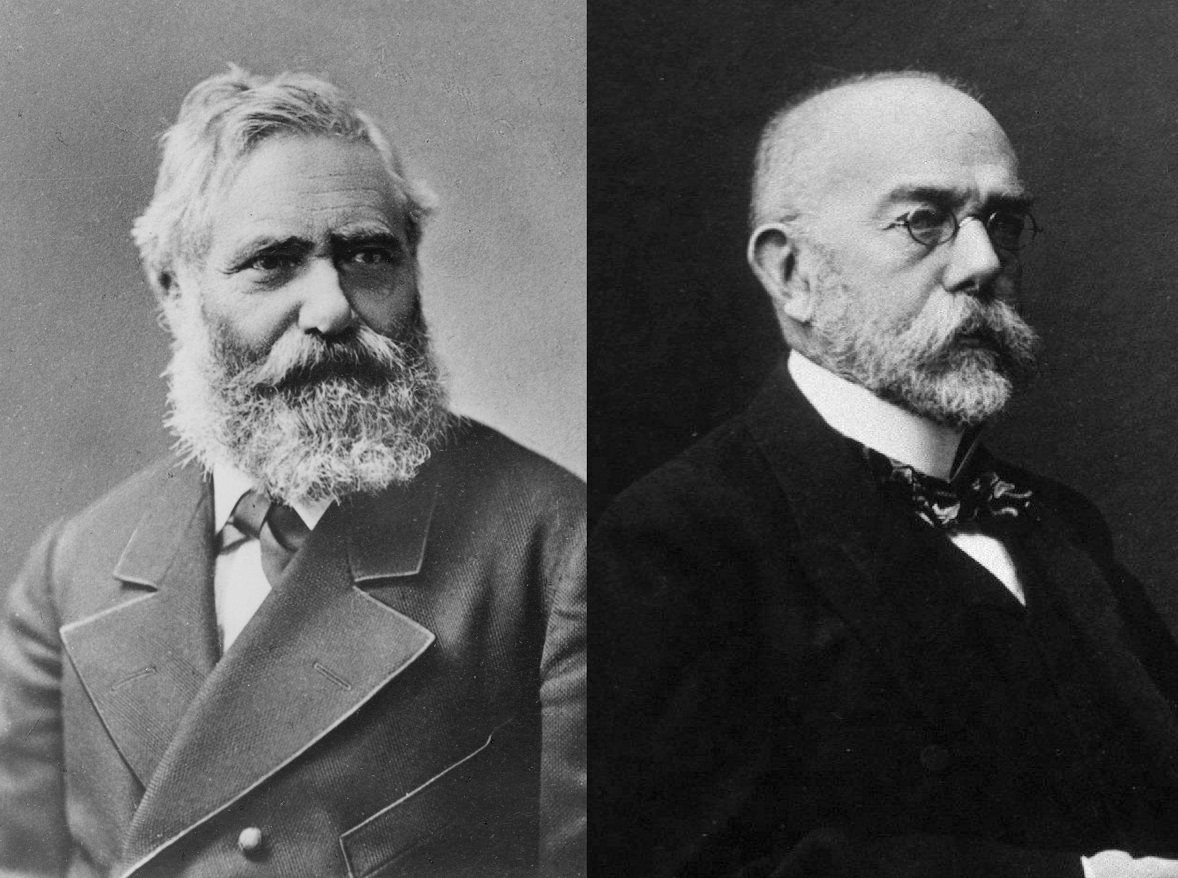
Then came the devastating cholera epidemic in Hamburg in 1892.
Hamburg’s outbreak strengthened the case that contaminated water and Vibrio cholerae were central to cholera transmission and badly weakened Pettenkofer’s environmental theory. Rather than quietly revising his position, the 74-year-old hygienist chose a somewhat more theatrical response.
On October 7, 1892, Pettenkofer swallowed a culture containing cholera bacteria.
Before doing so, he took sodium bicarbonate to reduce the acidity of his stomach. This mattered because V. cholerae is sensitive to acid, and stomach acid provides an important barrier against infection. Modern studies likewise show that reduced gastric acidity can increase susceptibility to cholera.
Pettenkofer did not develop the spectacularly severe cholera that might have ended the argument rather dramatically. He experienced gastrointestinal symptoms, including diarrhea, while cholera bacteria multiplied in his intestinal tract and were recovered from his stool. He nevertheless regarded the absence of severe disease as evidence that the organism alone could not account for cholera. Historical analyses emphasize that his self-experiment did not actually disprove Koch’s position.
Today we know that toxigenic strains of Vibrio cholerae cause cholera. After surviving passage through the stomach, the bacteria colonize the small intestine and produce cholera toxin. The toxin disrupts normal ion transport across intestinal epithelial cells, causing large amounts of chloride and water to move into the intestinal lumen. The result is the profuse watery diarrhea characteristic of severe cholera.
But Pettenkofer’s mild illness also illustrates something Koch’s simple germ-versus-no-germ argument could not completely capture: exposure to a pathogen does not guarantee that every person will develop the same disease in the same way.
The amount of bacteria swallowed matters. Gastric acidity matters. Previous immunity and other host characteristics matter. The strain and its virulence characteristics matter. And on the population level, access to clean water, sanitation, sewage treatment, and patterns of exposure enormously influence whether cholera spreads. Modern cholera research therefore considers interactions among the pathogen, the human host, and the surrounding environment.
That does not make Pettenkofer’s soil theory correct.
His proposed mechanism involving particular soil and groundwater conditions was eventually abandoned, while Koch’s identification of Vibrio cholerae as the causative organism became foundational to our understanding of the disease.
But Pettenkofer’s career had another legacy.
He was one of the major architects of nineteenth-century hygiene and preventive medicine. He promoted improved drinking-water supplies, sewage systems, urban sanitation, ventilation, and the systematic scientific study of environmental conditions affecting human health. His work helped establish hygiene as an academic discipline and contributed to major public-health improvements.
So history handed Pettenkofer an unusually complicated verdict.
He was wrong about why cholera depended so strongly on environmental conditions.
He was very right that environmental conditions mattered.
And to demonstrate the distinction, he personally swallowed the pathogen.
Science has since developed less intestinally adventurous methods of peer review.
Sources
-
Epidemiologic Interactions, Complexity, and the Lonesome Death of Max von Pettenkofer
Morabia, A. (2007). Epidemiologic interactions, complexity, and the lonesome death of Max von Pettenkofer. American Journal of Epidemiology, 166(11), 1233–1238.
Why this source matters: Primary historical-analysis source for Pettenkofer’s multifactorial cholera theory, particularly his proposed interaction between the cholera germ, soil conditions, and groundwater. Supports the article’s distinction between rejecting germ theory entirely and arguing that the germ alone was insufficient.
-
Max von Pettenkofer (1818–1901) as a Pioneer of Modern Hygiene and Preventive Medicine
Locher, W. G. (2007). Max von Pettenkofer (1818–1901) as a pioneer of modern hygiene and preventive medicine. Environmental Health and Preventive Medicine, 12(6), 238–245.
Why this source matters: Supports Pettenkofer’s role in developing experimental hygiene and preventive medicine and his advocacy for improved water supplies, sewage networks, and urban sanitation. Also provides historical context for his cholera research and self-experiment.
-
Vibrio cholerae, classification, pathogenesis, immune response, and trends in vaccine development
Montero, D. A., Vidal, R. M., Velasco, J., George, S., Lucero, Y., Gómez, L. A., Carreño, L. J., García-Betancourt, R., & O’Ryan, M. (2023). Vibrio cholerae, classification, pathogenesis, immune response, and trends in vaccine development. Frontiers in Medicine, 10, 1155751.
Why this source matters: Modern review supporting Vibrio cholerae as the causative agent of cholera and explaining intestinal colonization, virulence, cholera toxin, host responses, and modern understanding of cholera pathogenesis.