
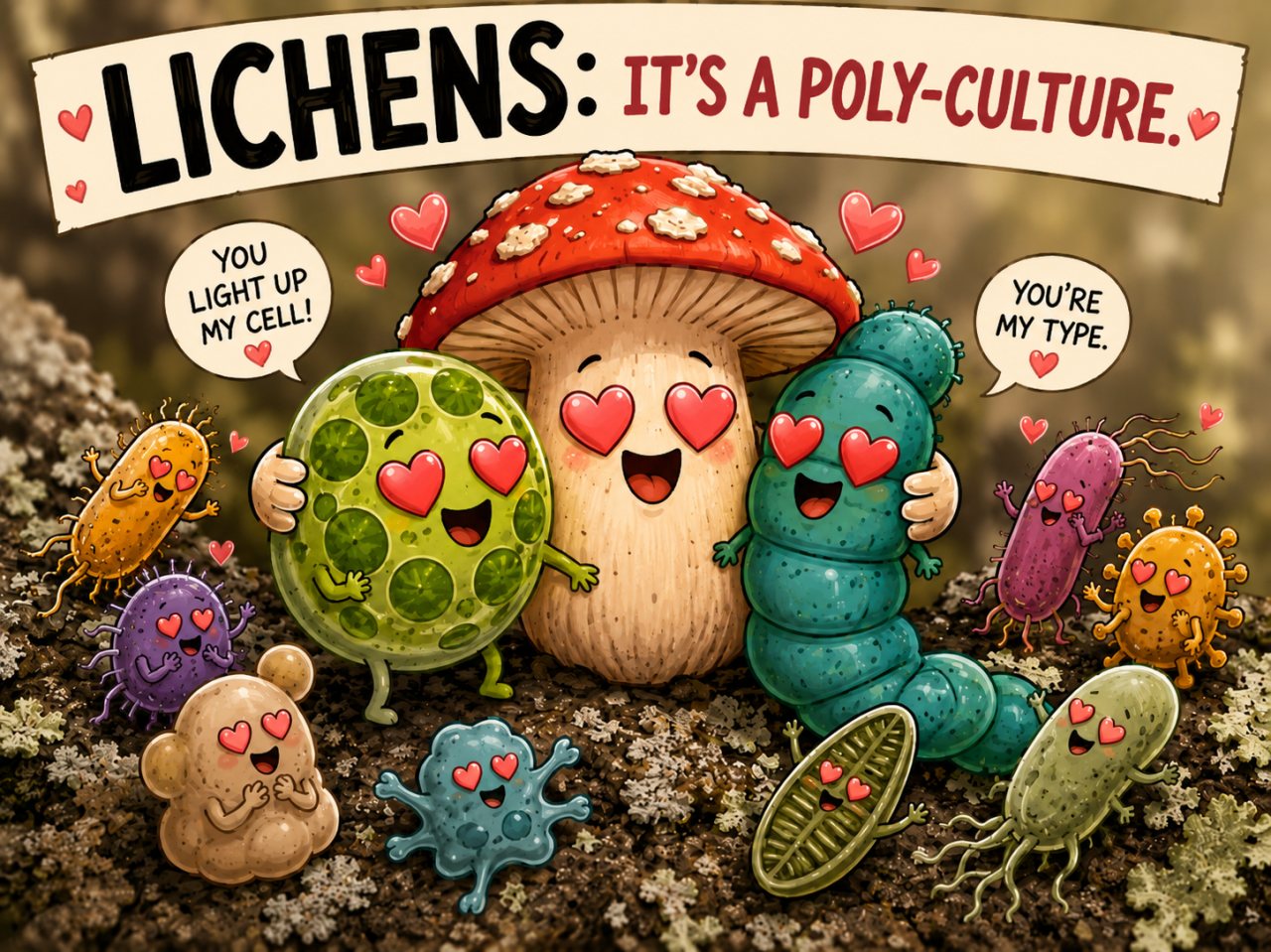
You know that weird stuff you see growing on tree trunks, rocks, fences, and sometimes even metal?
It comes in all sorts of shapes and colors, but often looks crusty, leafy, powdery, or just generally unlike anything else nearby. Not quite a plant. Not quite a mushroom. Not quite a bacterial film.
You may even know the name for it:
LICHEN.
And some of you may have learned that a lichen is a symbiotic relationship between a fungus and an alga.
Which is true.
It is also apparently the sanitized textbook version.
At its core, a lichen is a remarkably stable biological partnership built around a fungus and a photosynthetic partner. Often that partner is a green alga, meaning both belong to the domain Eukarya.
But sometimes the fungus pairs up with a cyanobacterium instead.
Different domain entirely.
Apparently lichens do not recognize conventional relationship boundaries.
And it gets more complicated.
Researchers have found that many lichens contain far more than the traditional fungus-plus-photobiont couple. Depending on the lichen, there may also be additional fungi, diverse bacterial communities, and other microorganisms living in or on the lichen body.
There is, scientifically speaking, a whole lotta group lovin’ going on in there.
What looks to us like one little crusty organism stuck to a rock may actually be an entire miniature biological community.
Sources did not confirm whether the community includes a swimming pool, bowling alley, or HOA.
So exactly how many organisms are hiding inside that thing you thought was one organism?
There is no single answer. Different lichens host different communities, and scientists are still working out exactly who is living there and what everyone is doing.
But one thing is clear:
That relationship status needs updating.
And somehow, the arrangement works remarkably well.
Lichens can survive in environments that would make many organisms reconsider their life choices, from deserts and polar regions to exposed rock surfaces. Some even live inside rock, tucked into tiny spaces beneath the surface.
Closer to home, they will cheerfully colonize tree bark, stone, fences, patio furniture, and apparently any piece of tin that remains outdoors long enough.
So perhaps the real scandal is not how many organisms are involved.
It is how this biological group project became so ridiculously successful.
The Real Story
A lichen is not a single organism.
At its core, it is a long-term symbiotic association built around a fungus, called the mycobiont, and at least one photosynthetic partner, called the photobiont. The photobiont may be a green alga, a cyanobacterium, or in some lichens, both.
The partners bring very different skills to the arrangement.
The fungal partner builds most of the visible lichen body, called the thallus. Its network of fungal filaments gives the lichen structure, helps hold water, gathers minerals from the environment, and provides a protected place for the photosynthetic cells to live.
The photosynthetic partner handles much of the food production. Green algae and cyanobacteria can use light energy to fix carbon into organic molecules, providing a source of carbon and energy that the fungus cannot make for itself. When the photobiont is a nitrogen-fixing cyanobacterium, it may contribute another valuable service by converting atmospheric nitrogen into forms that can be used biologically.
For a long time, that fungus-plus-photobiont partnership was the standard textbook picture of a lichen.
Then researchers started looking more closely.
Modern DNA sequencing and microscopy have revealed that many lichens also contain diverse communities of bacteria and additional fungi. In 2016, researchers even discovered basidiomycete yeasts embedded in the outer cortex of many common macrolichens, adding another fungal participant to lichens that had traditionally been described as a two-member partnership.
The bacterial community can be surprisingly rich as well. Different bacterial groups occupy different regions of the lichen and may contribute to nutrient cycling, stress tolerance, growth, and other functions. Scientists are still working out exactly what many of these microbes are doing, so not every organism found in a lichen should automatically be promoted to “essential partner.”
That is why modern researchers increasingly describe lichens as multi-species symbioses or even as small ecosystems rather than simply a fungus paired with an alga. The fungal and photosynthetic partners remain central to the identity of the lichen, but they often live alongside an entire microbial community.
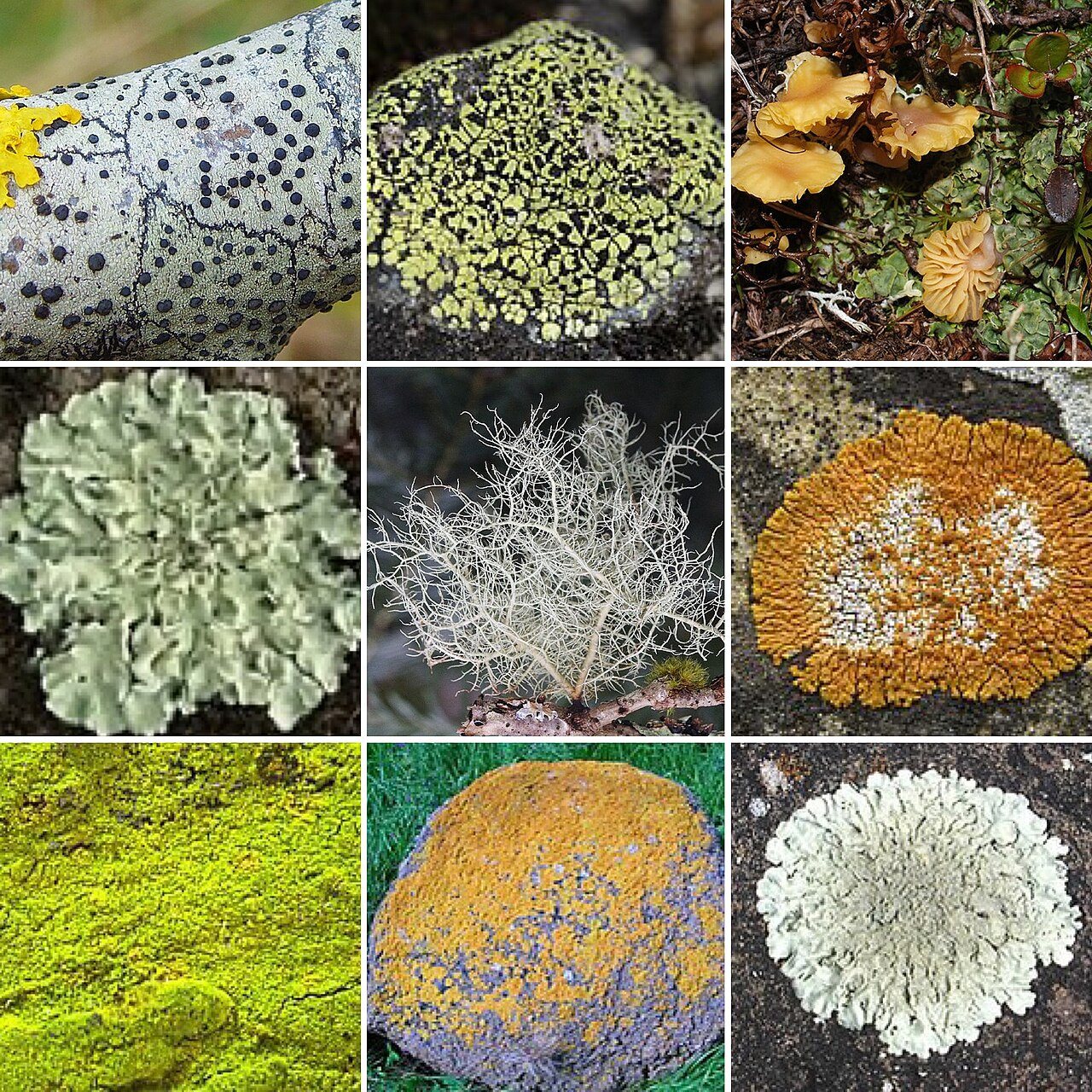
This collaboration allows lichens to occupy some remarkably inhospitable places. They grow on exposed rock, tree bark, soil, buildings, and other surfaces where nutrients may be scarce and water availability unpredictable. Their ability to tolerate drying and resume metabolism when water returns helps explain why lichens are so successful in environments that many organisms would find considerably less welcoming.
So when you look at a patch of lichen, you are not necessarily looking at one organism quietly minding its own business.
You may be looking at a fungus, one or more photosynthetic partners, additional fungi, and an entire bacterial neighborhood all occupying the same tiny structure.
Apparently nature discovered communal living long before humans started arguing about whose turn it was to buy groceries.
Sources
-
Evolutionary biology of lichen symbioses
Spribille, T. (2022). Evolutionary biology of lichen symbioses. New Phytologist, 234(5), 1566–1582.
Why this source matters: Broad modern review of lichen evolution and symbiosis. Supports the description of lichens as open, interspecies associations centered on a fungus and a phototroph, usually an alga and/or cyanobacterium, and discusses the evolutionary exchange of resources among partners.
-
Understanding Microbial Multi-Species Symbioses
Aschenbrenner, I. A., Cernava, T., Berg, G., & Grube, M. (2016). Understanding microbial multi-species symbioses. Frontiers in Microbiology, 7, 180.
Why this source matters: Supports the modern view of lichens as multi-species systems rather than strictly two-part partnerships. Reviews the roles of the fungal and photosynthetic partners and the increasingly recognized contribution of structured bacterial microbiomes.
-
Basidiomycete yeasts in the cortex of ascomycete macrolichens
Spribille, T., Tuovinen, V., Resl, P., Vanderpool, D., Wolinski, H., Aime, M. C., Schneider, K., Stabentheiner, E., Toome-Heller, M., Thor, G., Mayrhofer, H., Johannesson, H., & McCutcheon, J. P. (2016). Basidiomycete yeasts in the cortex of ascomycete macrolichens. Science, 353(6298), 488–492.
Why this source matters: Landmark study showing that many common macrolichens contain basidiomycete yeasts in addition to the traditionally recognized ascomycete fungus and photosynthetic partner. Useful for the article’s “relationship is more complicated than the textbook version” hook.