
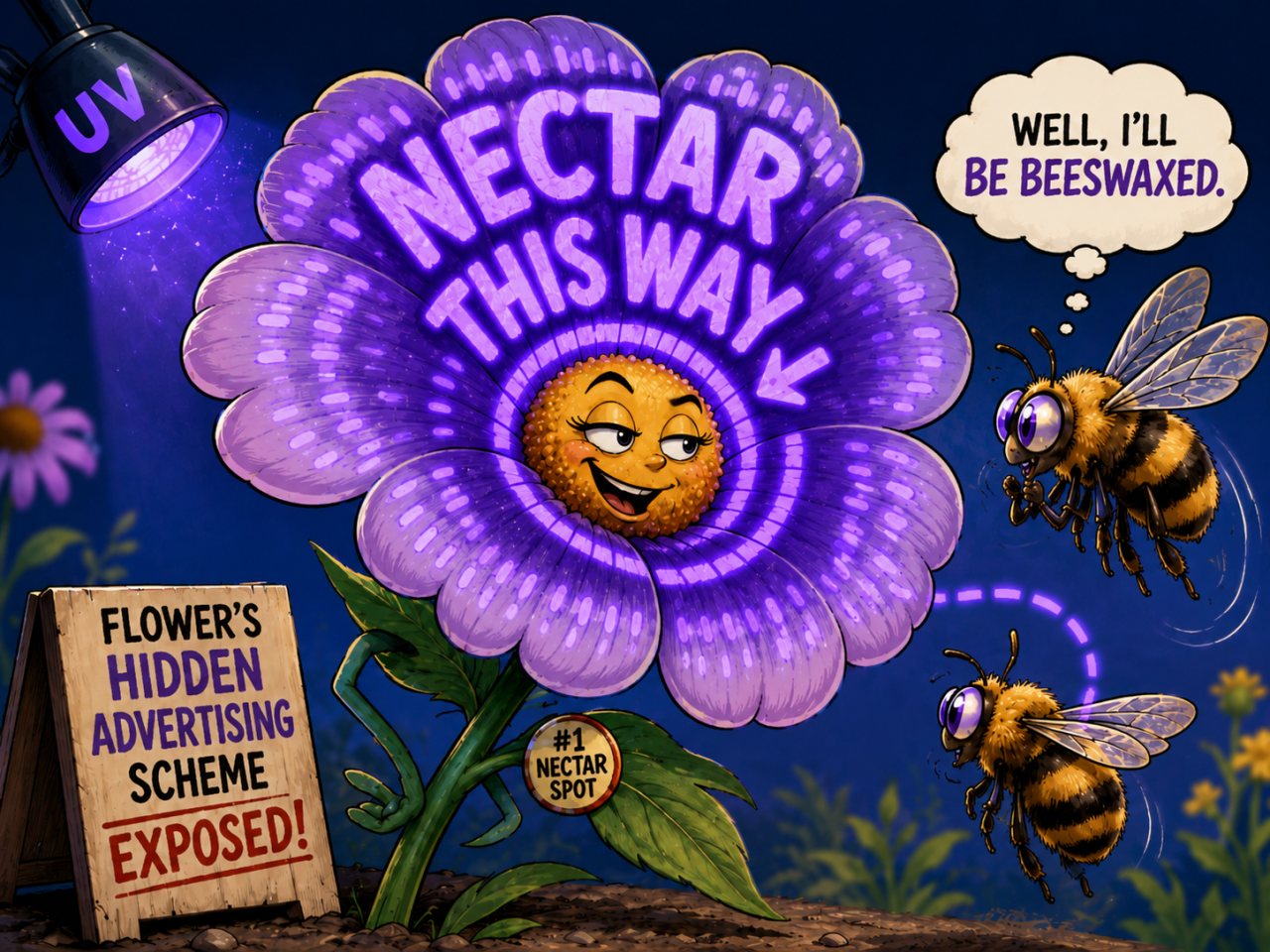
You thought you couldn’t escape the constant barrage of targeted advertising?
Have you seen what the flowers are putting out there?
Oh. Right.
If you’re reading this, you’re probably human. And humans cannot see ultraviolet wavelengths.
The bees can.
That means you and a bee can look at the exact same flower and see two very different advertisements. What looks to you like a perfectly ordinary yellow, white, or purple blossom may contain bold ultraviolet patterns that are completely invisible to human eyes.
And the flowers are not exactly being subtle about it.
NECTAR THIS WAY!
OVER HERE!
POLLINATE ME!
ME FIRST!
Some flowers even go with the botanical equivalent of a giant flashing bullseye right in the middle: dark ultraviolet patterns surrounded by contrasting petals, practically directing incoming pollinators toward the center.
Humans stroll through the garden admiring the pretty colors while an entirely separate advertising campaign is running right under our noses.
The target demographic has wings.
Bees can detect ultraviolet light, allowing them to see floral patterns and contrasts that we simply cannot. So while you may think a bee is happily wandering from flower to flower on a peaceful summer afternoon, she may actually be navigating one relentless stream of highly targeted botanical marketing.
NECTAR NEAR YOU!
HOT SINGLE FLOWERS IN YOUR AREA!
CLICK HERE TO POLLINATE!
So the next time social media serves you your seventeenth suspiciously specific advertisement of the day, spare a thought for the bee in your backyard.
She may be getting spammed too.
The Real Story
Human eyes can detect only a narrow portion of the electromagnetic spectrum. Ultraviolet light falls just outside that range, so any floral pattern made by differences in UV reflection is completely invisible to us. Bees, however, have visual systems that include sensitivity to ultraviolet wavelengths.
That means a flower that looks uniformly yellow or white to a human may look dramatically patterned to a bee.
Many flowers absorb ultraviolet light strongly near the center while reflecting more UV from the outer portions of their petals. To an insect that can see ultraviolet, this can create a dark central region surrounded by brighter petals, producing the familiar UV bullseye pattern. Similar differences in UV reflection can create stripes, patches, and other markings that humans simply cannot see without specialized photography.
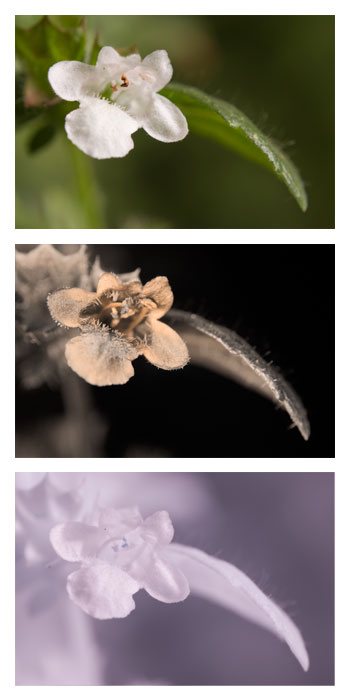
These hidden patterns can affect pollinator behavior. In field experiments, flowers with UV bullseyes attracted more bees and flies than flowers whose petals were made uniformly UV-reflective or UV-absorbing. Other experiments with Rudbeckia found that wild bees preferentially visited flower heads with larger UV-absorbing floral guides.
The patterns are often called nectar guides, because in some flowers they can help pollinators locate floral rewards or reproductive structures. But the advertisements are not necessarily literal arrows saying NECTAR HERE. In at least some species, UV patterning appears to make the entire flower easier to notice from a distance rather than directly steering the insect toward the center once it lands.
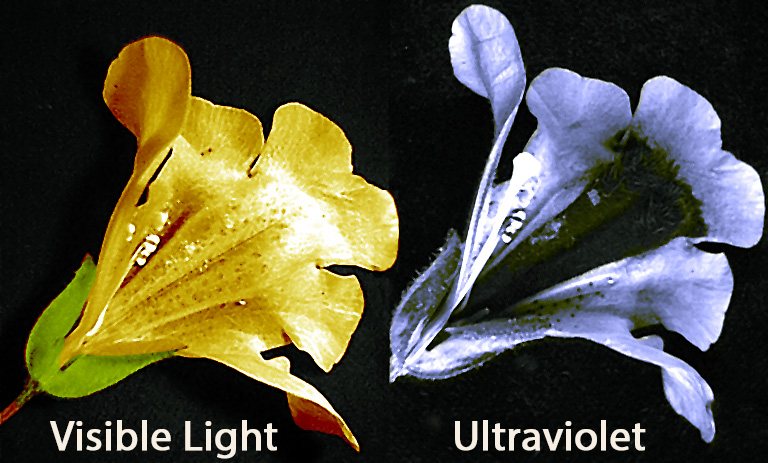
So when a bee visits a flower, she may be using visual information that has been sitting in front of human eyes the entire time.
We just weren't invited to see the ad campaign.
Sources
-
Bees, flowers and UV
Lunau, K., Camargo, M. G. G., & Ren, Z.-X. (2025). Bees, flowers and UV. Plant Biology, 27(6), 948–961.
Why this source matters: Recent review supporting the broad explanation that humans cannot perceive floral UV patterns while many pollinators, including bees, can. Also supports the formation of UV patterns through differential absorption and reflection and the possible roles of UV bullseyes in floral signaling and pollinator guidance.
-
Dissecting pollinator responses to a ubiquitous ultraviolet floral pattern in the wild
Koski, M. H., & Ashman, T.-L. (2014). Dissecting pollinator responses to a ubiquitous ultraviolet floral pattern in the wild. Functional Ecology, 28(4), 868–877.
Why this source matters: Field experiment testing the function of UV bullseye patterns in natural flowers. Supports the claim that UV patterning increased attraction by bees and syrphid flies compared with uniformly UV-reflective or UV-absorbing flowers. Also provides important nuance that the bullseye did not necessarily improve orientation toward the flower center, suggesting that some UV patterns may primarily increase floral conspicuousness rather than function as literal nectar guides.
-
Wild bees preferentially visit Rudbeckia flower heads with exaggerated ultraviolet absorbing floral guides
Horth, L., Campbell, L., & Bray, R. (2014). Wild bees preferentially visit Rudbeckia flower heads with exaggerated ultraviolet absorbing floral guides. Biology Open, 3(3), 221–230.
Why this source matters: Experimental study showing that wild bees preferentially visited Rudbeckia flower heads with larger UV-absorbing floral guides. Supports the article’s central claim that hidden UV patterning can influence pollinator preference and visitation.