

Are you, a friend, or a family member “lactose intolerant”? Are you tired of being treated as biologically defective just because a milkshake can turn your digestive tract into a crime scene?
Good news.
You may now safely and proudly emerge from the Dairy Shunning Closet.
Sources have revealed that YOU are not the strange one.
It is the adults still drinking milk, eating cheese, and demolishing bowls of ice cream without gastrointestinal consequences who are carrying the unusual evolutionary tweak.
Yes. You heard correctly.
Mammals produce milk for their young, and mammalian babies therefore need plenty of lactase, the intestinal enzyme that breaks down lactose, the main sugar in milk. But milk is generally a baby-food arrangement. After weaning, lactase production normally drops dramatically.
Which means the ancestral mammalian plan is essentially:
BABY: Drink milk.
ADULT: We are done with that now.
Adult monkeys? Lactase activity drops after weaning.
Adult horses? Same general mammalian program.
Adult squirrels? Nobody issued them a lifelong dairy pass either.
Adult cats? Many become lactose intolerant after kittenhood, which is why that adorable saucer of milk can end with abdominal distress, gas, or diarrhea instead of the cozy storybook scene everyone was promised.
You get the picture.
For most mammals, adulthood was never supposed to include casually wandering into the kitchen at midnight and drinking milk straight from the carton.
Humans, however, developed a loophole.
In some populations, genetic variants evolved that keep lactase production going long after childhood. These adults can continue digesting fresh milk while the rest of Mammalia looks on in confusion.
So the next time someone recoils when you say milk destroys your intestines, you may calmly point toward the adult chugging a giant glass of dairy and announce:
“Actually, THAT’S the mutant.”
The Real Story
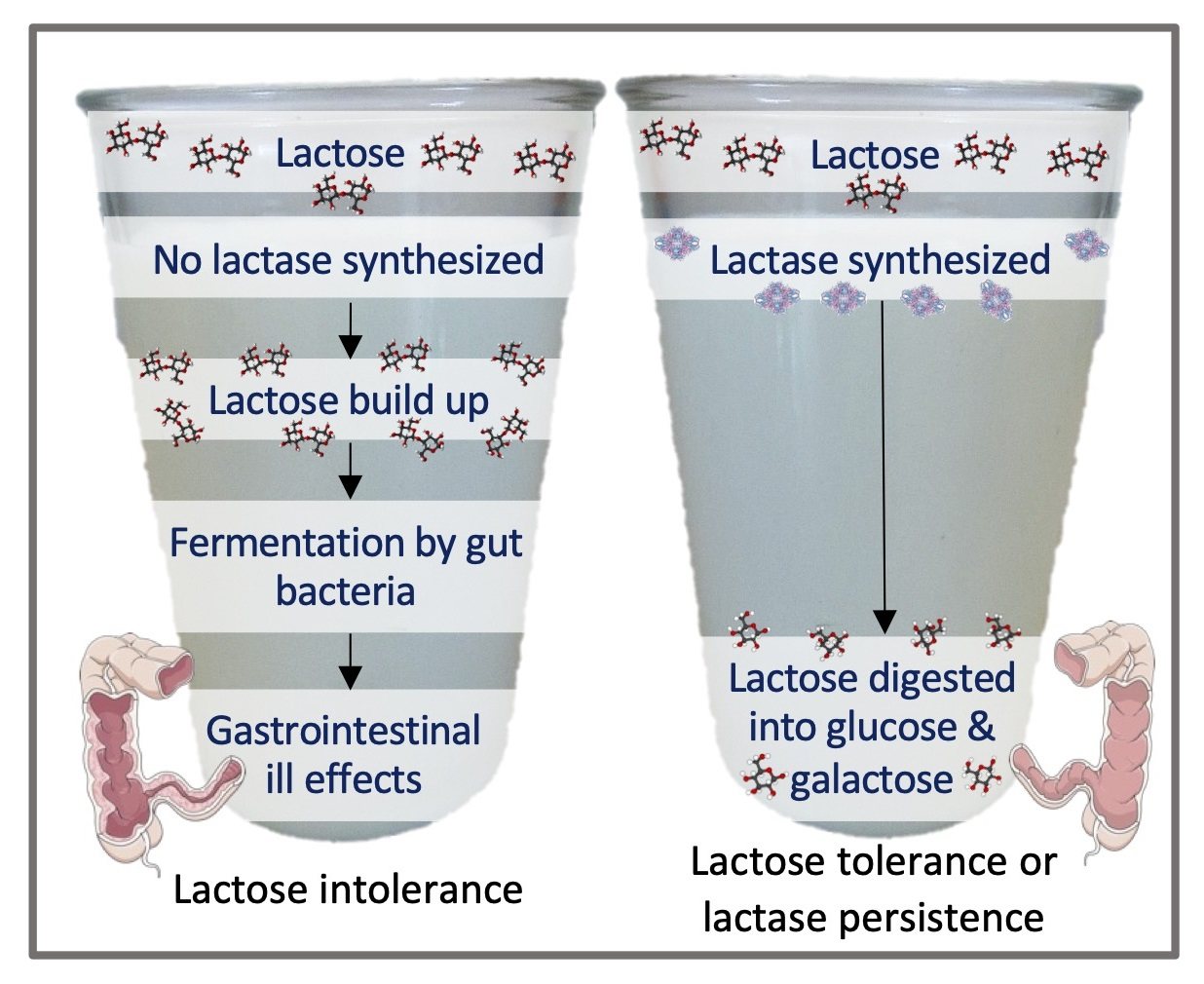
Lactose is the main sugar in milk. To absorb it, the small intestine uses an enzyme called lactase, which breaks lactose into the simpler sugars glucose and galactose. The instructions for making lactase come from the LCT gene on chromosome 2.
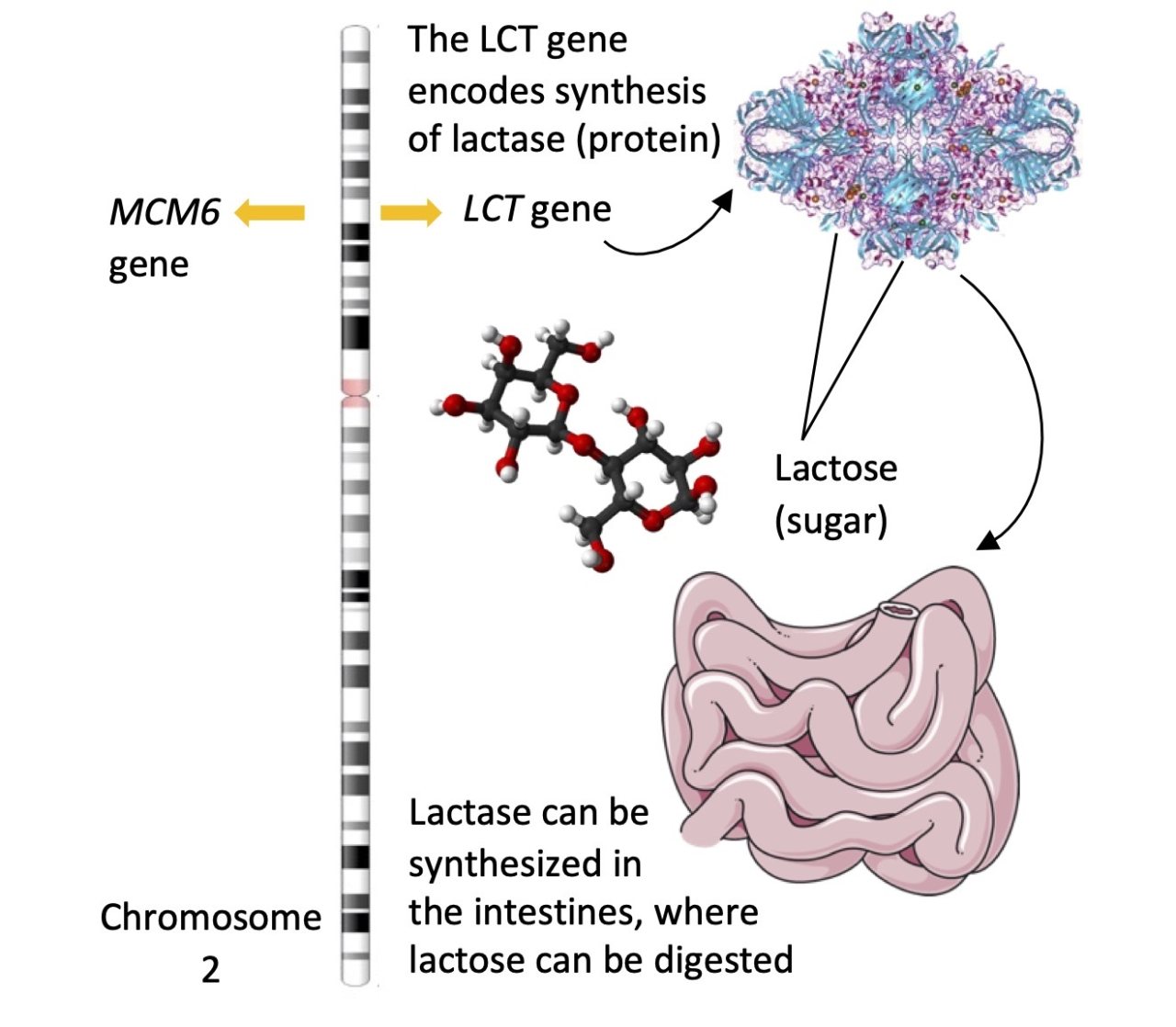
Human babies normally produce plenty of lactase because milk is their primary food. But in most mammals, including most humans, LCT activity decreases after weaning. That developmental change is called lactase non-persistence. It is the ancestral condition, not a genetic defect.
Some humans, however, inherited variants that keep lactase production going into adulthood. This trait is called lactase persistence.
Here is the especially interesting genetic twist: the best-known lactase-persistence variants are not mutations that change the lactase enzyme itself. Instead, they occur in regulatory DNA near LCT, including an enhancer located within the neighboring MCM6 gene. These variants help keep LCT switched on after childhood, when it would otherwise be turned down.
And humans did not evolve this trick only once.
Different lactase-persistence variants arose in different populations, including groups in Europe, Africa, and the Middle East. That is an example of convergent evolution: different genetic changes producing a similar useful trait.
Why would natural selection favor adults who could still digest milk?
Culture changed the environment.
After humans domesticated cattle, goats, sheep, and other milk-producing animals, some populations began using animal milk as a regular food source. In those settings, adults who could digest fresh milk had access to extra calories, protein, fluids, and nutrients. Over many generations, lactase-persistence variants became common in several populations with long histories of dairying. This relationship between a cultural practice and genetic evolution is a classic example of gene-culture coevolution.
So being unable to digest much lactose as an adult is not evidence that somebody’s digestive system forgot how mammals are supposed to work.
Quite the opposite.
The unusual evolutionary development was keeping the childhood milk-digesting machinery running long after weaning.
From mammalian normality to lifelong dairy privileges, courtesy of a few regulatory mutations.
Sources
-
The molecular basis of lactase persistence: Linking genetics and epigenetics
Cohen, C. E., Swallow, D. M., & Walker, C. (2025). The molecular basis of lactase persistence: Linking genetics and epigenetics. Annals of Human Genetics, 89(5), 321–332.
Why this source matters: Supports the molecular-genetics explanation of lactase persistence, including the continued expression of LCT into adulthood and the role of regulatory variants in an enhancer located within MCM6. Useful for explaining that the important variants alter gene regulation rather than simply changing the lactase protein.
-
Convergent adaptation of human lactase persistence in Africa and Europe
Tishkoff, S. A., Reed, F. A., Ranciaro, A., Voight, B. F., Babbitt, C. C., Silverman, J. S., Powell, K., Mortensen, H. M., Hirbo, J. B., Osman, M., Ibrahim, M., Omar, S. A., Lema, G., Nyambo, T. B., Ghori, J., Bumpstead, S., Pritchard, J. K., Wray, G. A., & Deloukas, P. (2007). Convergent adaptation of human lactase persistence in Africa and Europe. Nature Genetics, 39(1), 31–40.
Why this source matters: Supports the claim that lactase persistence evolved through different regulatory variants in different human populations. Particularly useful for the article’s convergent-evolution angle and for showing that the European lactase-persistence variant is not the only genetic route to adult milk digestion.
-
Dairying and the evolution and consequences of lactase persistence in humans
Stock, J. T., & Wells, J. C. K. (2023). Dairying and the evolution and consequences of lactase persistence in humans. Animal Frontiers, 13(3), 7–13.
Why this source matters: Supports the gene-culture coevolution portion of the article: animal domestication and dairying created new dietary environments in which lactase-persistence variants were strongly selected in multiple populations across Eurasia and Africa.