

Move over, blue whale! The heavyweight title belongs to something growing beneath an Oregon forest.
That something is a honey fungus, a tree-killing fungus that spreads underground and invades the roots and living tissues of its unsuspecting neighbors.
The largest-organism title is widely attributed to one particular honey fungus in Oregon. This single organism occupies approximately 2,385 acres and has an estimated mass of 7,500 to 35,000 tons. A very large blue whale weighs around 160 tons, which means the fungus may contain roughly as much mass as 45 to more than 200 blue whales. That is an unreasonable quantity of fungus.
You may have heard of Pando, the enormous aspen clone in Utah that covers about 106 acres. Impressive, certainly. The Oregon fungus, however, sprawls across roughly 2,385 acres and appears to have misplaced all sense of proportion.
Before packing your bags to admire this fungal titan, you should know that most of it is hidden underground or inside infected roots and wood. Its visible mushrooms are merely the occasional aboveground announcement that something much larger has been operating beneath the forest.
Beneath the forest floor, the fungus sends out dark, cordlike structures often described as black shoestrings. These creep through the soil, encounter new trees, and expand the organism’s territory without so much as posting a zoning notice.
Meanwhile, the blue whale is swimming through the ocean eating as much as six tons of krill per day, while the Oregon Humongous Fungus remains beneath the trees, slowly consuming portions of the surrounding forest.
Apparently, the secret to becoming enormous is staying underground and refusing to respect property lines.
The Real Story
The Oregon “Humongous Fungus” is a single genetic individual belonging to the honey-fungus genus Armillaria. For many years it was identified in North American sources as Armillaria ostoyae. A 2025 taxonomic study clarified that the North American species should instead be called Armillaria solidipes.
Calling it one organism may sound strange when no single gigantic mushroom is visible. Fungi, however, are not limited to the mushrooms they produce. A mushroom is a temporary reproductive structure called a fruiting body, comparable more to an apple on a tree than to the entire tree itself. The main body of a fungus is its mycelium, an interconnected network of microscopic filaments called hyphae.
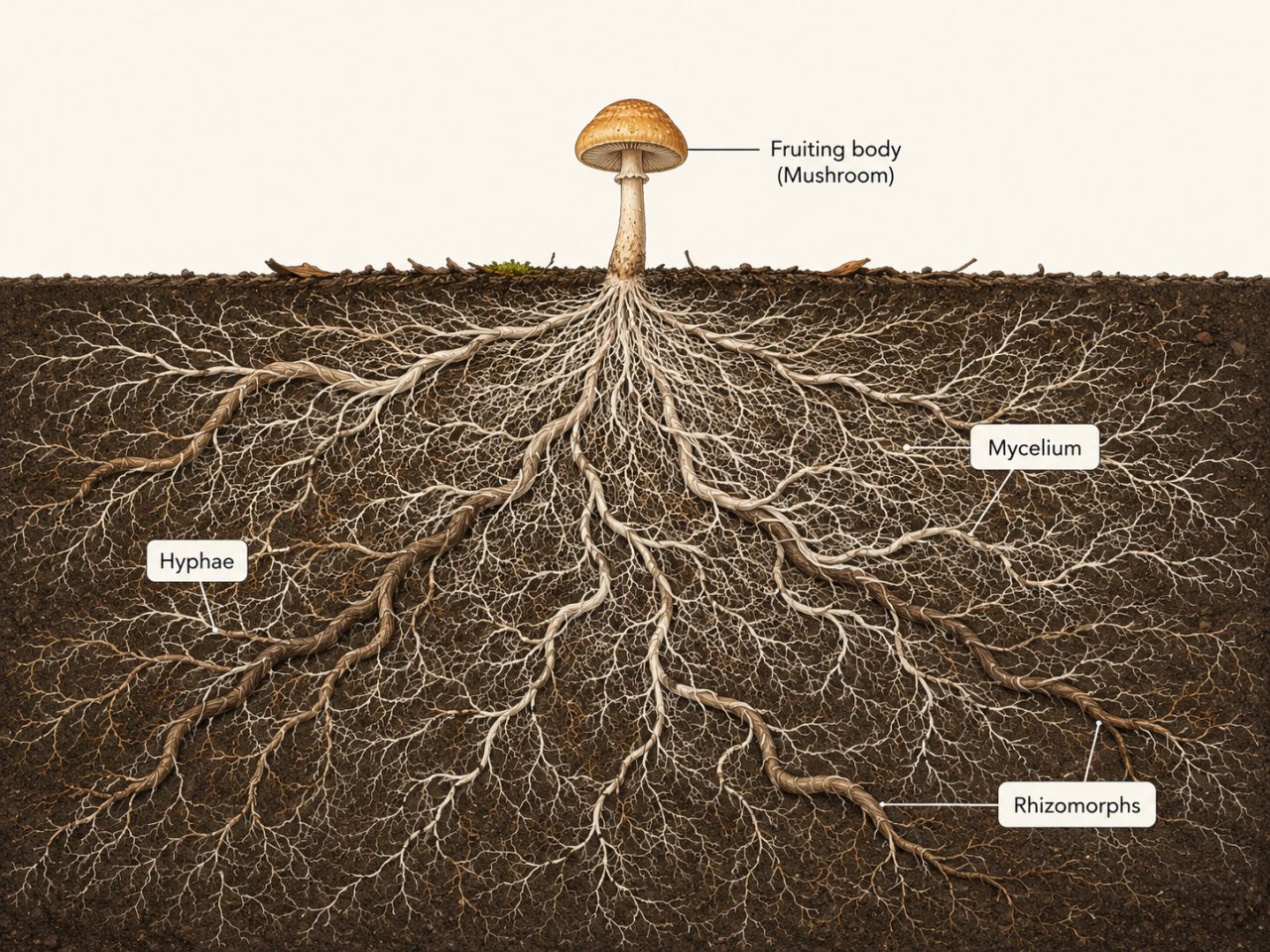
The Humongous Fungus does produce honey-colored mushrooms, usually in clusters near the bases of infected trees. Those visible structures are surprisingly ordinary in size, with stalks approximately two to four inches tall and caps about two to five inches across. They are merely the occasional aboveground appearance of an organism whose vast majority remains concealed in soil, roots, and wood.
Researchers established the fungus’s enormous size by collecting samples from living and recently killed trees across the Malheur National Forest in northeastern Oregon. They compared the fungal isolates using both compatibility testing and molecular identification. DNA testing of samples collected across approximately 965 hectares, or 2,385 acres, belonged to the same genetic individual, also called a genet or clone.
That area is roughly 22 times larger than Pando, the famous quaking-aspen clone in Utah. Pando covers approximately 106 acres and consists of about 47,000 genetically identical stems connected through one clonal root system.
Pando is estimated to weigh about 13 million pounds, or approximately 6,600 US tons. The Oregon fungus has been estimated at roughly 7,500 to 35,000 US tons, which would make it heavier than Pando even at the low end of the fungal estimate. It is therefore commonly described as the largest known single organism by area and the heaviest known organism, while Pando retains the title of the largest known plant by mass.
The fungus reaches new trees partly through structures called rhizomorphs. A rhizomorph is a cord made from many bundled fungal hyphae. Armillaria rhizomorphs are dark, tough, and rootlike, giving them their familiar description as “black shoestrings.” They can extend through soil from infected roots or buried wood, encounter another tree, and enter its root system. Once established, the fungus may grow beneath the bark and produce pale, fan-shaped sheets of mycelium while decaying the roots and lower trunk.
Many fungi obtain nutrients by breaking down organisms that are already dead. Armillaria can also live as a pathogen, attacking living woody plants. It infects roots, damages the tissues that move water and nutrients, and decomposes structural wood. Infected trees may grow poorly, lose branches, develop root and trunk decay, fall during storms, or eventually die. The fungus can then continue surviving in the remaining stump and roots, using the dead wood as both food and a base from which to reach new hosts.
The Oregon clone lives in a mixed-conifer forest and was detected in several conifer species. Researchers found other Armillaria individuals in the study area as well, but one genet dwarfed them all, occupying 965 hectares by itself. Estimates based on possible rates of underground spread suggest that this individual may be approximately 1,900 to 8,650 years old. That makes it extraordinarily ancient, although not securely the oldest organism known.
Its enormous size also illustrates why defining the “largest organism” can become complicated. A blue whale is a compact individual with clear boundaries. Pando consists of tens of thousands of tree trunks connected by one clonal root system. The Oregon fungus is a genetically continuous network threaded through soil, roots, and wood, with no convenient outer skin marking where the organism ends. Scientists therefore identify these giants through genetics, geography, anatomy, and informed estimates rather than through ordinary measurements.
What looks aboveground like a scattering of modest honey mushrooms is only the reproductive fringe of a fungal individual extending across thousands of acres. The forest does not merely contain the Humongous Fungus. A substantial portion of the forest is occupied, infiltrated, and gradually digested by it.
Sources
-
Coarse-Scale Population Structure of Pathogenic Armillaria Species in a Mixed-Conifer Forest in the Blue Mountains of Northeast Oregon
Ferguson, B. A., Dreisbach, T. A., Parks, C. G., Filip, G. M., & Schmitt, C. L. (2003). Coarse-scale population structure of pathogenic Armillaria species in a mixed-conifer forest in the Blue Mountains of northeast Oregon. Canadian Journal of Forest Research, 33(4), 612–623.
Why this source matters: Primary research supporting the genetic identification, approximately 965-hectare or 2,385-acre extent, sampling distances, forest hosts, and estimated age of the Oregon clone.
-
Epitypification of Armillaria solidipes, a Cause of Armillaria Root Disease in North America
Antonín, V., Fitz Axen, A. J., Ibarra Caballero, J. R., Worrall, J. J., Marchetti, S. B., Stewart, J. E., Klopfenstein, N. B., & Kim, M.-S. (2025). Epitypification of Armillaria solidipes, a cause of Armillaria root disease in North America. Mycologia, 117(6), 1077–1087.
Why this source matters: Current taxonomic source distinguishing the North American species Armillaria solidipes from the Eurasian A. ostoyae and explaining why older North American sources commonly use the latter name.
-
Armillaria Root Rot of Trees
Moorman, G. W. (2026). Armillaria root rot of trees. Penn State Extension.
Why this source matters: Plain-language source supporting the explanations of rhizomorphs, mycelial fans, honey-colored fruiting bodies, underground spread, infection of tree roots, wood decay, and tree symptoms.
-
“Pando” Lives: Molecular Genetic Evidence of a Giant Aspen Clone in Central Utah
DeWoody, J., Rowe, C. A., Hipkins, V. D., & Mock, K. E. (2008). “Pando” lives: Molecular genetic evidence of a giant aspen clone in central Utah. Western North American Naturalist, 68(4), 493–497.
Why this source matters: Primary genetic study confirming Pando as one clone and estimating its area at approximately 43.6 hectares, or about 106 acres, for comparison with the Oregon fungus.
-
Humongous Fungus
Scheppke, J. (2024). Humongous fungus. The Oregon Encyclopedia.
Why this source matters: Accessible overview supporting the fungus’s location, nickname, estimated area and biomass, discovery history, visible mushrooms, infected-tree symptoms, and public description as the largest known single organism by biomass. The page was last updated October 8, 2024.