
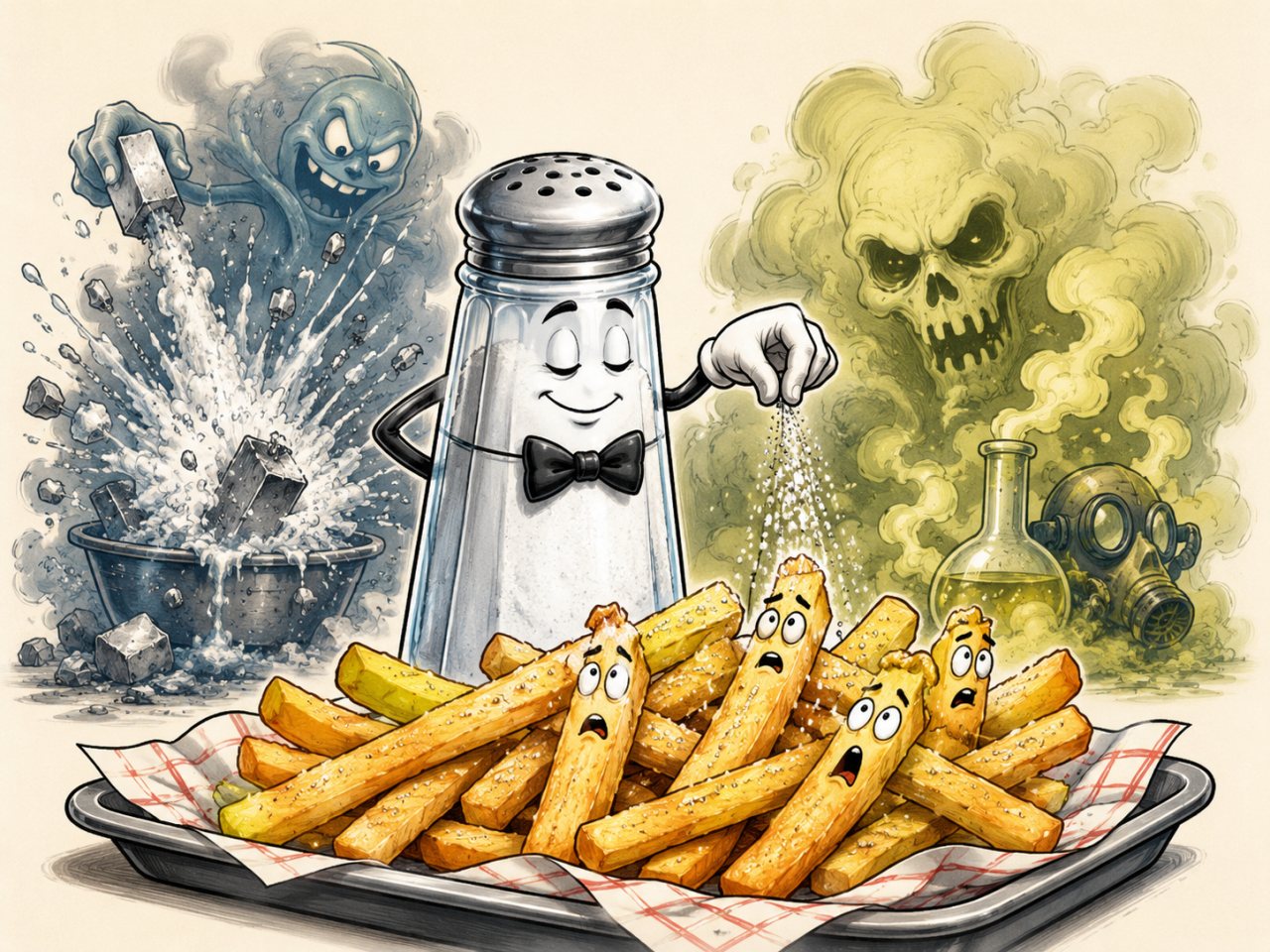
Sodium is a dangerously reactive metal known for having a violent relationship with water.
Literally.
Drop pure sodium metal into water, and it rapidly produces hydrogen gas, caustic sodium hydroxide, enough heat to ignite the hydrogen, and occasionally the sort of explosion that causes chemistry teachers to say:
“This demonstration will be conducted from waaaaay over here.”
Chlorine has an equally alarming résumé. In its elemental form, it is a toxic, corrosive yellow-green gas that irritates the eyes and lungs and has absolutely no business lurking near dinner.
Two dangerous characters. Two troubling histories. Surely nothing wholesome could come from this.
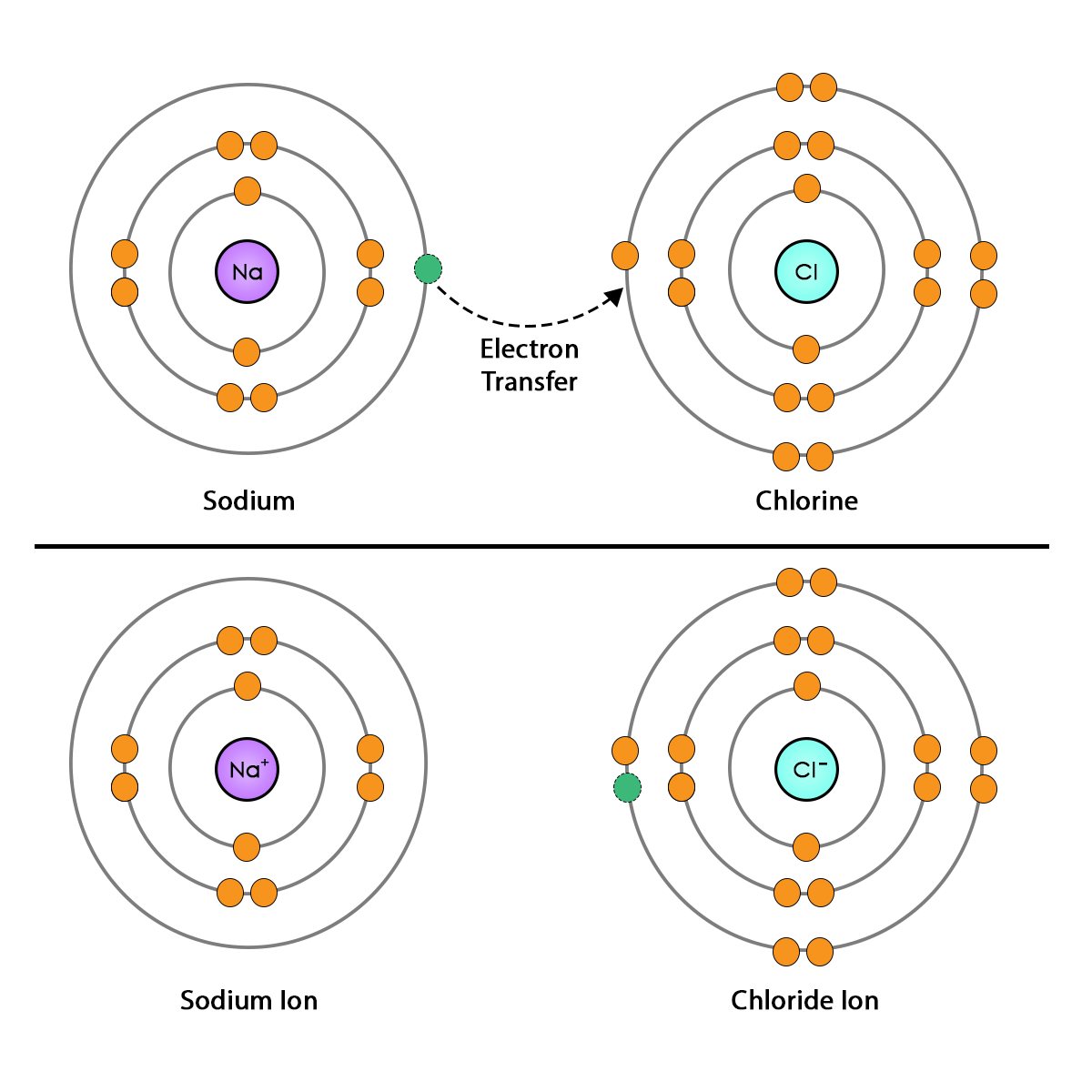
But somewhere out of public view, sodium quietly hands one of its electrons to chlorine.
The transformation is immediate.
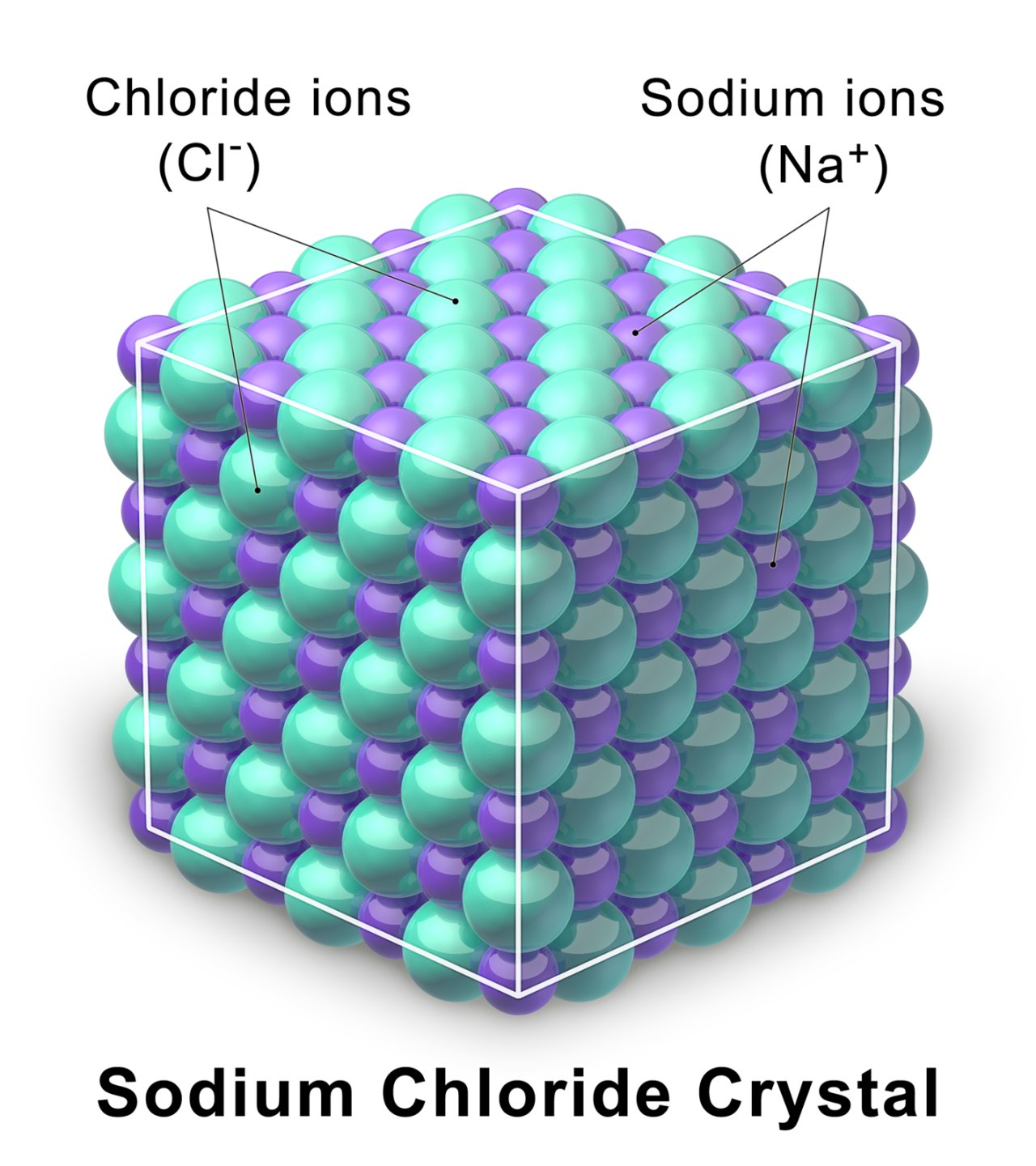
Sodium emerges under a new identity as a positively charged sodium ion, Na⁺. Chlorine becomes a negatively charged chloride ion, Cl⁻. The opposite charges attract, the former hazards assemble into an orderly ionic crystal, and the entire relationship is rebranded as:
table salt.
Days later, the pair can be found sitting innocently beside the pepper, waiting to be sprinkled onto french fries as though neither has a dangerous past.
One electron changes hands, two identities disappear, and a reactive metal and toxic gas begin a quiet new life as seasoning.
That is quite the career change.
The Real Story
Sodium chloride is not a mixture of tiny pieces of sodium metal and trapped pockets of chlorine gas. When sodium and chlorine react, their atoms undergo a genuine electronic identity change.
A neutral sodium atom has one electron in its outermost shell that it gives up relatively easily. A chlorine atom is one electron short of a full outer shell and readily accepts it. When sodium transfers that electron to chlorine, sodium becomes a positively charged sodium ion, Na⁺, while chlorine becomes a negatively charged chloride ion, Cl⁻.
Because opposite electrical charges attract, the sodium and chloride ions arrange themselves into a repeating three-dimensional structure called an ionic crystal lattice. There are no individual sodium chloride molecules tucked inside a salt crystal. Instead, each ion is surrounded by oppositely charged neighbors in an enormous, orderly network.
Sources
-
2.2 Chemical Bonds
Betts, J. G., Young, K. A., Wise, J. A., Johnson, E., Poe, B., Kruse, D. H., Korol, O., Johnson, J. E., Womble, M., & DeSaix, P. (2022). 2.2 Chemical bonds. In Anatomy and Physiology 2e. OpenStax.
Why this source matters: Supports the explanation that sodium donates one electron to chlorine, producing Na⁺ and Cl⁻ ions. Also supports the attraction between oppositely charged ions, formation of ionic bonds and salt crystals, and the role of dissolved ions as electrolytes contributing to electrical activity in the body.
-
2.3 Principles of Bioelectricity
Kirby, E. D., Glenn, M. J., Sandstrom, N. J., & Williams, C. L. (2024). 2.3 Principles of bioelectricity. In Introduction to Behavioral Neuroscience. OpenStax.
Why this source matters: Supports the article’s discussion of sodium and chloride ions in neurons. Describes Na⁺ and Cl⁻ concentration gradients, ion pumps and channels, and how movement of these ions contributes to electrical currents and membrane-potential changes involved in neural signaling.