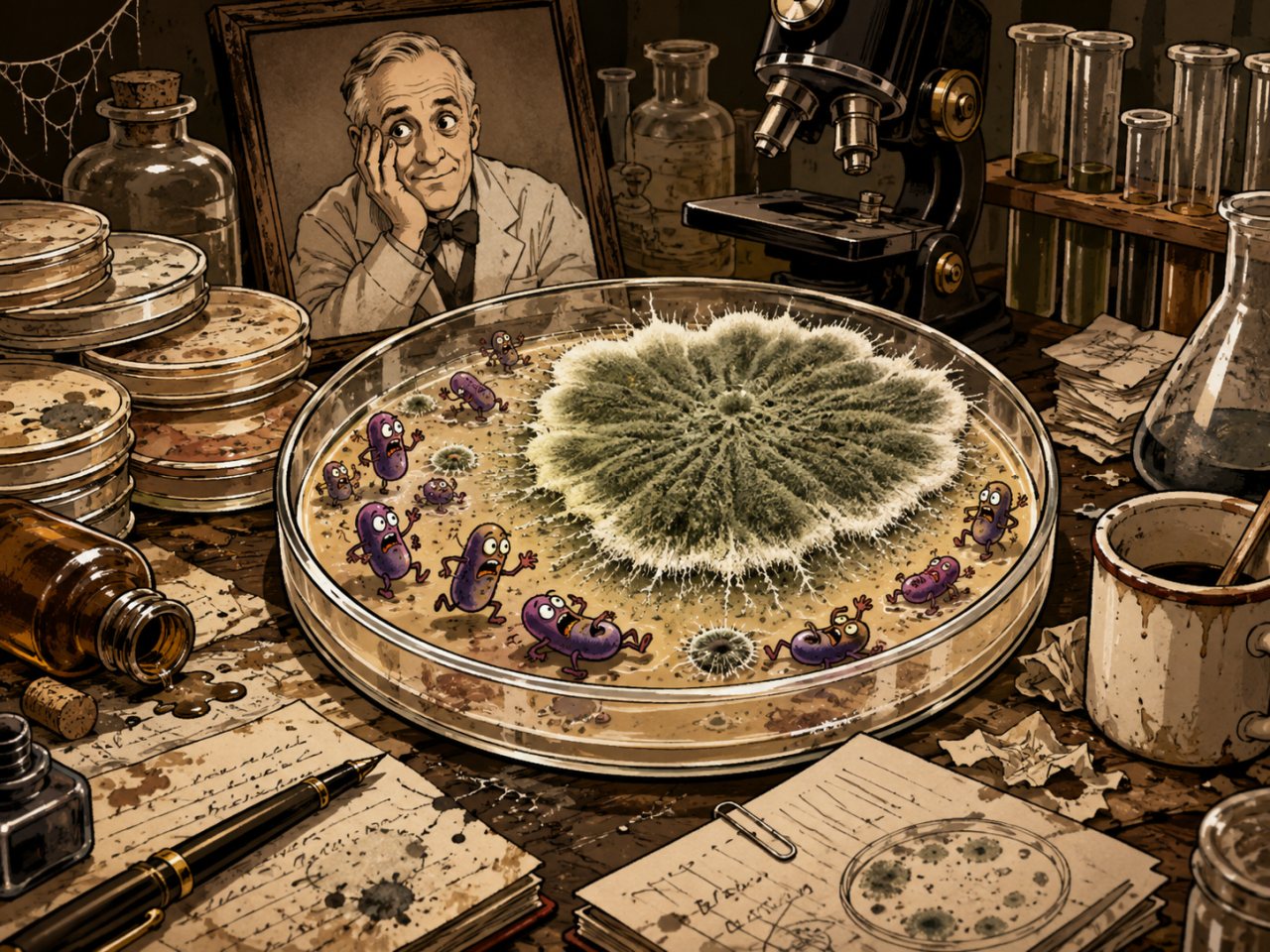
In 1928, microbiologist Alexander Fleming left St. Mary’s Hospital in London for a holiday, abandoning a collection of bacterial culture plates on a laboratory bench. His workspace was already famous for being less “meticulously organized research facility” and more “perhaps something important is buried underneath that pile.”
When Fleming returned, an unidentified mold had invaded one of the dishes and terrorized the bacteria growing there. The bacteria closest to the intruder had been destroyed, while colonies farther away continued about their business, presumably hoping not to attract attention.
Fleming reportedly surveyed this scene of microbial devastation and remarked, “That’s funny.”
Displaying considerably more curiosity than housekeeping enthusiasm, he investigated. Fleming hypothesized that the mold was producing a substance that inhibited several kinds of bacteria. Fleming named that substance penicillin, beginning the chain of research that would eventually produce one of the most important medicines in modern history.
This was not even the first useful substance Fleming had discovered among the biological debris in his laboratory. Fleming also fortuitously discovered an antibacterial component of snot after mixing his nasal discharge with contaminated bacterial plates in the same messy lab. His colleague V. D. Allison later recalled teasing Fleming about his clutter, only to be told, in effect, that excessive tidiness might have prevented both discoveries.
I remind my husband of this whenever he complains about dishes in the sink. One never knows where the next medical revolution may be growing.
The Real Story
Fleming’s untidy laboratory had already produced one antibacterial surprise before penicillin entered the story.
In 1922, he discovered lysozyme, an enzyme found in tears, saliva, mucus, and other bodily secretions. Lysozyme can break apart an important component of certain bacterial cell walls, making it one of the body's natural defenses against microbes. Today it is recognized as part of the innate immune system, although its broader role in immunity was not fully understood when Fleming first encountered it.
Six years later, Fleming was studying staphylococci, a group of round bacteria that includes species capable of causing skin infections, pneumonia, bloodstream infections, and other diseases. Before leaving for his holiday in 1928, he left several culture plates containing these bacteria on a laboratory bench.
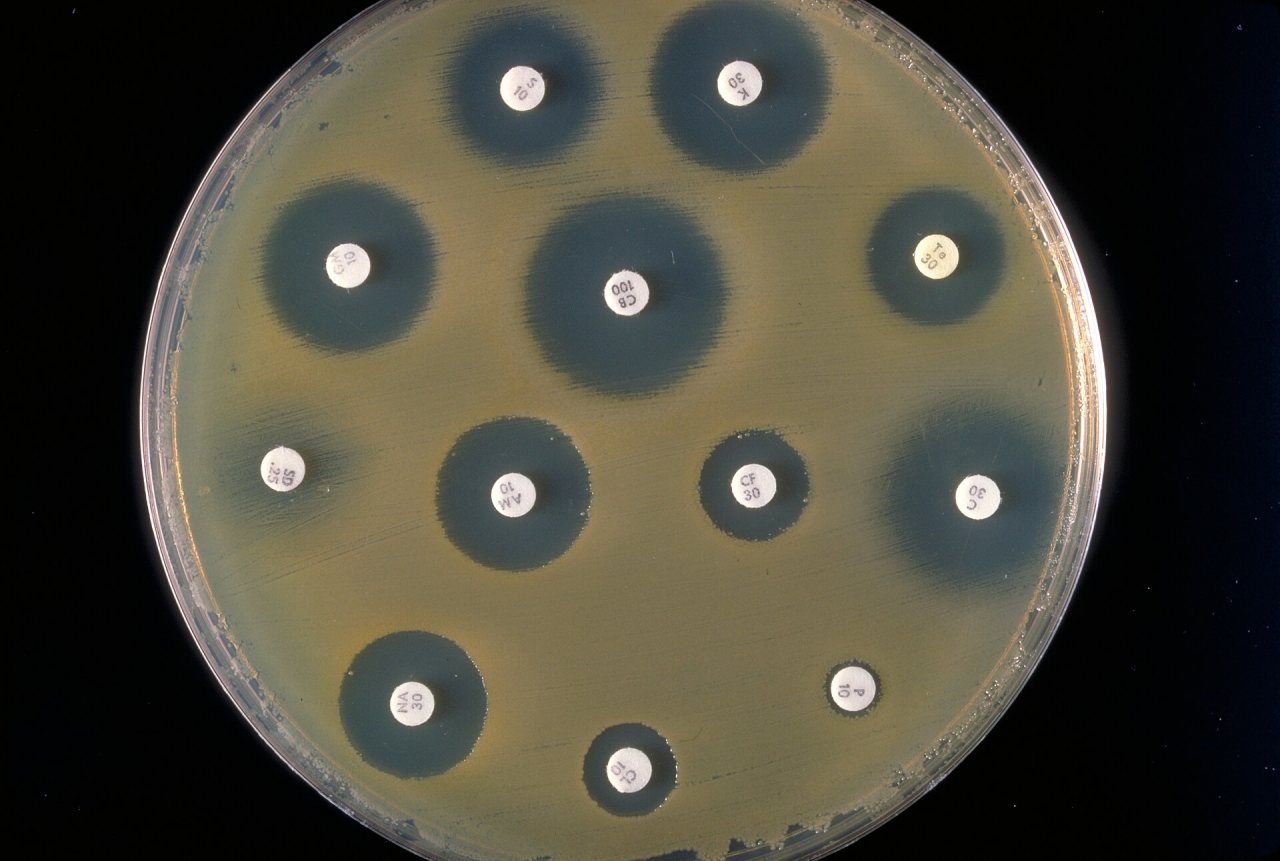
When he returned, Fleming noticed that one plate had been contaminated by a mold. The bacteria had grown normally across much of the dish, but the area immediately surrounding the mold was clear.
That clear space is called a zone of inhibition. It forms when a substance released into the surrounding growth medium prevents nearby bacteria from multiplying or kills them outright. The larger bacterial colonies farther from the mold were outside the substance's most effective range.
Fleming determined that the mold belonged to the genus Penicillium and that it released a substance capable of inhibiting several bacteria. He called the substance penicillin and published his findings in 1929. The original mold is now classified as Penicillium rubens, although older accounts commonly identify it under earlier names.
Penicillin was promising, but it was not yet a practical medicine. Fleming's mold produced only small quantities, and the active substance was unstable and difficult to isolate in a purified form. His laboratory could demonstrate that it worked against bacteria, but it could not manufacture enough reliable penicillin to treat infections on a useful scale.
More than a decade later, Howard Florey, Ernst Chain, Norman Heatley, Edward Abraham, and other researchers at Oxford developed methods for purifying penicillin, testing it in animals and humans, and producing it in much larger quantities. Researchers, government laboratories, and pharmaceutical manufacturers in Britain and the United States then helped turn penicillin into a widely available drug.
In 1945, Fleming, Florey, and Chain jointly received the Nobel Prize in Physiology or Medicine "for the discovery of penicillin and its curative effect in various infectious diseases."
Penicillin did not single-handedly create every antibiotic that followed, but its successful development helped usher medicine into what became known as the antibiotic era. Infections that had once turned small wounds, routine surgery, and childbirth into potentially fatal events could finally be treated directly with powerful antibacterial drugs.
Sources
-
Personal Recollections of Sir Almroth Wright and Sir Alexander Fleming
Allison, V. D. (1974). Personal recollections of Sir Almroth Wright and Sir Alexander Fleming. The Ulster Medical Journal, 43(2), 89–98.
Why this source matters: Firsthand recollections from Fleming’s colleague and longtime friend, supporting details about Fleming’s laboratory habits, personality, lysozyme work, and the circumstances surrounding his discoveries.
-
On the Antibacterial Action of Cultures of a Penicillium, with Special Reference to Their Use in the Isolation of B. influenzæ
Fleming, A. (1929). On the antibacterial action of cultures of a Penicillium, with special reference to their use in the isolation of B. influenzæ. British Journal of Experimental Pathology, 10(3), 226–236.
Why this source matters: Fleming’s original publication describing the antibacterial effect of the mold, the substance he named penicillin, and its activity against several bacteria.
-
Discovery and Development of Penicillin
American Chemical Society International Historic Chemical Landmarks. (1999). Discovery and development of penicillin. American Chemical Society.
Why this source matters: Historical overview of Fleming’s observation, the difficulty of isolating penicillin, the Oxford team’s later work, and the development of large-scale production in the United States.
-
Penicillin Man: Alexander Fleming and the Antibiotic Revolution
Brown, K. (2004). Penicillin man: Alexander Fleming and the antibiotic revolution. Sutton Publishing.
Why this source matters: Book-length historical account of Fleming, the discovery of penicillin, the Oxford research team, wartime production, and the myths that developed around the story.
-
Applications of Lysozyme, an Innate Immune Defense Factor, as an Alternative Antibiotic
Ferraboschi, P., Ciceri, S., & Grisenti, P. (2021). Applications of lysozyme, an innate immune defense factor, as an alternative antibiotic. Antibiotics, 10(12), 1534. https://doi.org/10.3390/antibiotics10121534
Why this source matters: Modern review supporting the explanation of lysozyme as an innate antibacterial defense factor found in bodily secretions and other biological sources.
-
The Nobel Prize in Physiology or Medicine 1945
Nobel Prize Outreach. (n.d.). The Nobel Prize in Physiology or Medicine 1945.
Why this source matters: Official Nobel Prize summary confirming that Alexander Fleming, Ernst Boris Chain, and Howard Walter Florey jointly received the 1945 prize for penicillin and its curative effects.
-
A Brief History of the Antibiotic Era: Lessons Learned and Challenges for the Future
Aminov, R. I. (2010). A brief history of the antibiotic era: Lessons learned and challenges for the future. Frontiers in Microbiology, 1, 134.
Why this source matters: Review supporting the broader historical significance of penicillin and its role in beginning the modern antibiotic era.