Surprise! The Pacific Ocean has large swings in winds, rainfall, and sea-surface temperatures.
I know. Absolutely shocking behavior from the largest and deepest ocean on Earth.
But these changes are not random little mood swings. They are part of a recurring climate pattern called the El Niño–Southern Oscillation, or ENSO, in which the tropical Pacific shifts among a warm phase, a cool phase, and periods that scientists unimaginatively call neutral.
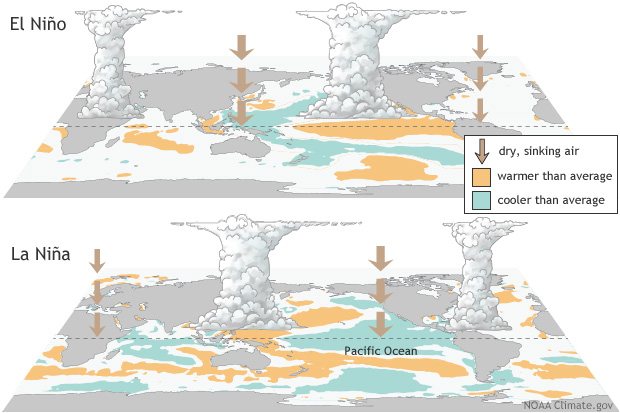
During El Niño, Spanish for “the little boy,” surface waters across the central and eastern tropical Pacific become warmer than average while the normally east-to-west trade winds weaken. Those changes rearrange where heat and rainfall occur across the Pacific, and the atmosphere responds accordingly.
And the Little Boy does not keep his problems at home.
El Niño can alter rainfall, drought, temperatures, storm tracks, fisheries, agriculture, and tropical cyclone activity thousands of miles away. It also tends to push global average temperatures upward while it is underway.
Then comes La Niña, Spanish for “the little girl.”
During La Niña, the trade winds strengthen and cooler-than-average water spreads across the central and eastern tropical Pacific. The Little Girl has arrived, and she brings her own weather agenda.
That extra upwelling can be good news for marine productivity and fisheries in some regions.
But lest you think La Niña is all “sugar and spice and everything nice” while El Niño gets saddled with the “snips and snails and puppy-dog tails” reputation, the Little Girl is perfectly capable of causing trouble too.
La Niña tends to favor a busier Atlantic hurricane season, while El Niño tends to suppress Atlantic hurricanes and favor more hurricane activity in the eastern and central Pacific. Both phases can also contribute to drought or heavy rainfall and flooding, depending on where you live.
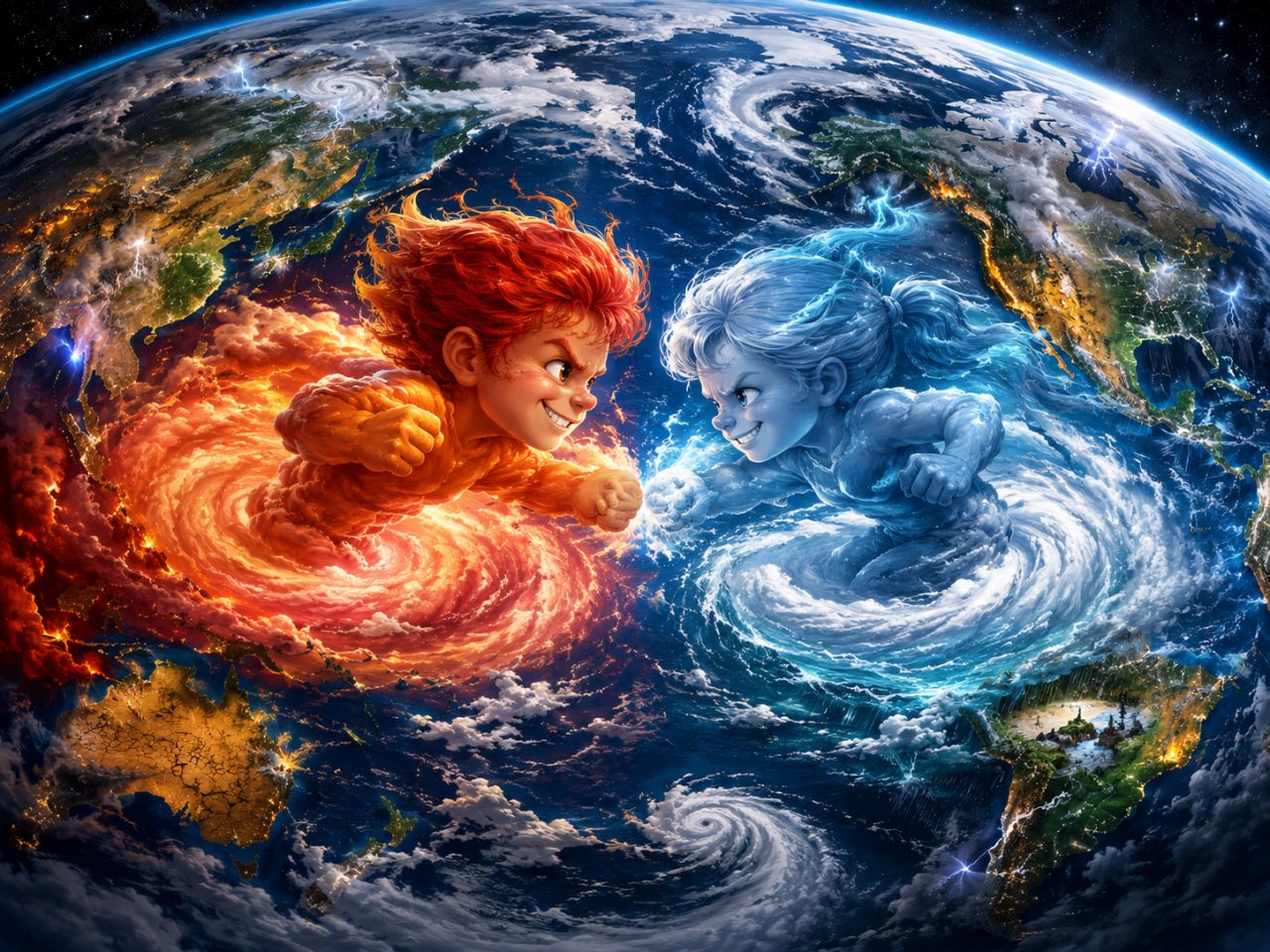
So yes: the Little Boy and the Little Girl may start their argument over the tropical Pacific...
…but the rest of the planet gets dragged into it.
And somewhere, your weather app is quietly updating itself again.
The Real Story
El Niño and La Niña are not storms, hurricanes, or individual weather events. They are the warm and cool phases of a larger natural climate pattern called the El Niño–Southern Oscillation, or ENSO, centered in the tropical Pacific Ocean. Between them is a third state called ENSO-neutral, when ocean temperatures and atmospheric conditions are closer to their long-term averages.
Under ordinary Pacific conditions, steady trade winds blow from east to west along the equator. Those winds help push warm surface water toward Asia and allow colder water from deeper in the ocean to rise near the western coast of South America. That rising water, called upwelling, is rich in nutrients and supports productive marine ecosystems and fisheries.
During El Niño, the trade winds weaken. Warm surface water spreads farther east across the central and eastern tropical Pacific, and the usual upwelling of cold water near South America is reduced. During La Niña, the opposite tendency occurs: the trade winds strengthen, warm water is pushed farther west, and cold-water upwelling in the eastern Pacific becomes stronger.
If that were all ENSO did, it would be mostly a Pacific Ocean story.
It isn't.
The ocean and atmosphere constantly exchange heat and moisture. When the location of warm tropical Pacific water changes, the location of rising warm air and heavy rainfall changes with it. That alters large-scale atmospheric circulation and can shift jet streams and storm tracks. The result is a chain of effects that can influence weather far beyond the tropical Pacific.
Those distant connections are called teleconnections. They are why an El Niño or La Niña event can change the odds of drought, flooding, unusual temperatures, tropical cyclones, crop problems, and changes in marine ecosystems thousands of kilometers away from the Pacific waters where ENSO begins.
For example, El Niño commonly favors wetter conditions in some regions and drier conditions in others, while also tending to raise global average temperatures. It usually suppresses Atlantic hurricane activity while favoring more tropical cyclone activity in parts of the central and eastern Pacific. La Niña often shifts many of these tendencies in the opposite direction and can favor a more active Atlantic hurricane season.
But El Niño does not mean “everywhere gets hotter and wetter,” and La Niña does not mean “everywhere gets colder and drier.”
Each ENSO event develops differently, and its effects depend on its strength, timing, duration, location, and interactions with other climate patterns. Some regions may experience strong effects while others notice relatively little. ENSO changes the odds of particular seasonal weather patterns; it does not dictate every storm, drought, or rainy day.
And ENSO does not follow a tidy alternating schedule. El Niño and La Niña events occur irregularly, typically every two to seven years, and neutral conditions can persist between them. A neutral year simply means neither the El Niño nor La Niña pattern is dominating the tropical Pacific. It most definitely does not mean the weather has agreed to behave itself.
So the Little Boy and Little Girl aren't storms roaming around the planet.
They're enormous shifts in the relationship between the tropical Pacific Ocean and the atmosphere above it.
And when the world's biggest ocean changes the way it moves heat around, apparently the rest of us get copied on the email.
Sources
-
What are El Niño and La Niña?
National Oceanic and Atmospheric Administration. (2024, June 16). What are El Niño and La Niña? National Ocean Service.
Why this source matters: Primary lay-level source for the article. Supports the basic ENSO cycle; normal Pacific trade winds and upwelling; weakening trade winds during El Niño; strengthening trade winds and increased upwelling during La Niña; the meanings of El Niño and La Niña; marine impacts; and broad weather effects.
-
El Niño / La Niña Phenomena
World Meteorological Organization. El Niño / La Niña Phenomena. World Meteorological Organization.
Why this source matters: Supports El Niño and La Niña as opposite phases of ENSO; ENSO-neutral as the third state; warm and cool tropical-Pacific conditions; changes in trade winds; the irregular two-to-seven-year cycle; worldwide temperature and rainfall effects; the role of event strength and timing; and the important caveat that ENSO changes seasonal probabilities rather than determining weather everywhere.
-
WMO: Prepare for El Niño
World Meteorological Organization. (2026, June 2). WMO: Prepare for El Niño.
Why this source matters: Supports typical El Niño effects on global temperatures, rainfall and drought patterns, and tropical cyclone activity, including greater central/eastern Pacific hurricane activity and suppressed Atlantic hurricane formation. Also emphasizes that individual El Niño events vary in strength and impact.