
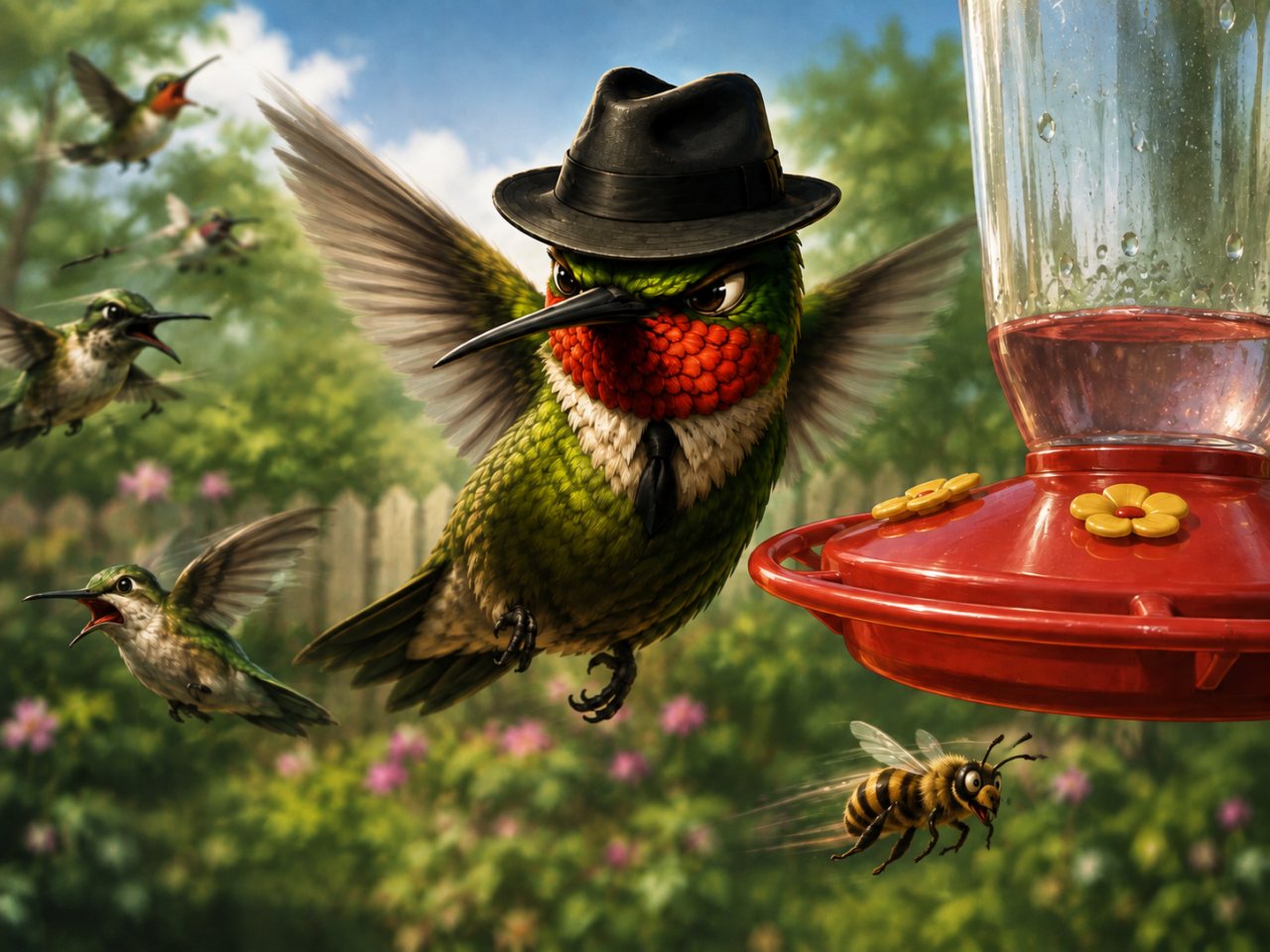
This story comes to you live from a rural Georgia property overrun by sky goblins with anger issues, otherwise known as ruby-throated hummingbirds.
A local woman has purchased multiple hummingbird feeders. She regularly cleans them, manufactures fresh sugar water, and keeps the feeders filled.
What she did not anticipate was the arrival of Vinnie Sugarbeak and the subsequent annexation of all sugar operations into his growing empire.
Property records indicate that Vinnie does not own the home.
Or the land.
Financial records further indicate that Vinnie did not purchase the feeder. Or the sugar. Or pay the water bill.
Witnesses confirm that Vinnie has never mixed a single batch of sugar water.
He has never cleaned a feeder.
He has never contributed so much as one cent toward operating expenses.
Nevertheless, the feeder is Vinnie’s.
Vinnie also insists that every hummingbird approaching the feeder is trespassing.
So are the bees.
So are other species of birds.
Even the woman herself is not immune to Vinnie’s strong-arm tactics. She was recently overheard muttering, “I’m hanging up more sugar water for you, you bossy bastard,” while Vinnie hovered threateningly nearby.
Vinnie declined to comment, but immediately chased another hummingbird across the yard.
The Real Story
Vinnie’s ownership claim would not survive even the most hummingbird-friendly property court. His behavior, however, is perfectly real.
Ruby-throated hummingbirds commonly defend valuable food sources, including nectar-producing flowers and artificial feeders. A bird may perch where it can watch the feeder, rush toward an approaching competitor, and pursue the intruder until it leaves the area. Male ruby-throated hummingbirds are particularly well known for aggressively defending flowers and feeders, sometimes engaging in dramatic aerial chases and even jabbing rivals with their bills.
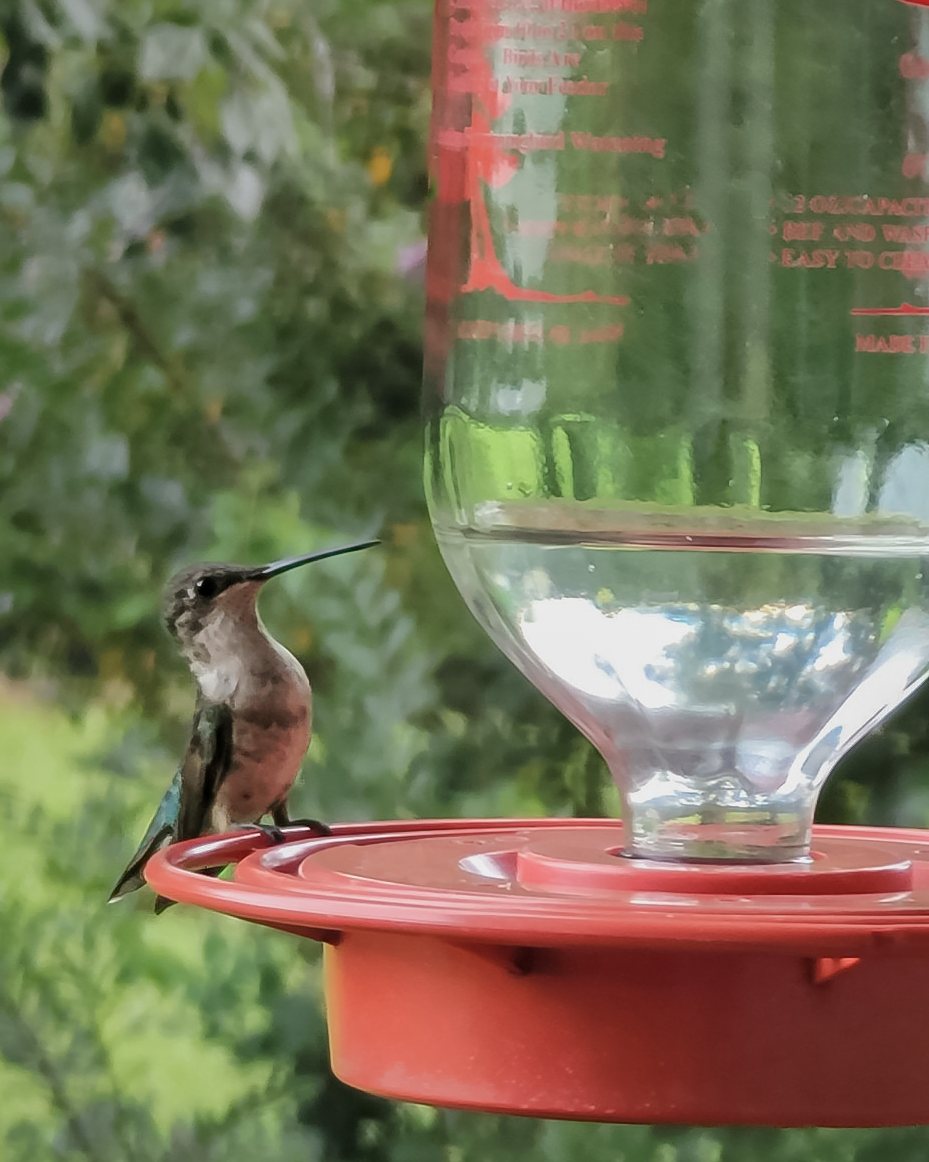
From Vinnie’s perspective, a feeder is an unusually attractive piece of real estate. Flowers scatter nectar across many individual blooms, and their rewards change as nectar is consumed and replenished. A regularly maintained feeder places a large, predictable supply of sugar water in one convenient location. Instead of searching across the landscape for many small meals, a hummingbird that controls the feeder gains repeated access to a concentrated energy source.
But defending food is not free.
Every patrol, threat display, and high-speed pursuit requires energy and takes time that could otherwise be spent feeding or resting. It may also draw attention to the bird and increase its exposure to predators. Territorial defense is therefore most useful when the resource is valuable enough to protect but concentrated enough that one bird can realistically control access to it.
Research on marked ruby-throated hummingbirds has shown that feeder monopolization depends on more than simple aggression. The number of competitors, the bird’s use of the surrounding space, the concentration of sugar in the feeder, and how clearly the bird can see the area all help determine whether one individual can successfully dominate a food source.
The resulting confrontations are not merely theatrical. Researchers who recorded ruby-throated hummingbirds defending a feeder found that the birds used rapid accelerations, tight turns, steep approaches, and demanding changes in speed and direction during competitive encounters. Some of these maneuvers brought them close to their estimated limits for flight force and metabolic power.
In other words, Vinnie is spending real energy to maintain an empire he did not purchase, stock, clean, or legally acquire.
Whether this strategy succeeds depends on who else arrives, how easily Vinnie can monitor the feeder, and whether repeated chases cost more energy than exclusive access saves him. A determined rival may keep returning. Several hummingbirds may overwhelm one defender. Another especially aggressive bird may seize the property through an entirely separate hostile takeover.
Until then, the feeder remains under Vinnie’s control.
The deed to the house and property remains under someone else’s name.
Sources
-
Resource defense and monopolization in a marked population of ruby-throated hummingbirds (Archilochus colubris)
Rousseu, F., Charette, Y., & Bélisle, M. (2014). Resource defense and monopolization in a marked population of ruby-throated hummingbirds (Archilochus colubris). Ecology and Evolution, 4(6), 776–793.
Why this source matters: Primary research supporting the explanation that ruby-throated hummingbirds defend and sometimes monopolize nectar feeders. The study examined how feeder defense was influenced by competitor abundance, individual space use, nectar sucrose concentration, and habitat visibility. It supports the article’s central point that successful feeder control depends on both resource value and whether the site can be practically defended.
-
Field Flight Dynamics of Hummingbirds during Territory Encroachment and Defense
Sholtis, K. M., Shelton, R. M., & Hedrick, T. L. (2015). Field flight dynamics of hummingbirds during territory encroachment and defense. PLOS ONE, 10(6), e0125659.
Why this source matters: Primary research measuring the three-dimensional flight trajectories of wild ruby-throated hummingbirds defending, approaching, and departing from a feeder. It supports the description of rapid approaches, acceleration, turning, and the substantial physical demands of competitive feeder defense. The authors note that the birds approached estimated maximum flight-force and power capabilities during some defensive maneuvers.
-
Ruby-throated Hummingbird Life History
Cornell Lab of Ornithology. (n.d.). Ruby-throated Hummingbird life history. All About Birds.
Why this source matters: Authoritative species overview supporting the general description of ruby-throated hummingbird behavior. The page states that males aggressively defend flowers and feeders and that these encounters can include aerial chases, dogfights, and occasional jabs with the bill. It also supports the basic dietary context that ruby-throated hummingbirds use flower nectar and hummingbird feeders while also consuming insects.