
You probably remember the basics of pollination. A flower gets pollinated, fertilization follows, and sometime later you have a fruit. A tomato. An apple. Maybe a peach.
Or a peanut.
Except peanuts do things a little weirdly.
First, did you know that peanuts are legumes? That’s right. They belong to the same plant family as beans, peas, lentils, chickpeas, and soybeans: the great collection of nutritious seeds that grow inside pods and provide plenty of protein and fiber.
But wait a minute.
Peanuts grow UNDERGROUND.
Also correct.
Peanuts are little weirdos.
Their small yellow flowers bloom above ground, where they usually pollinate themselves. Then, after fertilization, the plant does something that sounds considerably less botanical and considerably more criminal.
It buries the fertilized ovary.
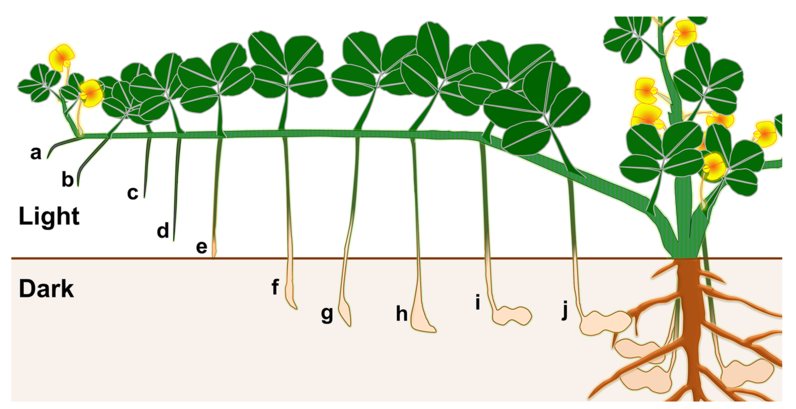
A structure beneath the ovary begins growing downward toward the soil, carrying that ovary with it. It eventually pushes into the dirt, where the fertilized ovary develops underground into the familiar peanut pod.
And yes, if you’re wondering why we’re casually referring to fruit as an ovary now, see our previous scandal about how you’ve been eating plant ovaries your whole life.
So let’s review.
Peanuts are not roots like carrots.
They are not underground stems like potatoes.
They are not bulbs like onions.
And peanuts are definitely not botanical nuts.
That last identity crisis is another upcoming scandal. [The scandal is in: Why peanuts aren't nuts!]
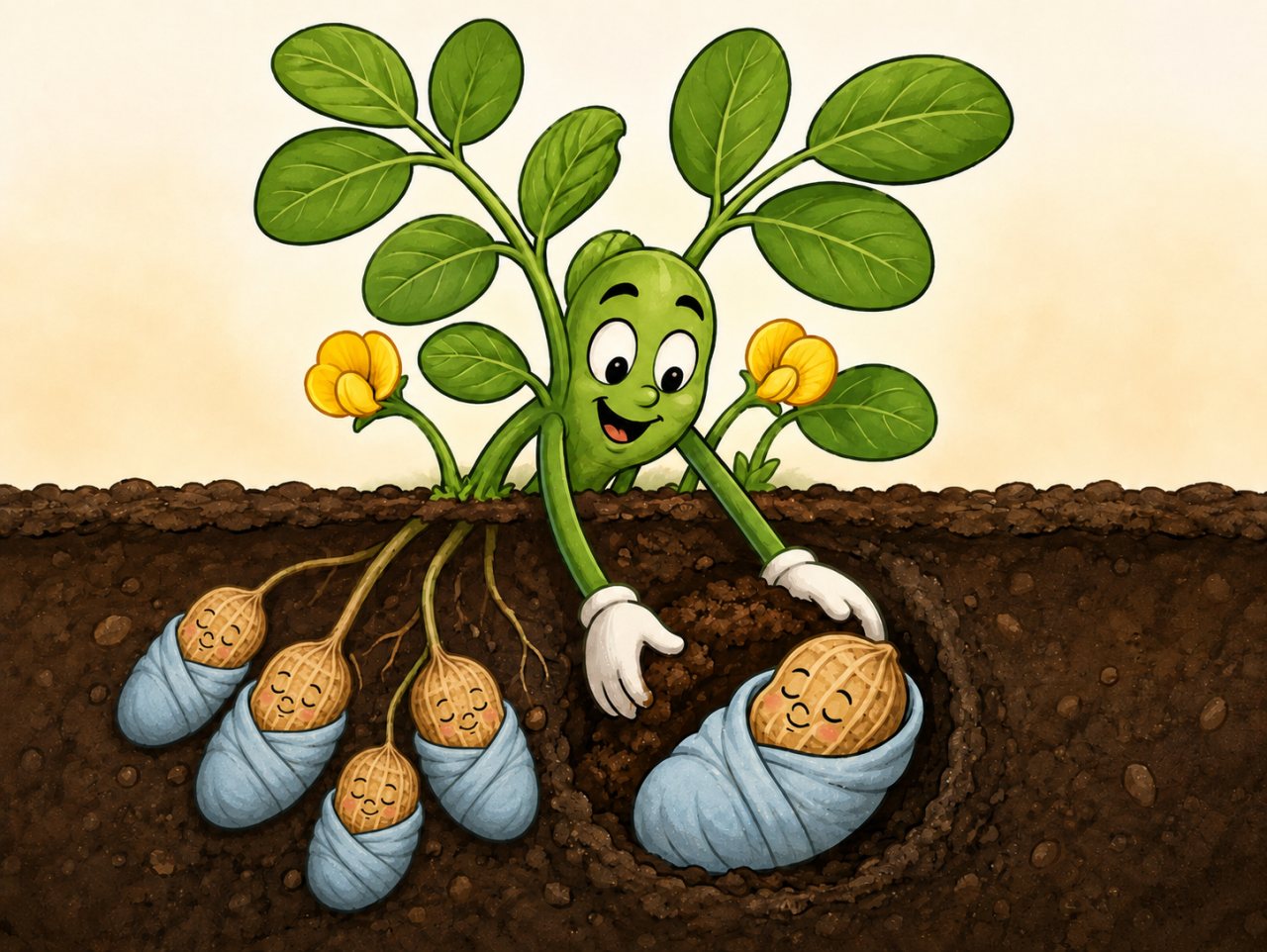
Peanuts are basically legumes that flower above ground and then bury their developing offspring.
In other words, the peanut plant essentially says:
“Thanks for the fertilization. I will now bury the resulting pregnancy.”
The Real Story
The peanut plant, Arachis hypogaea, is a flowering plant in the legume family, Fabaceae. Its relatives include beans, peas, lentils, chickpeas, and soybeans. Like other legumes, peanuts produce their seeds inside a pod.
What makes peanuts unusual is where that pod develops.
Peanut flowers form above ground. They are typically self-pollinating, and after fertilization, a specialized structure begins to elongate from the base of the ovary. This structure is called a gynophore, although peanut growers and botanists often simply call it a peg.
The peg contains the fertilized ovary at its tip.
At first, the peg grows outward and upward. Then it changes direction in response to gravity and begins growing downward. This response is called positive gravitropism: growth toward the pull of gravity.
The peg eventually reaches the soil and pushes its tip underground, carrying the fertilized ovary with it.
This reproductive strategy is called geocarpy, meaning that the fruit develops beneath the ground. Peanuts are among the best-known examples.
And the underground part is not optional.
During the early stages after fertilization, development of the peanut embryo slows dramatically while the peg is still exposed to light. Once the peg penetrates the soil, conditions change. Darkness, contact with the soil, and mechanical stimulation help trigger the developmental shift that allows the embryo to resume growth and the ovary to enlarge into a pod.
The peg itself also changes. After entering the soil, its tip reorients and the ovary begins to swell. The mature peanut pod then develops underground, with the seeds we call peanuts growing inside it.
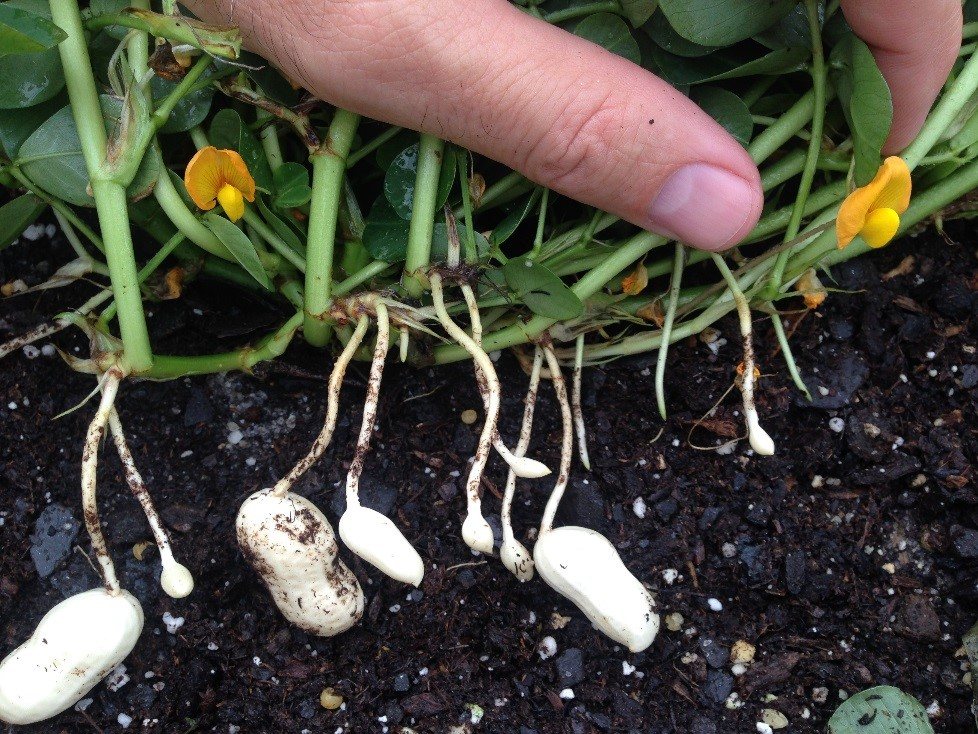
That means the familiar shell is not a root, tuber, bulb, or underground stem. It is a fruit wall surrounding seeds.
And because the peanut is a legume, the peanut pod is botanically related to pods such as peas and beans. It just happens to be the relative that insists on finishing its reproductive business underground.
Scientists are still studying exactly how the peanut plant integrates gravity, light, hormones, mechanical stimulation, and gene regulation to control this unusual developmental sequence. But the broad pattern is clear: flowering and fertilization happen above ground, while pod and seed development take place below it.
Most flowering plants keep their reproductive structures where sunlight and pollinators can find them. Peanuts use the above-ground world for flowers and then send the next generation underground.
Apparently even plants can believe that some family matters are best handled in private.
Sources
-
Peanut – Arachis hypogaea
Royal Botanic Gardens, Kew. “Peanut – Arachis hypogaea.” Kew Gardens.
Why this source matters: Supports peanut classification as a legume in Fabaceae and provides an accessible description of geocarpy, with flowers above ground and fruit development below ground.
-
Peg Biology: Deciphering the Molecular Regulations Involved During Peanut Peg Development
Kumar R, Pandey MK, Roychoudhry S, Nayyar H, Kepinski S, Varshney RK. Peg Biology: Deciphering the Molecular Regulations Involved During Peanut Peg Development. Front Plant Sci. 2019 Oct 18;10:1289.
Why this source matters: Best overall source for the biology of the peg/gynophore. Supports positive gravitropism, peg elongation, embryo developmental arrest while aerial, soil penetration, and the roles of darkness and mechanical stimulation in pod development.
-
Transcriptome profiling of peanut gynophores revealed global reprogramming of gene expression during early pod development in darkness
Xia H, Zhao C, Hou L, Li A, Zhao S, Bi Y, An J, Zhao Y, Wan S, Wang X. Transcriptome profiling of peanut gynophores revealed global reprogramming of gene expression during early pod development in darkness. BMC Genomics. 2013 Jul 29;14:517.
Why this source matters: Supports the striking light/dark developmental switch. Peanut embryo and fruit development can remain arrested while the gynophore is exposed to light and resume after burial in darkness, accompanied by major changes in gene expression.