
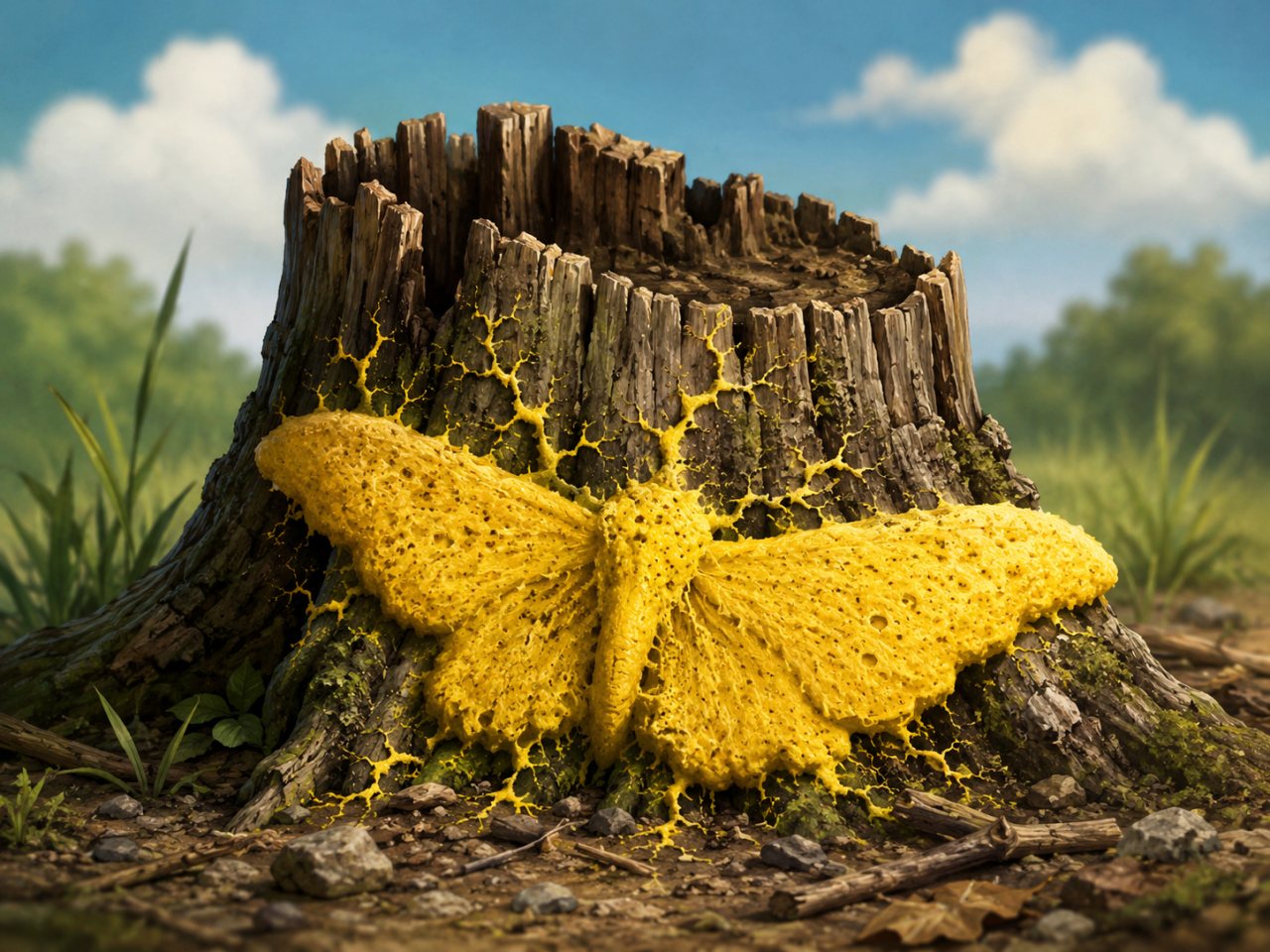
One morning I looked out my bathroom window.
And then did a double-take.
Was that a ginormous yellow moth sitting at the base of a dead tree stump in our front yard?
After snapping a quick picture from the window, I ran outside to investigate.
Nope.
Definitely NOT a moth.
Instead, it was something much, much stranger.
It was a slime mold that had apparently decided to grow in the shape of a bright yellow moth.
Despite having the word “mold” in the name, slime molds are not fungi. They are generally grouped among the protists: an extraordinarily diverse assortment of eukaryotic organisms that mostly share the distinction of not being animals, plants, or fungi.
Basically, protists are the junk kitchen drawer of the eukaryotes.
For decades, introductory biology courses often sorted them into handy categories such as “plant-like,” “animal-like,” and “fungus-like” protists. Those labels are useful descriptions, but modern evolutionary relationships are considerably messier.
Yep.
Protists are weird.
Slime molds earned the old “fungus-like protist” label because they live on decaying material, produce spores, and form structures that can look suspiciously fungal.
They also like moisture, which is why you often find them on logs, bark, mulch, leaf litter, and other damp places.
This particular one appeared on my dead tree stump after several days of heavy rain.
There are many different slime molds, but the one in my photographs appears to be Fuligo septica, charmingly known as dog vomit slime mold.
Really.
And this thing is WEIRD.
Fuligo septica is a plasmodial slime mold. Earlier in its life cycle, it exists as tiny amoeba-like cells. After compatible cells fuse, the resulting cell begins dividing its nuclei over and over without dividing the whole cell into separate daughter cells.
The result is a plasmodium: one enormous cell containing many nuclei.
Yes.
Believe it or not, that giant yellow mass in my photograph is technically one cell.
And it can move.
The plasmodium creeps across surfaces using amoeboid movement while feeding on bacteria, yeasts, fungal spores, and other microorganisms living among the decaying material. Inside it, cytoplasm streams through branching channels, and I actually caught some of that network-like structure in one of my photographs.
Eventually, the plasmodium switches from feeding and wandering around to reproduction.
It transforms into a spore-producing structure, which releases spores capable of starting the next generation. Sure enough, within a few days my fake yellow moth had changed dramatically, drying into a much paler, crustier mass as it moved into that reproductive stage.
So slime molds are one of those organisms that make our neat schoolroom categories look hilariously overconfident.
It’s not a fungus.
It’s definitely not a ginormous yellow moth.
And during the stage I photographed, it was apparently one giant cell crawling around on a dead tree stump.
Biology really does need better warning labels.
The Real Story
Slime molds are a good reminder that biology does not care whether our categories feel tidy.
The yellow “moth” on my dead tree stump was not an insect, and it was not a fungus either. It appears to have been Fuligo septica, commonly called dog vomit slime mold—a plasmodial slime mold often found on mulch, decaying wood, bark, leaf litter, and other damp organic surfaces. Fresh Fuligo septica is often bright yellow and can look uncannily like scrambled eggs, spilled foam, or, in my case, a giant moth pasted onto a tree stump. As it matures, it typically becomes paler, drier, crustier, and more powdery.
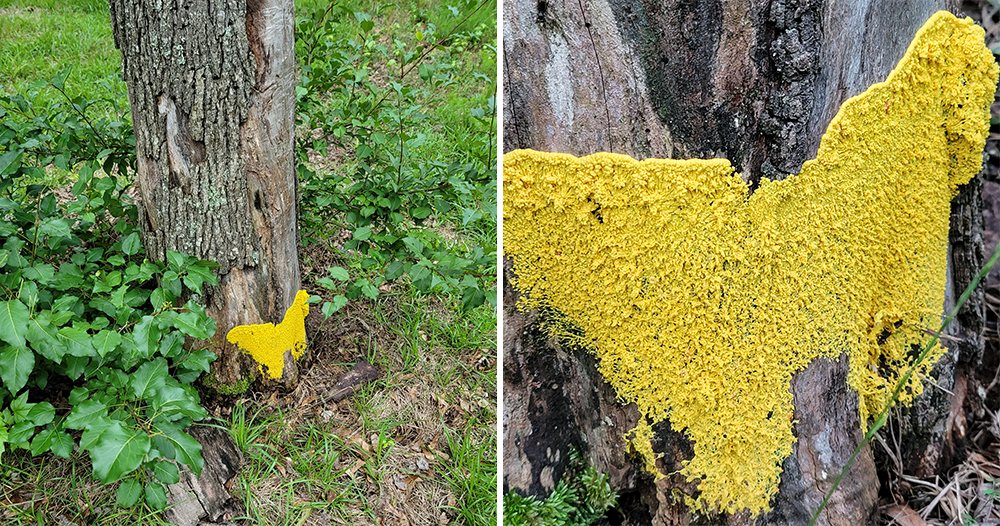
Despite the name, slime molds are not true molds and are not part of the kingdom Fungi. In everyday teaching language, they are usually discussed as protists—a convenient umbrella term for eukaryotic organisms that are not animals, plants, or fungi. That umbrella is a messy one, and “slime mold” itself is not one neat, single lineage. But the particular kind relevant here—plasmodial slime molds, also called myxomycetes—belongs among the amoebozoans.
That classification matters because plasmodial slime molds do something wonderfully strange: during one major stage of their life cycle, they exist as one enormous cell containing many nuclei.
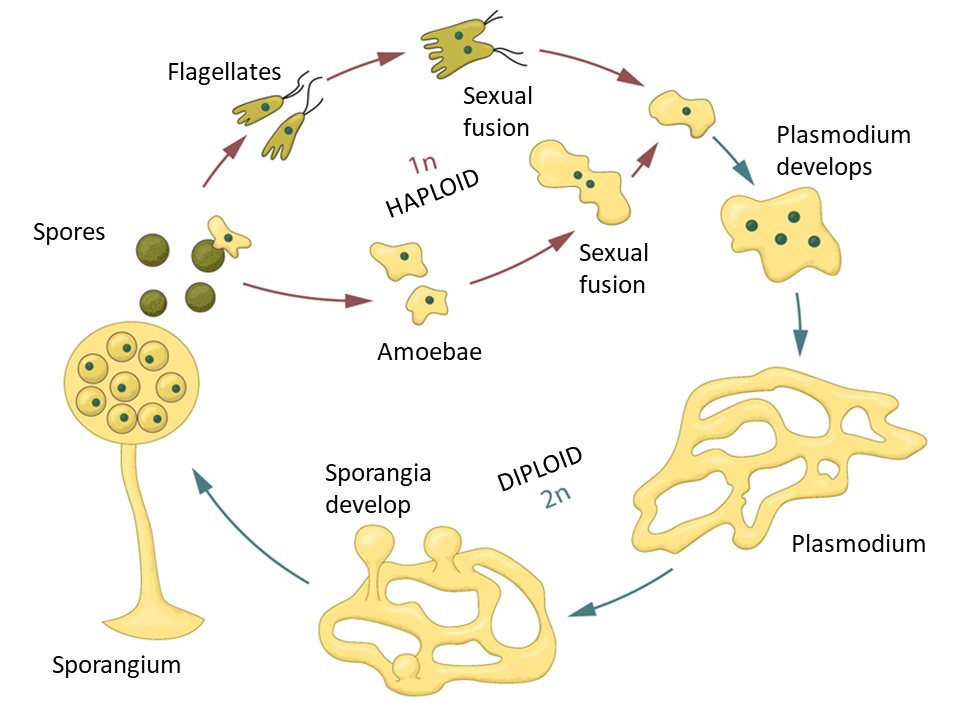
The life cycle starts with spores. Those spores germinate into tiny haploid amoeba-like cells; under some conditions, flagellated forms can also appear. When compatible cells meet, they fuse. The resulting diploid cell does not simply divide into many separate daughter cells. Instead, its nuclei divide repeatedly without the entire cell splitting apart. The result is a multinucleate plasmodium: a giant, mobile mass of living cytoplasm enclosed by a single cell membrane.
That means the conspicuous organism spreading across my tree stump was, in a very real sense, a single cell.
And not a passive one, either. A plasmodium can move. It creeps slowly across damp surfaces using amoeboid movement while its cytoplasm streams through an internal network of branching veins. It is not “eating the wood” itself so much as grazing on the microscopic life associated with decaying material—especially bacteria, yeasts, fungal spores, and other microorganisms living on and around the stump.
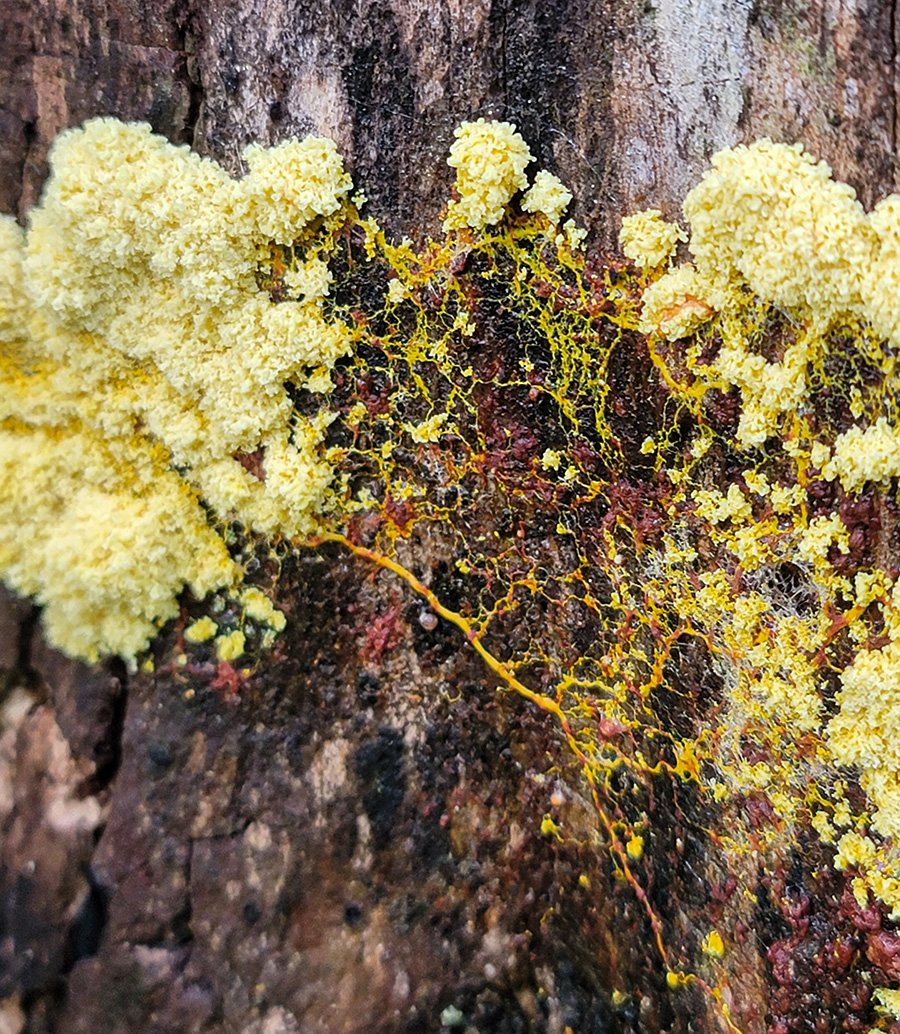
That close-up image gives a better sense of the organism’s architecture. The thicker yellow masses represent the more obvious body of the slime mold, while the finer branching network reflects the protoplasmic strands through which cytoplasm can stream. In other words, the closer I looked, the less “moth” it became and the more it looked like a living road map.
Plasmodial slime molds do not stay in that feeding, wandering state forever. When conditions change—or when development reaches the appropriate stage—the plasmodium can transform into spore-producing structures. In Fuligo septica, the mature mass often becomes much paler than the fresh yellow stage and takes on a dry, crusty, sometimes powdery appearance as it transitions toward reproduction.
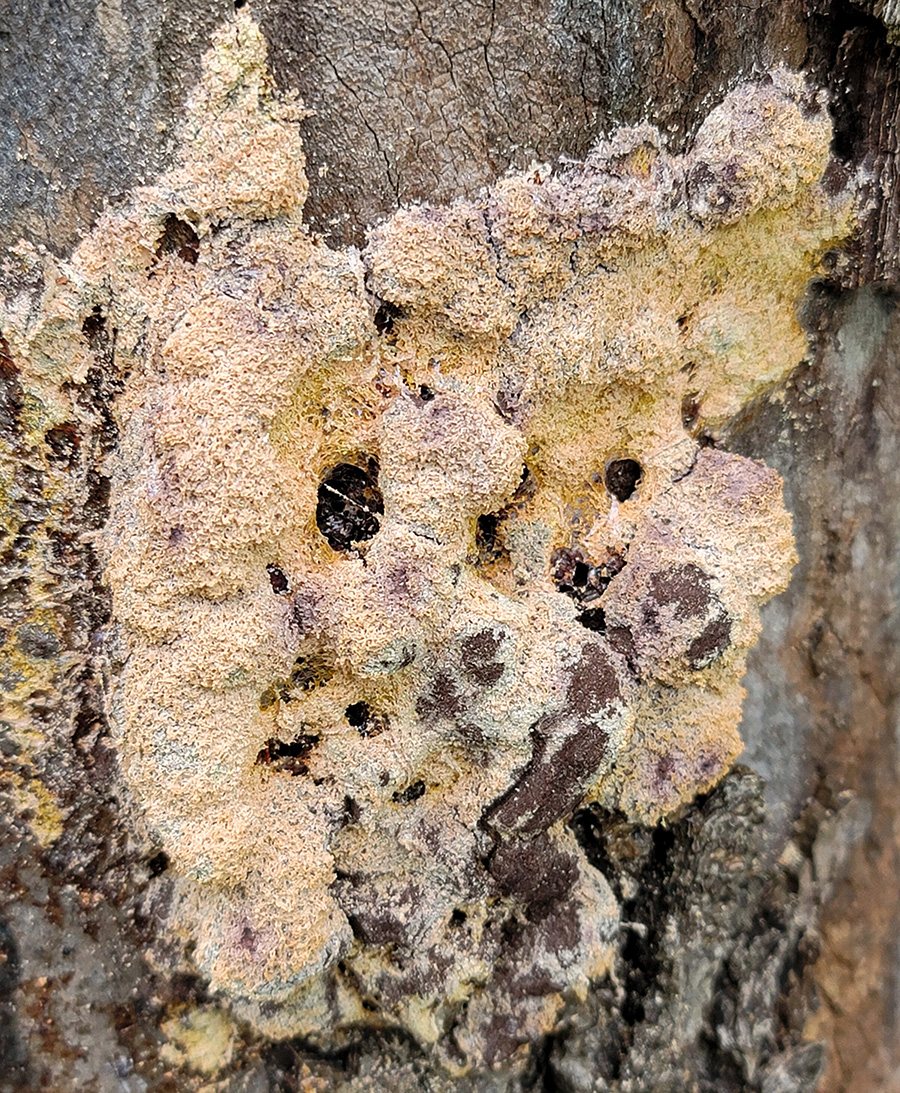
My final photo appears to capture that later stage. A few days after the brilliant yellow “moth” first appeared, the organism had changed dramatically. The vivid color faded, the surface dried, and the mass took on the look of something far less lively and far more crumbly. That visible transformation is part of the biological story: the same organism that first looked like a bright yellow mass of dog vomit was moving toward the stage that would eventually disperse spores and begin the cycle again.
So the scandal here is not merely that I mistook a slime mold for a giant moth.
It is that an organism visible to the naked eye, spreading across a tree stump like a bizarre natural prop, can still belong quite comfortably in a topic called Single-Celled Life.
Because in the plasmodial stage, that dramatic yellow mass is not a swarm of many little animals, and it is not a fungal mycelium.
It is one giant multinucleate cell, oozing across damp wood, eating microbes, and quietly making a mockery of anyone who thinks “single-celled” has to mean “tiny and boring.”
Sources
-
Slime Molds
U.S. National Park Service. (2020, September 28). Slime molds. National Park Service.
Why this source matters: General explanation of slime molds as protists rather than fungi; overview of cellular vs. plasmodial slime molds; description of plasmodia as large multinucleate masses that move and feed on microbes associated with decaying material.
-
23.3 Groups of Protists
OpenStax. (2018). Biology 2e (Section 23.3, “Groups of Protists”). Rice University.
Why this source matters: Lay-level explanation that slime molds are amoebozoans/protists rather than fungi; distinction between plasmodial and cellular slime molds; wording about the multinucleate feeding stage of plasmodial slime molds.
-
A Basic Guide to Mushrooms Commonly Encountered in Potted Plants in Florida
Karlsen-Ayala, E., Gazis, R., & Smith, M. E. (2021). A basic guide to mushrooms commonly encountered in potted plants in Florida (PP377). UF/IFAS Extension, University of Florida.
Why this source matters: Specific information on Fuligo septica—common name dog vomit slime mold, bright yellow fresh appearance, habitat on mulch/bases of trees/other vegetation, feeding on bacteria and yeasts associated with decaying materials, and maturation to a paler, crustier, powderier stage.
-
Deep Phylogeny and Evolution of Slime Moulds (Mycetozoa)
Fiore-Donno, A. M., Nikolaev, S. I., Nelson, M., Pawlowski, J., Cavalier-Smith, T., & Baldauf, S. L. (2010). Deep phylogeny and evolution of slime moulds (Mycetozoa). Protist, 161(1), 55–70.
Why this source matters: Background on slime molds within Amoebozoa / Mycetozoa and the broader classification context for plasmodial slime molds.