

Have you ever seen a trail of ants marching toward a food source and back again, some of them carrying tiny pieces of food in their mandibles?
Most of us are familiar with the sight. Unfortunately, some of us are familiar with it inside our own houses, but I digress.
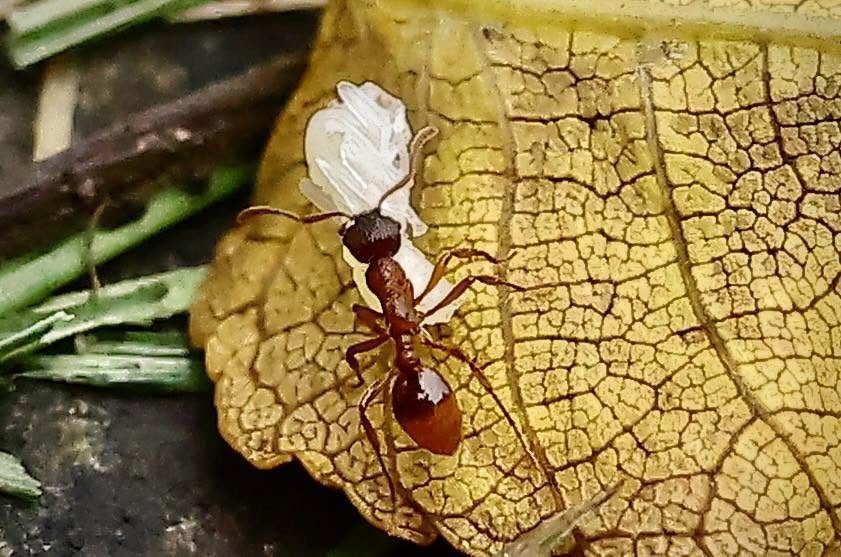
But have you ever seen a line of ants marching along while some of them carry little white parcels?
Congratulations. You may have witnessed an ant colony moving house.
And here is the scandal: nobody is in charge.
Not even the queen.
There is no tiny clipboard. No emergency meeting. No colony-wide announcement that everyone has thirty minutes to pack the larvae and report to Tunnel B.
When conditions at a nest become bad enough that relocation begins, some female workers head out looking for alternatives. A scout finds a promising property, inspects it, and begins persuading sisters to come have a look. Other scouts may be doing exactly the same thing somewhere else.
Soon the colony has what amounts to several competing real-estate agents enthusiastically showing different properties to prospective tenants.
“This one is dark!”
“This one has a tiny entrance!”
“This one has excellent ceilings!”
“This one is three inches closer!”
Nobody compares notes in a conference room. Nobody counts ballots. Yet somehow, as more ants become convinced by one option, momentum builds behind it.
And then something remarkable happens.
One moment you have scouts wandering around, ants inspecting possible homes, and what looks to an outside observer like complete insect chaos.
The next moment:
BABY PARCELS. EVERYWHERE.
Workers begin carrying eggs, larvae, pupae, and even other adult ants toward the new home. Moving day has officially begun.
Naturally, Fred sees his sisters hauling the family across the landscape and immediately announces:
“I’m helping!”
For once, someone decides to take him up on it.
“Fine, Fred. Carry the babies.”
Fred looks at the brood.
Fred looks at his suitcase.
Fred looks back at the brood.
This may have been a mistake.
The Real Story
When an ant colony needs a new home, there is usually no single ant making the decision. The queen does not inspect properties, issue evacuation orders, or direct traffic. Instead, the decision emerges from the actions of many individual workers. Some of the best-studied examples come from house-hunting ants in the genus Temnothorax, which can collectively choose among possible nest sites without any ant overseeing the entire process.
A relatively small number of workers act as scouts. They leave the old nest, search for possible new homes, and evaluate what they find. Depending on the species, ants may respond to features such as darkness, entrance size, cavity dimensions, and other properties that affect how suitable and secure a nest is. Scouts that favor a site can recruit other workers to visit it, often through behaviors such as tandem running, in which one ant literally leads another to the candidate nest.
That recruitment creates positive feedback. A promising site attracts scouts, those scouts recruit more workers, and the growing number of ants at the site makes it increasingly likely that still more ants will become involved. But the colony does not wait for every worker to agree. Instead, house-hunting ants can use a quorum threshold: once enough ants are present at a candidate nest, the colony effectively treats that site as the winner. Researchers have described this as ants almost literally “voting with their feet.”
Reaching that quorum changes the entire pace of the operation. Before the decision, recruitment can be relatively slow while workers inspect and assess potential homes. Once the threshold is reached, workers switch to much faster transport behavior. They begin carrying nestmates and brood to the chosen site, turning what looked like a scattered house search into a full colony emigration.
The system is also flexible. Experiments with Temnothorax have shown that colonies can alter how they make these decisions depending on urgency. When the old nest is badly compromised, speed becomes more important. Under safer conditions, colonies can afford to spend more time evaluating alternatives and make a more deliberate choice. In other words, the colony does not use one rigid moving policy for every emergency.
This is one reason ant colonies are often discussed as superorganism-like systems: no individual ant understands or controls the whole operation, yet interactions among many individuals can produce coordinated behavior at the colony level. The new home is selected, the brood is transported, and thousands of moving parts somehow end up in the same place.
The female workers handle the move.
Fred remains available with his suitcase.
Sources
-
A tunable algorithm for collective decision-making
Pratt, S. C., & Sumpter, D. J. T. (2006). A tunable algorithm for collective decision-making. Proceedings of the National Academy of Sciences of the United States of America, 103(43), 15906–15910.
Why this source matters: Primary research on house-hunting Temnothorax ants. Supports the discussion of distributed nest choice, quorum-based decision-making, and the colony’s ability to adjust the balance between fast emergency relocation and slower, more accurate nest selection depending on circumstances.
-
How ants use quorum sensing to estimate the average quality of a fluctuating resource
Franks, N. R., Stuttard, J. P., Doran, C., Esposito, J. C., Master, M. C., Sendova-Franks, A. B., Masuda, N., & Britton, N. F. (2015). How ants use quorum sensing to estimate the average quality of a fluctuating resource. Scientific Reports, 5, 11890.
Why this source matters: Primary research on collective nest-site choice in Temnothorax albipennis. Supports the explanation of quorum thresholds, accumulation of ants at candidate nest sites, flexible quorum behavior, and the idea that ants collectively assess nest quality by effectively “voting with their feet.”