
As I'm writing this, it's late summer and the sugar-water operations are running at full steam. Pun intended, because I use an electric kettle to boil the water. I currently make eight to twenty cups of sugar water per day to keep Vinnie and his empire fed.
After another grueling evening in the kitchen cleaning feeders, someone asked, “Why don't you just double the sugar concentration so you aren't making it as often?”
And that led to me envisioning the following Vinnie scandal:
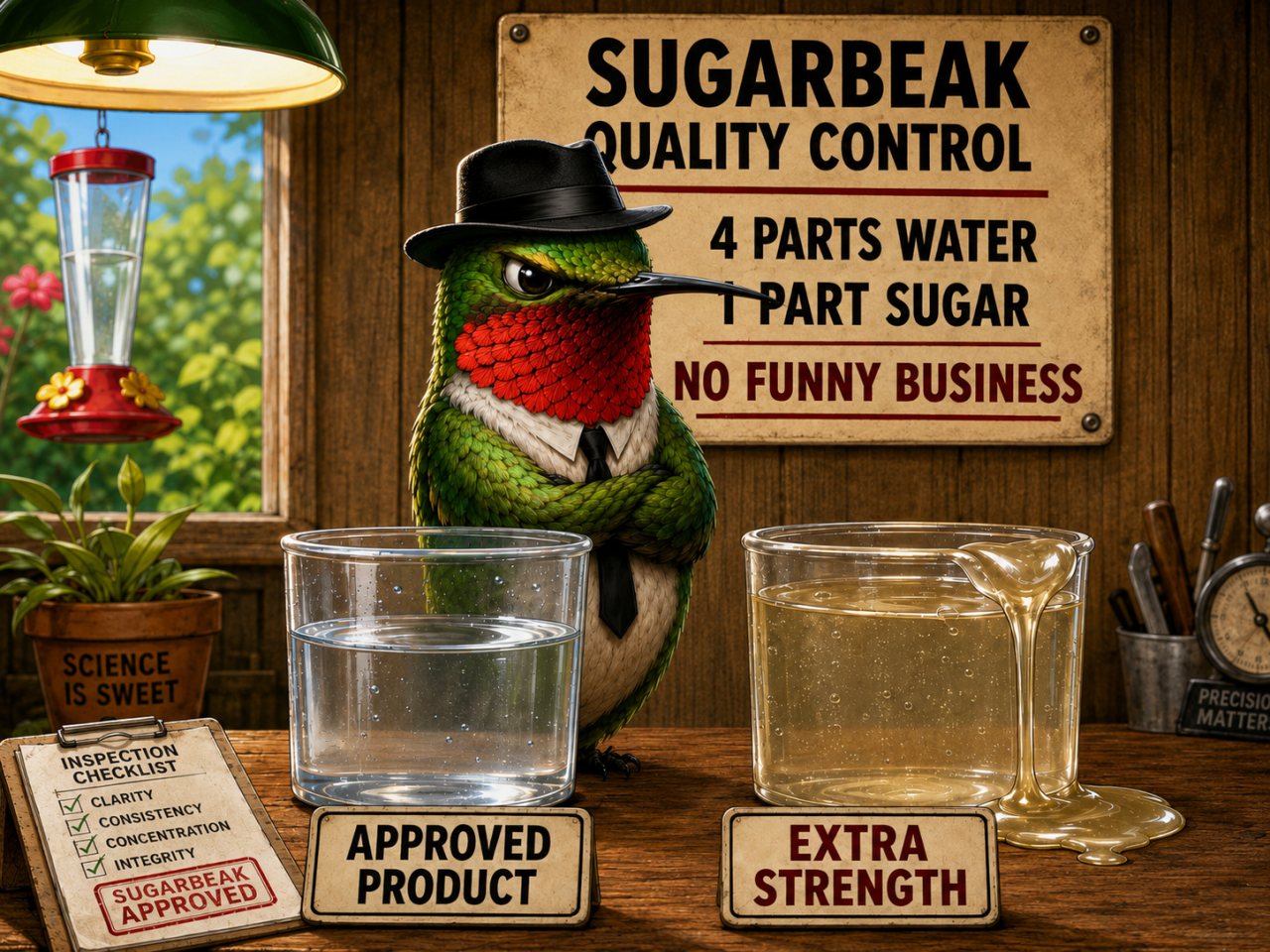
Vinnie and his cronies were inspecting the latest shipment of sugar water. The supplier promised a mixture containing “twice the energy” of the usual product. The supplier apparently believed that if more sugar meant more energy, then considerably more sugar would make the hummingbirds extraordinarily grateful.
Vinnie immediately rejected the shipment of “extra-strength” nectar following the unauthorized increase in sugar. Vinnie’s nutrition department confirmed that it also contained substantially less water per calorie, a higher concentration of dissolved particles, and the consistency of breakfast syrup.
“You can’t just keep adding sugar,” Vinnie said. “There are standards in this business.”
Vinnie ordered the product diluted and the supplier blacklisted.
The next supplier tried diluting the finished product in an underhanded attempt at “cost cutting.” There was considerably less sugar per ounce than there should have been.
“This is NOT what the flowers are serving!” shouted Vinnie.
That supplier was never seen nor heard from again.
In this business, Vinnie expects the standard: four parts water, one part sugar, and no funny business.
The Real Story
The standard hummingbird-feeder recipe is simple: one part refined white sugar to four parts water. For example, one cup of sugar mixed with four cups of water. That ratio is widely recommended by organizations including the Cornell Lab of Ornithology, Smithsonian’s National Zoo, and the National Audubon Society.
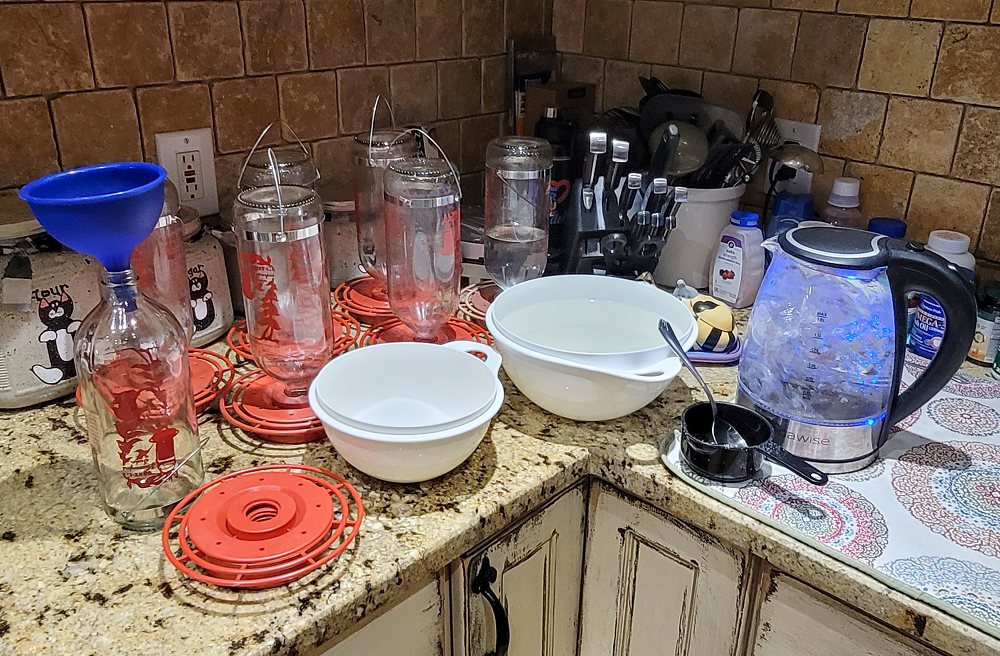
But the 4:1 recipe is not a magical concentration copied exactly from every flower. Natural nectar varies among plant species and environmental conditions. Cornell notes that flower nectars span concentrations roughly comparable to mixtures ranging from about one-quarter to one-third cup of sugar per cup of water. During hot, dry weather, when water becomes especially important, Cornell recommends staying at the standard one-quarter cup per cup. During cold, rainy conditions, a somewhat stronger mixture, up to about one-third cup per cup, can be appropriate.
There is also an easy mathematical trap hiding in the recipe. A 1:4 mixing ratio does not mean that the finished nectar is “25 percent sugar.” It means one measured part sugar is combined with four measured parts water. Sugar is therefore one of five measured parts before it dissolves, and the actual percentage of the finished solution depends on whether concentration is being expressed by weight, volume, or another chemical measure.
Why does the concentration matter so much? Because hummingbird nectar is doing two jobs at once. It provides carbohydrate energy, but it also provides water. Change the sugar concentration and you change both sides of that equation.
At the dilute end, a hummingbird has to drink increasingly large volumes to obtain the same amount of sugar. Experiments have found hummingbirds consuming enormous quantities of low-concentration nectar, sometimes several times their own body mass over part of a day. Much of that water is absorbed and then has to be handled by the kidneys. Researchers have suggested that at sufficiently low concentrations, the ability to process and eliminate all that extra water can become one of the limits on how quickly a hummingbird can obtain usable energy.
So the solution is obviously to keep adding sugar, right?
Vinnie’s quality-control department would like a word.
More concentrated nectar does provide more sugar in a given volume, and hummingbirds often prefer richer solutions over very dilute ones. But that relationship does not continue indefinitely. In experiments with rufous hummingbirds, energy-intake rates increased with sugar concentration only to a point and then declined at very high concentrations. The birds themselves began avoiding the most concentrated solutions. Other work on nectar-feeding birds has shown why concentration can become limiting: as sugar solutions become stronger, their physical properties change, including increased viscosity, while osmotic and digestive constraints also affect how rapidly the food can be processed.
And a richer mixture necessarily supplies less water for a given amount of energy. That matters because nectar-feeding birds continually juggle the opposite problems of getting rid of excess water when nectar is dilute and conserving water when intake is lower. Their digestive tract and kidneys are actively involved in maintaining that balance.
That is why the standard 4:1 recipe is such a useful backyard compromise. It supplies substantial carbohydrate energy, provides plenty of water, falls within the broad range hummingbirds encounter from flowers, and is easy for humans to reproduce consistently. It is not the only sugar concentration a hummingbird can tolerate, but it is a sensible default that does not require the backyard supplier to start freelancing with avian physiology.
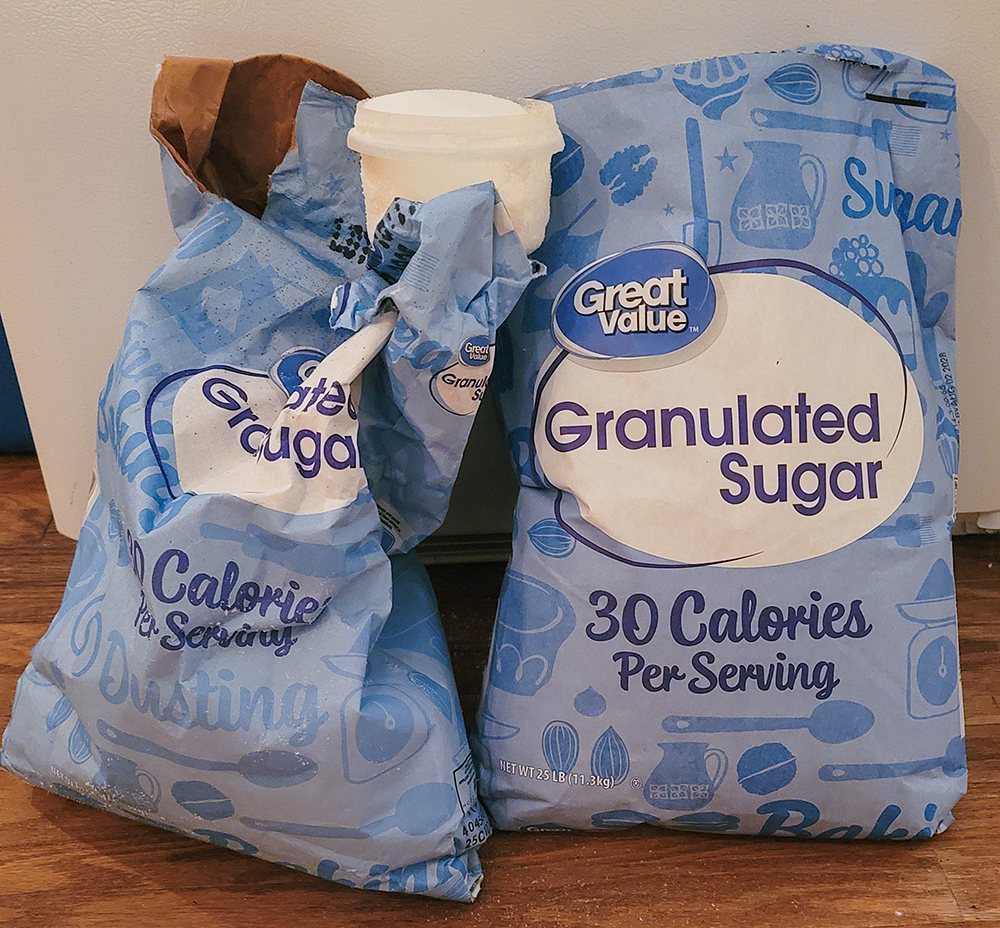
The ingredients should be just as boring.
Use refined white table sugar and water. Smithsonian specifically advises against honey, corn syrup, and raw or unprocessed sugars; powdered sugar may contain additional ingredients such as cornstarch. Audubon likewise advises against brown sugar, molasses, honey, and artificial sweeteners.
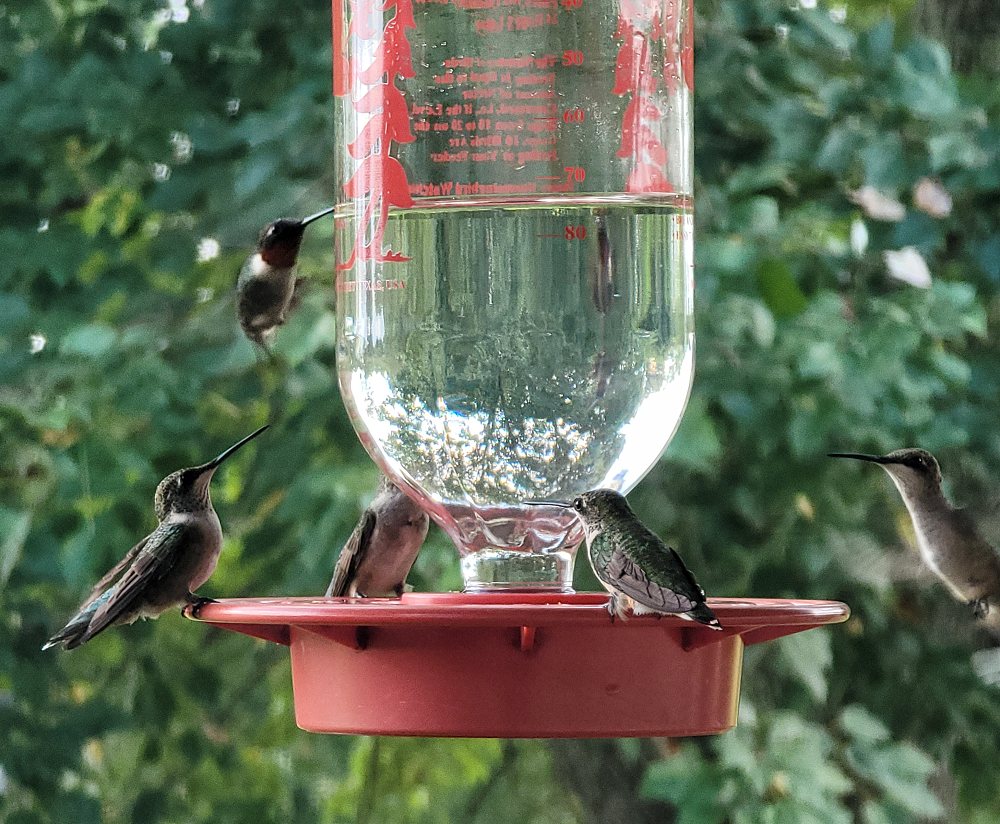
And there is no need to turn the nectar red. Natural nectar is clear. Hummingbirds may be attracted to brightly colored flowers and feeder parts, but the liquid itself does not need dye. Cornell, Smithsonian, and Audubon all recommend leaving food coloring out of homemade hummingbird nectar. A red feeder is perfectly capable of advertising the premises without turning the product itself into hummingbird Kool-Aid.
Finally, the perfect recipe becomes a terrible product if it sits around growing microbes. Sugar water can ferment and support mold and bacterial growth, especially in hot weather. Feeders should be emptied, cleaned, and refilled frequently, with the schedule becoming more aggressive as temperatures rise. Cornell recommends changing nectar at least every three to five days and more often during hot weather, with immediate replacement if it becomes cloudy or discolored.
The hummingbird feeder, in other words, is not a tiny soda fountain where sweetness is the only goal.
It is a delivery system for fuel and fluid.
Vinnie wants the sugar.
He also wants the water.
And the feeder to be clean.
And apparently he wants everyone in the supply chain to stop getting creative.
He doesn't want much, does he?
Continue the investigation: How ants organize a raid on Vinnie's sugar supply!
Sources
-
What’s the best recipe for hummingbird nectar?
Cornell Lab of Ornithology. (n.d.). What’s the best recipe for hummingbird nectar? All About Birds.
Why this source matters: Authoritative practical guidance on nectar concentration. Supports the standard 1:4 recipe, natural variation in flower nectar, the recommendation to avoid stronger mixtures during hot/dry weather, and the possibility of modestly stronger mixtures during cold/rainy conditions.
-
Ruby-throated Hummingbird Overview
Cornell Lab of Ornithology. (n.d.). Ruby-throated Hummingbird overview. All About Birds.
Why this source matters: Species-specific source for Archilochus colubris. Supports using approximately one-quarter cup sugar per cup water, refined table sugar, no food coloring, and frequent replacement because sugar water can ferment rapidly in hot weather.
-
Hummingbird Nectar Recipe
Smithsonian’s National Zoo and Conservation Biology Institute. (n.d.). Hummingbird nectar recipe.
Why this source matters: Practical feeder guidance supporting one part refined white sugar to four parts water, no red dye, regular cleaning, and avoidance of honey, corn syrup, raw sugars, and powdered sugar containing additives.
-
Food ingestion and water turnover in hummingbirds: how much dietary water is absorbed?
McWhorter, T. J., & Martínez del Rio, C. (1999). Food ingestion and water turnover in hummingbirds: how much dietary water is absorbed? Journal of Experimental Biology, 202(20), 2851–2858.
Why this source matters: Primary research supporting the water-balance side of nectar feeding. At low sucrose concentrations, hummingbirds consumed very large volumes; much of the ingested water was absorbed and therefore had to be processed by the kidneys. The authors conclude that excess-water elimination may constrain energy assimilation on very dilute nectar.
-
Gastrointestinal and renal responses to water intake in the green-backed firecrown (Sephanoides sephanoides), a South American hummingbird
Bakken, B. H., & Sabat, P. (2006). Gastrointestinal and renal responses to water intake in the green-backed firecrown (Sephanoides sephanoides), a South American hummingbird. American Journal of Physiology-Regulatory, Integrative and Comparative Physiology, 291(3), R830–R836.
Why this source matters: Primary research demonstrating how nectar-feeding hummingbirds regulate water absorption and renal water handling. Supports the article’s central framing that nectar feeding involves balancing both energy and water.
-
Energy intake rates and nectar concentration preferences by hummingbirds
Tamm, S., & Gass, C. L. (1986). Energy intake rates and nectar concentration preferences by hummingbirds. Oecologia, 70(1), 20–23.
Why this source matters: Primary research showing that rufous hummingbirds preferred concentrations near those maximizing energy-intake rate and discriminated against very concentrated sucrose solutions. Supports the key point that progressively increasing sugar concentration does not produce progressively better food.