
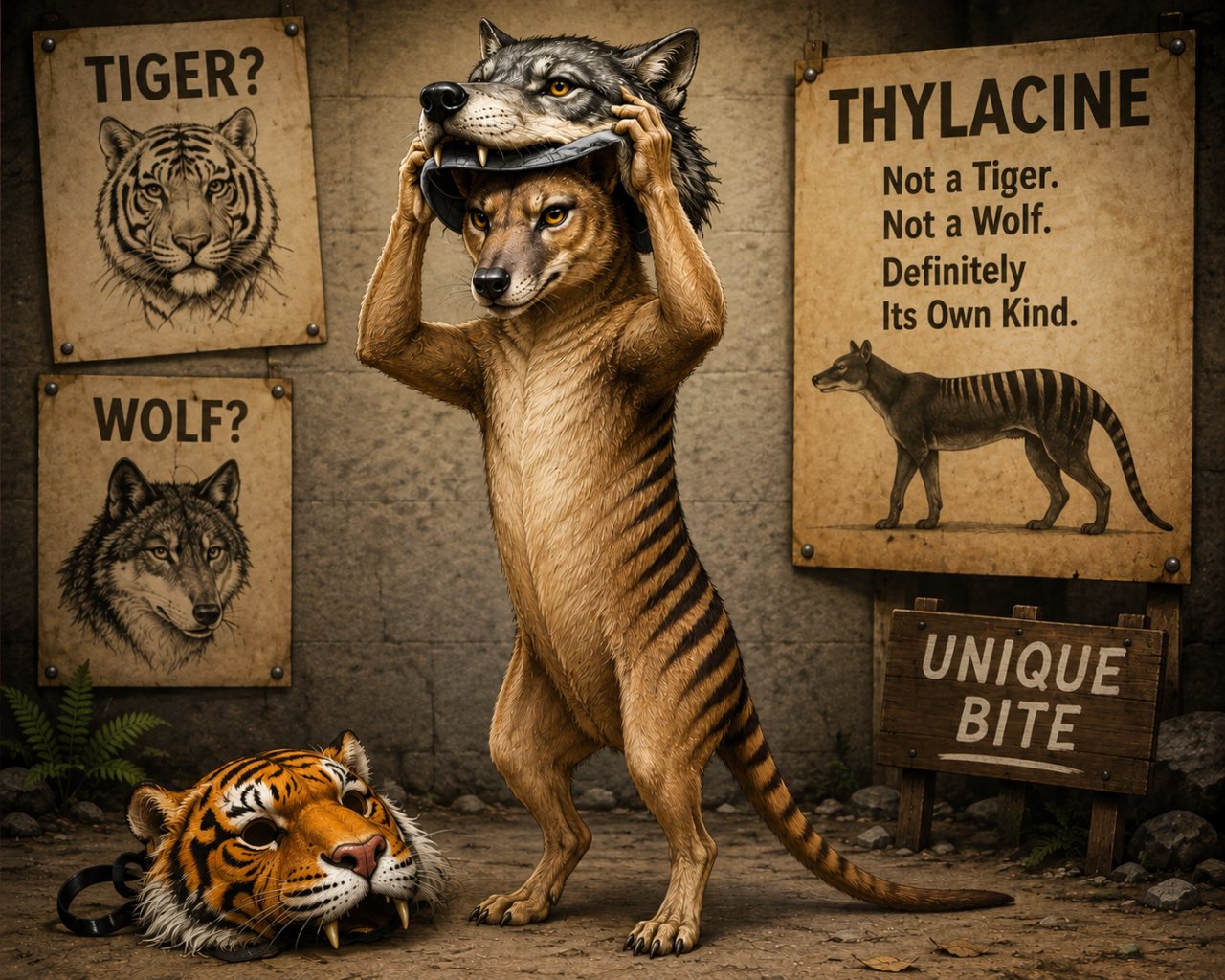
When the first European settlers arrived in Australia and Tasmania, they were confronted by the sight of a striped marsupial with a dog-like head.
At some point, they started calling it the Tasmanian Tiger because of the dark tiger-like stripes across its back and rump.
But, nope.
It was not a tiger. Or anything else from the Felidae family.
Other names were floated around, including “zebra opossum,” “zebra wolf,” “Tasmanian wolf,” and even “native hyena.”
Seriously.
This poor animal must have been having a major identity crisis.
The wolf comparisons at least made visual sense. The thylacine had a long muzzle, upright ears, long legs, and an overall body shape strikingly similar to a canid. Its scientific name, Thylacinus cynocephalus, even means roughly “dog-headed pouched one.”
But nope again.
It was not a wolf relative. Or anything else from the Canidae family.
The thylacine was a carnivorous marsupial, and its wolf-like appearance became one of the classic examples of convergent evolution: distantly related animals independently evolving similar features because they face similar ecological pressures.
But apparently evolution’s wolf imitation came with some fine print.
Newly published skull analyses suggest that the thylacine was not simply a marsupial wolf with different reproductive equipment. Its oversized skull, long slender snout, and unusual canine region point toward a predator adapted for fast, high-impact snapping, potentially at smaller or more agile prey, rather than the sustained skull-loading mechanics associated with wolves tackling large prey.
In fact, researchers found that its particular combination of skull features appears to have no living mammalian counterpart.
So basically:
Tasmanian Wolf = “Holy crap, that thing looks like a canid.”
Tasmanian Tiger = “Holy crap, that thing has stripes.”
Actual evolutionary relationship = “Neither. Please stop naming Australian animals after whatever European mammal they vaguely remind you of.”
Thylacine = “Thank you. Finally.”
The Real Story
The thylacine, Thylacinus cynocephalus, was not a wolf, a tiger, or even a placental mammal. It was a marsupial predator whose lineage had been evolving separately from canids for well over 100 million years.
Yet put a thylacine beside a wolf and the resemblance is hard to miss.
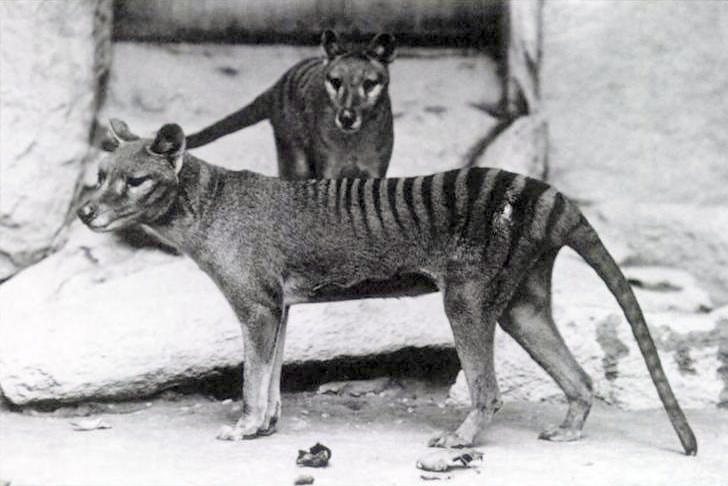
Both had long muzzles, upright ears, relatively long legs, and skulls that looked remarkably similar despite their distant ancestry. Scientists have long regarded the pair as a classic example of convergent evolution, in which unrelated organisms independently evolve similar traits because they face similar environmental or ecological pressures.
Previous studies have even found similarities in the way thylacine and wolf skulls developed and in genetic regulatory regions associated with skull growth.
But a new analysis suggests that evolution did not simply build a marsupial version of a wolf.
Researchers compared thylacine skulls with those of dozens of living and extinct mammalian predators and examined different regions of the skull separately rather than treating the whole thing as a single shape. What emerged was an unusual anatomical mosaic.
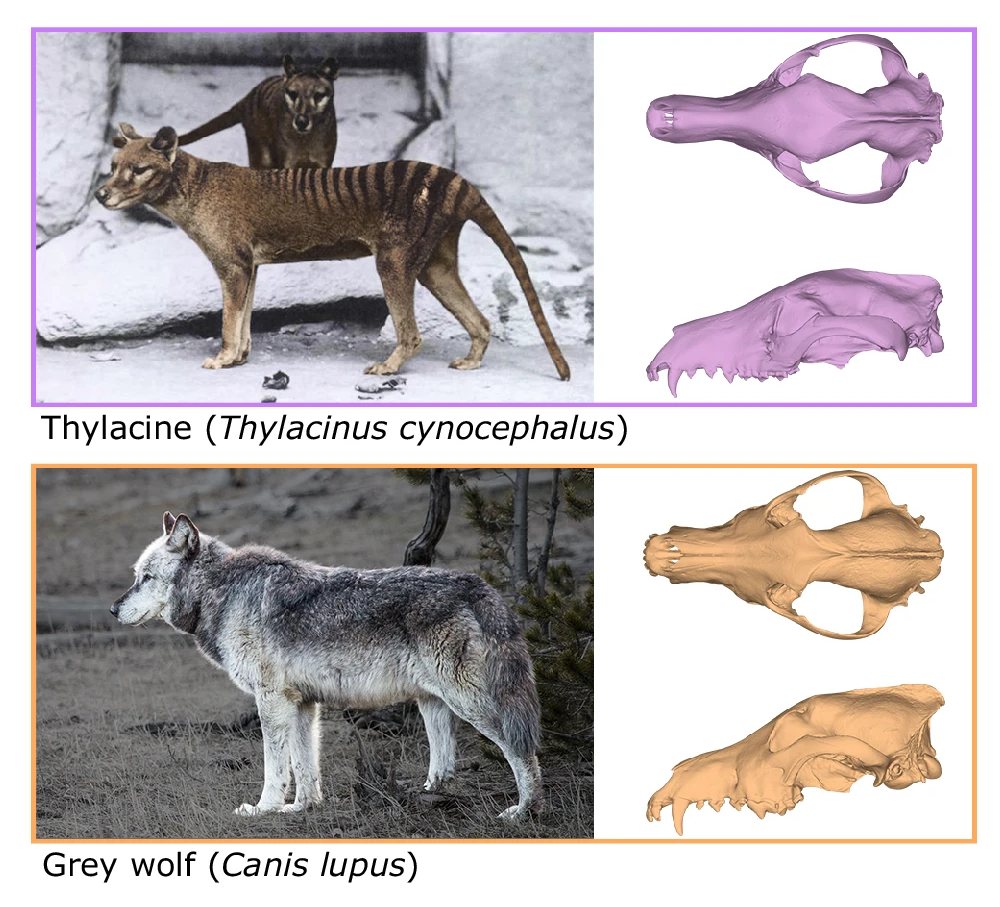
The thylacine had a disproportionately large skull, combined with a long, tall, relatively slender snout that widened around the canine teeth. That combination does not match the skull design of any living mammalian carnivore examined in the study.
And those proportions matter.
Long, slender jaws can move quickly, making them useful for snapping at fast-moving prey. But slender skulls are generally less resistant to the twisting and prolonged mechanical stresses produced when a predator grabs, holds, and wrestles with a large struggling animal.
Wolves that specialize in large prey have comparatively robust skulls built to withstand those forces.
The thylacine appears to have solved the problem differently.
Its unusually large skull would have provided more bone and room for more muscle, helping compensate for the mechanical disadvantages of its long, narrow snout. The researchers propose that this combination allowed the thylacine to deliver fast, powerful, high-impact bites with its canine teeth, potentially allowing it to subdue relatively small or agile prey with a rapid snapping attack.
In other words, the thylacine may have looked remarkably wolf-like while using its skull in a way that had no direct equivalent among living mammalian predators.
That distinction carries some historical baggage.
European settlers in Tasmania widely blamed thylacines for attacks on sheep and other livestock. Private bounties appeared as early as the 1830s, and in 1888 the Tasmanian government began paying £1 for every adult thylacine killed and 10 shillings for a juvenile. More than 2,180 government bounties were eventually paid.
Modern historical evidence suggests that thylacines became convenient scapegoats for livestock losses caused substantially by other factors, including feral dogs and poor livestock management. Hunting and trapping, combined with habitat loss, disease, and other pressures, helped drive the species toward extinction.
The last known thylacine died in captivity in Hobart on September 7, 1936.
Nearly ninety years later, its skull is still correcting the story people told about it.
The Tasmanian tiger wasn't a tiger.
The Tasmanian wolf wasn't a wolf.
And even one of evolution's most famous wolf look-alikes may have been doing something entirely its own way.
Sources
-
Skull morphology of the extinct Tasmanian tiger suggests unique biting style
Weisbecker, V., Pask, A. J., Newton, A. H., & Rovinsky, D. S. (2026). Skull morphology of the extinct Tasmanian tiger suggests unique biting style. Nature Communications, 17, 8729.
Why this source matters: Primary source for the new comparative skull analysis, including the thylacine’s unusual cranial proportions, functional comparisons with living and extinct mammalian carnivores, and the inference that it may have used fast, high-impact canine snapping rather than wolf-like sustained loading during large-prey capture.
-
Extinction of thylacine
National Museum of Australia. (2026, August 21). Extinction of thylacine. National Museum of Australia.
Why this source matters: Supports the origin of the common name “Tasmanian tiger” from the stripes on the animal’s back; the meaning of thylacine as roughly “dog-headed pouched one”; historical range and extinction; livestock persecution; private and government bounty programs; more than 2,180 government bounties paid; and evidence that feral dogs and poor livestock management accounted for much of the stock loss blamed on thylacines. The page also documents the death of the last known thylacine on September 7, 1936.
-
Zebra opossum
Australian National Dictionary Centre. Zebra opossum. Australian National University.
Why this source matters: Supports the historical use of “zebra opossum” and “zebra wolf” as early common names for the thylacine. The page traces both names to the early 1800s and quotes an 1808 source describing the animal as “vulgarly called the Zebra Opossum, Zebra Wolf, &c.” It also explains that early colonial observers struggled to categorize the unfamiliar marsupial and compared it variously with hyenas, tigers, wolves, and opossums. It further explains that George Harris originally classified it in 1808 as Didelphis cynocephala, essentially “dog-headed opossum,” before its genus was later changed.