
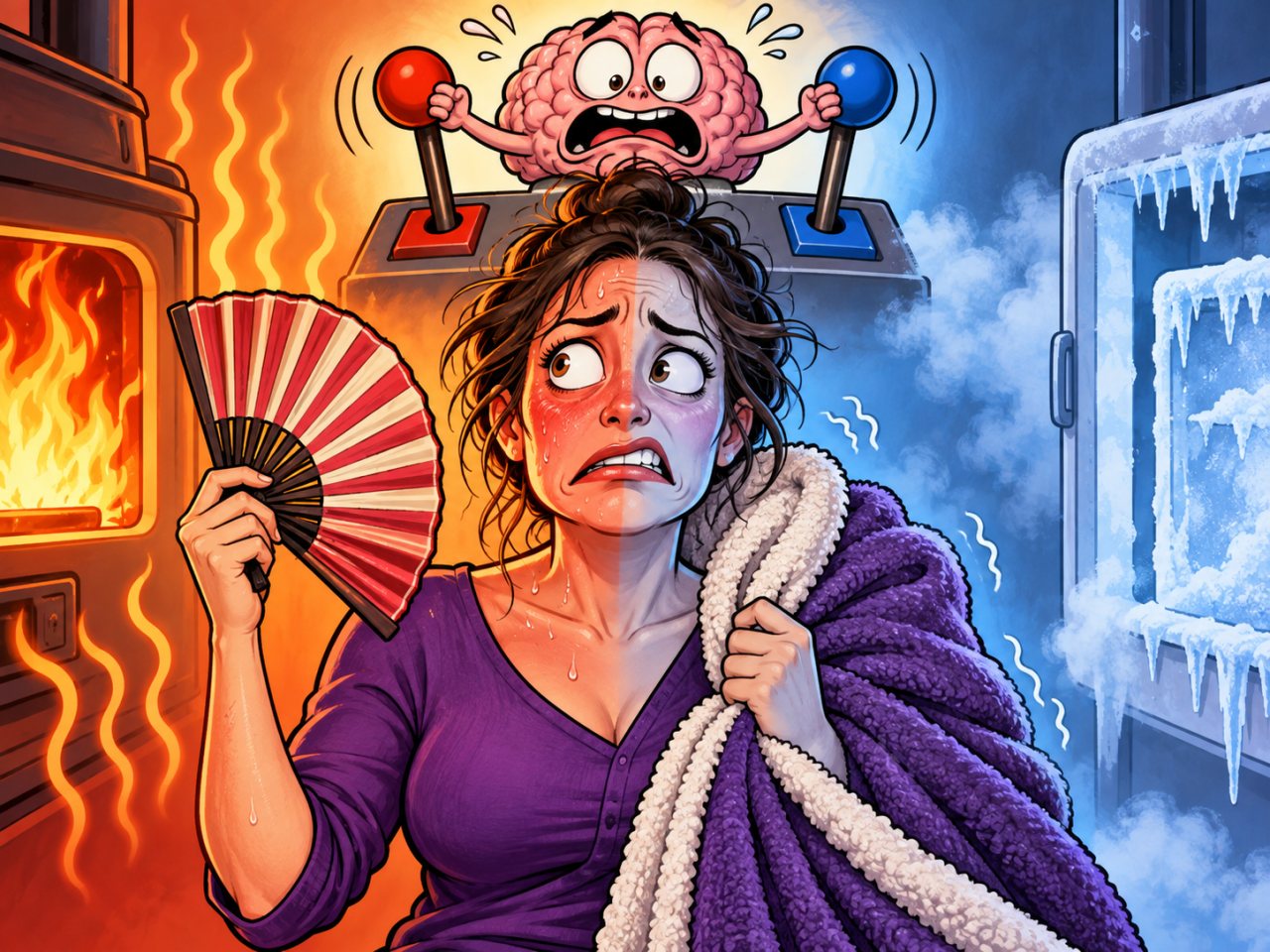
I've started having hot flashes, and boy do I hate them already.
Technically, I'm in the period known as perimenopause, the transition surrounding menopause. It usually begins years before the final menstrual period and can last anywhere from a few months to as long as eight years (four years is the average). A lot of women say, “I'm going through menopause,” when they technically mean they are in perimenopause.
The word menopause itself refers to the final menstrual period, and then a woman is considered postmenopausal.
But back to the hot flashes.
For anyone who has never experienced them, they suck.
You can be sitting perfectly still, doing absolutely nothing, and just break out in a full-body sweat. While feeling like you're sitting in a furnace.
But it's even worse than that, because I have “cold flashes,” too!
One minute I can be sweating and miserable, and five minutes later I am chilled to the bone and shivering.
This led me to look more closely at the physiology of our thermoregulatory system and how it's affected by female hormones. And I found out that the hormonal changes of perimenopause may not be causing enormous swings in body temperature themselves. Instead, they can destabilize the brain circuits controlling when the body decides a temperature is “too hot” or “too cold.”
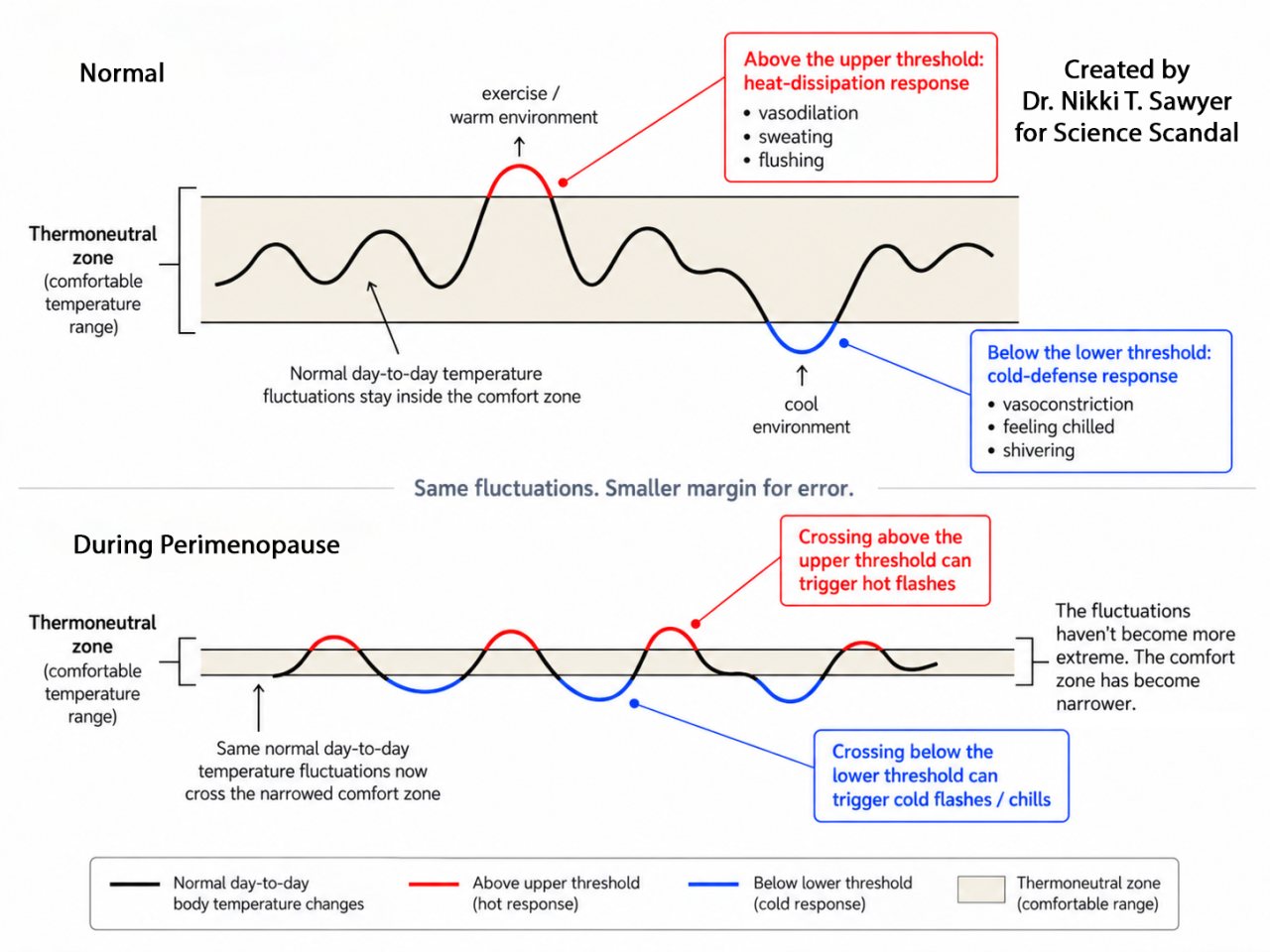
In other words, the control window can get more narrow.
Your temperature normally fluctuates throughout the day. Don't believe me? Grab a thermometer and record your temperature every 30 minutes for a day. But unless your temperature crosses one of the thresholds that trigger active cooling or warming responses, you probably won't notice those little fluctuations at all. It takes a major change to make you aware and to provoke a response.
For example, we're all familiar with what happens when you exercise. Or clean. Or exert any effort beyond couch surfing. Or go outside during a Georgia summer. You start to sweat. Blood flow to the skin increases to help release heat, leaving you flushed and hot. This is all part of your body's response when it decides you've gotten too warm and needs to cool you back down.
Likewise, going outside in the winter or sitting in a very chilled room can leave you feeling cold. Blood vessels in your skin constrict, helping conserve heat. Hello, cold hands and cold feet! And if the cold signal gets strong enough, you might even shiver to generate more heat.
Normally, there is a comfortable range between the point where your body starts actively trying to cool you down and the point where it starts actively trying to warm you up - the thermoneutral zone.
The problem during perimenopause is that this range can become annoyingly narrow.
So a SMALL fluctuation in body temperature that might have been completely ignored five years ago can suddenly cross a threshold, sound the alarm bells, and mobilize the temperature “fixers.”
Result: hot flashes and chills.
And I don't hear enough women talking about the cold periods that can come with or after hot flashes.
But I think I've figured that out, too.
I hate the hot flashes more than the cold flashes. You can always put more clothes on, but there are only so many clothing items you can take off, especially in public! And I know that if I complain about being cold, my husband will say no to my fifteen fans and extra window AC unit that I got to combat the hot flashes.
And I absolutely could not live without those during a hot flash.
So I stay mum about the cold flashes. 🤣
The Real Story
Your body temperature is not perfectly constant.
Even under ordinary conditions, core temperature rises and falls slightly across the day. Exercise, environmental temperature, sleep, circadian rhythms, and reproductive hormones can all shift it.
Most of the time, those changes are small enough that the body does not need to launch a dramatic response.
The hypothalamus helps regulate this system by maintaining a range between two important thresholds.
Cross the upper threshold, and the body activates heat-loss mechanisms. Blood flow to the skin increases, sweating begins, and heat is transferred away from the core.
Cross the lower threshold, and the body begins conserving and generating heat. Skin blood vessels constrict, you feel chilled, and if the signal becomes strong enough, you may shiver.
Between those thresholds is sometimes called the thermoneutral zone or interthreshold zone: the range in which major heat-loss or cold-defense responses are not required.
And that range may become much narrower in people who experience menopausal vasomotor symptoms.
A classic laboratory study compared postmenopausal women who experienced hot flashes with women who did not. Researchers experimentally determined both their sweating and shivering thresholds and found that the symptomatic women had significantly smaller zones between those thresholds. Small increases in core temperature were therefore much more likely to cross the upper boundary and trigger sweating and vasodilation.
That creates a very different thermoregulatory situation.
A temperature fluctuation that might previously have remained comfortably inside the neutral range can suddenly cross a threshold.
Cross upward, and the body launches a heat-dissipation response.
Hot flash.
Sweating.
Flushing.
That heat loss can then lower core temperature. If temperature falls far enough to cross the lower threshold, the opposite response may follow: feeling chilled, constricting blood vessels in the skin, and sometimes shivering. Older thermoregulatory studies specifically described this sequence as one explanation for the chills that can follow a hot flash.
So the problem is not necessarily that body temperature itself has started making enormous swings.
The control system has become easier to trigger.
Why?
That leads back to the reproductive hormones.
Estradiol and progesterone normally influence thermoregulation. Across an ovulatory menstrual cycle, core body temperature typically rises by about 0.3 to 0.7°C during the progesterone-dominant luteal phase. Estrogen tends to favor lower core temperature, while progesterone has a thermogenic effect. These hormonal changes normally occur as part of an organized ovarian rhythm that the thermoregulatory system routinely accommodates.
During the menopause transition, that rhythm begins to break down.
Ovarian follicles become depleted, ovulation becomes less predictable, progesterone exposure becomes irregular, and estradiol levels can vary widely. Importantly, vasomotor symptoms do not appear to depend simply on having a particular low estrogen concentration. The transition and withdrawal from prior estrogen exposure seem to matter more than one absolute hormone value.
One of the strongest mechanistic links involves a population of hypothalamic neurons called KNDy neurons.
The name comes from the three signaling molecules they express: kisspeptin, neurokinin B, and dynorphin.
These neurons sit in the arcuate region of the hypothalamus and are sensitive to estradiol. Under normal estrogen exposure, estradiol provides inhibitory feedback that helps restrain their activity.
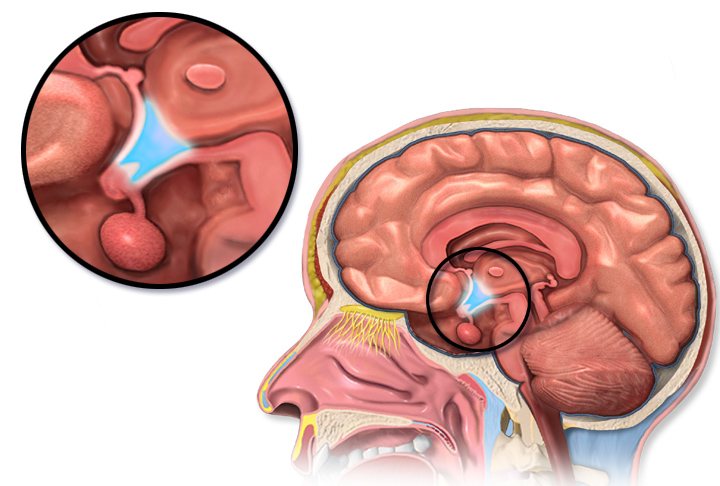
As estradiol feedback decreases during the menopause transition, KNDy neurons become more active. Their neurokinin B signaling influences neurons in the preoptic hypothalamus, one of the brain's major thermoregulatory centers.
That connection matters because activating this pathway can trigger heat-dissipation responses such as increased skin blood flow and sweating.
In other words, changes in reproductive hormone signaling can alter the neural circuitry controlling when the body decides it needs to dump heat.
This KNDy-neurokinin pathway is no longer merely an interesting laboratory hypothesis.
Drugs that block neurokinin receptors can reduce menopausal hot flashes, providing strong clinical evidence that this circuitry really does participate in vasomotor symptoms.
The older “narrowed thermoneutral zone” model and the newer KNDy model are therefore not competing explanations.
They describe different levels of the same problem.
The narrowed zone describes what happens to thermoregulatory control: ordinary temperature changes are more likely to cross a response threshold.
The KNDy pathway helps explain how changing ovarian hormone signals can make the hypothalamic system more prone to launching those responses.
There is still uncertainty about exactly how much the sweating and shivering thresholds shift in every symptomatic person. More recent reviews have found mixed results when researchers try to measure those thresholds experimentally, so the thermoneutral-zone model should not be interpreted as an identical fixed-width window in every woman with hot flashes.
But the larger principle remains remarkably useful:
The body does not need to become dramatically hotter or colder for the thermoregulatory system to react dramatically.
Sometimes the temperature barely moved.
The alarm system did.
Sources
-
Effects of menopause on temperature regulation
Gombert-Labedens M, Vesterdorf K, Fuller A, Maloney SK, Baker FC. Effects of menopause on temperature regulation. Temperature (Austin). 2025;12(2):92-132.
Why this source matters: Best overall modern review for the article. Supports menopausal thermoregulatory changes, estradiol-sensitive KNDy neurons, projections to preoptic hypothalamic regions, heat-dissipation responses, and the important caveat that experimental findings on sweating thresholds are mixed.
-
Reduced thermoregulatory null zone in postmenopausal women with hot flashes
Freedman RR, Krell W. Reduced thermoregulatory null zone in postmenopausal women with hot flashes. Am J Obstet Gynecol. 1999;181(1):66-70.
Why this source matters: Primary experimental source for the narrowed interthreshold-zone model. Supports the central figure concept: symptomatic women had significantly smaller zones between sweating and shivering thresholds, and small elevations in body temperature could trigger hot flashes.
-
Temperature regulation in women: Effects of the menstrual cycle
Baker FC, Siboza F, Fuller A. Temperature regulation in women: Effects of the menstrual cycle. Temperature (Austin). 2020;7(3):226-262.
Why this source matters: Supports the distinction between normal cyclic hormone changes and menopausal dysregulation. Documents the approximately 0.3-0.7°C higher core temperature during the progesterone-dominant luteal phase and reviews thermogenic progesterone and temperature-lowering estrogen effects.
-
The Menopause Transition: Signs, Symptoms, and Management Options
Santoro N, Roeca C, Peters BA, Neal-Perry G. The Menopause Transition: Signs, Symptoms, and Management Options. J Clin Endocrinol Metab. 2021;106(1):1-15.
Why this source matters: Supports the endocrine-transition portion of the story: progressive follicular depletion, altered gonadal-steroid feedback, wide hormonal fluctuations, irregular menstrual patterns, and the broader hormonal milieu associated with vasomotor symptoms. The article was published online in October 2020 and appeared in the January 2021 issue.