

Yes, I have a PhD.
Granted, it's in neuroscience and not herpetology, but that did not prevent me from carrying around one particular misconception for years.
I blame Indiana Jones and Raiders of the Lost Ark.
I was six years old when that movie came out, and it permanently cemented the image of a literal pit full of snakes in my brain. So when I later encountered the term “pit viper,” I apparently decided it meant the type of viper one might find in a pit.
Really. 😂
Turns out even scientists can keep learning new things.
I recently discovered that pit viper refers to an entire group of venomous snakes in the subfamily Crotalinae, which includes rattlesnakes, copperheads, cottonmouths, bushmasters, lanceheads, and many others.
And get this:
The “pit” is on the snake's face.
Pit vipers have a pair of specialized sensory organs called loreal pits, located roughly between the eyes and nostrils. These pits detect thermal infrared radiation, allowing the snake to sense radiant heat coming from objects and animals around it.
In other words, pit vipers have an entire sensory system that humans simply do not possess.
We navigate the world using familiar senses such as vision, hearing, smell, taste, and touch. A pit viper gets another stream of information layered into that picture: Where is the heat?
The “viper” part of the name has an interesting history too. The word comes ultimately from the Latin vipera, traditionally connected with roots meaning something like “live-bearing.” Many vipers do give birth to live young rather than laying eggs, although this is not true of every pit viper species.
So what are those facial pits actually for?
For a long time, scientists regarded them mainly as hunting equipment. Warm-bodied prey such as mammals and birds radiate heat, and pit vipers can use that thermal information to help detect, aim at, and track prey, including under poor lighting conditions.
For some species, that can work beautifully with another part of the viper toolkit:
Venom.
A pit viper can strike a warm-bodied animal, inject venom, release it, and then use multiple sensory cues to relocate the prey after the venom has taken effect.
But research has shown that the pits are more versatile than a dedicated prey detector.
Pit vipers can also use thermal radiation to make thermoregulatory decisions, such as choosing between warmer and cooler places in their environment. Which leads me to imagine the following conversation:
- Scientists: “Obviously they evolved these things to find warm prey.”
- Pit vipers: “Actually, have you considered that I would also like to know where the warm rock is?”
So while pit vipers tend to evoke a certain amount of alarm, and Indiana Jones himself famously lamented, “Why did it have to be snakes?”, they are also carrying around one remarkably sophisticated piece of sensory equipment.
And perhaps the bigger lesson is:
Never stop learning.
Even scientists can carry misconceptions for decades.
The important part isn't never being wrong.
It's being willing to replace the old explanation when a better one crawls into view. Literally.
The Real Story
Pit vipers really are named for the pits on their faces.
They belong to the snake subfamily Crotalinae, a group within the viper family that includes rattlesnakes, copperheads, cottonmouths, bushmasters, lanceheads, and many other species. What distinguishes them from other vipers is a pair of specialized loreal pits, located between the eyes and nostrils.
Those pits are sensory organs for detecting thermal infrared radiation.
That does not mean pit vipers see infrared light with their eyes the way humans see visible light. Instead, infrared radiation from a warm object reaches a thin membrane suspended inside each pit. The radiation warms that membrane by a tiny amount, activating heat-sensitive sensory nerve endings.
One of the key molecular players is an ion channel called TRPA1. In pit-bearing snakes, TRPA1 is unusually sensitive to heat. Sensory information from the pit travels through branches of the trigeminal nerve, part of the somatosensory system, before ultimately reaching brain regions where thermal information can be combined with information from the eyes.
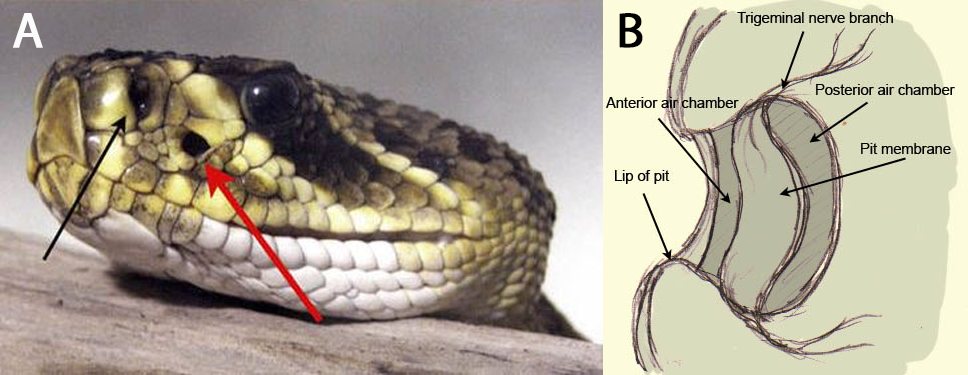
So the snake receives information about the location of warm and cool objects around it even when ordinary vision is limited.
That is particularly useful when the menu includes warm-bodied mammals and birds.
A pit viper can detect thermal contrast between prey and its surroundings, helping it orient toward and accurately strike prey under low-light conditions. Infrared sensing can also help some pit vipers relocate prey after striking it. Because vipers possess hollow fangs that deliver venom, a snake can bite, release an animal, and then follow sensory cues while the venom takes effect.
But the facial pits are not simply specialized prey detectors.
Researchers studying western diamondback rattlesnakes (Crotalus atrox) tested whether the snakes could use infrared radiation to select thermally appropriate retreat sites. When the facial pits were functional, the snakes could use thermal radiation to guide those choices. When researchers temporarily blocked the pits, that ability was impaired.
That suggested something intriguing: the pits function as part of a more general thermal sense rather than as equipment devoted exclusively to hunting.
Researchers later tested 12 species of pit vipers representing different branches of the group and different thermal environments. Every pit-viper species tested could use thermal radiation to guide thermoregulatory movements. A closely related true viper lacking facial pits could not.
Those results led researchers to propose that thermoregulation may even represent an ancestral function of the pit organ, although the exact evolutionary history cannot be reconstructed with certainty.
In other words, the sensory system that now helps a rattlesnake locate a warm mouse may also help it answer another vitally important reptile question:
Where is the good warm spot?
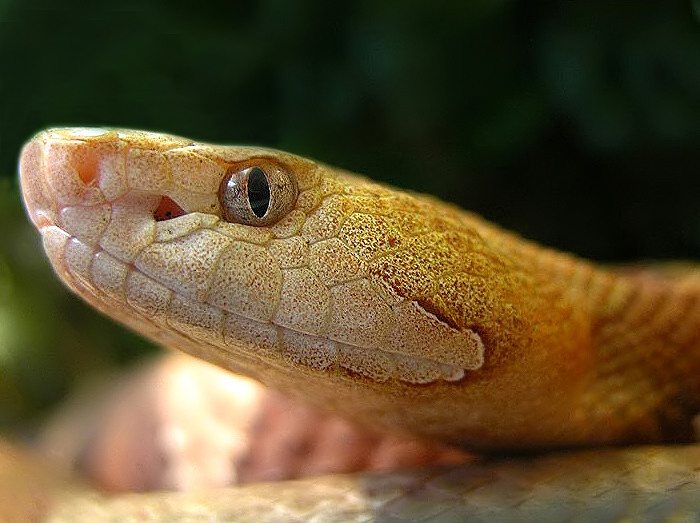
There is one more twist.
Pit vipers are not the only snakes capable of infrared sensing. Some boas and pythons also possess heat-sensitive pit organs, but theirs are arranged differently along the lips rather than as the paired loreal pits characteristic of pit vipers. Infrared sensing evolved independently in these snake lineages, making it an excellent example of different branches of evolution arriving at similar sensory solutions.
And although popular illustrations sometimes portray these snakes as if they possess crystal-clear Predator-style thermal vision, their heat sense is not a biological thermal camera. The images formed by the pit organs have relatively poor spatial resolution, and the nervous system has to extract useful information from noisy thermal contrasts in the environment.
Which somehow makes the system more impressive, not less.
Pit vipers are taking tiny differences in radiant heat, converting them into electrical signals in sensory neurons, combining that information with other senses, and using the result to hunt, navigate, and regulate their own body temperature.
All because of two little pits on the face that I spent decades assuming referred to somewhere people put the snakes.
Sources
-
Molecular basis of infrared detection by snakes
Gracheva EO, Ingolia NT, Kelly YM, et al. Molecular basis of infrared detection by snakes. Nature. 2010;464:1006–1011.
Why this source matters: Primary molecular source for infrared sensing in pit-bearing snakes. Supports the role of the facial pit as a specialized thermal-sensing structure, radiant heating of the pit membrane, sensory innervation through the somatosensory system, and the identification of TRPA1 as a major infrared-transduction channel in pit-bearing snakes.
-
Thermoregulation is the pits: use of thermal radiation for retreat site selection by rattlesnakes
Krochmal AR, Bakken GS. Thermoregulation is the pits: use of thermal radiation for retreat site selection by rattlesnakes. J Exp Biol. 2003;206(Pt 15):2539–2545.
Why this source matters: Primary behavioral study showing that western diamondback rattlesnakes (Crotalus atrox) can use thermal radiation to guide thermoregulatory movements when their facial pits are functional, but lose that ability when the pits are blocked. Supports the argument that facial pits are used for more than prey acquisition.
-
Heat in evolution's kitchen: evolutionary perspectives on the functions and origin of the facial pit of pitvipers (Viperidae: Crotalinae)
Krochmal AR, Bakken GS, LaDuc TJ. Heat in evolution's kitchen: evolutionary perspectives on the functions and origin of the facial pit of pitvipers (Viperidae: Crotalinae). J Exp Biol. 2004;207(Pt 24):4231–4238.
Why this source matters: Comparative study across 12 pit-viper species. Supports the finding that all tested pit vipers could use facial-pit thermal information to guide thermoregulatory movements and supports thermoregulation as a plausible ancestral function of the facial pit rather than assuming prey detection was its original evolutionary purpose.
-
Infrared-sensing snakes select ambush orientation based on thermal backgrounds
Schraft, H.A., Bakken, G.S. & Clark, R.W. Infrared-sensing snakes select ambush orientation based on thermal backgrounds. Sci Rep 9, 3950 (2019).
Why this source matters: Supports the placement of pit-viper facial pits between the eye and nostril, the highly sensitive pit membrane, integration of infrared and visual information, use of infrared sensing in behavioral thermoregulation and prey detection, and the importance of thermal background contrast during ambush behavior.