

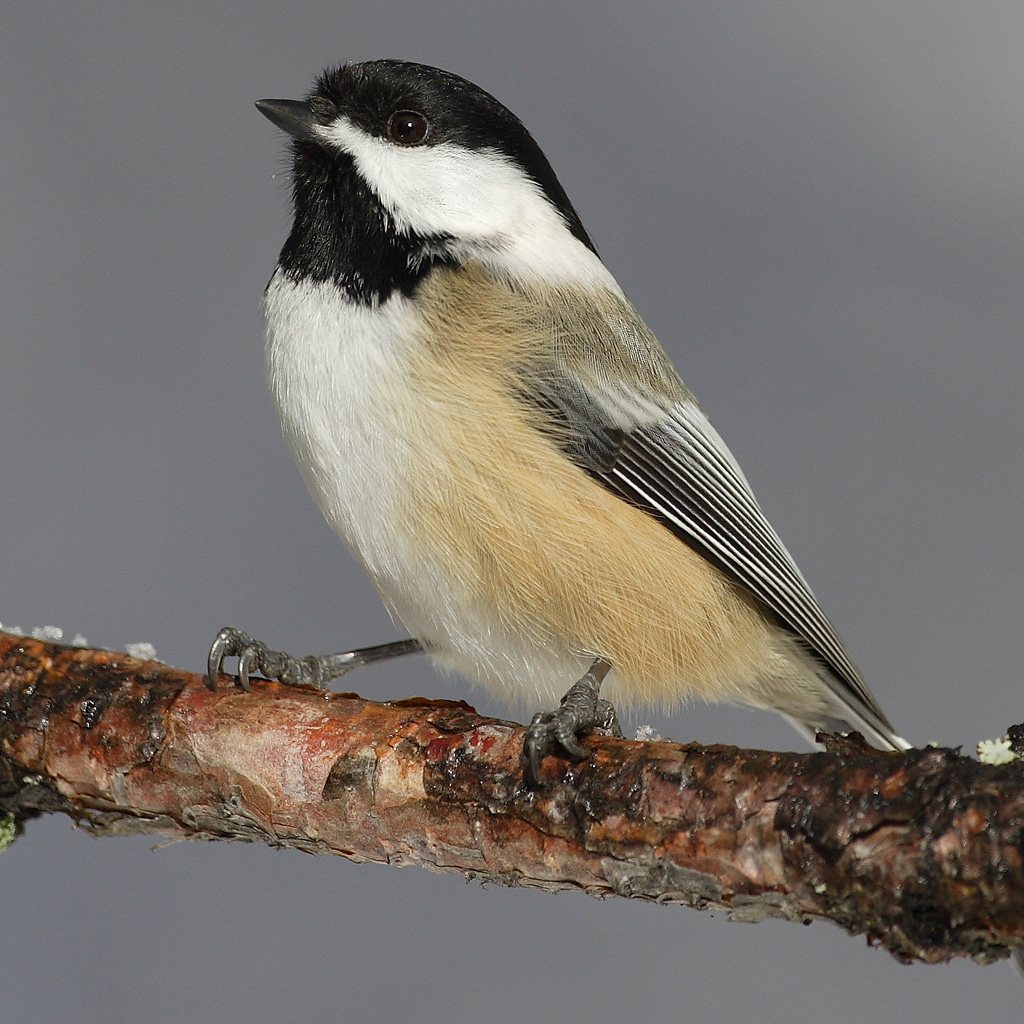
One of my favorite feeder birds is the black-capped chickadee. I've always been fascinated by his behavior of taking a single seed and then flying off with it. Often, you can watch him fly to a nearby tree branch where he perches, holds the seed steady between his feet, and uses his beak to hammer his way into the hidden treasure.
But sometimes he disappears with the seed in his beak and doesn't return until 10 minutes later to grab a new one.
And then I found out that not only does the chickadee stash part of his seed spoils for later, but he has an astonishingly good memory for where his stashes are!
Seriously. This little bird is out there opening thousands of tiny savings accounts all across the neighborhood, while I have trouble keeping track of my handful of bank accounts!
And then it gets even more amazing! This tiny little bird's brain is apparently highly specialized for this memory ability.
Researchers looked at the chickadee's hippocampus (a part of the brain especially important for spatial and episodic memory) and found that neurons in this area fired distinct patterns related to EACH CACHING EVENT. Like a barcode of sorts.
And yes, the females do this, too! It's not limited to just male chickadees, despite me calling my regular feeder visitor a "him".
So now I can't help but picture these little birds running the following scenario:
CACHE #1: 🌻 behind bark, 2nd tree on the left by creek
Barcode: 101001101
CACHE #2: 🌻 under twig, shrub pile #3, mile marker 3
Barcode: 011010011
CACHE #3: 🌻 under leaf, leaf #435 in area #78 by the barn
Barcode: 110100101
CACHE #4: 🌻 crack in fence post, 5th post from gate, leeward side
Barcode: 001101101
CACHE #5: 🌻 under moss, crack in boulder #24, by the orange house
Barcode: 110011010
CACHE #6,847: 🌻 ...somewhere
Chickadee: “I know where it is.”
Human: “You have a brain the size of a chickpea.”
Chickadee: “And yet you spent twenty minutes looking for your phone this morning.”
The Real Story
Black-capped chickadees (Poecile atricapillus) are scatter hoarders: instead of maintaining one giant pantry, they hide individual food items in many different locations throughout their territory. A chickadee may store several hundred food items in a single day, potentially creating thousands of separate caches over time.
Finding those caches again is not simply a matter of wandering around until something turns up. Experiments have shown that black-capped chickadees use spatial memory to relocate stored food. They can also remember more than location alone, including whether they have already emptied a cache, whether they previously found a cache empty, and what type of food was stored there.
The hippocampus is central to this ability. This brain region plays an important role in spatial memory in both birds and mammals. When researchers experimentally damaged the hippocampus of black-capped chickadees, the birds continued caching food and continued trying to retrieve it, but their accuracy in recovering their caches fell to chance levels. Their performance on a task requiring memory for locations was also disrupted much more than performance on a task that could be solved using nonspatial cues.
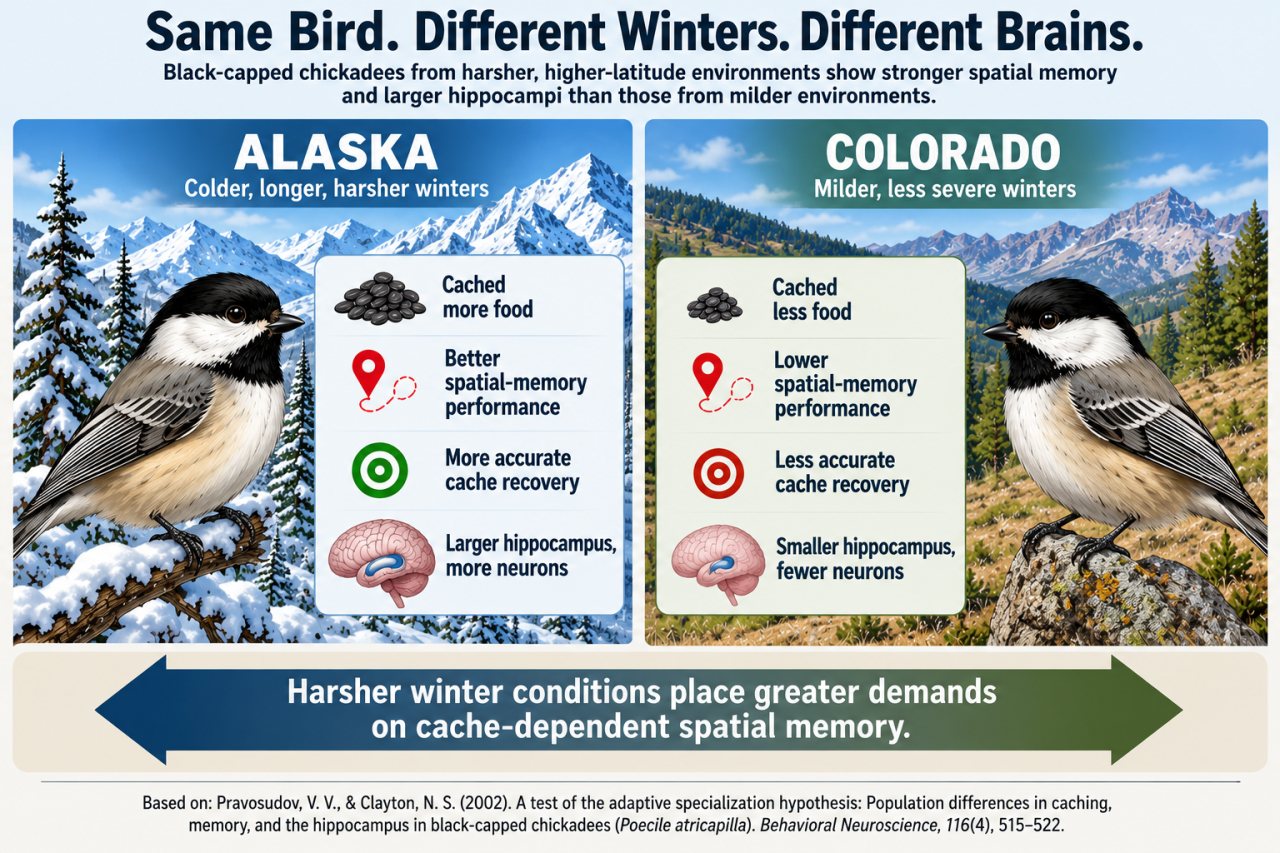
There is also evidence that the demands of the environment are reflected in both chickadee memory and hippocampal anatomy. In one study, researchers compared black-capped chickadees from Alaska with birds from Colorado under identical laboratory conditions. The Alaskan birds, which came from a harsher and less predictable winter environment, cached more food, recovered caches more efficiently, performed better on spatial-memory tasks, and had larger hippocampi containing more neurons. When the task could instead be solved using a nonspatial cue, the advantage disappeared.
Related work with mountain chickadees (Poecile gambeli) makes the evolutionary connection even stronger. Birds living at harsher, higher elevations have shown better spatial memory and differences in hippocampal structure compared with birds living at lower elevations. Researchers following wild mountain chickadees have also found that juveniles performing better on spatial-learning tasks were more likely to survive to the following winter. More recently, a long-term study of 227 wild mountain chickadees found that individuals with better spatial learning and memory lived longer.
That makes a good memory more than an impressive party trick. For a small resident bird facing winter, remembering where food was hidden can affect whether that food is available when natural supplies become scarce. When individuals vary in a cognitive ability that affects survival and longevity, natural selection has an opportunity to act on that variation.
And researchers have now begun watching what happens inside the chickadee hippocampus as individual caches are formed. In a 2024 study, scientists recorded hippocampal neurons in black-capped chickadees while the birds hid and later retrieved food. Each caching event was accompanied by a sparse, distinctive pattern of neural activity that the researchers called a “barcode.”
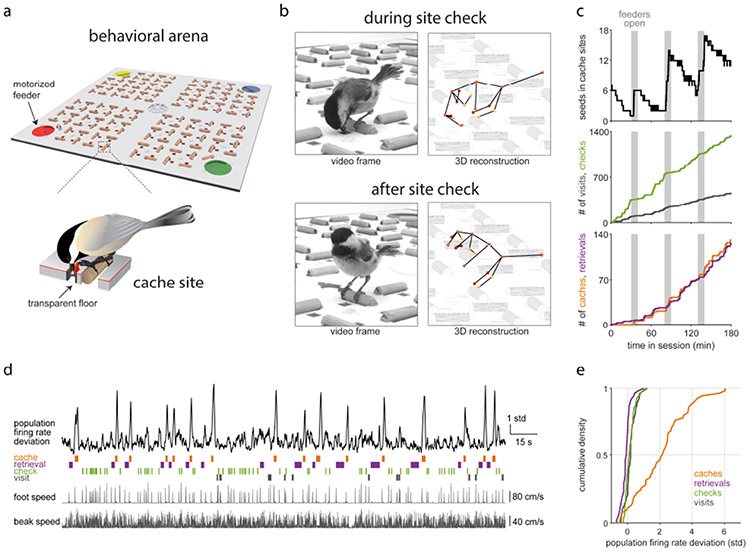
These barcodes (distinct patterns of neural activity) were different from the more familiar activity of place cells that represents where an animal is in space. Even caches made near one another, where the ordinary spatial representations were similar, produced distinct barcodes. When a chickadee later returned to retrieve a particular cache, the barcode associated with that caching event briefly reappeared.
The researchers propose that these patterns may act somewhat like unique identifiers, allowing the hippocampus to keep large numbers of individual experiences separate without confusing one memory with another. They even compared the idea to computer hash codes.
So no, the chickadee is not literally assigning 101001101 to the sunflower seed behind the second tree on the left.
But fascinatingly, our imaginary chickadee database may have been closer to the truth than it had any right to be.
Sources
-
Food storage by black-capped chickadees: Memory for the location and contents of caches
Sherry, D. F. (1984). Food storage by black-capped chickadees: Memory for the location and contents of caches. Animal Behaviour, 32(2), 451–464.
Why this source matters: Classic experimental evidence that black-capped chickadees use memory for the locations and contents of scattered food caches; it also documents that several hundred food items may be cached in a single day.
-
Hippocampus and memory for food caches in black-capped chickadees
Sherry, D. F., & Vaccarino, A. L. (1989). Hippocampus and memory for food caches in black-capped chickadees. Behavioral Neuroscience, 103(2), 308–318.
Why this source matters: Provides causal evidence linking the chickadee hippocampus to spatial cache memory: hippocampal lesions reduced cache-recovery accuracy to chance while leaving caching behavior and retrieval attempts intact.
-
A test of the adaptive specialization hypothesis: Population differences in caching, memory, and the hippocampus in black-capped chickadees (Poecile atricapilla)
Pravosudov, V. V., & Clayton, N. S. (2002). A test of the adaptive specialization hypothesis: Population differences in caching, memory, and the hippocampus in black-capped chickadees (Poecile atricapilla). Behavioral Neuroscience, 116(4), 515–522.
Why this source matters: Compared Alaskan and Colorado black-capped chickadees under identical laboratory conditions and found that birds from the harsher Alaskan environment cached more, recovered caches more efficiently, performed better on spatial-memory tasks, and had larger hippocampi containing more neurons.
-
Spatial cognitive ability is associated with longevity in food-caching chickadees
Welklin, J. F., Sonnenberg, B. R., Branch, C. L., Heinen, V. K., Pitera, A. M., Benedict, L. M., Whitenack, L. E., Bridge, E. S., & Pravosudov, V. V. (2024). Spatial cognitive ability is associated with longevity in food-caching chickadees. Science, 385(6713), 1111–1115.
Why this source matters: Long-term field study of 227 mountain chickadees showing that individuals with better spatial learning and memory lived longer, directly connecting variation in food-caching cognition with fitness-related outcomes in the wild.
-
Barcoding of episodic memories in the hippocampus of a food-caching bird
Chettih, S. N., Mackevicius, E. L., Hale, S., & Aronov, D. (2024). Barcoding of episodic memories in the hippocampus of a food-caching bird. Cell, 187(8), 1922–1935.e20.
Why this source matters: High-density neural recordings in caching black-capped chickadees revealed sparse, event-specific hippocampal activity patterns that reappeared during retrieval of the corresponding cache, leading the researchers to describe them as neural “barcodes” analogous in some respects to computer hash codes.