
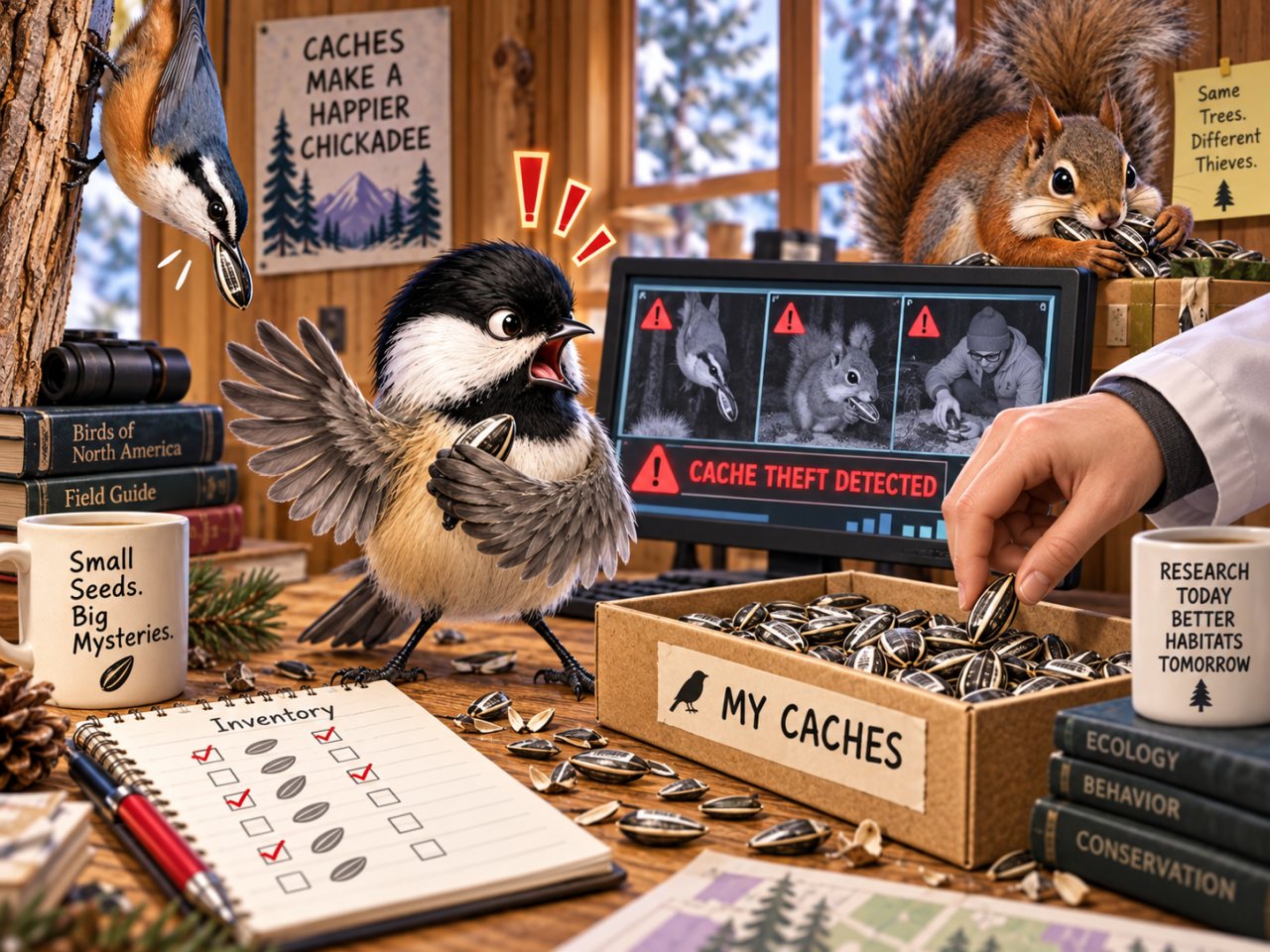
The curiosity never stops around here!
I'd barely finished writing and publishing my previous story about chickadees and their amazing memory for where they hide their seed caches when another question occurred to me.
[Missed the previous story? Check it out here: Chickadee's Tiny Brain Exposed Running Massive Seed Database!]
I'd recently restocked my bird-feeding empire for fall, and I was watching chickadees, titmice, nuthatches, cardinals, migrating grosbeaks, mockingbirds, woodpeckers, finches, mourning doves, wrens, and squirrels all visiting my feeding stations - a veritable metropolis of seed eaters!
And it occurred to me: Surely there must be occasions when another bird (or squirrel!) steals a chickadee's cached seed.
Does the chickadee know? Or does it think it misremembered the cache location when it arrives to find the seed missing?
Which led me to imagine the following scene:
Chickadee: "Time to check on cache #217. Sunflower seed. Stored October 8."
Opens cache.
Chickadee Brain: "ERROR! ITEM NOT FOUND."
Chickadee: "A suspected unauthorized withdrawal has occurred!"
Looks at squirrel.
Squirrel: "What?"
Chickadee: "YOU KNOW WHAT!"
_______________________
Or... possibly even this scene:
Chickadee: "I've hidden 400 sunflower seeds for winter."
Nuthatch: "That's wonderful! Where?"
Chickadee: "I'm not telling you."
Nuthatch: "Of course not. Completely understand."
Chickadee flies away.
Nuthatch turns upside down and begins inspecting bark.
Nuthatch: "Now, let's see what we've got here..." 🤣
_______________________
In any case, my curiosity led me to discover that, yes, researchers have investigated this very question!
And some of them weren't content merely to observe the theft.
They actually stole the chickadees' food themselves!
For that scandalous story, we now turn to THE REAL STORY...
The Real Story
Chickadees are remarkable little food hoarders. Rather than maintaining one large pantry, they practice scatter-hoarding, hiding individual food items in numerous locations, including crevices in tree bark. This strategy spreads their food reserves across many sites, but it also creates a problem: other animals may discover those caches and help themselves.
Scientists call this cache pilferage, and chickadees have developed some surprisingly sophisticated ways of dealing with it.
When researchers become the thieves
In a 1998 study published in Behavioral Ecology, Jeffrey Lucas and Denise Zielinski investigated how Carolina chickadees (Poecile carolinensis) respond when their food reserves are repeatedly stolen.
Under controlled laboratory conditions, the researchers removed 25% of the birds' cached seeds every 30 minutes. During comparison periods, they left the caches undisturbed.
The chickadees responded by taking more seeds from the feeder when their caches were being pilfered. Even more surprisingly, they generally cached a greater proportion of those seeds, rather than abandoning their storage strategy as the researchers had predicted.
The response varied with the season. In summer, for example, the percentage of seeds cached was not significantly affected by theft.
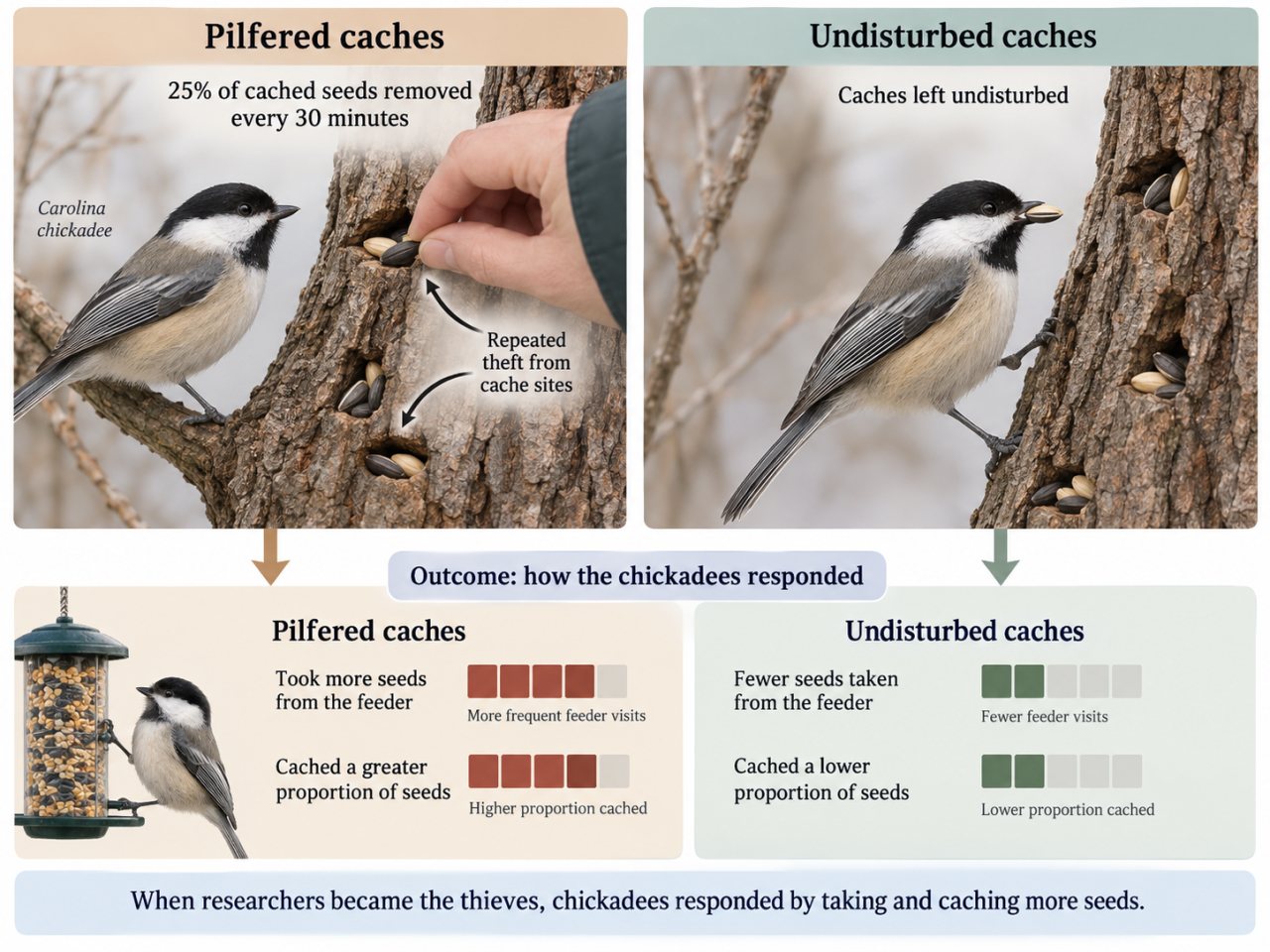
The experiment suggested that chickadees can adjust their food-storing behavior when their reserves are disappearing. However, the researchers also acknowledged another explanation for increased feeder visits: the birds might simply have been hungrier because their stored food was missing.
Either way, the stolen food changed their behavior.
Apparently, the response to inventory shrinkage was to acquire more inventory.
A missing seed doesn't necessarily mean a faulty memory
But what about the question that started this whole investigation? When a chickadee returns to an empty cache, does it continue behaving as though food should be there?
Research suggests that these birds can do considerably more than remember where they originally hid something.
In 1984, David Sherry demonstrated that black-capped chickadees (Poecile atricapillus) could remember several different kinds of information about their caches. They could relocate hidden food, remember which caches they had already emptied themselves, and remember locations they had previously discovered empty after the food disappeared. They could also retain information about the type of food stored.
That last distinction is particularly important. A chickadee's memory isn't simply a list of places where seeds were once deposited. It can incorporate information about whether those locations still contain food, based on the bird's subsequent experience.
More recently, a 2022 study by Marissa Applegate and Dmitriy Aronov demonstrated that black-capped chickadees flexibly use their cache memories when making decisions. The birds were more likely to retrieve food from occupied sites and avoided placing new food into locations they remembered already contained something. They also showed a preference for storing food in sites they had recently checked and found empty.
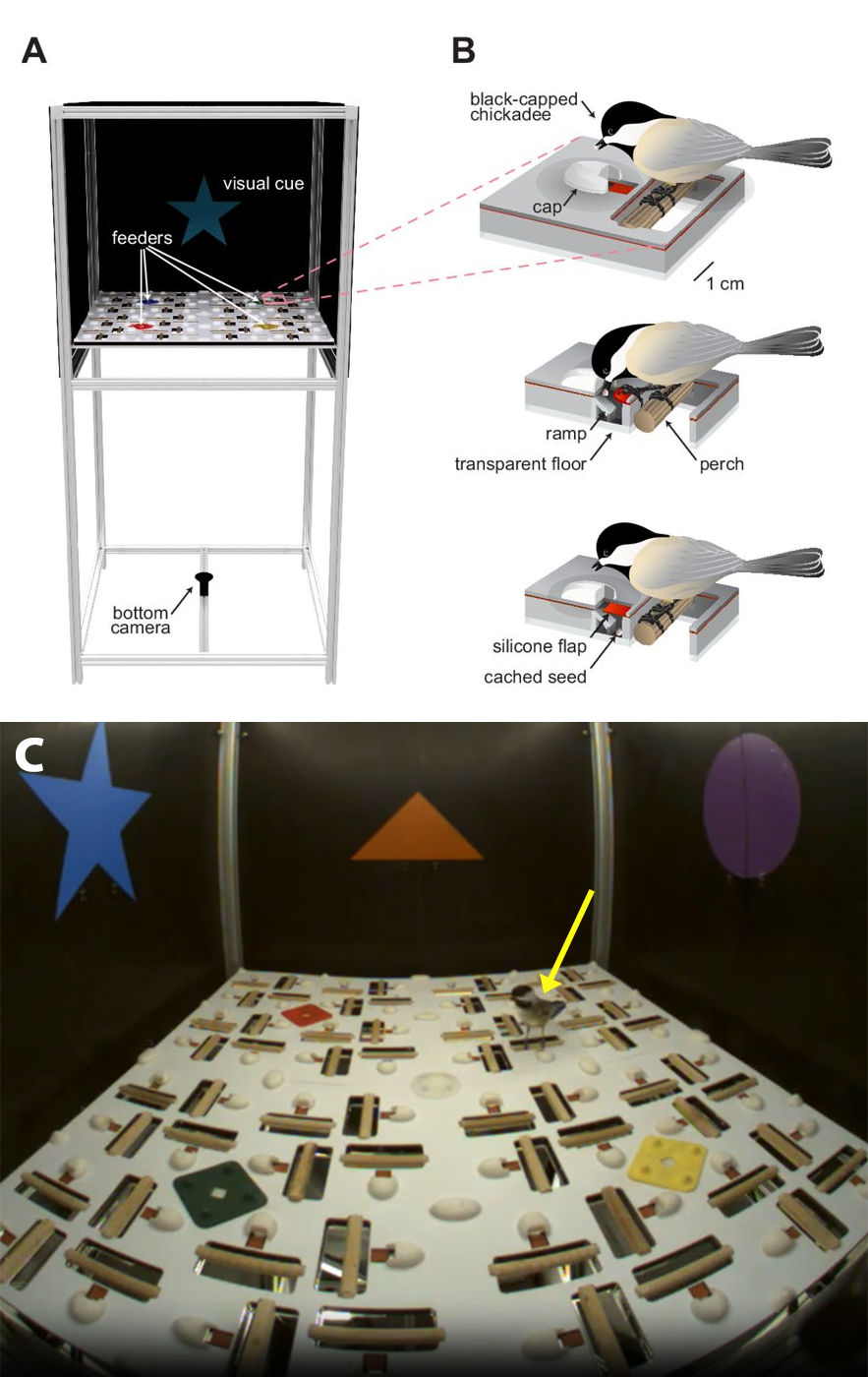
Together, these findings show that chickadees maintain and use more sophisticated information about their caches than a simple map of storage locations.
The neighbors are under surveillance
Chickadees don't merely respond after food disappears. They also change their behavior when potential thieves are watching.
In a study published online in 2007 and in print in 2008, Vladimir Pravosudov investigated whether mountain chickadees (Poecile gambeli) altered their caching behavior depending on which birds could see them.
The researchers provided caching locations that were either visible to or concealed from observing birds.
The results were striking:
-
When another mountain chickadee was watching, the birds preferred concealed caching locations.
-
When a red-breasted nuthatch was watching, they again preferred concealed locations.
-
When a dark-eyed junco was watching, they did not show the same avoidance of visible caching sites.
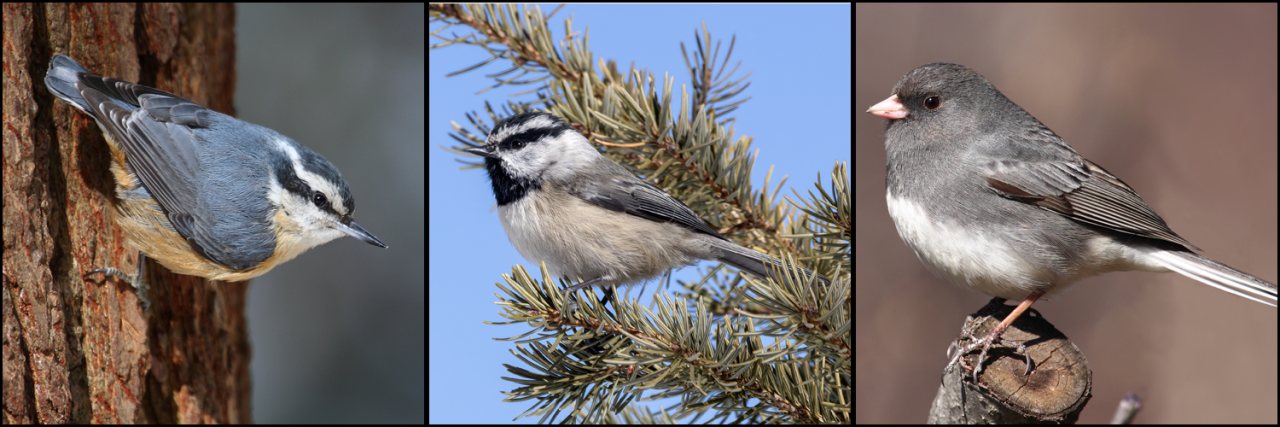
The chickadees weren't simply refusing to cache in the presence of other birds. They continued storing food but changed where they stored it depending on the observer.
This suggests that mountain chickadees can distinguish potential cache pilferers from birds that are less likely to steal their food, and adjust their behavior accordingly.
And yes, nuthatches really were among the potential thieves identified in the experiment!
Not even friends get access to the pantry
A 2010 follow-up study revealed another interesting detail: mountain chickadees concealed their caches from both familiar members of their own social group and unfamiliar chickadees.
When an observer was present, the birds preferred sites farther away and out of its direct view. Without observers, they used the available sites more evenly.
The researchers were testing whether familiar group members might tolerate one another's food theft as part of a reciprocal arrangement. Instead, the results suggested that chickadees attempt to protect their caches even from birds they already know.
Apparently, belonging to the same neighborhood doesn't entitle anyone to complimentary sunflower seeds.
The memory mystery isn't completely solved
These experiments reveal an impressive combination of memory and behavioral flexibility. Chickadees can remember information about individual storage sites, respond to disappearing food reserves, and take precautions when potential thieves are watching.
But they also raise a fascinating neuroscience question.
As we explored in our earlier article, researchers have identified distinctive patterns of hippocampal activity associated with individual caching events, sometimes called neural barcodes. Similar patterns can reappear when birds retrieve their food.
What remains less clear is exactly how these neural representations change when a bird returns to a location where it accurately remembers storing a seed, only to discover that the seed has disappeared.
Does the original cache-associated activity pattern reactivate? How does the brain represent the new information that the location is now empty? And how does that updated information influence the bird's next decision?
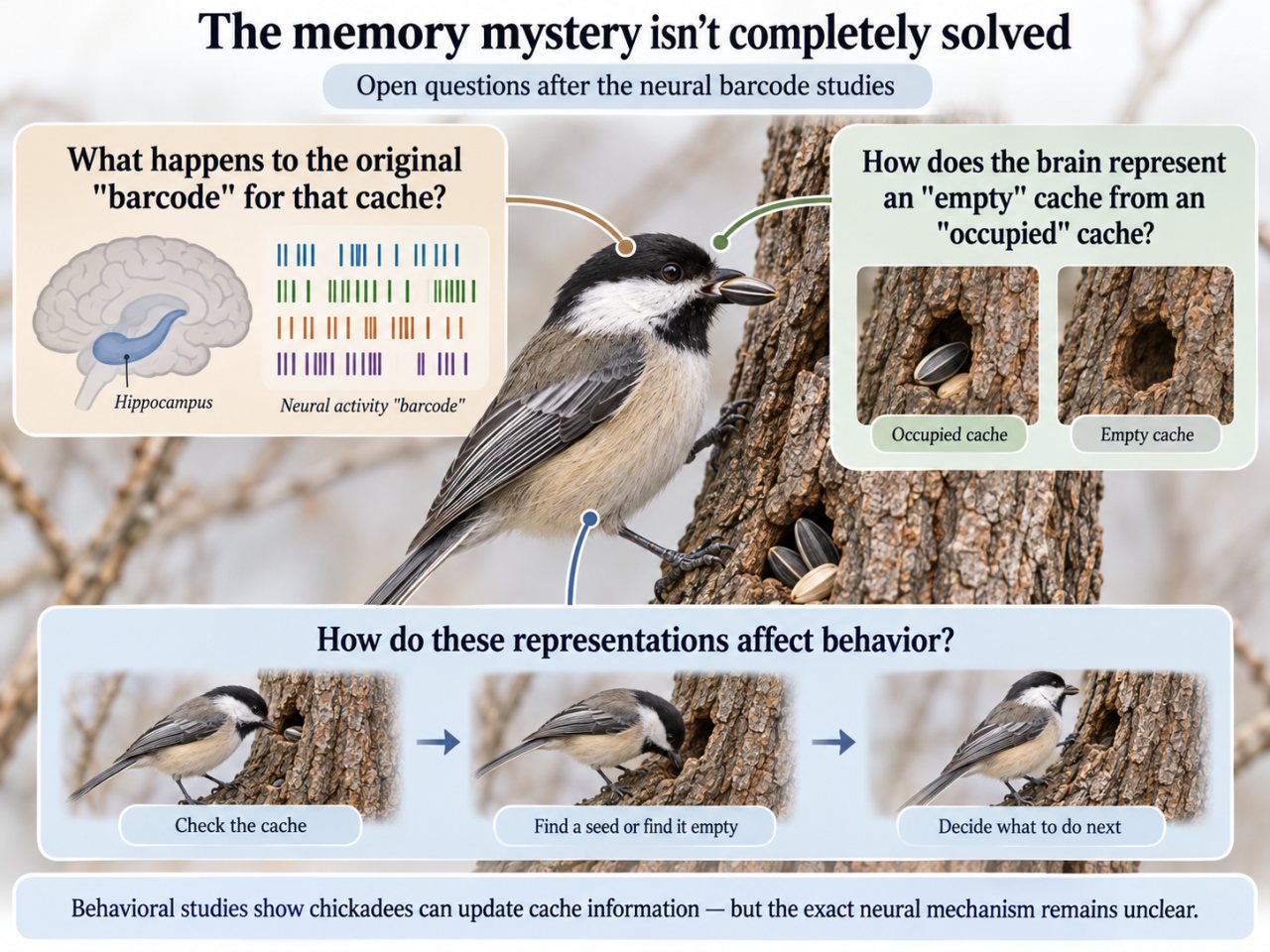
The behavioral experiments show that chickadees can use information about empty and occupied caches, but the precise neural mechanisms underlying these updates remain an active area for investigation.
So the next time a chickadee visits your backyard feeder, collects a sunflower seed, and disappears into the trees, consider what might be happening beyond the feeder.
Somewhere out there, that tiny bird may be maintaining an astonishingly sophisticated collection of hidden food reserves, while keeping a careful eye on its neighbors.
And if one of those neighbors happens to be a nuthatch?
Well, the chickadee might prefer that it mind its own business.
Sources
-
Seasonal variation in the effect of cache pilferage on cache and body mass regulation in Carolina chickadees: what are the trade-offs?
Lucas, J. R., & Zielinski, D. L. (1998). Seasonal variation in the effect of cache pilferage on cache and body mass regulation in Carolina chickadees: What are the trade-offs? Behavioral Ecology, 9(2), 193–200.
Why this source matters: Researchers experimentally removed one-quarter of Carolina chickadees' cached food every 30 minutes and measured how the birds responded. The study demonstrates changes in food acquisition and caching behavior under repeated theft, with important seasonal differences.
-
Food storage by black-capped chickadees: Memory for the location and contents of caches
Sherry, D. F. (1984). Food storage by black-capped chickadees: Memory for the location and contents of caches. Animal Behaviour, 32(2), 451–464.
Why this source matters: This foundational experiment demonstrates that black-capped chickadees can remember not only cache locations and contents, but also sites they have already emptied or discovered empty after losing their stored food.
-
Flexible use of memory by food-caching birds
Applegate, M. C., & Aronov, D. (2022). Flexible use of memory by food-caching birds. eLife, 11, e70600.
Why this source matters: Using an automated experimental arena, researchers demonstrated that black-capped chickadees flexibly use memories of cache locations and contents when deciding where to retrieve food and where to store additional seeds.
-
Mountain chickadees discriminate between potential cache pilferers and non-pilferers
Pravosudov, V. V. (2008). Mountain chickadees discriminate between potential cache pilferers and non-pilferers. Proceedings of the Royal Society B: Biological Sciences, 275(1630), 55–61.
Why this source matters: This experiment found that mountain chickadees concealed caches from other chickadees and red-breasted nuthatches, but not from dark-eyed juncos. The findings suggest that chickadees alter cache placement according to the potential risk posed by different observers.
-
Chickadees are selfish group members when it comes to food caching
Pravosudov, V. V., Roth, T. C., & LaDage, L. D. (2010). Chickadees are selfish group members when it comes to food caching. Animal Behaviour, 80(2), 175–180.
Why this source matters: Mountain chickadees concealed their caches from both familiar social-group members and unfamiliar birds of their own species. The results suggest that familiarity does not eliminate precautions against potential cache theft.