

Ask someone, “What is electricity?”
If they don’t give you a blank stare in return, they’ll probably say something like, “The movement of electrons?” or “The thing that kills you if you touch it?” 😂
But the electron answer is the interesting one.
For decades, electrons have taken most of the credit for electricity. Many people picture tiny electrons zooming through wires like overcaffeinated utility workers.
Which is very flattering for electrons.
But it is significantly less flattering for the other charged particles involved in the electrical industry.
Because while electrons really do carry electrical current through metals - like the wires in your house - they do not have an exclusive contract as the one-and-only current carrier.
In salty water, ions can carry the current. [We introduced sodium ions and chloride ions in this past story!]
In static electricity, charge can build up without a sustained current.
And voltage is sitting in a corner sulkily wondering why everyone keeps confusing it with current.
We at Science Scandal have therefore opened an investigation into what appears to be a decades-long case of electrical credit hogging.
And confusing electrical terminology.
It turns out that electricity is not an electron-only business.
It is a charge business.
And several employees would like their names added to the company website for the recognition they deserve.
The Real Story
Electricity is not a single substance moving through the world. It is a broad set of phenomena involving electric charge, the forces between charges, the energy associated with their positions, and sometimes the movement of those charges.
So before we can rescue the ions from the electron publicity machine, we need to start with the thing they all have in common:
Charge.
Electric charge is a property of matter. We describe it as positive or negative, and those charges interact through electric forces. Opposite charges attract. Like charges repel.
In ordinary matter, protons carry positive charge and electrons carry negative charge. Most objects contain equal amounts of positive and negative charge overall, so they are electrically neutral. But electrons can sometimes be transferred or redistributed, leaving one object with an excess of electrons and another with a deficit. [Click here to review how sodium and chlorine atoms can swap electrons, resulting in sodium ions and chloride ions.]
That is where our first example enters the investigation.
Static electricity: charge without a steady current
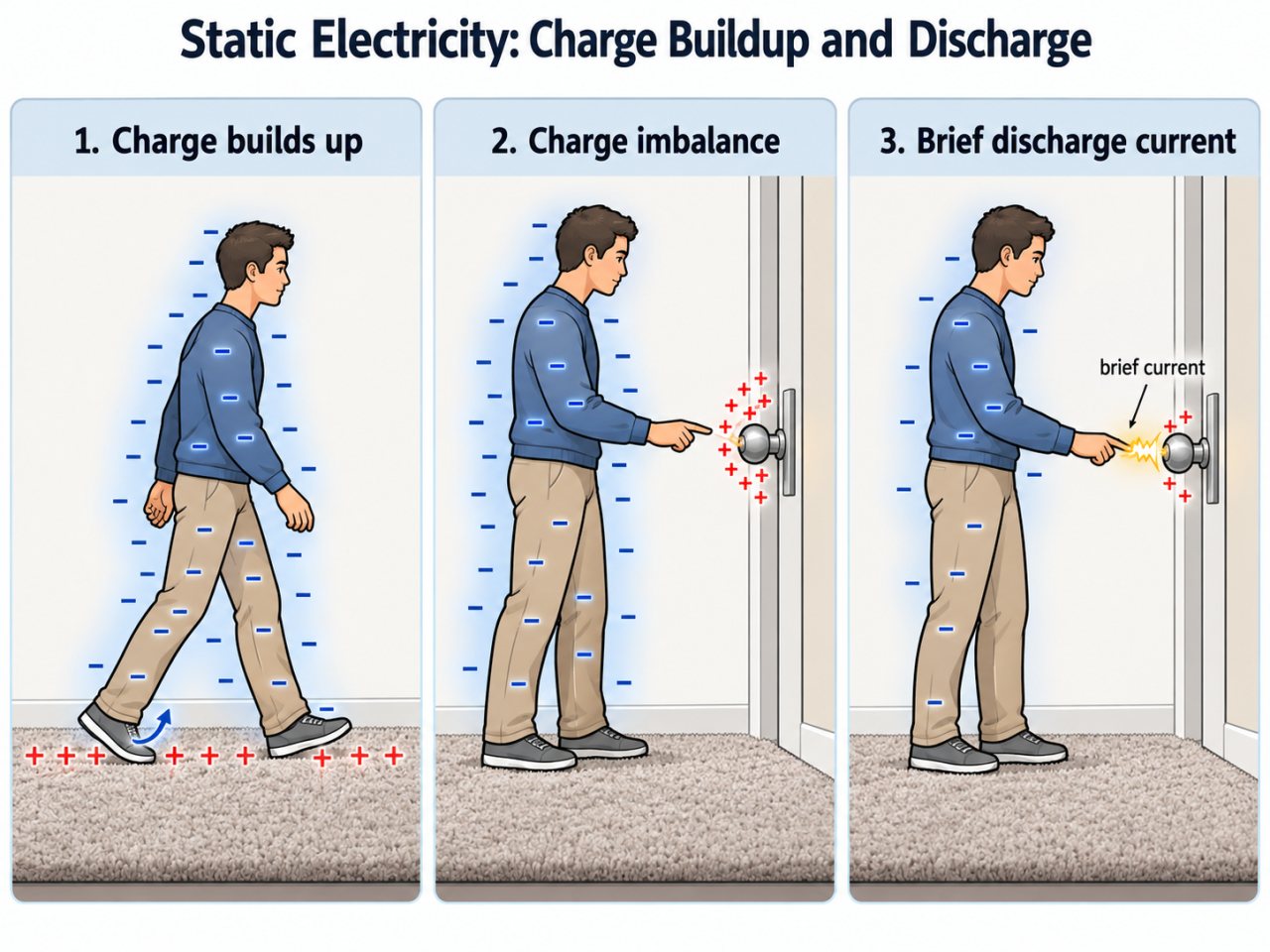
Rub a balloon on your hair, shuffle across a carpet, or pull certain materials apart, and electrons can be transferred or redistributed between surfaces.
The result is a charge imbalance.
An object with extra electrons has a net negative charge. An object that has lost some electrons has a net positive charge. Those charges can remain separated for a while, particularly when they are trapped on insulating materials that do not let charge move easily.
That is static electricity.
The important word here is static. There does not have to be a continuous flow of charge for an electrical phenomenon to exist.
But static charge does not always stay put forever.
Walk across a carpet, accumulate excess charge, and then bring your finger close to a metal doorknob. If the electric field across the air gap becomes strong enough, the air can break down and provide a conducting path. Charge suddenly moves through that path.
Spark!
At that moment, there is an electric current, but only briefly while the accumulated charge discharges.
So static electricity gives us our first important distinction:
Charge can exist without a sustained current.
Current: charge on the move
When charge does move, we can describe that movement using electric current.
More precisely, electric current is the rate at which electric charge flows past a point. One ampere of current corresponds to one coulomb of charge passing a point each second.
Notice what that definition does not say.
It does not say “the rate at which electrons flow.”
It says charge.
That matters because the particles carrying the charge depend on the material.
In metal wires, the electrons really are doing the work
Electrons have not fabricated their entire résumé.
In metals such as copper, some electrons are not confined to individual atoms and can move through the material. When an electric field is established in a wire, these mobile electrons acquire a small average drift in response to that field.
That movement of negative charge constitutes electric current.
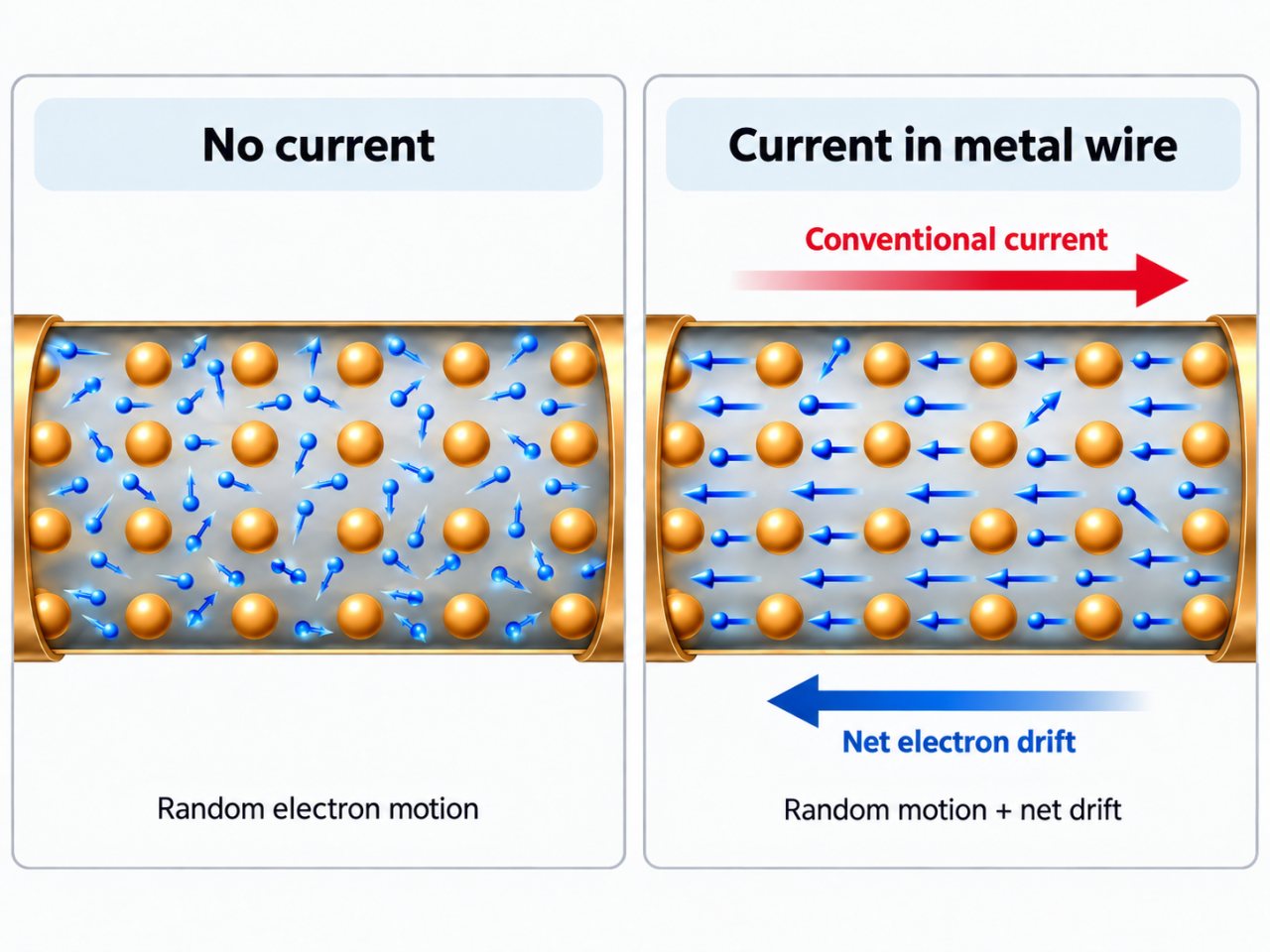
So when you picture electricity in household wiring as electrons moving through metal, that basic picture is legitimate.
There is one wrinkle, though.
The individual electrons are not racing through the wire at anything remotely resembling the speed of an electrical signal. Their average drift through an ordinary conductor can be quite slow. What propagates through the circuit very quickly is the change in the electric field that makes electrons throughout the conductor respond.
In other words, flipping a light switch does not release one particularly ambitious electron that sprints through the wall until it reaches the bulb.
Electrons were already present throughout the conductor.
The electrical conditions of the circuit change, and charges throughout the circuit respond.
Electrons retain their position in the electrical industry.
They just lose the exclusive naming rights.
In salty water, ions take over
Now drop an ionic compound such as sodium chloride into water.
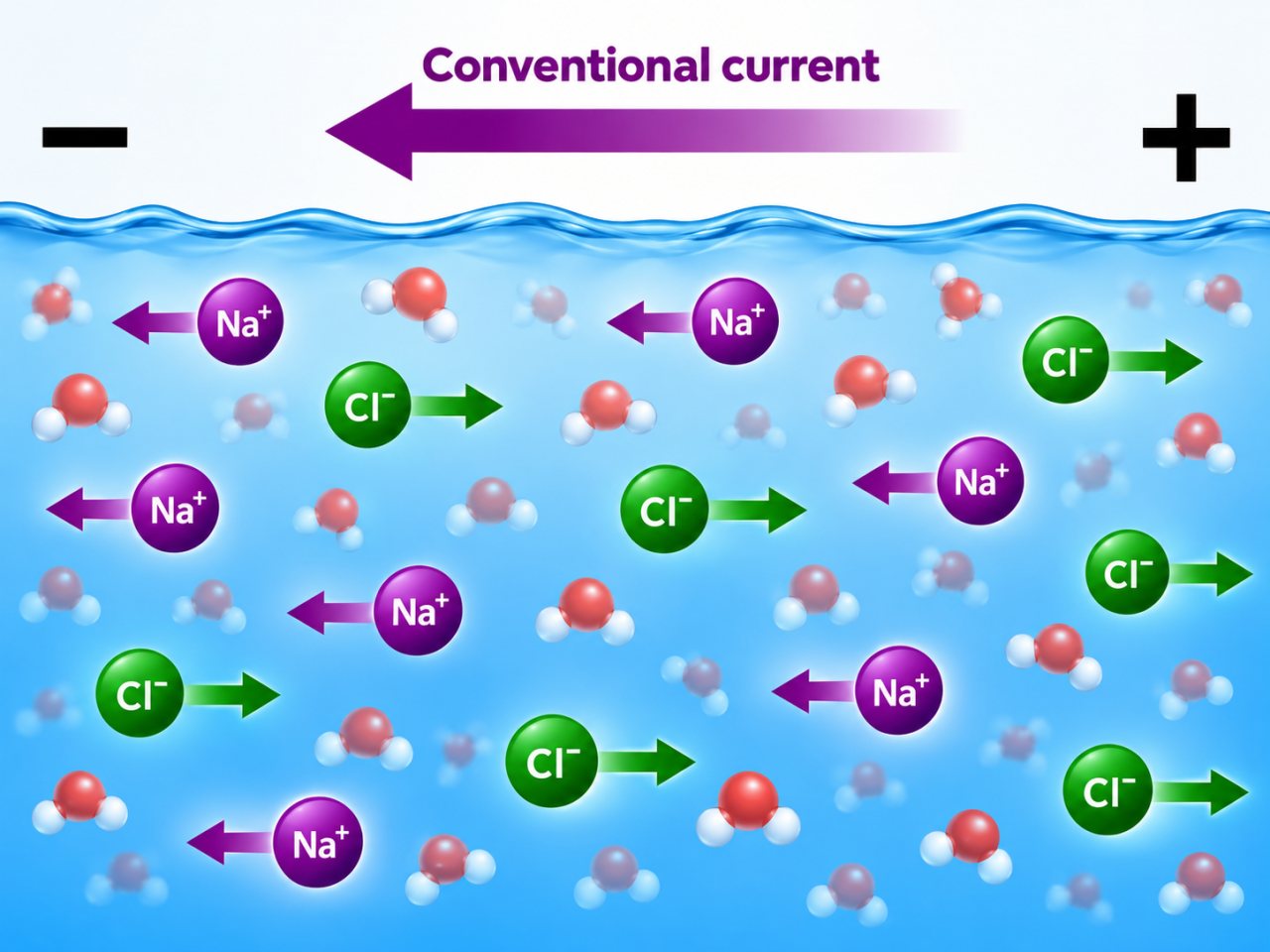
As we covered in our earlier investigation into your suspicious salt shaker, sodium chloride consists of positively charged sodium ions and negatively charged chloride ions. When salt dissolves in water, those ions separate and become free to move through the solution.
That mobility changes everything.
A solution containing freely moving ions can conduct electric current because the ions themselves carry charge. Under an applied electric field, positive ions move preferentially one way while negative ions move preferentially the opposite way. Both movements contribute to the current.
So:
Metal wire: moving charge carriers are primarily electrons.
Salt water: moving charge carriers are ions.
Same concept of electric current.
Different employees.
And this is why saying “electricity is moving electrons” is too narrow.
A better statement is:
Electric current is the flow of electric charge.
Sometimes the charge is carried by electrons.
Sometimes it is carried by ions.
And in some systems, both positive and negative charge carriers can contribute.
This also explains something that sounds strange at first: pure water is a poor electrical conductor.
Water molecules can ionize very slightly on their own, but pure water contains very few mobile ions. Dissolve salts or other electrolytes into it, however, and the concentration of mobile charged particles increases, allowing much greater electrical conduction. Ordinary tap water already contains dissolved ions, which is one reason it conducts far better than ultrapure water.
And then there is voltage, sitting in the corner
Charge tells us what has the electrical property.
Current tells us how rapidly charge is moving.
Voltage tells us something different.
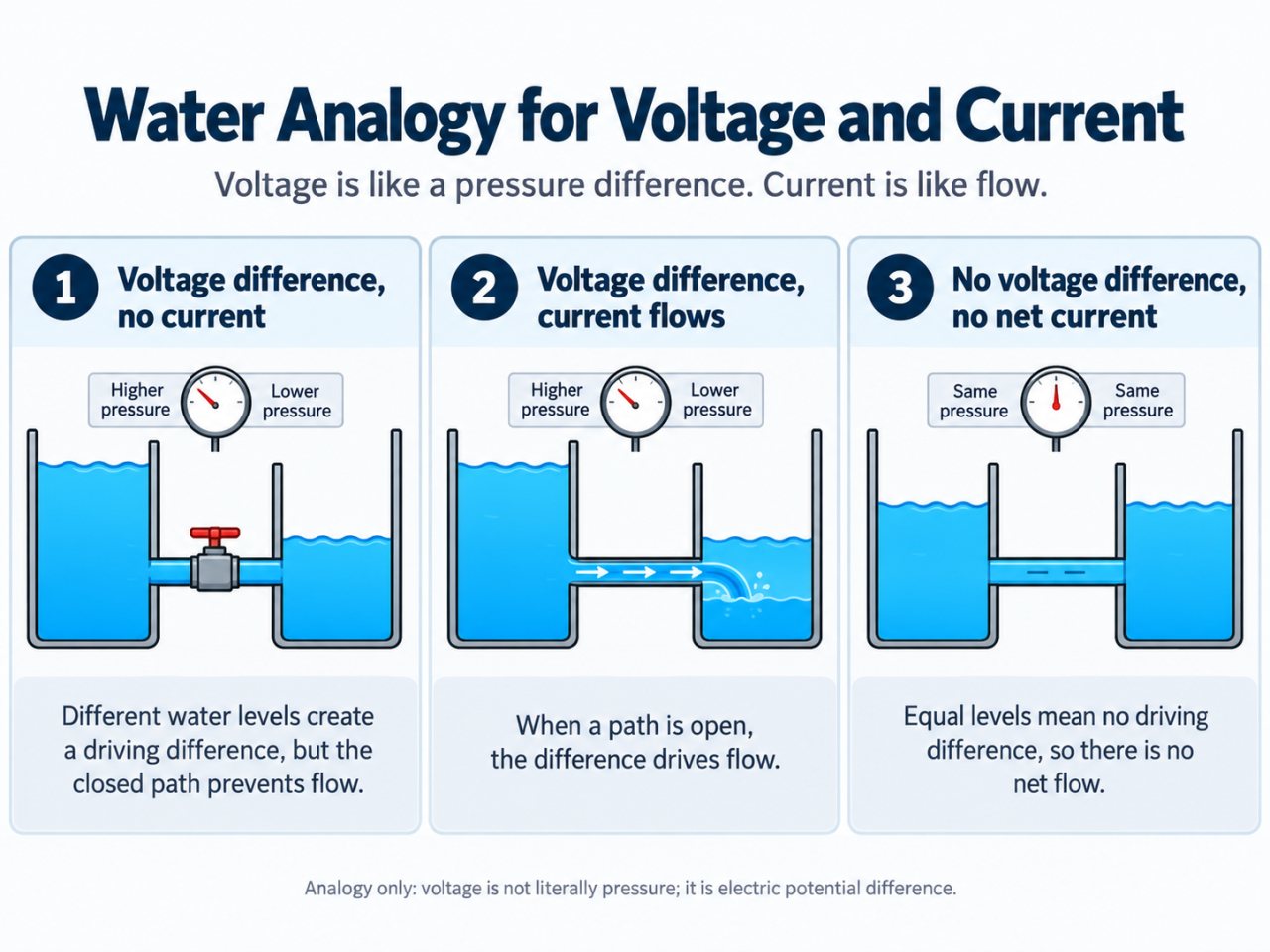
Voltage is the common term for electric potential difference. It describes a difference in electric potential energy per unit charge between two points.
One volt is one joule of potential-energy difference per coulomb of charge.
That definition can sound abstract, so it helps to think in terms of an electrical hill.
A ball at the top of a hill has gravitational potential energy because of its position. Give it a path downhill, and gravity can make it move.
Likewise, a difference in electric potential can provide the conditions for charged particles to move when an appropriate conducting path exists.
A battery, for example, maintains a potential difference between its terminals. Connect those terminals through a conducting circuit, and that potential difference establishes an electric field that can drive charge through the circuit.
But voltage and current are not the same thing.
You can have a voltage difference even when no continuous current is flowing.
A disconnected battery still has a voltage across its terminals.
A statically charged object can have an electric potential difference relative to another object even before the spark occurs.
Current appears when charge actually moves.
So the electrical department finally has something resembling an organizational chart:
Charge is the electrical property.
Electric forces and fields act on charges.
Voltage describes an energy difference per unit charge between locations.
Current describes the movement of charge.
And the identity of the moving charge carrier depends on the material.
In metals, electrons get the assignment.
In salty water, ions report for duty.
In static electricity, charge may simply accumulate until conditions allow it to move.
Which means the electrons were telling the truth about working in electricity.
They just neglected to mention they're only one part of the department.
Sources
-
18.2 Conductors and Insulators
Urone, P. P., & Hinrichs, R. (2022). “18.2 Conductors and Insulators.” In College Physics 2e. OpenStax, Rice University.
Why this source matters: Provides the foundation for conductors and insulators, electron mobility in metals, ionic conduction in salty water, charge transfer, and the distinction between pure water and water containing dissolved ions.
-
20.1 Current
Urone, P. P., & Hinrichs, R. (2022). “20.1 Current.” In College Physics 2e. OpenStax, Rice University.
Why this source matters: Defines electric current as the rate of charge flow; explains that electrons carry current in metal wires while both positive and negative ions can carry current in ionic solutions; distinguishes electron drift from the much faster propagation of electrical signals; and explains conventional current direction.
-
19.1 Electric Potential Energy: Potential Difference
Urone, P. P., & Hinrichs, R. (2022). “19.1 Electric Potential Energy: Potential Difference.” In College Physics 2e. OpenStax, Rice University.
Why this source matters: Defines electric potential and potential difference, explains that voltage is energy difference per unit charge, and establishes why voltage and current are related but fundamentally different quantities.
-
11.2 Electrolytes
Flowers, P., Theopold, K., Langley, R., & Robinson, W. R. (2019). “11.2 Electrolytes.” In Chemistry 2e. OpenStax, Rice University.
Why this source matters: Explains why aqueous electrolyte solutions conduct electricity, how dissolved ions become mobile charge carriers, why conductivity increases with ion concentration, and why pure water conducts very poorly.