
Sugar has been behaving rather strangely lately.
Ordinarily, it's a perfectly respectable pantry staple. White, crystalline, sweet, and generally willing to cooperate with whatever recipe you've got planned.
But put some sugar in a saucepan, add a little water, and turn up the heat.
At first, nothing particularly scandalous happens. The sugar dissolves. The water gets hot. Everything seems perfectly normal.
Then things start getting suspicious.
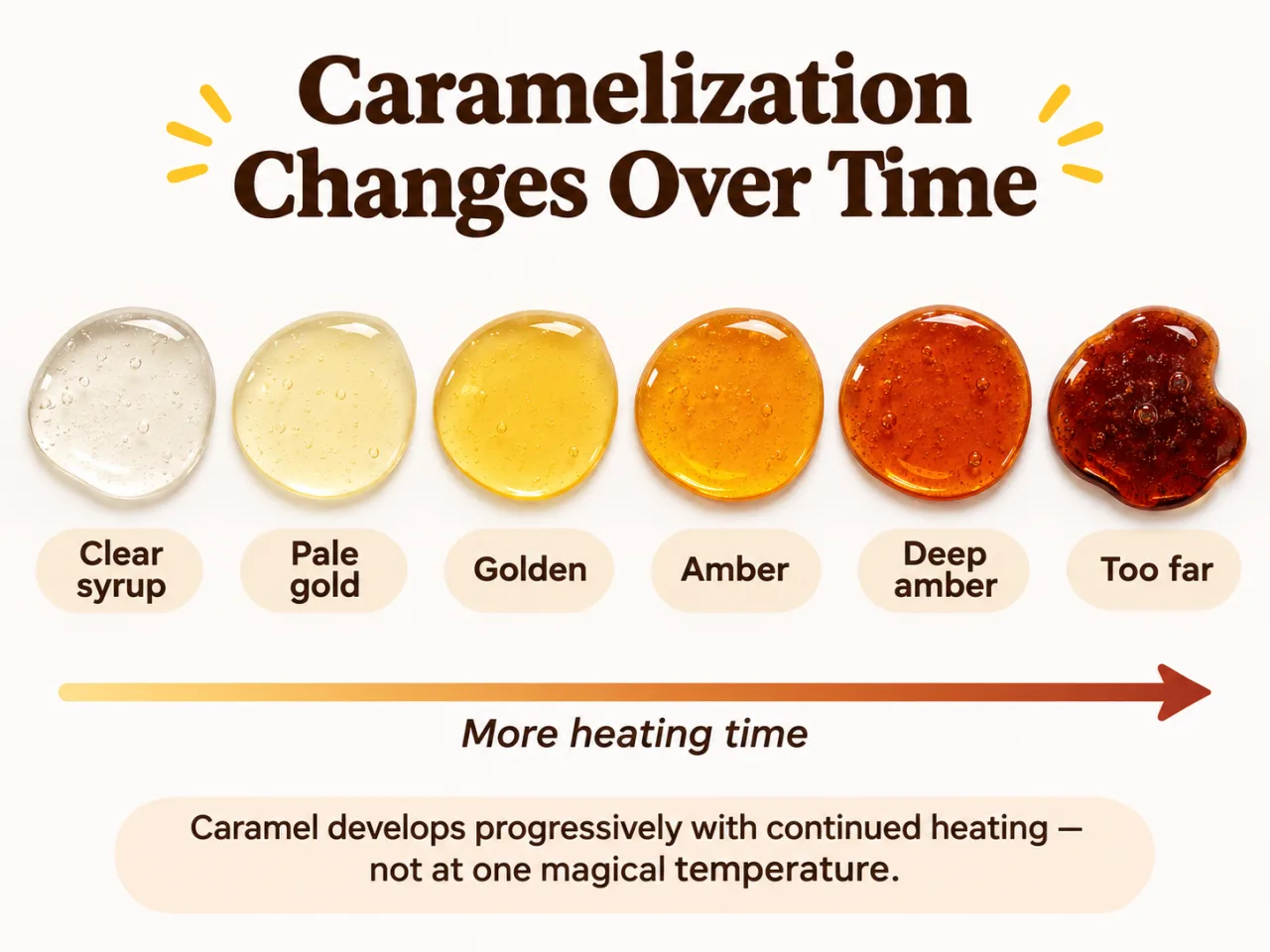
The liquid begins turning pale yellow. Then golden. Then amber. And suddenly, your kitchen smells like something that costs $14 at an artisan candy shop.
The sugar has undergone a complete transformation.
Naturally, it claims it merely melted.
Nice try.
Melting does not explain why your formerly innocent sugar now has a dramatically different color, an elaborate aroma profile, and a flavor that has apparently developed several new personality traits.
And if you keep heating it, things can get even uglier. That beautiful golden caramel can turn dark, bitter, and eventually become something you'll spend the next twenty minutes trying to scrape out of your saucepan.
Which brings us to an important question:
What exactly happened to the sugar?
Because unlike its previous heated affair with amino acids, this time sugar has been getting into trouble entirely on its own.
The process is called caramelization.
And apparently, sugar doesn't need anybody else's help to have a complete chemical identity crisis.
The Real Story
Caramelization is a complex series of chemical reactions that occurs when sugars are heated, producing new compounds responsible for the characteristic colors, aromas, and flavors of caramel.
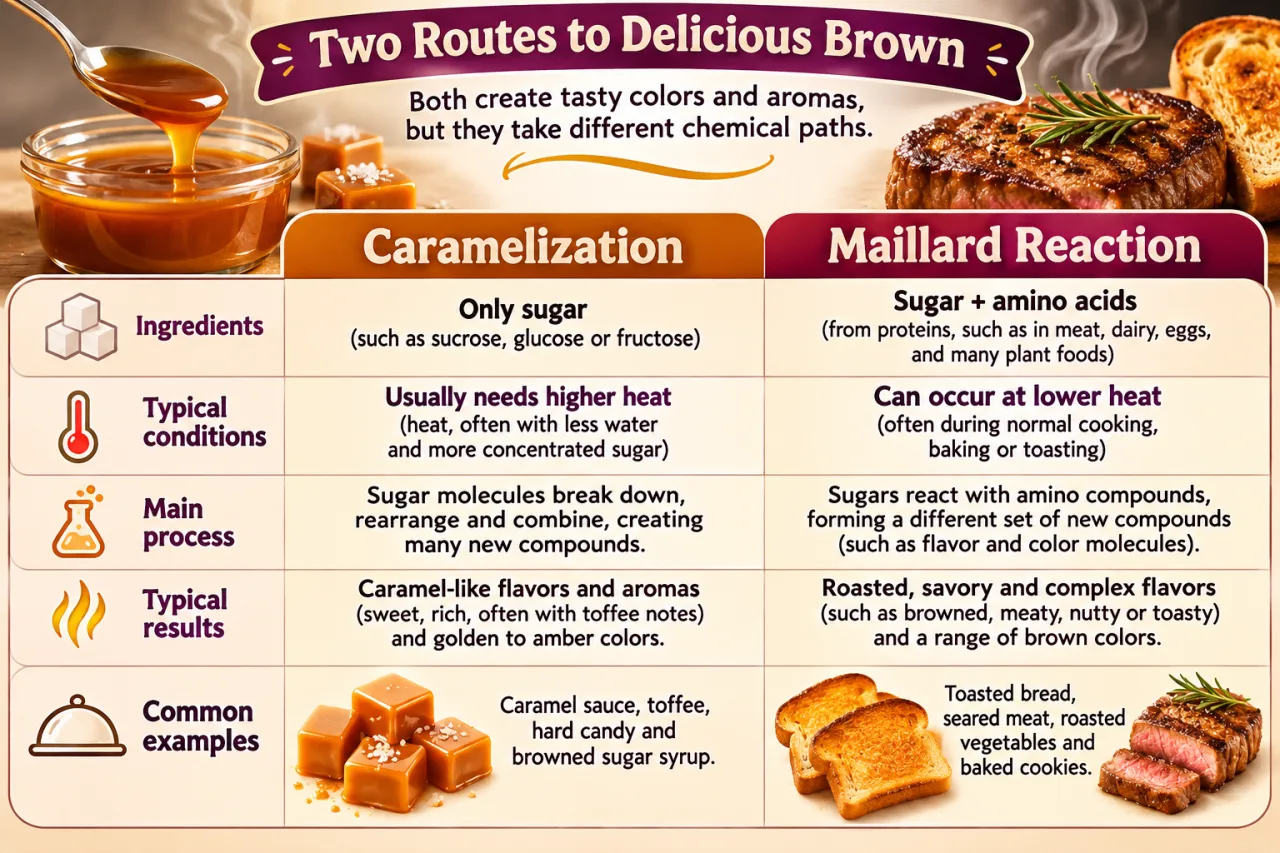
And unlike the Maillard reaction, which involves sugars reacting with amino compounds, caramelization doesn't require proteins or amino acids at all.
Sugar is perfectly capable of causing this particular chemical scandal by itself.
Melting, dissolving, and caramelizing are not the same thing
Let's begin with ordinary table sugar, chemically known as sucrose.
When you stir sugar into water, the sugar crystals dissolve. Individual sucrose molecules become dispersed throughout the liquid, but they're still sucrose. You haven't transformed them into a new substance.
Similarly, when a solid substance melts, it changes from a solid to a liquid. That's a physical change, not necessarily a chemical reaction.
But when you make caramel, something much more interesting happens.
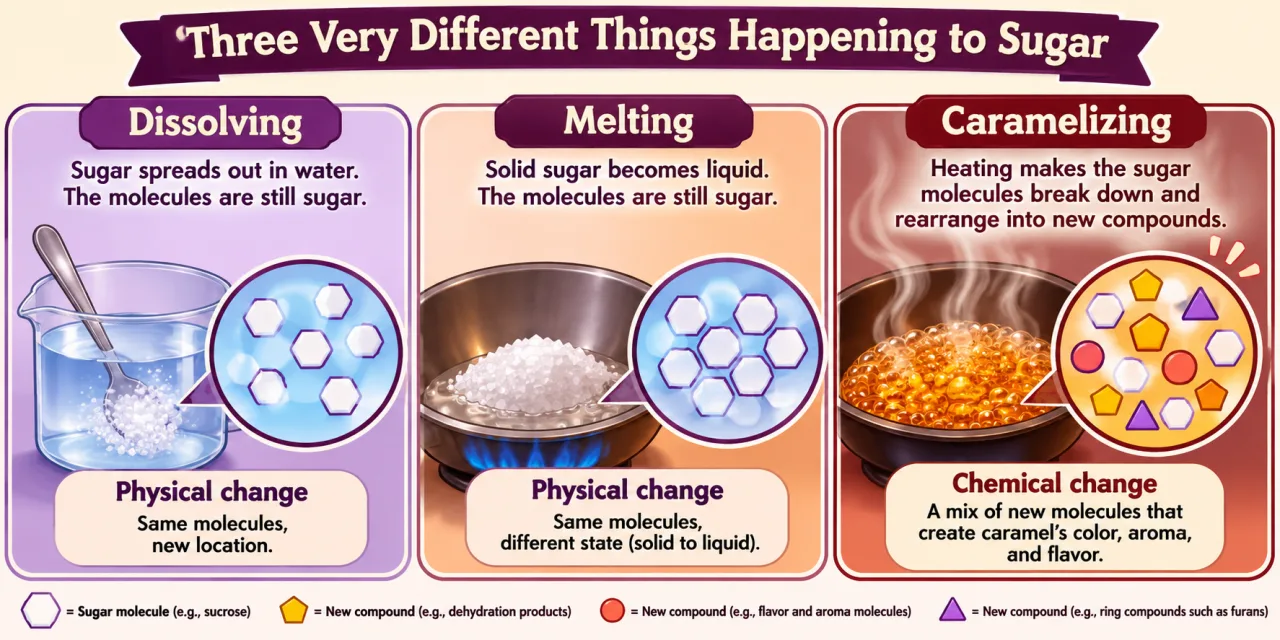
Imagine heating a saucepan containing sugar and a little water. As the mixture warms, the sugar dissolves and water gradually evaporates. The increasingly concentrated syrup can reach higher temperatures, and the sugar molecules begin undergoing chemical transformations.
The mixture that eventually turns golden brown isn't simply melted sugar. It contains new chemical compounds that weren't present in the original sugar in the same amounts.
That's the difference: dissolving and melting change the physical arrangement or state of a substance. Caramelization changes its chemical composition.
So what actually happens to the sugar?
Caramelization isn't one chemical reaction with one final product. It's a complicated network of reactions that can follow different pathways depending on the sugar and the conditions.
When heated, sugar molecules can undergo several transformations.
Some reactions involve dehydration, in which molecules lose the chemical components of water. Others involve fragmentation, where larger molecules break into smaller pieces. Molecules can also rearrange their structures or react with one another to form larger, more complex substances.
Sucrose itself can break down into glucose and fructose, which can then participate in additional reactions.
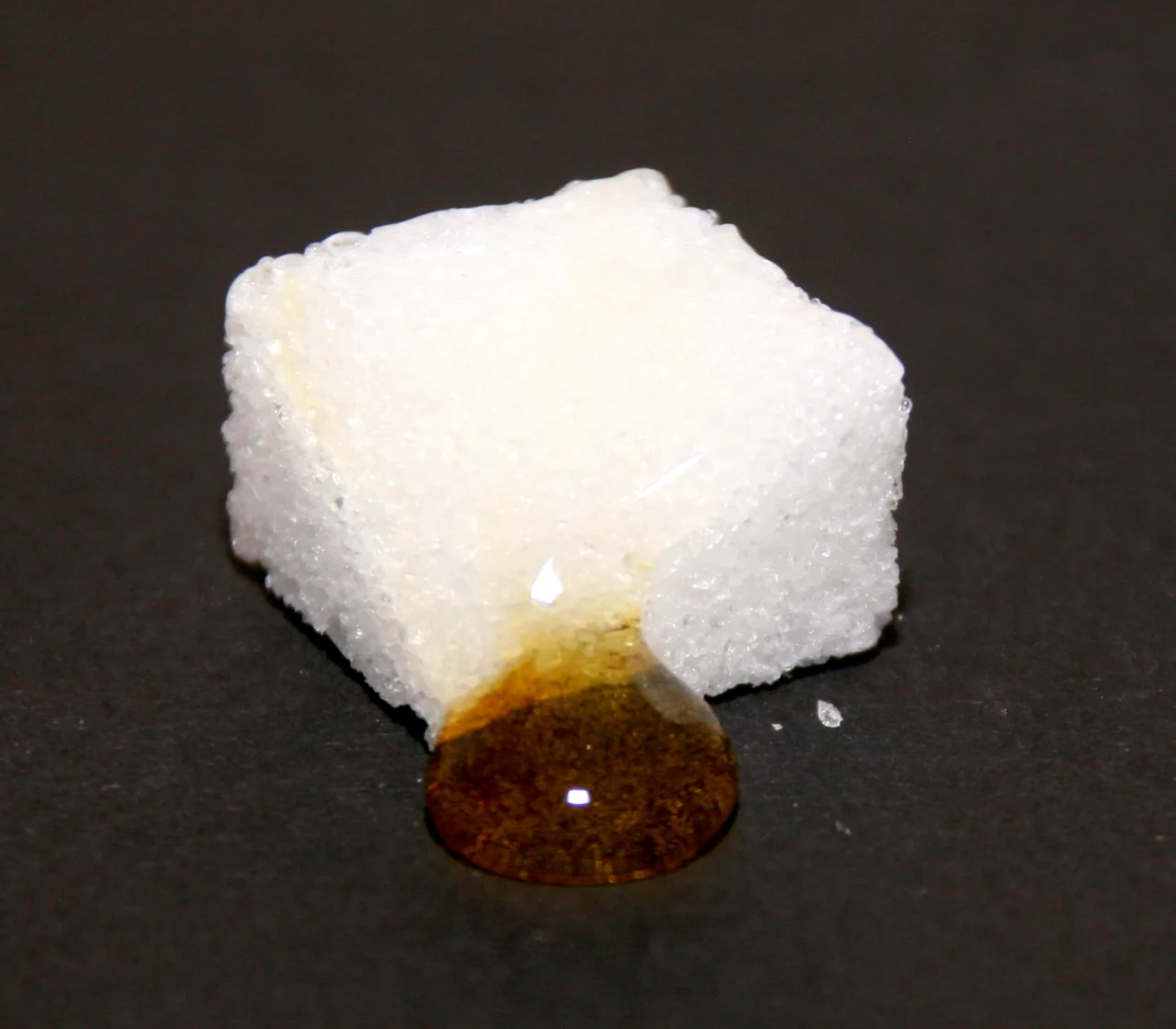
As this chemical network develops, it produces a changing mixture of compounds. Some contribute to caramel's rich, characteristic aroma, while others create flavors ranging from pleasantly sweet and buttery to toasted, nutty, and eventually bitter.
Compounds such as 5-hydroxymethylfurfural (HMF) can form during sugar degradation, while additional reactions produce substances responsible for the increasingly golden, amber, and brown colors.
In other words, caramel isn't one new molecule replacing sugar. It's an evolving chemical mixture, and its composition continues changing as heating proceeds.
Timing is everything
You've probably seen cooking instructions claiming that sugar caramelizes at exactly 338°F (170°C).
The reality is more complicated.
Different sugars react at different rates, and caramelization depends on more than temperature alone. Heating time, water content, sugar concentration, and pH can all influence the reactions.
In fact, researchers studying concentrated sucrose solutions documented caramelization-related color changes at temperatures between 212°F and 320°F (100–160°C). Heating time made a measurable difference in how the color developed.
That doesn't mean a saucepan of ordinary sugar syrup will rapidly turn brown at 212°F. It means that caramelization cannot be described by a single universal temperature threshold.
In a typical kitchen, the color change becomes much more noticeable as water evaporates, the syrup becomes more concentrated, and its temperature rises.
And once the transformation gets going, things can change quickly.
A pale golden syrup develops a mild caramel flavor. Continued heating produces darker colors and increasingly complex flavors. Push the process too far, however, and the mixture can become unpleasantly bitter and eventually char.
The difference between beautifully caramelized sugar and a ruined saucepan can be surprisingly brief.
Wait. Didn't we already investigate browning?
We did.
In our previous Kitchen Chemistry investigation, Sugar Caught Having Heated Affair With Amino Acids!, we exposed the Maillard reaction, a network of reactions involving reducing sugars and amino groups.
Caramelization is a different process because sugars can undergo these transformations without amino compounds participating.
But that doesn't mean the two processes never occur together.
Consider the chewy caramel candies made with sugar, cream, and butter.
Despite their name, those candies may develop some of their color and flavor through Maillard reactions involving sugars and proteins from the cream. Caramelization can also contribute, depending on the ingredients and cooking conditions.
So the word caramel doesn't necessarily tell us which chemical reactions produced the finished food.
The important distinction is that caramelization changes the chemistry of sugars themselves, while the Maillard reaction involves interactions between sugars and amino compounds.
Both can make food brown. Both can create appealing flavors and aromas. But they arrive there through different chemistry.
And that brings us back to our saucepan.
Sugar didn't simply melt, acquire a tan, and develop expensive tastes. Its molecules underwent a complex series of chemical transformations, producing an entirely new combination of substances.
Apparently, sugar can reinvent itself without assistance.
Which is fortunate, because the Kitchen Chemistry investigations are far from over. We've discovered what happens when sugars get involved with amino acids, and now what happens when they get heated on their own.
There are still plenty of other ingredients in the kitchen behaving suspiciously. Stay tuned!
Sources
-
Modelling colour changes during the caramelisation reaction
Quintas, M. A. C., Brandão, T. R. S., & Silva, C. L. M. (2007). Modelling colour changes during the caramelisation reaction. Journal of Food Engineering, 83(4), 483–491.
Why this source matters: This experimental study investigated how the color of concentrated sucrose solutions changes during heating at different temperatures and durations. Its findings demonstrate why caramelization depends on both temperature and time, rather than one universal browning threshold.
-
Nonenzymatic Browning and Antioxidant Properties of Thermally Treated Cereal Grains and End Products
Schutte, M., Hayward, S., & Manley, M. (2024). Nonenzymatic browning and antioxidant properties of thermally treated cereal grains and end products. Journal of Food Biochemistry, 2024, Article 3865849.
Why this source matters: This scholarly review examines the chemical differences between caramelization and the Maillard reaction. It describes how sugars undergo degradation, rearrangement, and dehydration during heating, producing compounds responsible for color and flavor changes.
-
Science of Candy: Caramelization & Caramels
Exploratorium. (n.d.). Science of candy: Caramelization & caramels. Science of Cooking.
Why this source matters: This accessible science-museum explanation distinguishes heating sugar alone from browning reactions involving sugars and proteins. It also explains why caramel candies made with cream may develop their characteristic colors and flavors through Maillard chemistry.