
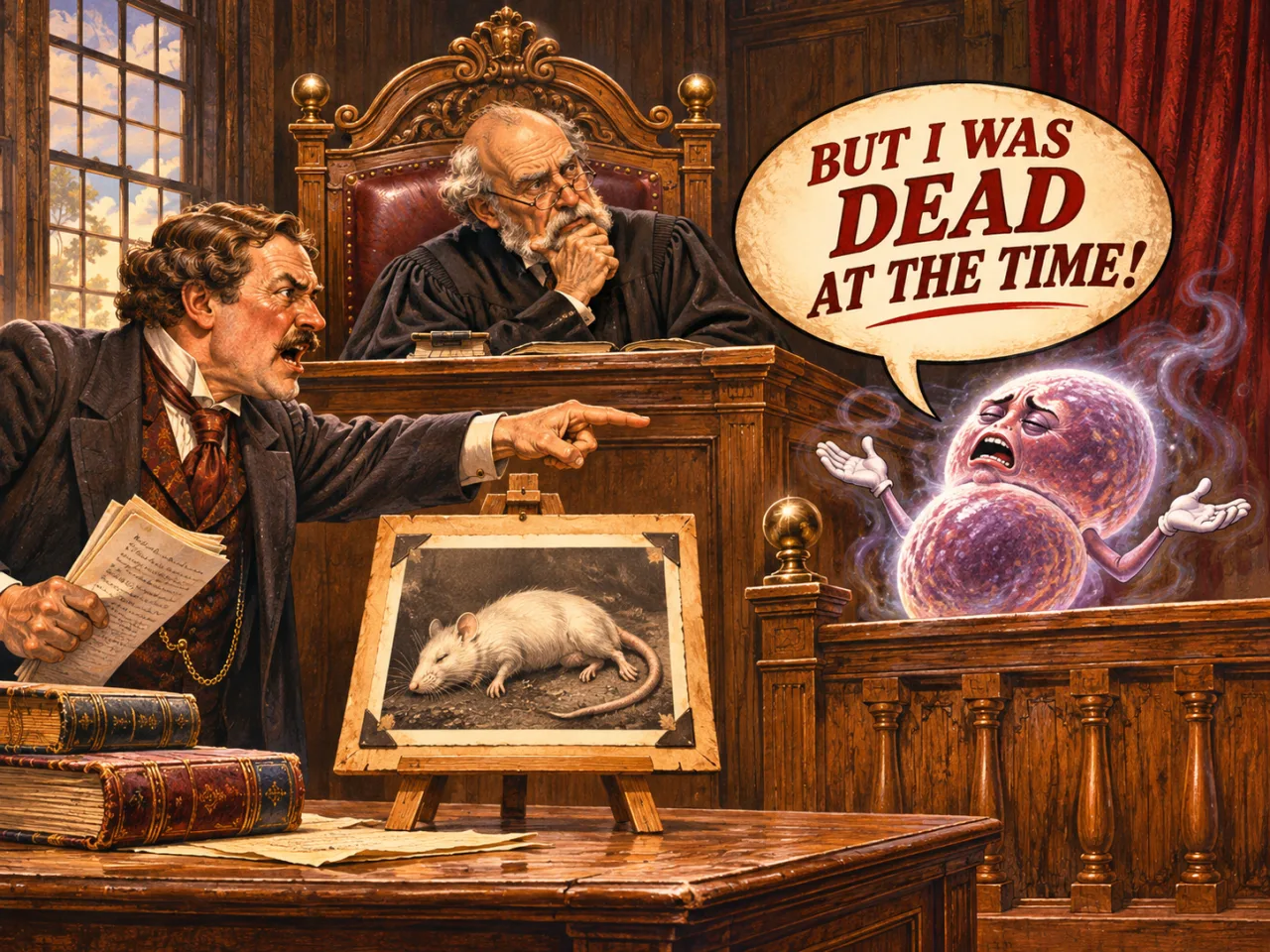
The case landed on the detective's desk on an otherwise ordinary morning in 1928.
One mouse. Dead. Suspicious circumstances.
There were two suspects: a strain of bacteria with a known history of killing mice and another strain with an apparently spotless record.
Naturally, investigators focused on the known killer.
The prosecution was confident. The evidence was compelling. The accused had a reputation for precisely this sort of behavior.
Unfortunately, the defense attorney had one rather inconvenient objection.
“Your Honor, my client was DEAD at the time of the alleged crime!”
The courtroom fell silent.
“And not merely presumed dead,” the attorney continued triumphantly. “My client had been deliberately subjected to lethal heat before the victim was even exposed!”
The judge adjusted his spectacles.
“Well, that does complicate matters.”
The prosecution reluctantly conceded that a bacterium already killed by heat was unlikely to have personally carried out the attack.
The case appeared to be falling apart.
Until the detective noticed the second suspect.
The supposedly harmless bacteria had been sitting quietly throughout the proceedings, avoiding eye contact and looking increasingly uncomfortable.
“Funny thing,” the detective remarked. “You were perfectly harmless before you started associating with the deceased.”
The bacterium shifted nervously.
“And yet, after spending some time with the remains, you somehow acquired the exact same deadly reputation.”
The prosecutor leaned forward.
“Care to explain that?”
The bacterium hesitated.
“Well... I might have picked up a few things after they died.”
“WHAT things?”
“Just some leftovers.”
“LEFTOVERS?!”
The courtroom erupted.
The judge demanded order. The defense attorney demanded clarification. The prosecutor demanded to know how a dead bacterium could leave behind something capable of turning an innocent relative into a killer.
The bacterium declined to elaborate.
And somewhere in Frederick Griffith’s laboratory, a scientific mystery was just beginning.
The Real Story
In 1928, British bacteriologist Frederick Griffith published the results of experiments that would become a landmark in the history of genetics. While studying Streptococcus pneumoniae, a bacterium capable of causing pneumonia and other serious infections, Griffith discovered that bacteria could acquire new characteristics from other bacteria that were already dead.
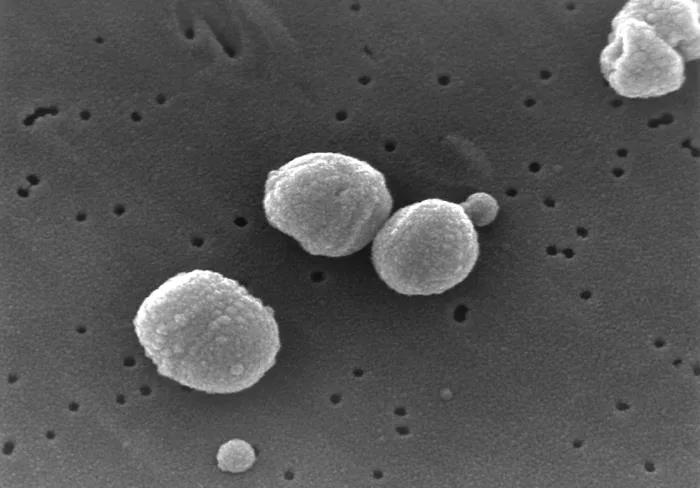
The discovery emerged from his investigations into different forms, or strains, of pneumococci. Two forms became particularly important: smooth (S) bacteria and rough (R) bacteria.
The smooth bacteria produced colonies with a glossy appearance because the cells were surrounded by a protective capsule made of complex sugars called polysaccharides. This capsule helped them evade the host's immune defenses, making certain S strains highly virulent (capable of causing serious disease).
The rough bacteria lacked this protective capsule. Their colonies appeared less smooth, and they were much more vulnerable to immune defenses. Under the experimental conditions Griffith used, small doses of these R bacteria were generally nonvirulent, meaning that they did not cause disease in the mice.
Griffith's experiments established several important observations:
-
Living S bacteria: Mice injected with the virulent, encapsulated bacteria developed fatal infections.
-
Living R bacteria: Mice given small doses of the nonvirulent, nonencapsulated bacteria survived.
-
Heat-killed S bacteria: Mice injected with bacteria that had been killed by heat also survived. The bacteria were no longer capable of reproducing or establishing an infection.
So far, everything made sense. Living virulent bacteria were dangerous. Living nonvirulent bacteria were relatively harmless. Dead bacteria could no longer cause an infection on their own. So far so good. No surprises.
Then Griffith combined living R bacteria with heat-killed S bacteria and injected the mixture into mice.
Some of the mice died.
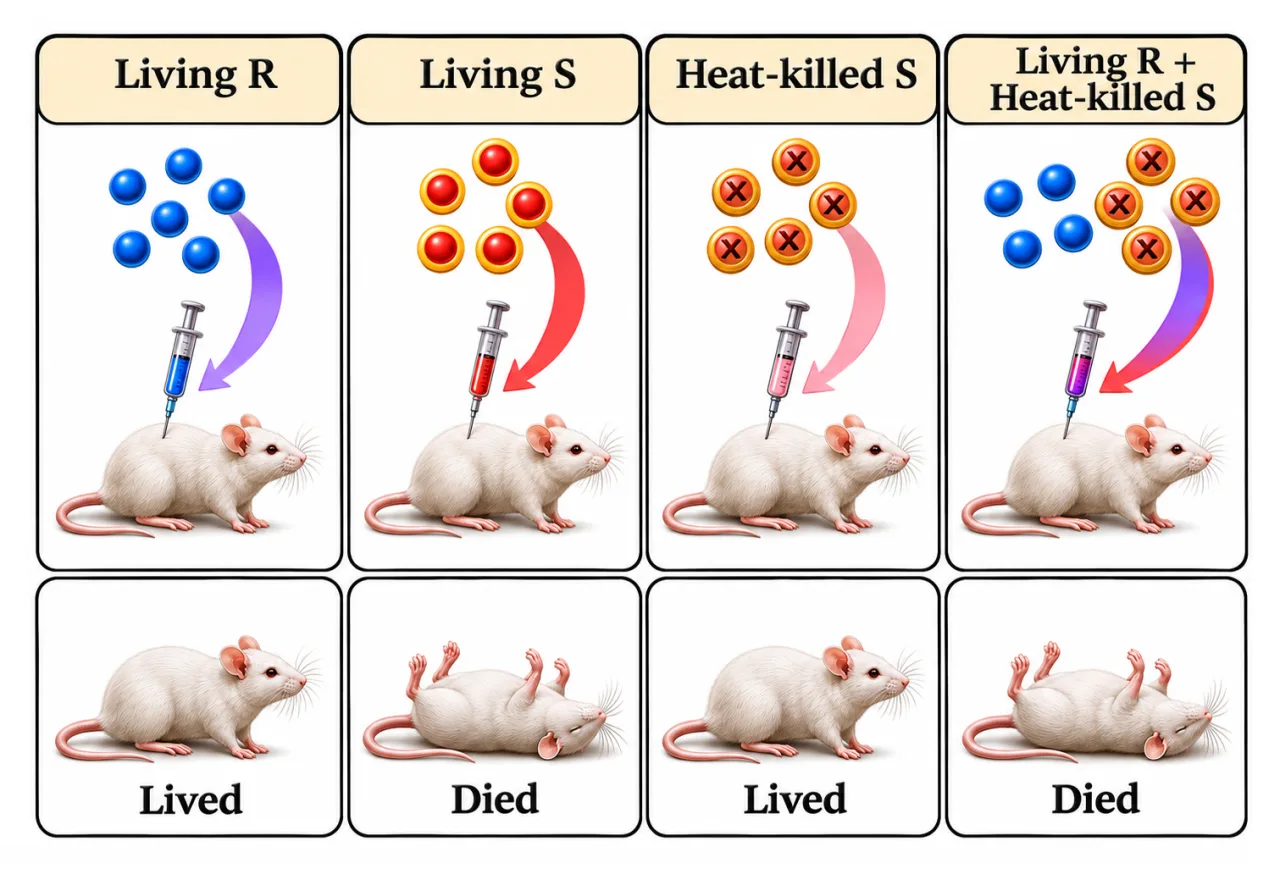
Even more astonishing was what Griffith discovered when he examined the dead animals. He recovered living, virulent S bacteria from their blood, despite having introduced the S bacteria only after killing them with heat.
The dead bacteria had not returned to life. Instead, something from their remains had apparently caused the living R bacteria to change into the virulent S form.
And this was not simply a temporary effect. The recovered bacteria could be grown in culture, and their descendants retained the characteristics of the transformed strain.
Griffith's investigations went beyond the familiar four-condition experiment often reproduced in biology textbooks. He tested different bacterial types, heating conditions, and combinations of living and dead bacteria, with varying results. In some experiments, the newly recovered S bacteria even displayed the specific type associated with the heat-killed donor bacteria rather than the original type of the living recipients.
This was particularly important. It suggested that the living bacteria were not merely regaining their own former characteristics. They could acquire characteristics associated with another bacterial type.
Griffith called the phenomenon transformation.
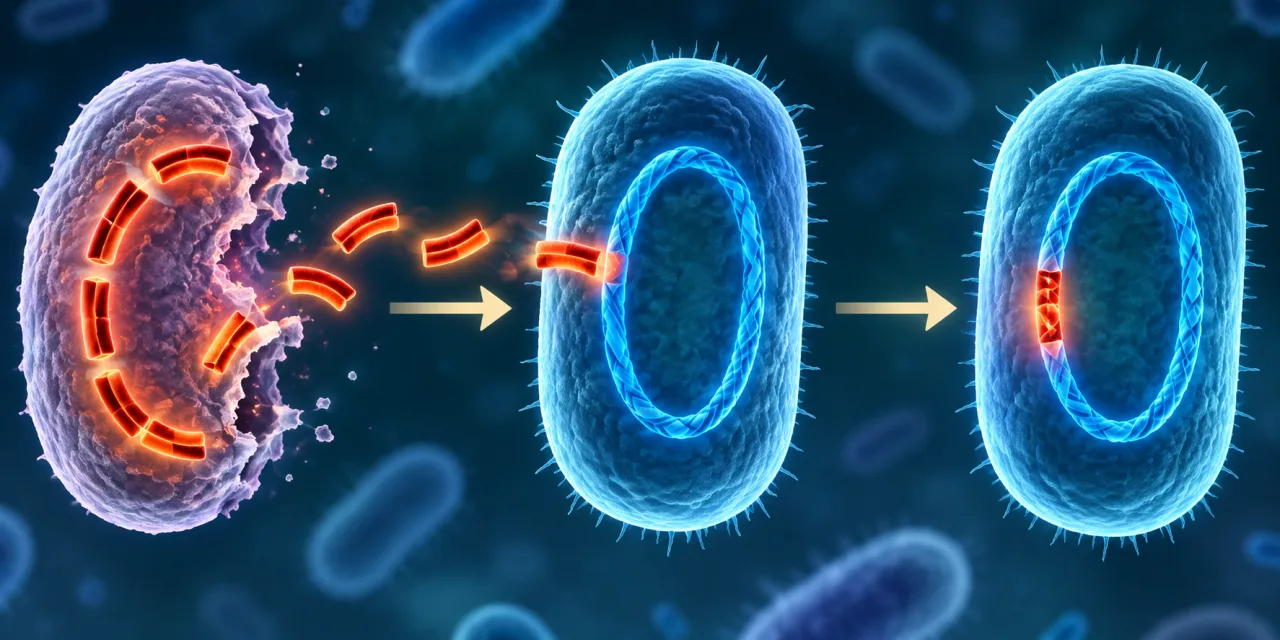
His results demonstrated that a stable biological characteristic could somehow be transferred from dead bacteria to living bacteria. But the nature of the substance responsible remained a mystery. Griffith considered possible explanations involving components of the bacterial capsule and other substances within the cells, but he could not identify precisely what caused the transformation.
That unanswered question would eventually become one of the most important investigations in molecular biology.
The bacteria were dead. Their influence survived. And in 1928, nobody yet knew exactly what had been passed on.
Stay tuned for the next chapter in this saga…
Sources
-
The Significance of Pneumococcal Types
Griffith, F. (1928). The significance of pneumococcal types. The Journal of Hygiene, 27(2), 113–159.
Why this source matters: Griffith's original research documents the experiments in which living, nonvirulent pneumococci acquired virulent characteristics after exposure to heat-killed bacteria. It provides the primary historical evidence for the discovery of bacterial transformation.
-
Rambling and Scrambling in Bacterial Transformation: A Historical and Personal Memoir
Lacks, S. A. (2003). Rambling and scrambling in bacterial transformation: A historical and personal memoir. Journal of Bacteriology, 185(1), 1–6.
Why this source matters: This historical review places Griffith's discovery in the broader development of bacterial genetics. It explains the original transformation experiments, Griffith's early interpretations, and the subsequent research that established the molecular basis of the phenomenon.
-
1944: DNA is "Transforming Principle"
National Human Genome Research Institute. (Last updates 2013, April 23). 1944: DNA is "transforming principle." National Institutes of Health.
Why this source matters: This institutional history explains Griffith's discovery and how subsequent research established the identity of the transforming substance. It connects the original bacterial experiments to a major breakthrough in understanding hereditary information.