
Have you ever wondered why toast tastes different from bread?
And no, I'm not talking about the temperature.
A piece of cold toast still tastes different from a piece of bread that's merely been warmed up. Something happened to that bread in the toaster, and there's no going back. You can refrigerate it, freeze it, or apologize to it profusely, but that toast is never going to be untoasted bread again.
Congratulations. You've just witnessed a chemical reaction before breakfast. Kitchen chemistry.
Now consider a steak.
You can cook a steak in boiling water, or you can slap it onto a sizzling-hot skillet and give it a beautiful brown crust. Both methods will cook the meat, but they're certainly not going to produce the same flavor. There's a reason steakhouses aren't famous for their boiled ribeyes.
And it's not because the frying pan has magical powers. Although, judging by the price of some cookware, the manufacturers would certainly like you to believe otherwise.
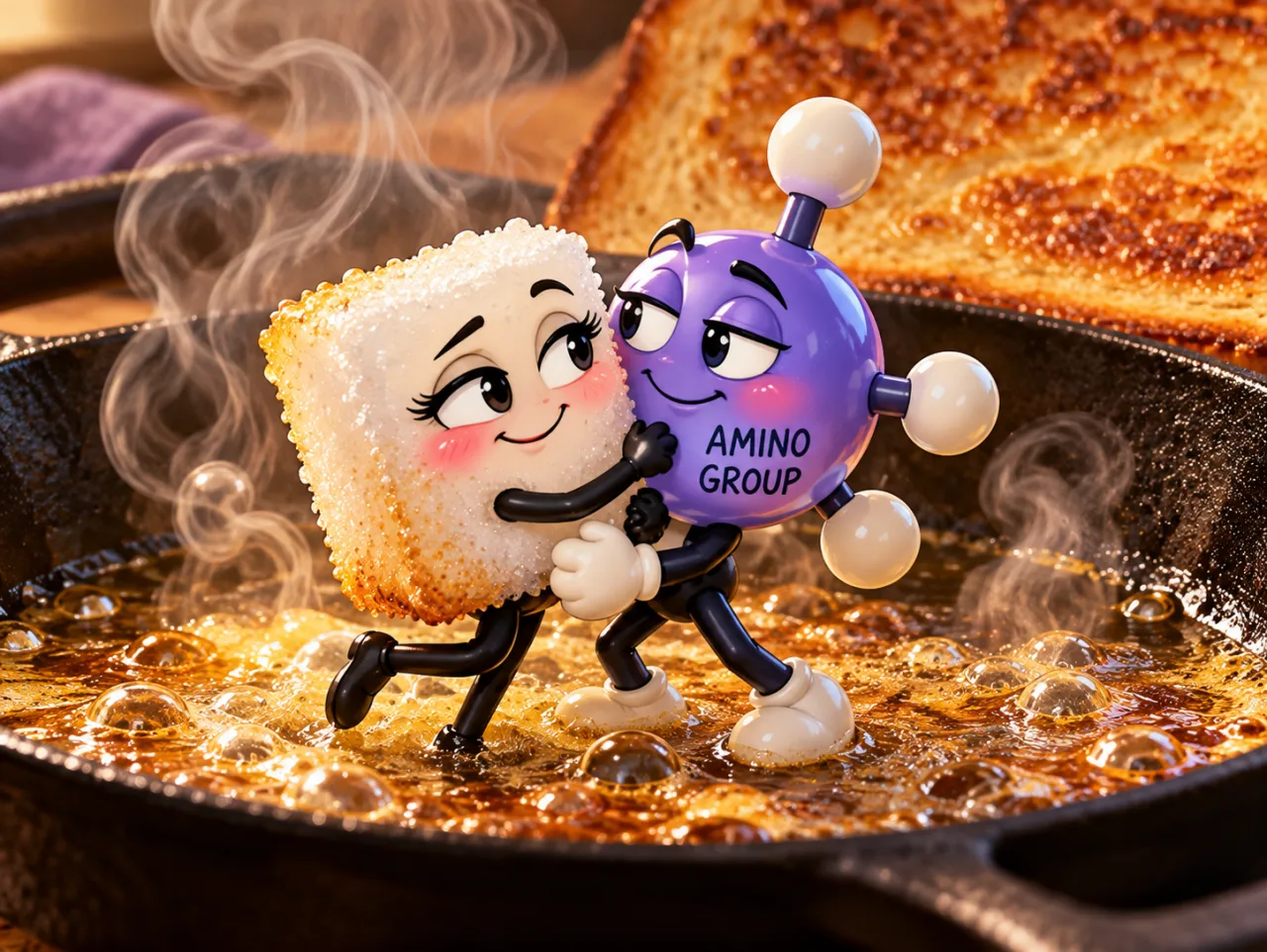
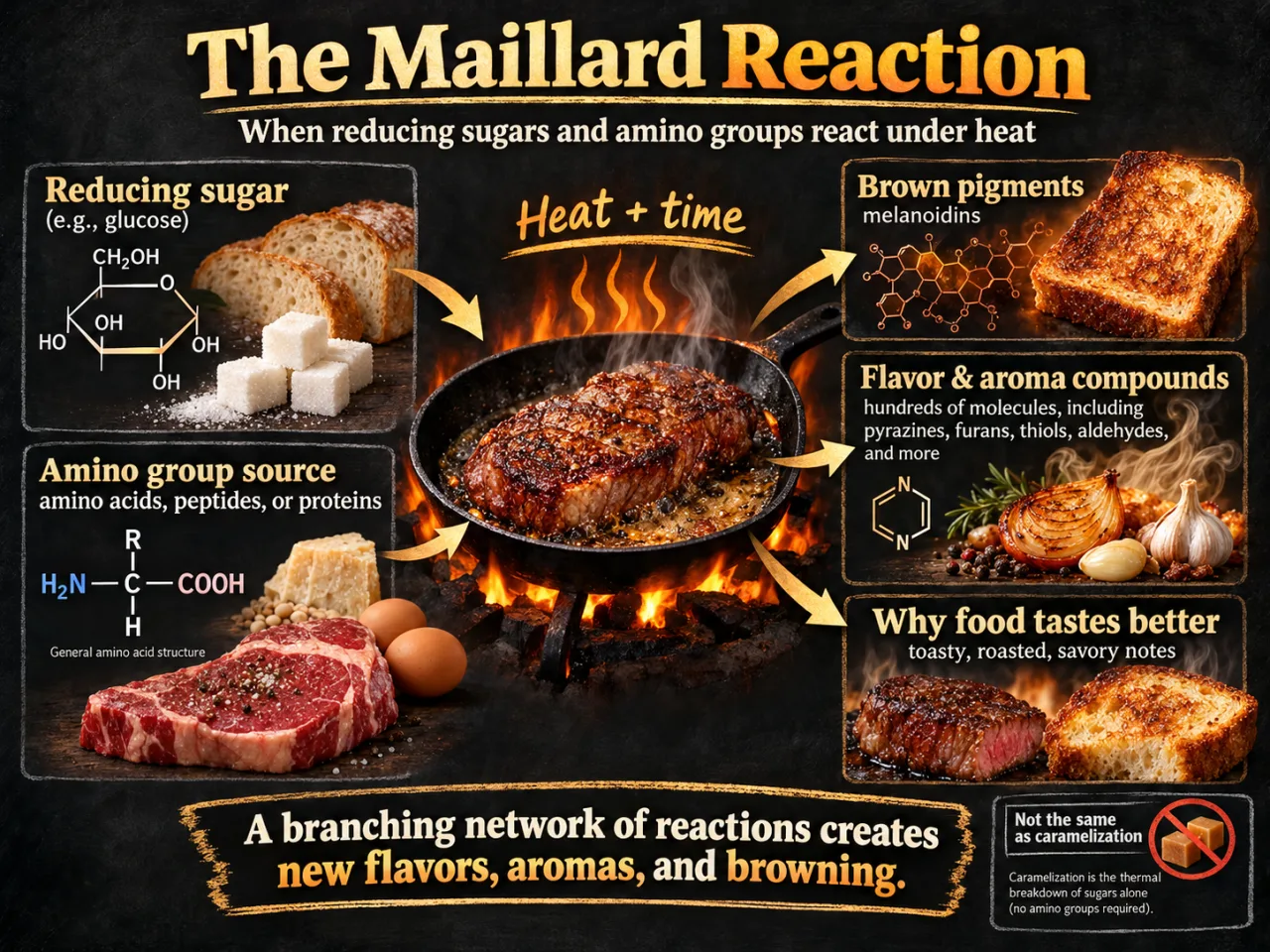
The secret is something called the Maillard reaction, a collection of chemical reactions between sugars and amino compounds that produces hundreds of new flavor and aroma compounds, along with the brown pigments that give toasted bread and seared meat their characteristic appearance.
In other words, your toaster and your frying pan have been running chemistry experiments in your kitchen for years.
And you've been eating the results.
Fortunately, they're delicious.
The Real Story
The secret behind the delicious transformation of toast, seared meat, and countless other cooked foods is a complex network of chemical reactions collectively known as the Maillard reaction.
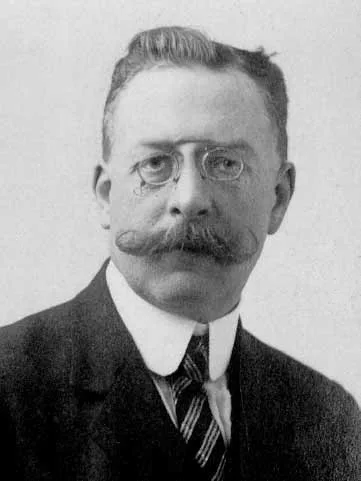
Named after French chemist Louis-Camille Maillard, who studied the reaction in 1912, the process begins when certain sugars react with amino groups found in amino acids, peptides, and proteins.
But not just any sugar will do. The reaction typically begins with a reducing sugar, such as glucose or fructose. These sugars can provide a reactive chemical group called a carbonyl group, which can interact with an amino group to begin the process.
That initial encounter sets off a complicated series of chemical reactions, producing an enormous variety of new compounds. Some contribute to the distinctive aromas and flavors of toasted bread, roasted coffee, and browned meat. Others eventually form larger, brown-colored compounds, including substances known as melanoidins.
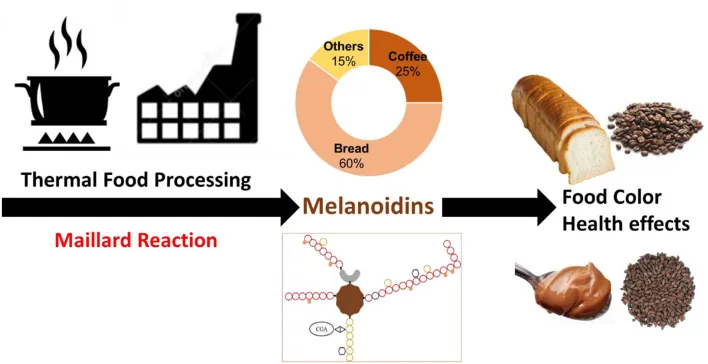
And here's the important part: the Maillard reaction isn't one reaction that produces one substance. It's an entire network of reactions, and the particular products depend on the ingredients and cooking conditions.
That helps explain why toasted bread doesn't smell like seared steak, even though both undergo Maillard browning. Different starting materials and different conditions produce different combinations of flavor and aroma compounds.
Why a frying pan beats a pot of boiling water
Temperature plays an important role in Maillard chemistry. Higher temperatures generally accelerate the reactions, which is why roasting, baking, and searing can produce such dramatic changes in flavor and color.
But temperature isn't the only factor.
Moisture matters, too.
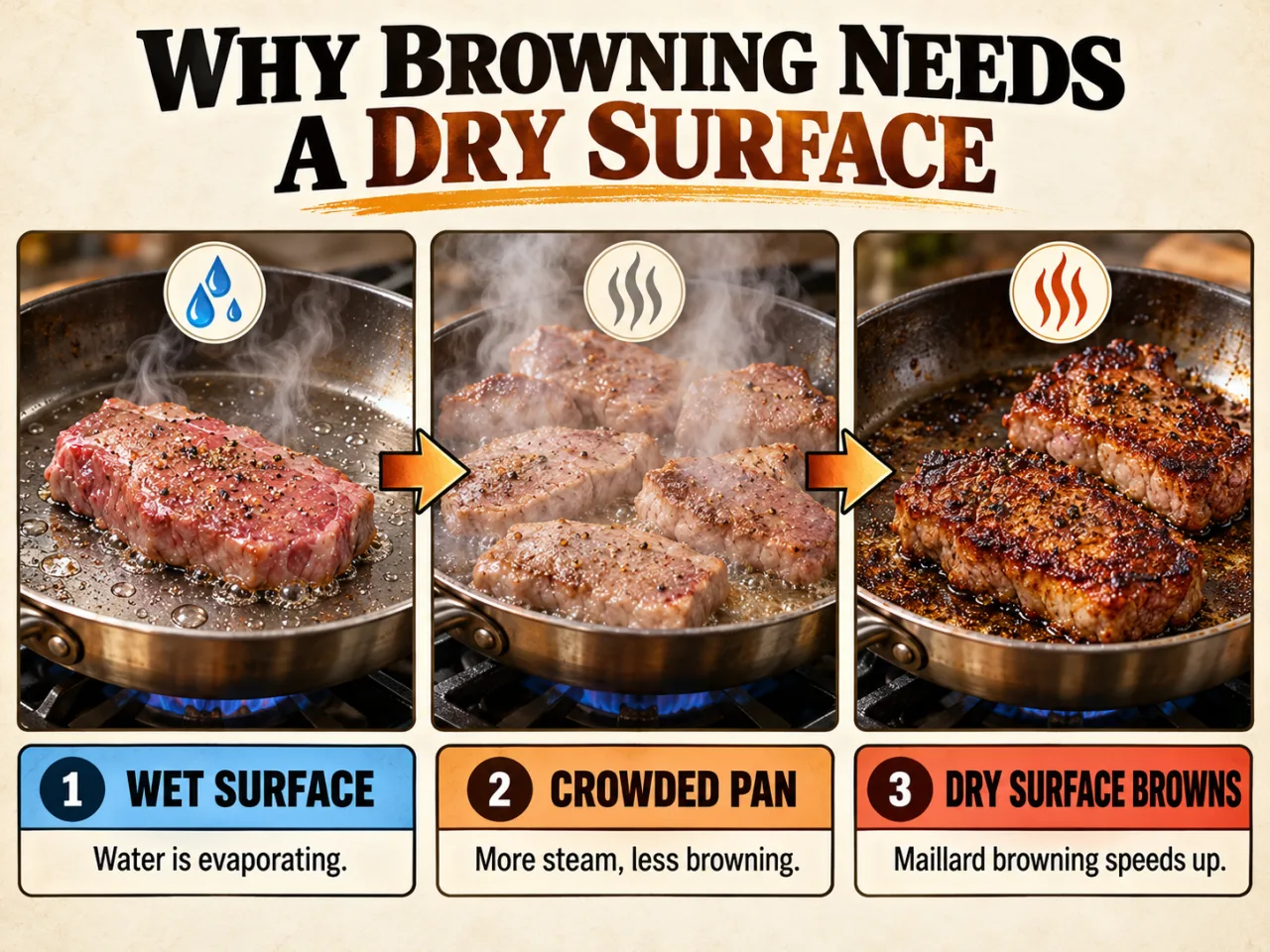
When a steak is submerged in boiling water, its surface stays wet and remains near the boiling temperature of the water. Proteins still change, and the meat still cooks, but the conditions are not particularly favorable for the rapid Maillard browning that produces a seared crust.
Place that same steak in a hot skillet, however, and the situation changes. As moisture evaporates from the surface, the meat can reach higher temperatures. Maillard reactions accelerate, and a brown, aromatic crust begins to develop.
This also explains why crowded pans often produce disappointing results. When meat releases moisture faster than it can evaporate, the food may spend more time steaming than browning.
Other factors influence the reaction as well. The length of heating, the kinds of sugars and amino compounds present, the amount of available water, and even the food's pH can all alter how rapidly Maillard chemistry proceeds and which products form.
In fact, these reactions don't require scorching temperatures. They can occur much more slowly under milder conditions, although the dramatic browning associated with cooking generally happens much faster at higher temperatures.
But isn't that just caramelization?
Not quite.
Although both processes can produce brown colors and appealing flavors, Maillard browning and caramelization are different kinds of chemistry.
The Maillard reaction involves sugars reacting with amino compounds. Caramelization, on the other hand, involves chemical changes in sugars themselves, without requiring amino compounds as reaction partners.
And to complicate things further, both processes can occur in the same food. A caramel candy made with milk, for example, may owe some of its brown color and flavor to Maillard reactions involving milk proteins rather than caramelization alone.
Then there's burning, where excessive heating produces still more chemical changes, often accompanied by unpleasant bitter flavors and charred material.
So not every brown surface tells the same chemical story.
And that brings us to an important revelation: cooking isn't merely heating food. It's changing its chemistry.
Every time you toast bread, roast coffee, or sear a steak, you're creating new compounds that weren't present in the same amounts before cooking. Some of those compounds are responsible for the flavors and aromas that make cooked foods so appealing.
But the Maillard reaction is only the beginning.
This is the first installment of Chemistry in the Kitchen, an ongoing Science Scandal investigation into the chemical transformations happening in ordinary home kitchens. We'll be uncovering why proteins change texture, how ingredients that normally refuse to mix can form stable mixtures, what happens to starch when it meets heat and water, and plenty of other culinary chemistry.
And coming up next: caramelization.
Because apparently sugar doesn't even need an amino-acid partner to get itself involved in another heated affair.
Sources
-
Maillard Reaction: Mechanism, Influencing Parameters, Advantages, Disadvantages, and Food Industrial Applications: A Review
El Hosry, L., Elias, V., Chamoun, V., Halawi, M., Cayot, P., Nehme, A., & Bou-Maroun, E. (2025). Maillard reaction: Mechanism, influencing parameters, advantages, disadvantages, and food industrial applications: A review. Foods, 14(11), 1881.
Why this source matters: This comprehensive review explains how reducing sugars react with amino compounds to produce the flavors, aromas, and colors associated with browned foods. It also examines how temperature, cooking time, moisture, and pH affect these chemical reactions.
-
Maillard reaction chemistry in formation of critical intermediates and flavour compounds and their antioxidant properties
Shakoor, A., Zhang, C., Xie, J., & Yang, X. (2022). Maillard reaction chemistry in formation of critical intermediates and flavour compounds and their antioxidant properties. Food Chemistry, 393, 133416.
Why this source matters: This review explores how the Maillard reaction generates a wide variety of flavor and aroma compounds. It explains why the process produces more than simply a brown color and contributes to the distinctive sensory qualities of cooked foods.
-
Science of Candy: Caramelization & Caramels
Exploratorium. (n.d.). Science of candy: Caramelization & caramels. Science of Cooking.
Why this source matters: This accessible explanation distinguishes Maillard browning from caramelization. It also shows how milk-containing caramel candies can develop flavor and color through reactions involving both sugars and proteins, illustrating why different browning processes can occur in the same food.
-
Acrylamide Questions and Answers
U.S. Food and Drug Administration. (2024, March 5). Acrylamide questions and answers.
Why this source matters: The FDA explains how acrylamide can form when sugars react with the amino acid asparagine during high-temperature cooking. This provides evidence-based context for the article's discussion of unwanted reaction products without suggesting that every serving of browned food presents a demonstrated health risk.