
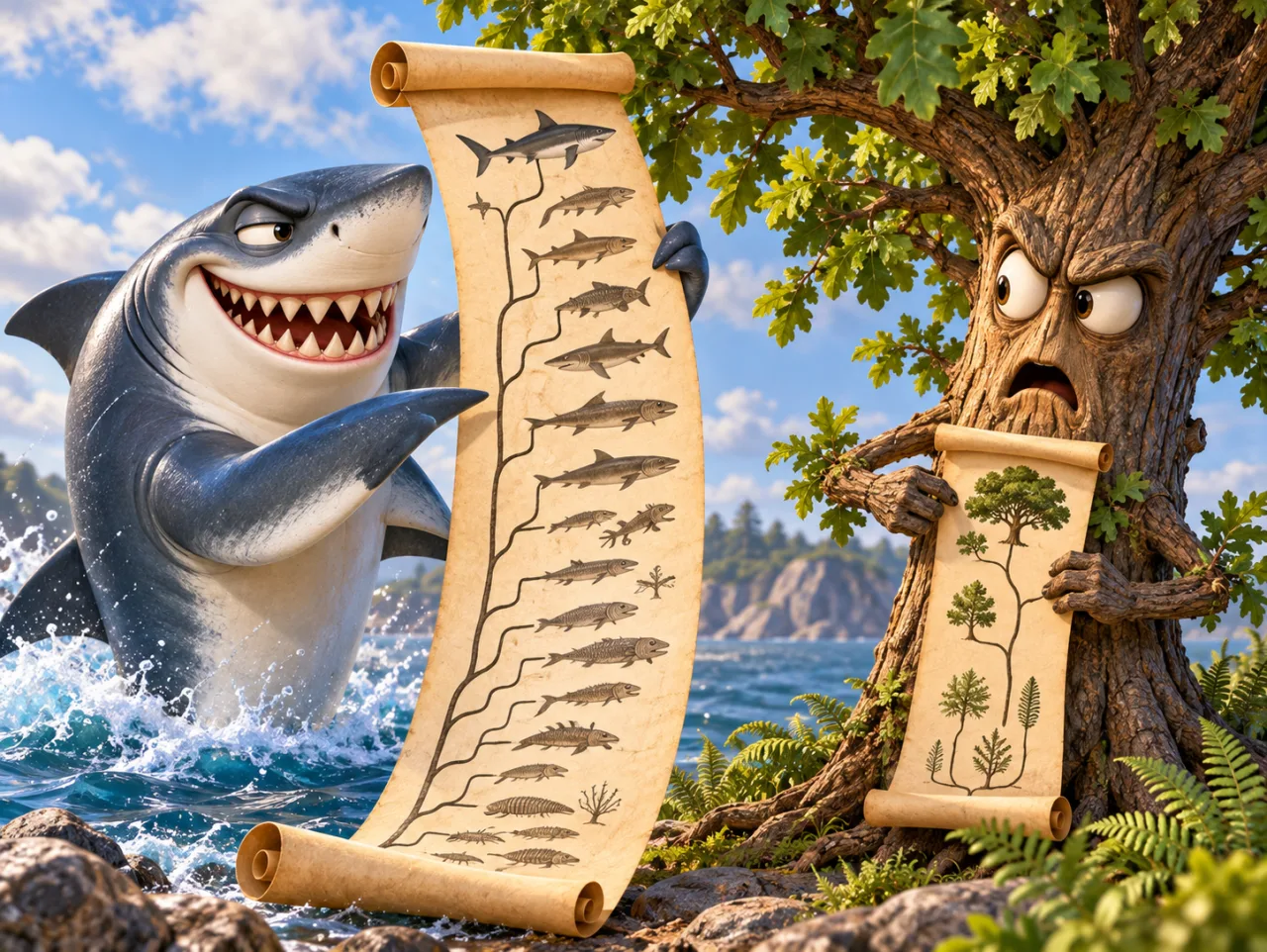
OAK TREE: Behold my magnificent branches! My ancient roots! My centuries of accumulated wisdom! I have stood here for 300 years, watching generations come and go.
SHARK: That's adorable.
OAK TREE: Excuse me?
SHARK: Three hundred years? That's barely a family vacation.
OAK TREE: I'll have you know that trees have been standing tall for millions of years!
SHARK: And my ancestors were swimming around before your ancestors figured out how to grow a trunk.
OAK TREE: Nonsense! Forests are among Earth's oldest ecosystems!
SHARK: Oh, you mean those enormous Carboniferous forests? The ones with giant clubmosses and towering horsetails? Very impressive. They showed up nearly a hundred million years after my family got into the swimming business.
OAK TREE: Well, those weren't the first forests! There were forests in the Devonian, nearly 400 million years ago!
SHARK: Getting warmer.
OAK TREE: HA! So you admit I'm right!
SHARK: No. I'm just enjoying watching you dig yourself into a hole. Which, I suppose, is what roots are for.
OAK TREE: I'll have you know that the earliest known forests date back approximately 390 million years!
SHARK: And the earliest evidence of my evolutionary lineage dates back roughly 450 million years.
OAK TREE: ...
SHARK: That's about 60 million years before your precious forests started sprouting.
OAK TREE: ...
SHARK: Face it, Woody. My family was here before your ancestors invented shade.
OAK TREE: You seem awfully proud of yourself for an animal that can't even climb a tree.
SHARK: And you seem awfully confident for something that can't run away from a chainsaw.
OAK TREE: That was unnecessarily personal.
SHARK: What can I say? I'm a natural at throwing shade.
OAK TREE: THAT'S MY JOB!
SHARK: Not originally. 😎
The Real Story
As ridiculous as that argument might sound, the shark has a point. The evolutionary history of sharks and their ancient relatives stretches back hundreds of millions of years, long before forests became a familiar feature of Earth's landscape.
To appreciate just how ancient that makes the shark family, let's start with the trees we know today.
Oak trees, maples, magnolias, and other flowering trees belong to the angiosperms, a group that diversified dramatically during the Cretaceous Period, when dinosaurs still roamed the Earth. Pines and other conifers belong to the gymnosperms, whose evolutionary history extends considerably further back.
But even the earliest fossil evidence of seed plants, the broader group that includes both gymnosperms and angiosperms, dates to approximately 365 million years ago.
By then, the shark side of the family had already been around for tens of millions of years.
And we're not just talking about the familiar forests surrounding us today.
Travel back to the Carboniferous Period, approximately 359–299 million years ago. Much of the land was covered by extraordinary forests containing towering relatives of modern clubmosses, giant horsetails, tree ferns, and other plants that would look distinctly unfamiliar in a modern woodland.
Some of these plants reached astonishing heights. Giant lycopsids, for example, could grow more than 30 meters (100 feet) tall. Their remains contributed to the extensive coal deposits that eventually gave the Carboniferous Period its name.
Surely those prehistoric forests are old enough to challenge the sharks?
Not even close.
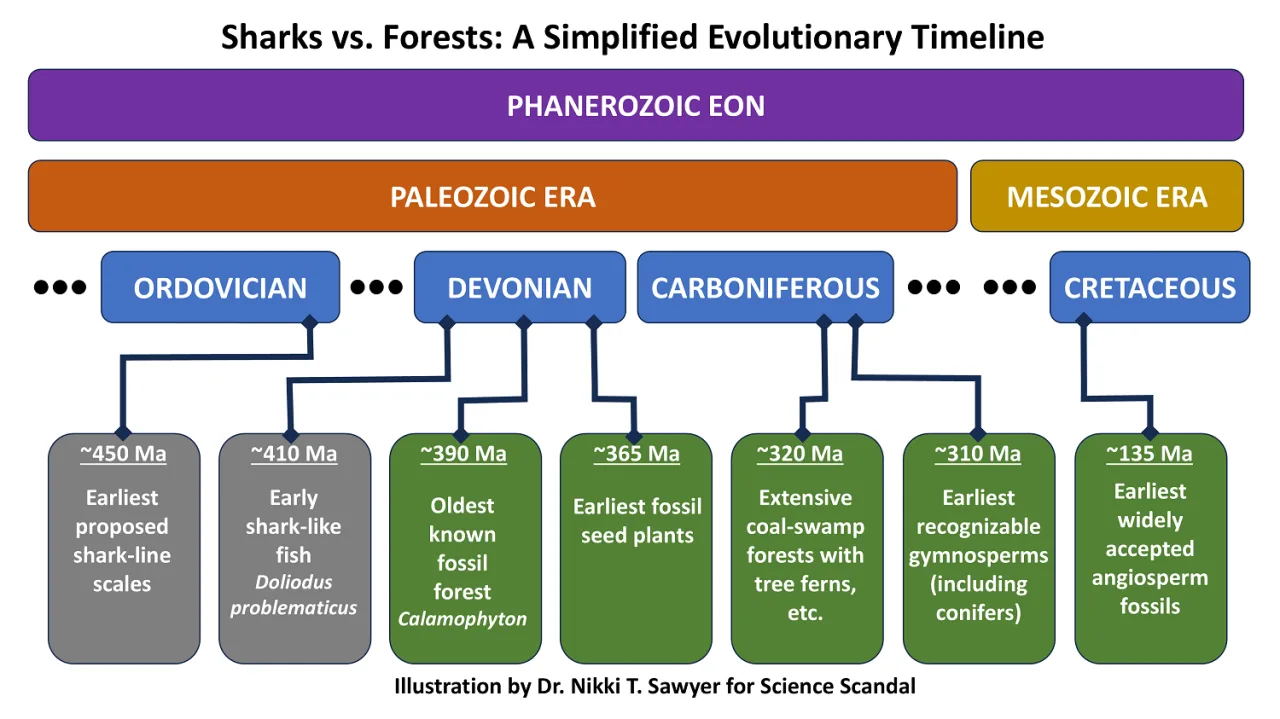
The oldest known fossil evidence associated with sharks or their ancient relatives dates back approximately 450 million years, to the Late Ordovician Period. That's roughly 90 million years before the Carboniferous Period even began.
But the Carboniferous forests weren't the first forests, either.
For that, we have to travel even further back, into the Devonian Period.
In 2024, researchers described fossilized trees preserved in approximately 390-million-year-old rocks along the coast of southwest England. This discovery pushed the record for the oldest known fossil forest back several million years.
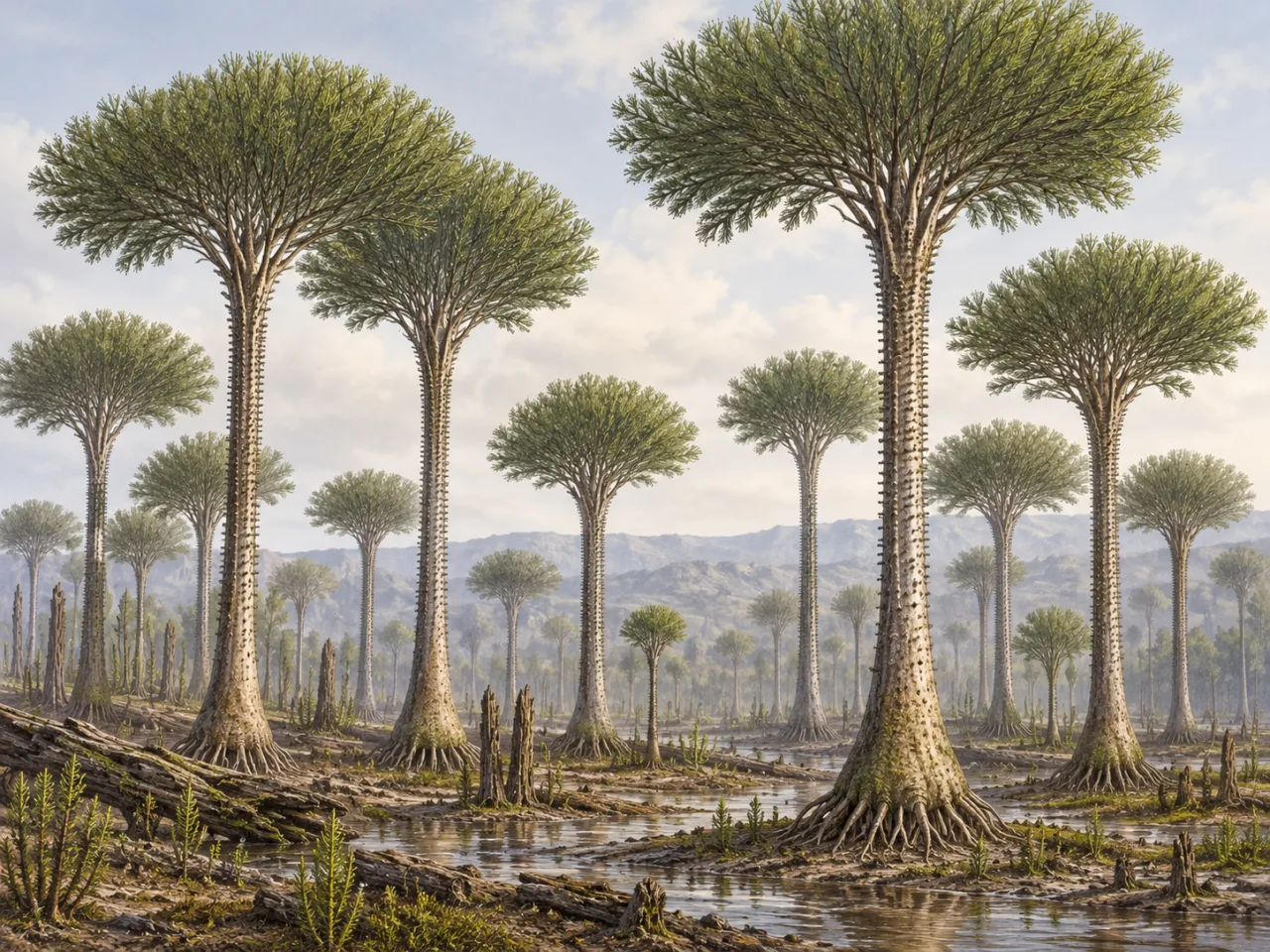
These weren't forests of oaks, pines, or flowering trees. They contained extinct tree-like plants called Calamophyton, with slender trunks and crowns of twig-like branches. Although they resembled small palm trees or tree ferns, they belonged to an ancient group of vascular plants unlike the familiar trees growing around us today.
Nevertheless, they formed genuine early forests, helping reshape terrestrial environments as plants developed increasingly complex structures above and below ground.
And the shark lineage was apparently already ancient by the time those forests appeared.
The earliest proposed evidence consists of isolated, shark-like scales dating to approximately 450 million years ago. Scientists are still debating whether those scales belonged to true sharks or more distant relatives.
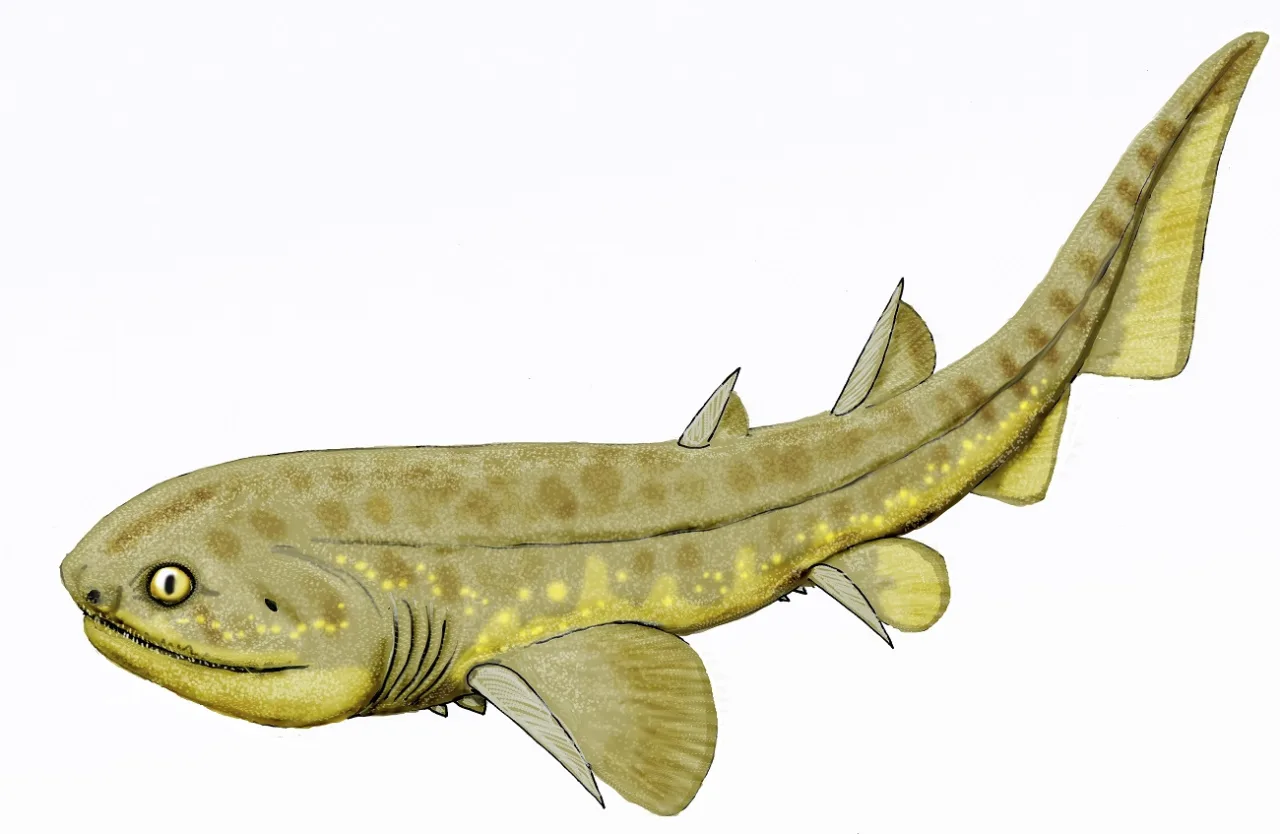
More substantial evidence appears later. Approximately 410-million-year-old fossils of the early cartilaginous fish Doliodus problematicus preserve shark-like teeth, while other Devonian fossils document the emergence of increasingly recognizable shark forms.
That distinction matters. The earliest shark relatives weren't necessarily shaped like great whites, tiger sharks, or hammerheads. And today's shark species haven't been swimming around unchanged for 450 million years.
Instead, sharks belong to an evolutionary lineage that has repeatedly diversified, evolved new anatomical features, and survived major environmental upheavals. Some branches disappeared entirely, while others gave rise to the extraordinary variety of sharks living today.
The same is true of trees. Ancient plant lineages evolved different ways of growing tall, supporting their bodies, and capturing sunlight. The tree growth form appeared in multiple branches of plant evolution, producing forests that changed enormously over geological time.
So when we say sharks are older than trees, we're comparing the deep evolutionary history of shark-like fishes with the later emergence of tree-sized plants and forest ecosystems.
And even using the oldest currently known fossil forest, the comparison is remarkable: approximately 450 million years for the earliest proposed shark-lineage evidence versus 390 million years for the earliest documented forest.
That's a difference of roughly 60 million years.
Of course, the fossil record doesn't tell us the precise day sharks or trees first evolved. New discoveries may push these dates further into the past.
But the evidence already tells an extraordinary story. Shark relatives were inhabiting ancient waters while plants were still developing the structures that would eventually transform the land into forests.
The oak might have centuries of wisdom. But the shark family has hundreds of millions of years of seniority.
And apparently, it's never going to let the trees forget it.
Sources
-
Shark evolution: a 450 million year timeline
Davis, J. (n.d.). Shark evolution: a 450 million year timeline. Natural History Museum, London.
Why this source matters: Explains the approximately 450-million-year evolutionary history of sharks and their relatives, including the uncertainty surrounding the earliest fossil scales, the appearance of shark-like teeth, and the subsequent diversification of sharks.
-
How trees changed the world
Spence, K. (n.d.). How trees changed the world. Natural History Museum, London.
Why this source matters: Explains what makes a plant a tree, why trees are a growth form rather than one evolutionary lineage, and how the earliest forests appeared during the Devonian Period.
-
The Age of Oxygen
Smithsonian Institution. (n.d.). The age of oxygen. National Museum of Natural History.
Why this source matters: Documents the ancient Carboniferous forests, including giant lycopsids, horsetails, tree ferns, and early seed plants, illustrating how dramatically prehistoric forests differed from those growing today.
-
Earth's earliest forest: fossilized trees and vegetation-induced sedimentary structures from the Middle Devonian (Eifelian) Hangman Sandstone Formation, Somerset and Devon, SW England
Davies, N. S., McMahon, W. J., & Berry, C. M. (2024). Earth's earliest forest: Fossilized trees and vegetation-induced sedimentary structures from the Middle Devonian (Eifelian) Hangman Sandstone Formation, Somerset and Devon, SW England. Journal of the Geological Society, 181(4), jgs2023-204.
Why this source matters: Original research documenting a roughly 390-million-year-old fossil forest in southwest England. The fossils reveal early tree-like plants and their effects on the surrounding landscape, providing the principal evidence for our shark-versus-forest comparison.
-
Early evolutionary history of the seed
Bateman, R. M., Spencer, A. R. T., & Hilton, J. (2026). Early evolutionary history of the seed. Biological Reviews, 101(3), 1511–1553.
Why this source matters: A comprehensive modern review of early seed evolution that places the first known fossil seed plants at approximately 365 million years ago, providing evolutionary context for familiar gymnosperm and angiosperm trees.