
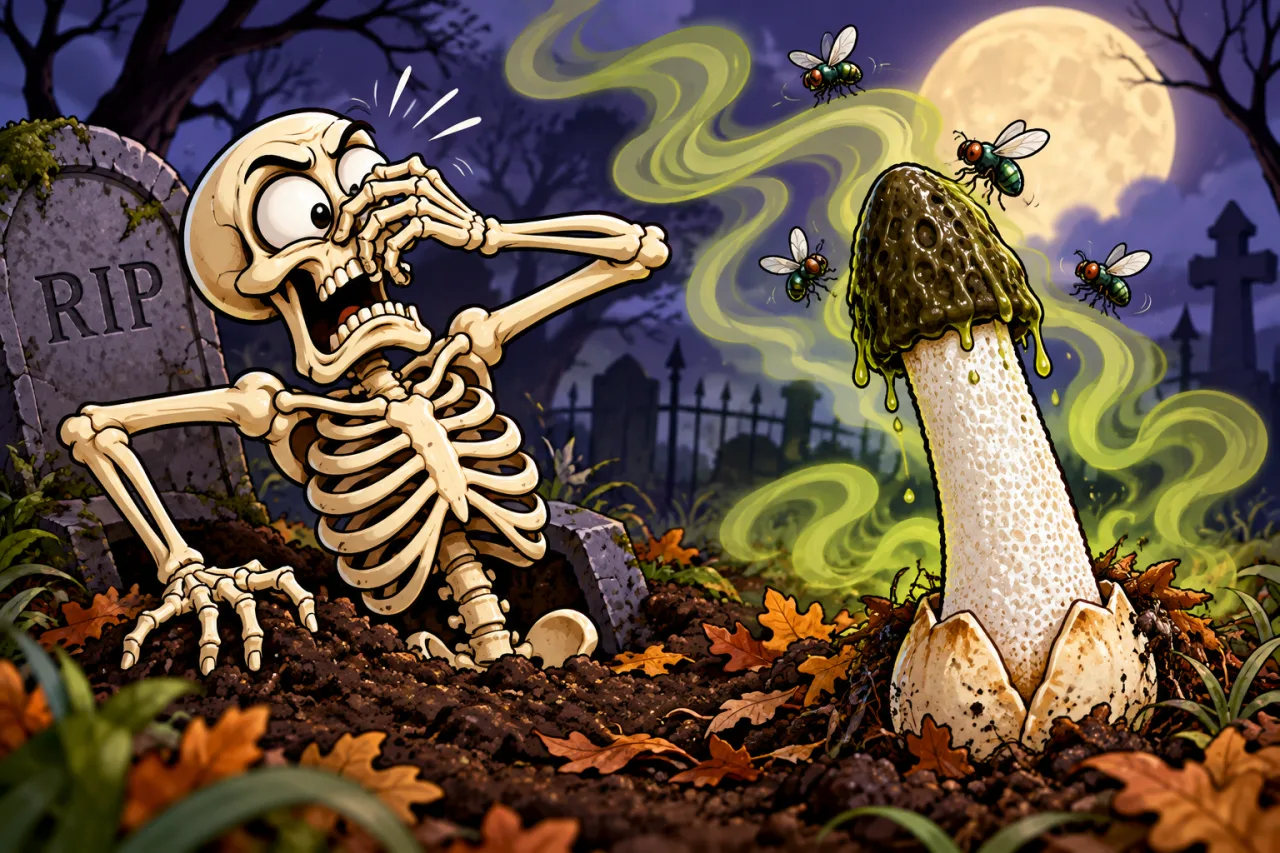
Science Scandal recently exposed the shocking truth that mushrooms have been displaying their reproductive organs in public.
We regret to inform readers that the situation has deteriorated. Fungi flashing their reproductive organs was only the beginning.
One particularly shameless offender belongs to a genus called Phallus.
Yes. Really.
An entire group of mushrooms has a genus name of Phallus. With a family name of Phallaceae. And an order name of Phallales. The taxonomists were doubling down HARD.
And apparently, this naming tradition goes back centuries before Linnaeus. Naturalists in the 1500s were already comparing these fungi to male anatomy, and by 1640, one botanist was calling one the "Hollanders Workingtoole." 👀
Yes. Seriously.
By the time Linnaeus formally established the genus Phallus in 1753, he wasn't inventing anything. He was simply making a long and distinguished tradition of scientific indecency official.
All of this happened before scientists could consider the impact of social media.
To make matters worse, the fruiting body erupts from an egg-like structure, leaving behind a sac at its base. Giving the entire arrangement an unfortunate resemblance to certain other male anatomical structures. 😏 I'm not making this up. I promise. I have pictures.
Our scandal today is focused on one species whose scientific name is Phallus impudicus, which translates to "shameless phallus."
And apparently, public indecency and a shameless name wasn't enough. This fungus also smells like a decomposing corpse.
And it smells like a decomposing corpse on purpose. And not because it's decomposing a body or anything. It uses normal decomposition of organic matter on the forest floor to get the ingredients necessary to create foul smelling volatile compounds. Some of the SAME compounds found in carrion and feces. 😝
And why would any living thing want to purposefully emit such horrendous odors? I'm glad you asked….
The Real Story
The fungus at the center of our scandal is Phallus impudicus, commonly known as the common stinkhorn. And yes, that name refers to both its distinctive shape and its extraordinarily unpleasant smell.
Stinkhorns are fungi that obtain nutrients by decomposing dead organic material, including decaying wood and leaf litter. Much of the fungus exists out of sight as a network of microscopic threads called hyphae, which collectively form a mycelium. The conspicuous structure that emerges aboveground is its reproductive fruiting body.
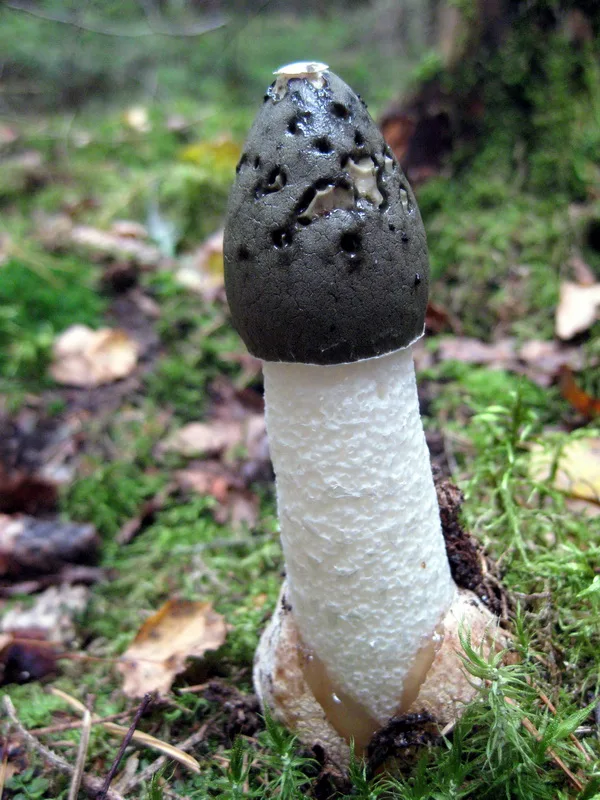
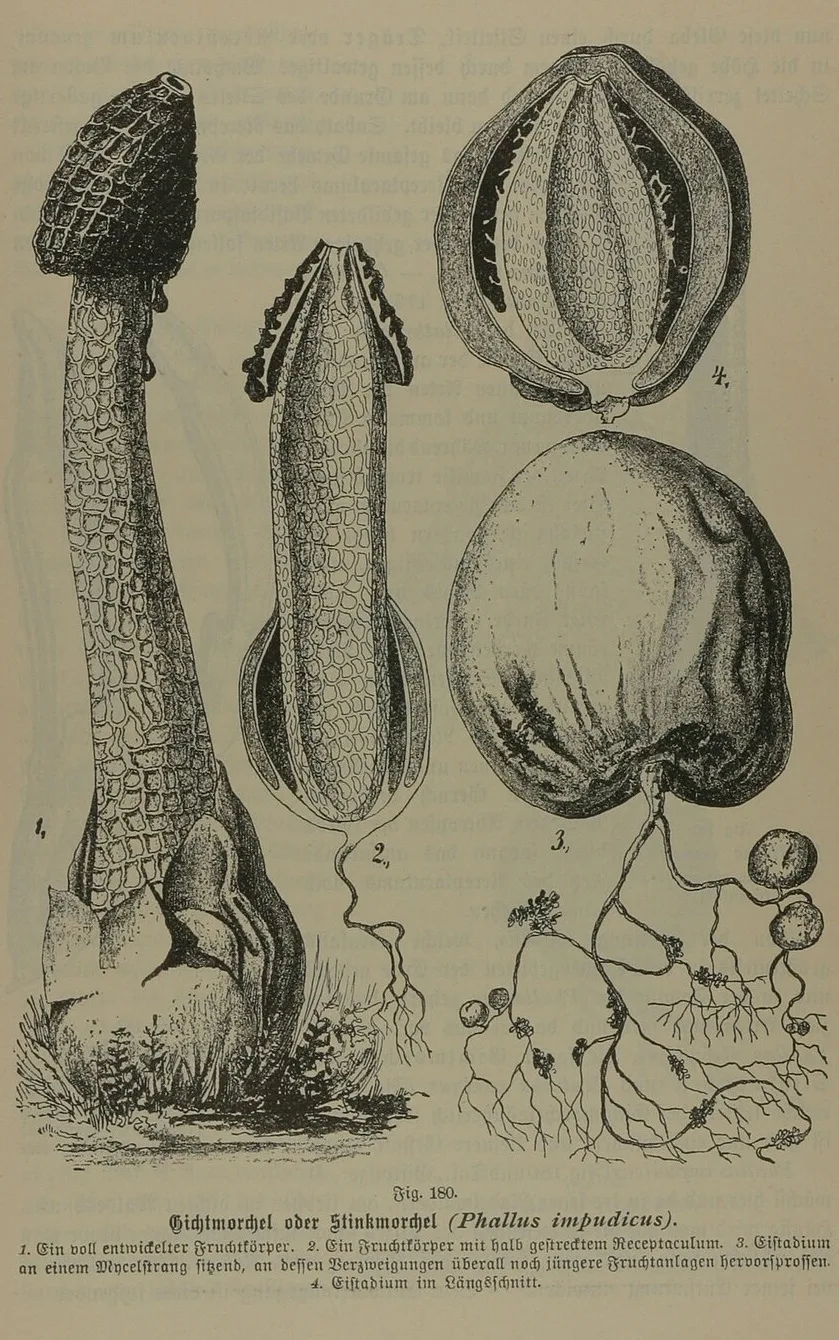
In P. impudicus, that fruiting body begins as a rounded, egg-like structure, sometimes called a devil's egg. Inside, the developing stalk and cap are already formed. When conditions are suitable, the stalk rapidly expands, rupturing the outer covering and pushing the cap upward. The remnants of the egg remain at the base as a cup-like structure called the volva.
Unlike the familiar mushrooms that release spores into the air to be carried away by wind, stinkhorns use a rather different delivery service.
The cap of a mature common stinkhorn is initially coated in a dark olive-green, sticky substance called the gleba. This slime contains the fungus's reproductive spores, along with the chemicals responsible for its notorious odor.
Researchers analyzing the volatile compounds released by P. impudicus identified several chemicals, including dimethyl disulfide and dimethyl trisulfide. These sulfur-containing compounds are also associated with the characteristic odors of decaying biological material.
The result is a smell that humans commonly describe as rotting flesh, feces, or sewage.
But the fungus isn't simply producing an unpleasant smell as an accidental byproduct of its metabolism. The odor serves an important reproductive function: attracting insects.
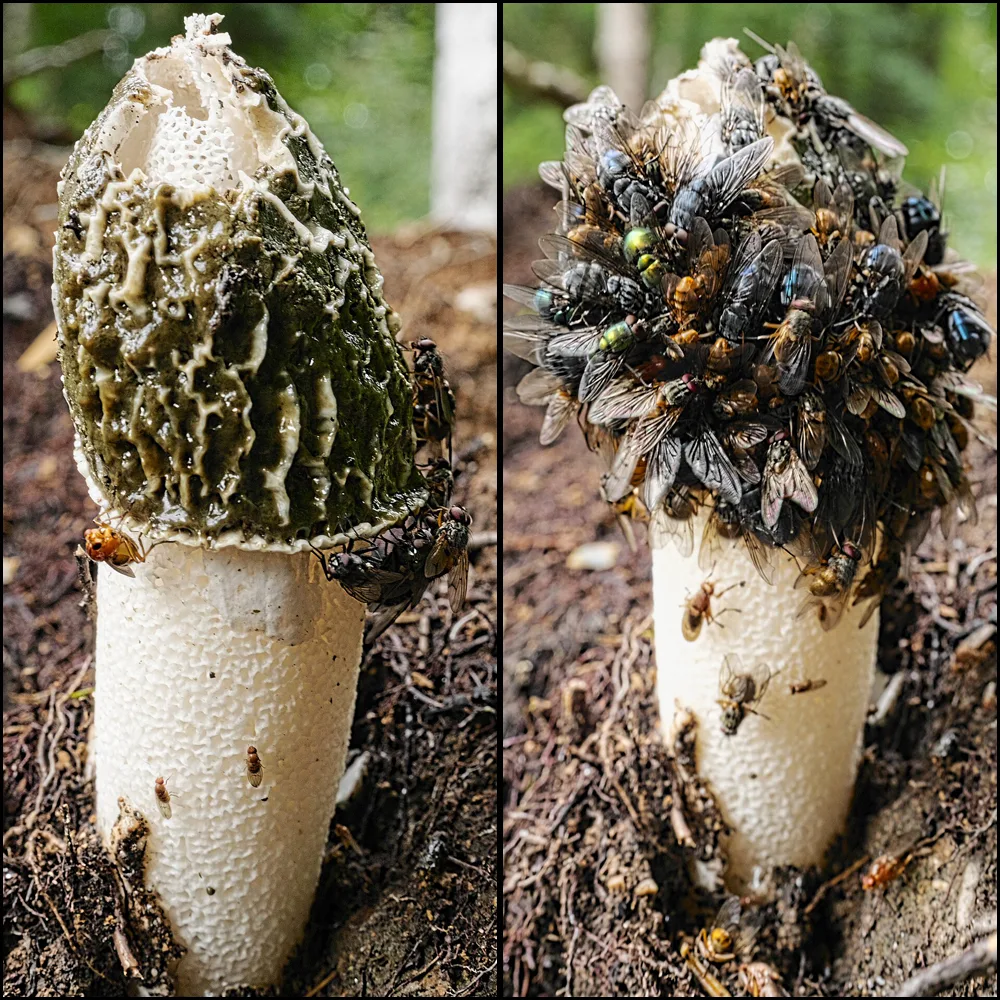
Flies that normally investigate decaying organic matter are particularly interested in stinkhorns. The gleba provides a food source, and visiting insects can pick up spores on their bodies as they move across the slimy surface. Spores that are swallowed may also pass through the digestive tract and be deposited elsewhere in insect droppings.
Either way, the fungus gains a potential means of dispersing its spores to new locations.
And the delivery service isn't limited to flies. Different stinkhorn species attract a variety of insects, including beetles, wasps, and even bees.
In a 2024 study conducted in the Brazilian Amazon, researchers observed 333 insects associated with six fruiting bodies of Phallus indusiatus sensu lato, a different stinkhorn from the common species featured in our story. They found that insects carried spores both externally and inside their digestive systems. Stingless bees carried particularly large numbers, and transport on insects' body surfaces appeared especially important.
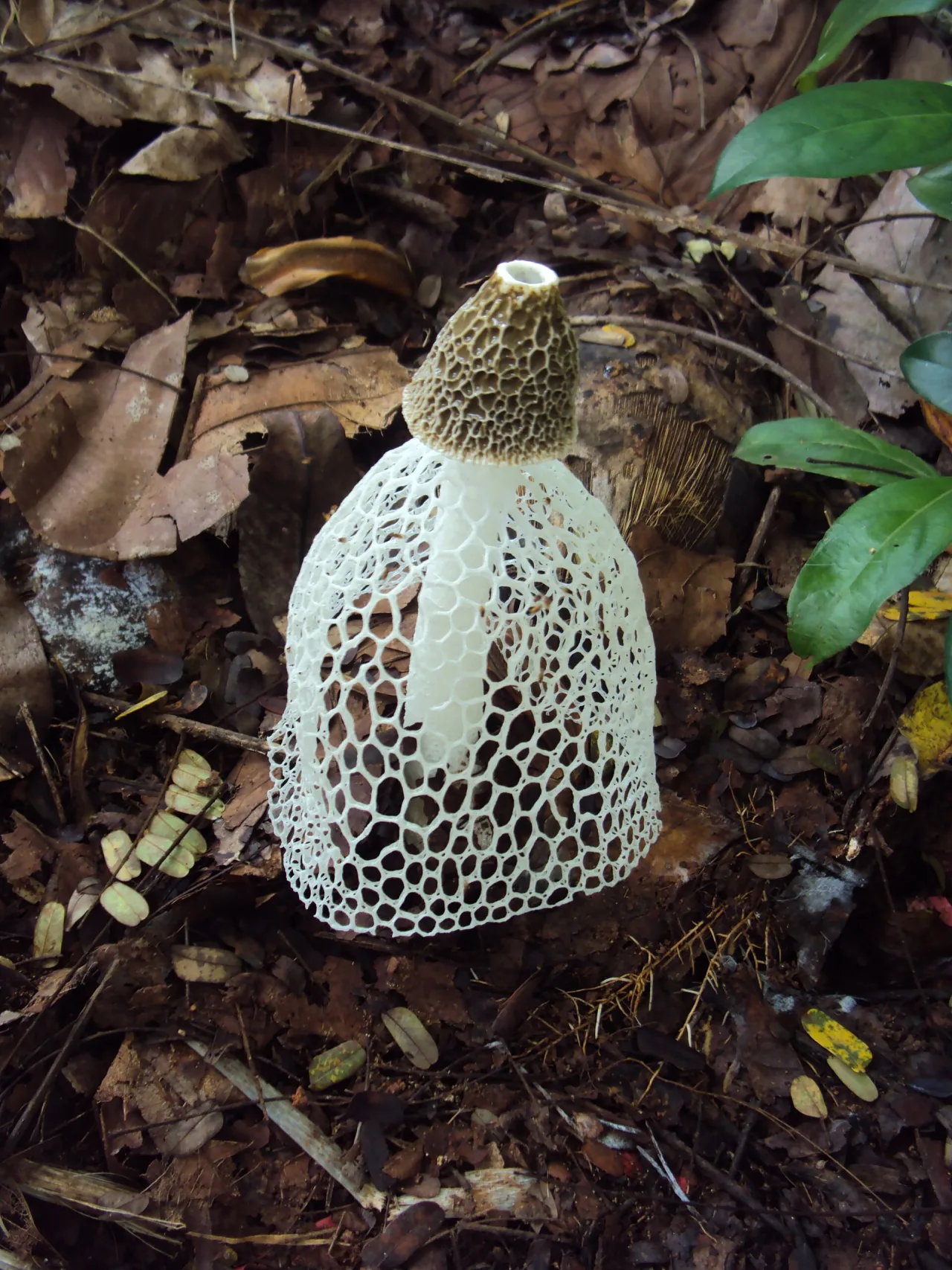
For stinkhorns, the relationship can benefit both parties: insects receive food, while the fungus gains access to mobile spore carriers.
And the strategy has an especially interesting ecological twist. Stinkhorns help break down dead organic material and recycle nutrients through their environments, while using chemical signals associated with decay to attract the animals that assist their reproduction.
What smells like death to us can help produce the next generation of fungi.
For Phallus impudicus, apparently, the secret to reproductive success is having absolutely no shame and smelling absolutely terrible.
Sources
-
Stinkhorn Mushrooms (Agaricomycetes: Phallales: Phallaceae)
Phillips, E., Gillett-Kaufman, J. L., & Smith, M. E. (2018). Stinkhorn mushrooms (Agaricomycetes: Phallales: Phallaceae). EDIS, PP345.
Why this source matters: University of Florida Extension explains stinkhorn anatomy, egg development, spore-bearing slime, decomposer ecology, and how insects help disperse fungal spores.
-
Phallus impudicus L. (Phallaceae)
Harris, S. (n.d.). Phallus impudicus L. (Phallaceae). Plants 400, University of Oxford.
Why this source matters: Oxford documents the common stinkhorn's development from a devil's egg, rapid expansion, cup-shaped volva, spore-rich gleba, sulfurous odor, and insect-assisted reproduction.
-
Dimethyl oligosulphides, major volatiles released from Sauromatum guttatum and Phallus impudicus
Borg-Karlson, A.-K., Englund, F. O., & Unelius, C. R. (1994). Dimethyl oligosulphides, major volatiles released from Sauromatum guttatum and Phallus impudicus. Phytochemistry, 35(2), 321–323.
Why this source matters: Original chemical analysis identifies volatile compounds released by the common stinkhorn, including dimethyl disulfide and dimethyl trisulfide, helping explain its characteristic carrion-like smell.
-
New insights on the spore dispersal of Phallus indusiatus s.l. (Basidiomycota, Phallaceae) for the Brazilian Amazon forest
Santana, M. D. F., & Couceiro, S. R. M. (2024). New insights on the spore dispersal of Phallus indusiatus s.l. (Basidiomycota, Phallaceae) for the Brazilian Amazon forest. Food Webs, 38, e00338.
Why this source matters: Primary research documents insects visiting Amazonian stinkhorns and carrying spores on their bodies and in their digestive systems, showing how insects can serve as fungal spore dispersers.
-
Stinkhorn (Phallus impudicus)
Woodland Trust. (n.d.). Stinkhorn (Phallus impudicus).
Why this source matters: Provides an accessible account of the common stinkhorn's odor, anatomy, spore-bearing gleba, attraction of insects, and scientific name.