
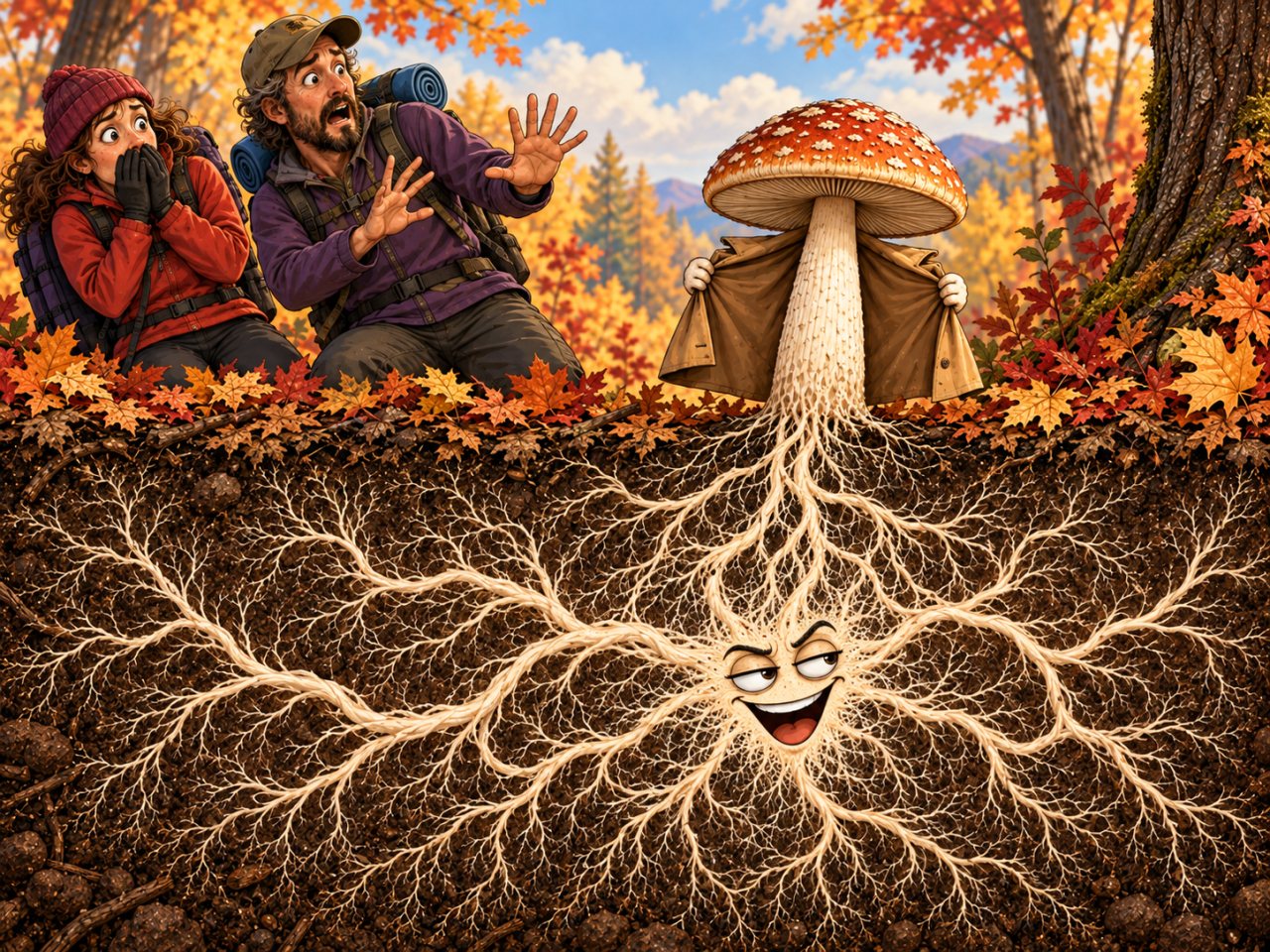
It is officially autumn, and fall is prime mushroom-spotting season for many fungi. Cooler, wetter weather can create favorable conditions for fruiting bodies to appear, while fallen leaves, dead wood, and other organic matter provide plenty of fungal real estate.
BUT....
Did you know that when you see a mushroom, you may be looking at a fungus popping its reproductive organ out into public? 😳
Yes, you thought it was a charming woodland ornament.
The fungus would like to clarify the nature of the display.
It’s... flashing you. 😜🤣
Much of a mushroom-forming fungus can remain out of sight, with microscopic filaments called hyphae threading through soil, leaf litter, wood, or other material. Together, those hyphae form the mycelium.
Then, when conditions are right and reproduction is on the agenda, the fungus builds the structure most of us actually notice: the mushroom.
That mushroom is a fruiting body. Its job is reproduction, including producing and releasing spores that can disperse and potentially establish new fungal growth elsewhere.
Which means that when you stroll through the woods and decide to “pick a mushroom,” you are not picking the fungus.
You are picking its reproductive parts.
The rest of the fungus may remain exactly where it was, hidden from view and presumably side-eyeing the enormous mammal walking away with its naughty bits. 😳
And here at Science Scandal, we respect the fungus’s editorial decision.
Fungus: Naughty bits on top, mycelium down below.
Science Scandal: Tabloid framing on top, reputable science down below.
And with that... it’s time for THE REAL STORY.
The Real Story
A mushroom is not a separate organism sitting on top of a fungus. It is part of the fungus itself: a specialized fruiting body built for reproduction.
For many mushroom-forming fungi, much of the organism is far less conspicuous. Its body consists of microscopic filaments called hyphae. As those hyphae grow and branch through soil, leaf litter, decaying wood, or other material, they form an interconnected network called the mycelium.
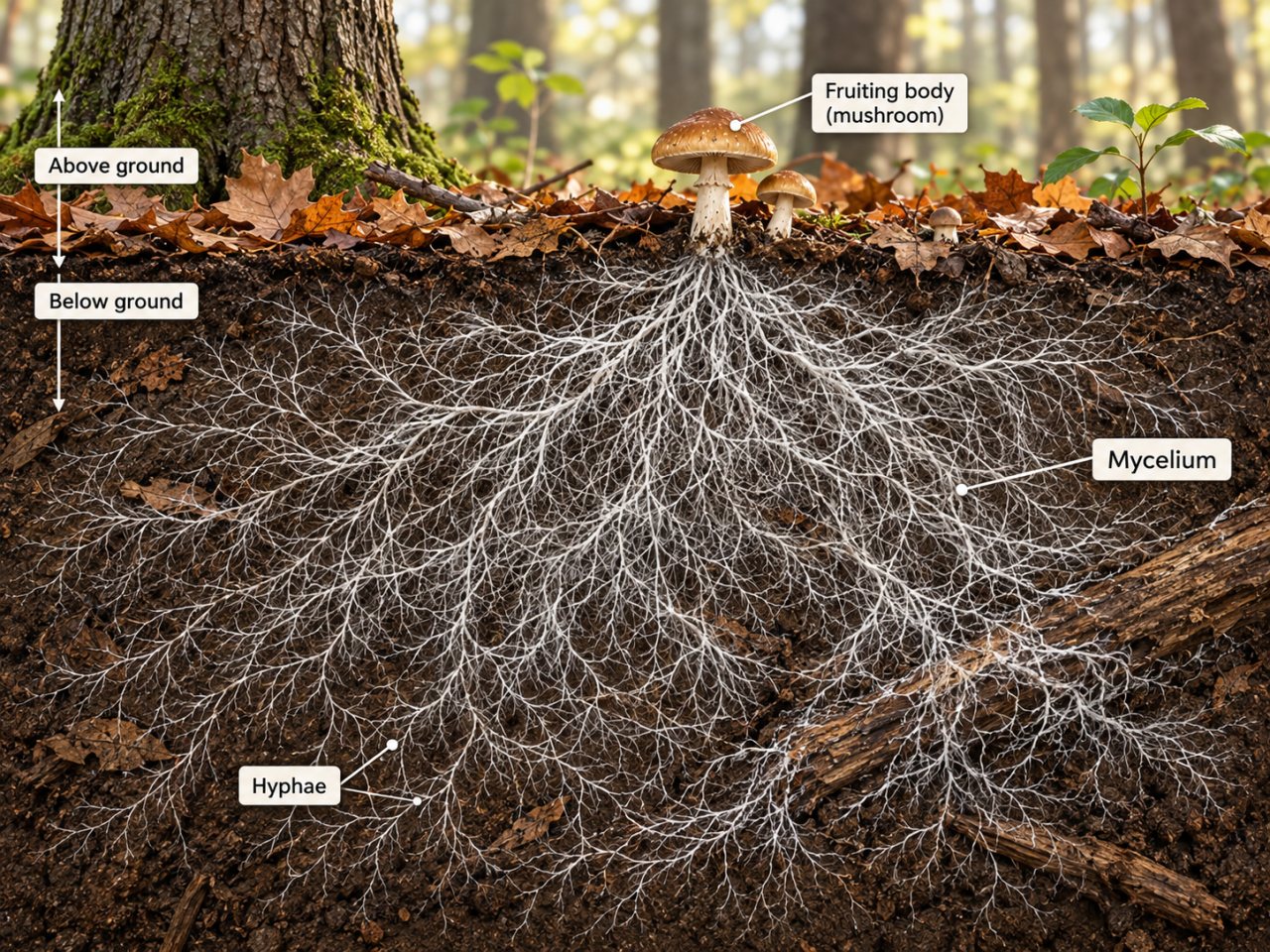
If that sounds familiar, we have met this arrangement before. In There’s a Humongous Fungus Among Us!, the mushrooms scattered through an Oregon forest turned out to be only the visible fruiting bodies of an enormous Armillaria fungus whose mycelium extends underground across a vast area.
Most fungi are not operating on quite that ridiculous of a scale, but the same basic distinction applies to many mushroom-forming species: the mushroom you notice is only one part of a larger fungal body underground.
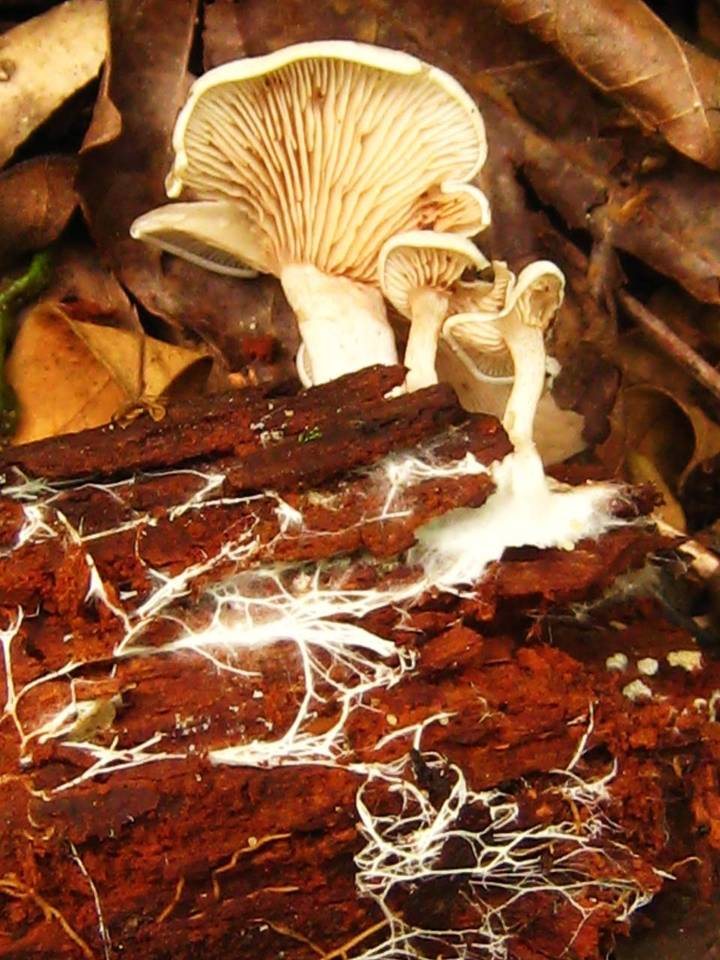
And the mushroom itself is made from hyphae, too.
When conditions and the fungus’s life cycle favor reproduction, hyphae become organized into a fruiting body. In the familiar cap-and-stalk mushrooms, that structure lifts spore-producing tissue into a position where spores can be released and dispersed. Depending on the species, spores may be produced on gills beneath the cap, inside pores, on ridges, or in other specialized structures.
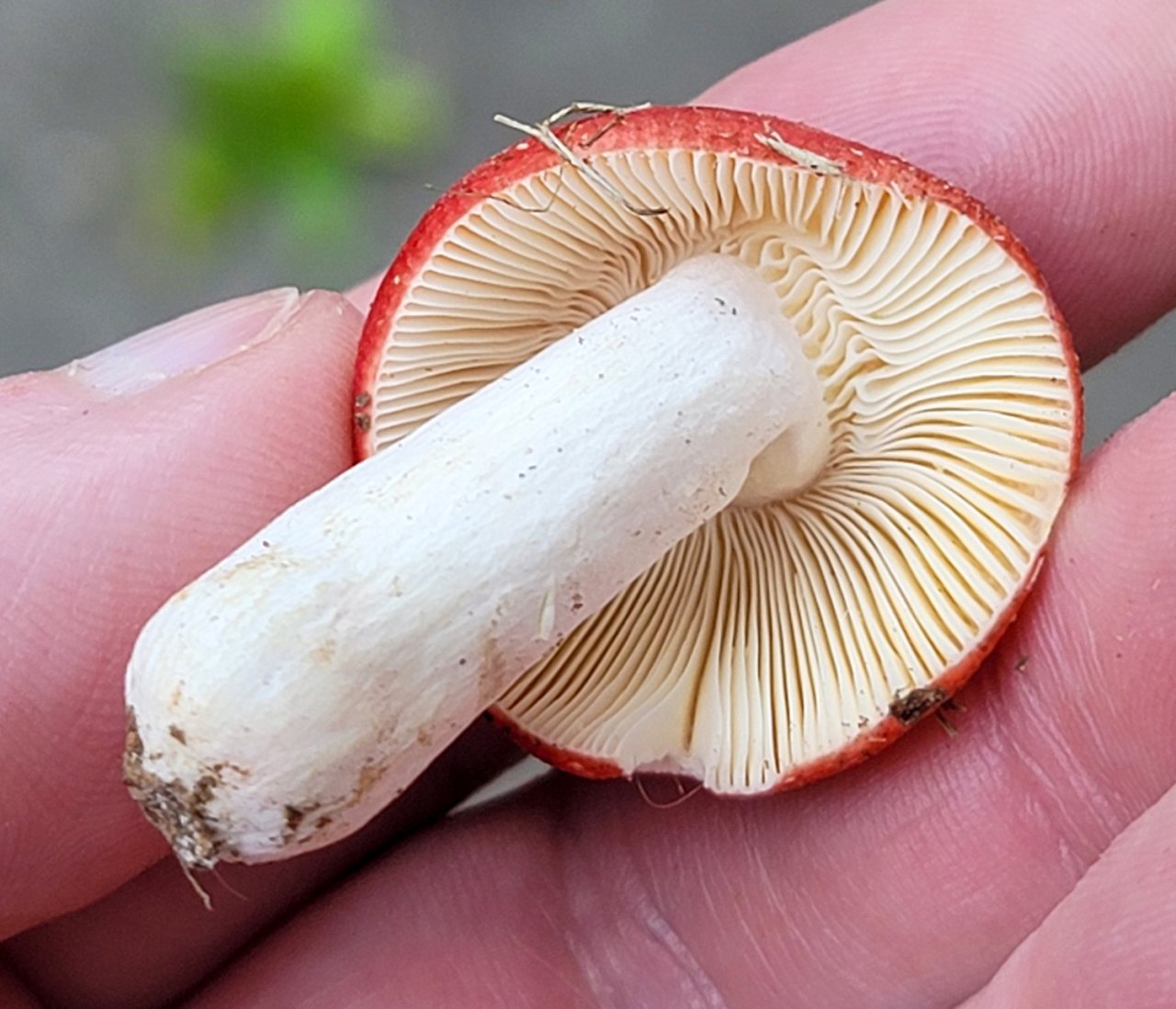
Those spores are reproductive cells, not seeds. Unlike a seed, a fungal spore does not contain a tiny multicellular plant embryo supplied with stored food. If a suitable fungal spore reaches an appropriate environment and germinates, it can begin producing new hyphae. Those hyphae grow and branch to form new mycelium, continuing the fungal life cycle.
This also explains why picking a mushroom usually does not mean that you have removed the entire fungus. You have removed its fruiting body. The mycelium from which it arose may remain in the soil, wood, or other substrate and may continue growing after the mushroom itself is gone.
There is, however, enormous diversity hiding behind the word fungus. Not every fungus produces the classic cap-and-stalk mushroom, and many fungi do not produce mushrooms at all. Fruiting bodies can take forms such as puffballs, brackets, cups, and truffles, while some fungi produce spores without making large visible fruiting bodies.
So the mushroom deserves a little more anatomical respect than it usually gets.
It is not merely a cute umbrella-shaped object that appears after the rain.
It is a temporary, highly organized reproductive structure built by a much less conspicuous fungal organism.
Which means the fungus really is putting its reproductive parts on public display.
Science Scandal regrets to report that the headline has survived fact-checking.
Sources
-
What is a fungus?
Lepp, H. (2012). What is a fungus? Australian National Botanic Gardens and Australian National Herbarium.
Why this source matters: Provides a concise authoritative explanation of fungal anatomy, including hyphae, mycelium, fruiting bodies, and the role of mushrooms in producing and dispersing spores. It also explicitly distinguishes the visible mushroom from the larger fungal organism.
-
What in earth? Understanding what fungi really are
Johnston, E. (2022, October 7). What in earth? Understanding what fungi really are. Royal Botanic Gardens, Kew.
Why this source matters: Provides an accessible institutional overview of fungal growth and reproduction, including spore germination, hyphae, mycelium, fruiting bodies, mushroom spore dispersal, and the important qualification that some fungi do not form fruiting bodies.
-
Biology 2e, Section 24.2: Classifications of Fungi
Clark, M. A., Douglas, M., & Choi, J. (2018). Biology 2e, Section 24.2, “Classifications of Fungi.” OpenStax, Rice University.
Why this source matters: Provides textbook-level support for the fungal life cycle and specifically identifies the basidiocarp as the fruiting body of a mushroom-producing fungus, with spores produced on specialized structures and germinating to establish new hyphae and mycelia.