
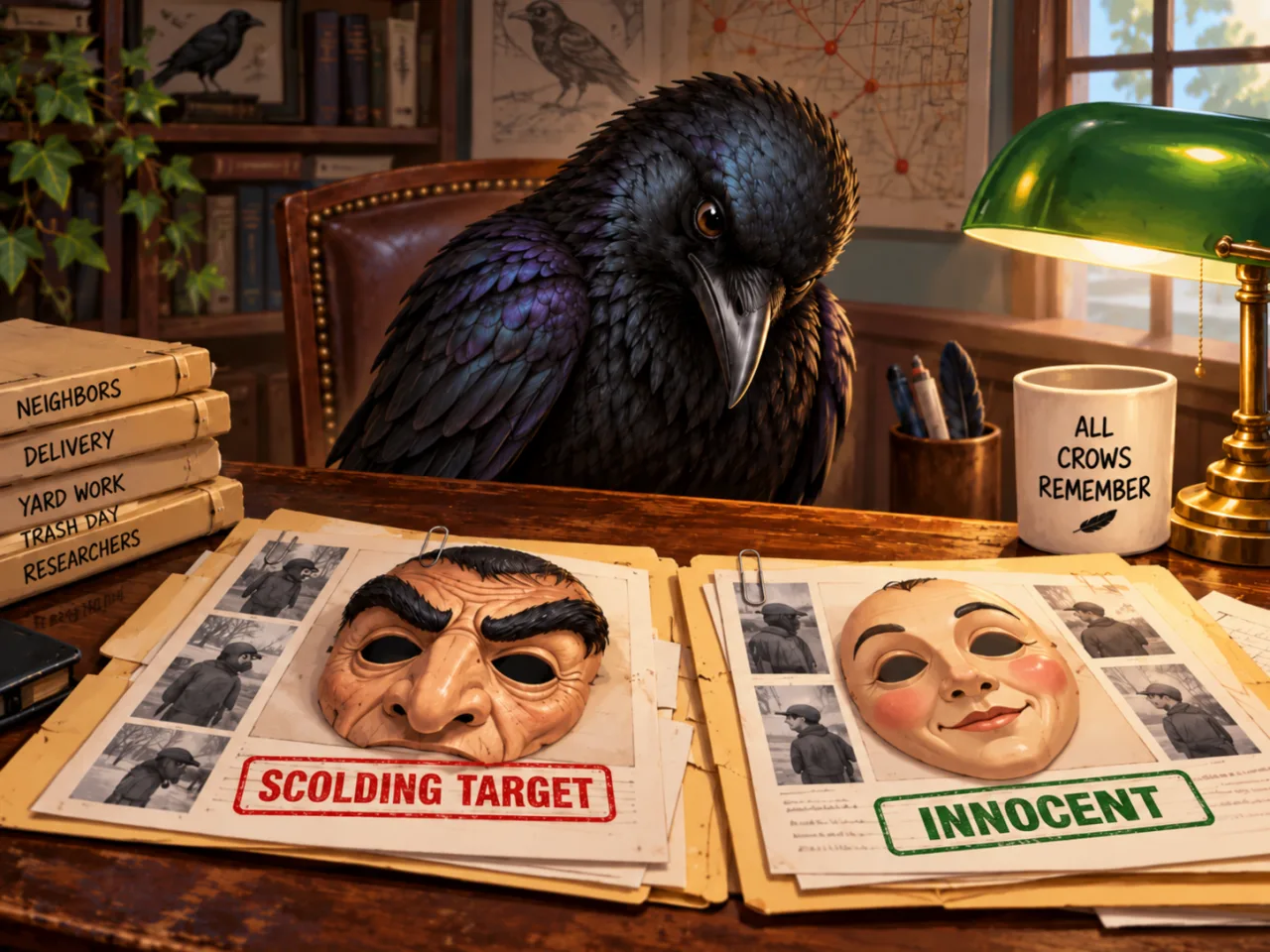
Imagine you're a graduate student at the University of Washington, eager to study crow behavior. One day, your advisor hands you a caveman mask and asks you to go capture, mark, and release some crows.
I'm sure the researchers got strange looks from more than just the local crows!
And since those masks had a distinctly Halloween-like appearance, what better time than Halloween week to introduce the newest recruit to our Rogue's Gallery: Carlton the Crow!
You see, Carlton has a good memory. And an uncanny ability to recognize human faces.
So researchers wanted to find out whether crows would remember a face associated with a threatening experience YEARS later. The birds were captured, color-banded, and released within 20 minutes, but apparently that was more than enough time to leave a lasting impression on their psyche.
And Carlton remembered.
As did an increasing number of his fellow crows. Year after year, more members of the local murder of crows (yes, a group of crows is traditionally called a murder) were observed scolding people wearing that same face mask.
And the best part? When an experimenter wore the threatening mask upside down, some crows simply turned their own heads upside down to inspect the face. 🤣 Smart birds.
So, for our first-ever Carlton the Crow story, we want you to know that you should mind your p's and q's around crows.
Because they're watching.
And noticing.
And remembering.
The Real Story
American crows (Corvus brachyrhynchos) are remarkably good at recognizing human faces, especially when those faces have been associated with danger. And research from the University of Washington has demonstrated that their memories can last for years.
In a study published in Animal Behaviour in 2010, researchers led by John Marzluff set out to determine whether wild American crows could learn to recognize individual human appearances and retain those memories over time.
To test this, the researchers captured, color-banded, and released small groups of wild crows at five locations around Seattle, Washington. During the captures, they wore distinctive rubber masks, ensuring that the birds could associate a particular face with the unpleasant experience of being trapped and handled.
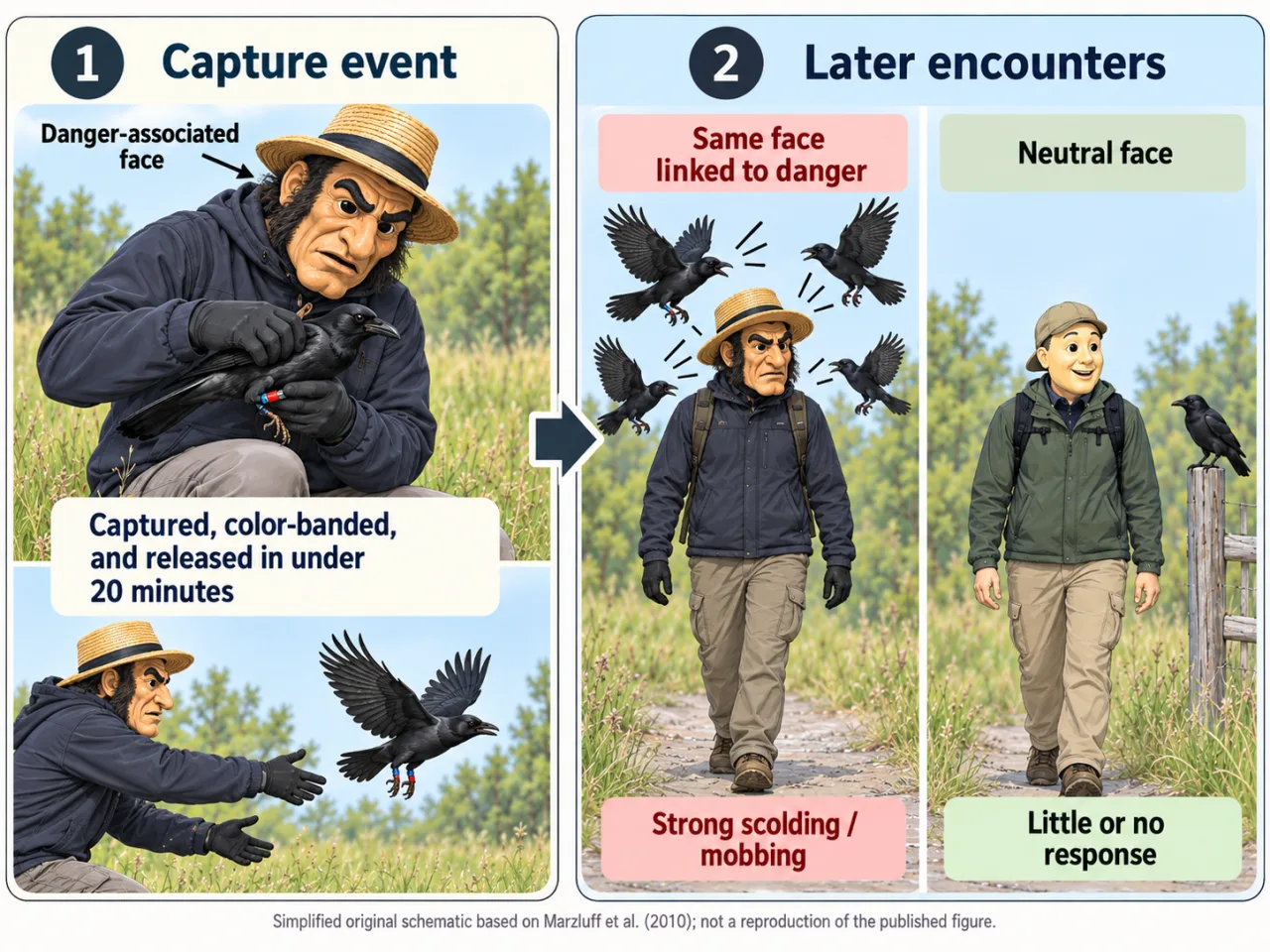
The researchers then returned to the study sites wearing either the same masks or different, neutral masks that had never been associated with trapping. They recorded how the crows responded to each appearance.
And the crows made their opinions known.
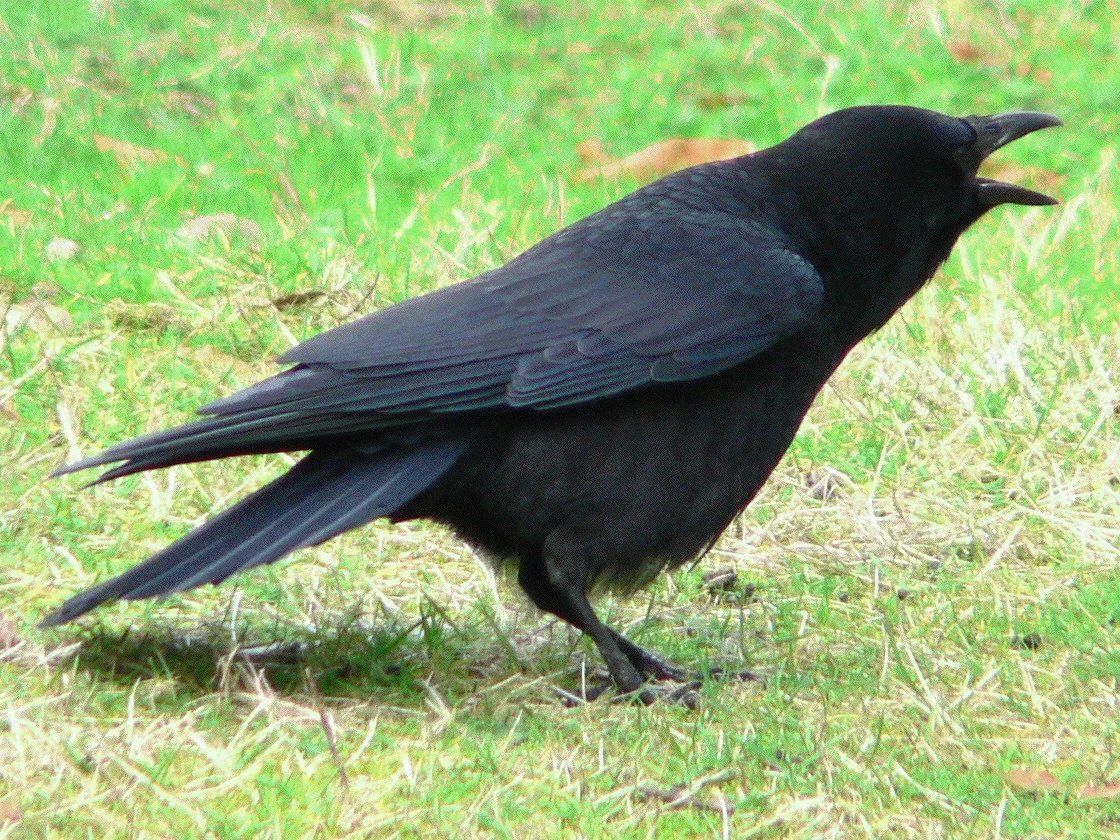
Birds encountering the previously threatening face often responded with harsh alarm calls, a behavior known as scolding. Some also engaged in mobbing, gathering with other crows to vocalize at and follow the perceived threat.
But when researchers appeared without masks or wore unfamiliar neutral masks, the birds generally responded much less aggressively.
The distinction was remarkably specific. Crows continued to recognize the threatening mask even when it was worn by different people who varied in height, body shape, sex, clothing, and walking style. In experiments where two masked people appeared simultaneously, the birds typically directed their attention and scolding toward the person wearing the mask associated with danger.
The researchers also tested how long this recognition persisted.
At the University of Washington campus, responses to the threatening mask remained evident throughout the 2.7-year observation period reported in the original study. In fact, the proportion of crows scolding that face increased from approximately 26% shortly after the original trapping events to 66% toward the end of the study.
But Marzluff wasn't finished. He continued returning to campus wearing the same caveman mask for years after the original study was published.
And the crows weren't finished either.
According to Marzluff's 2025 account of the continuing observations, the proportion of crows scolding the mask increased for the first seven years. Even twelve years after the original trapping event, approximately four out of every ten crows he encountered still scolded the familiar face.
Eventually, however, the response faded. By eighteen years after the original captures, the threatening mask appeared to attract little interest from the local crows. Marzluff noted that the last of the seven originally captured birds had died approximately one year earlier.
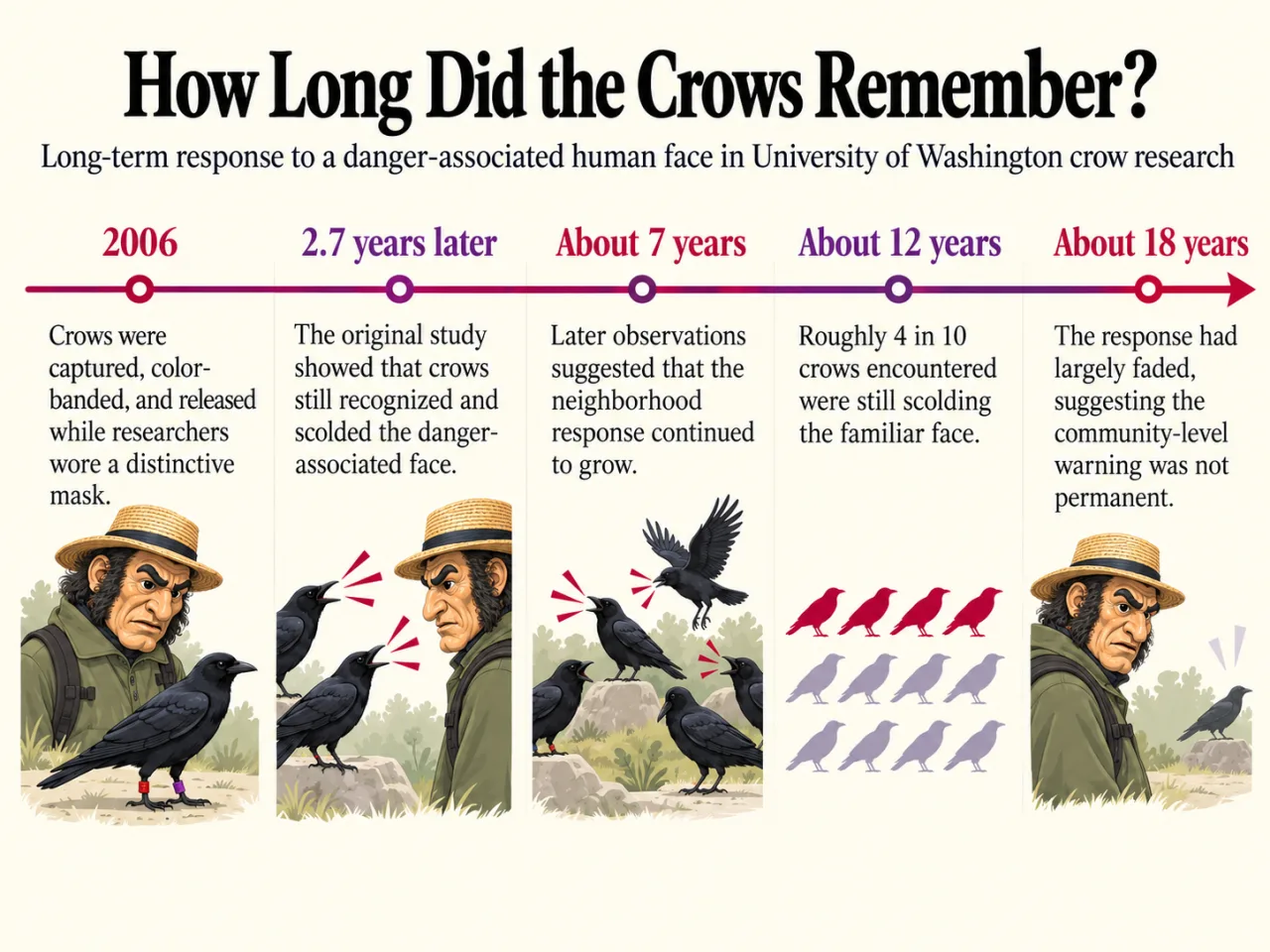
These later observations have not been presented in the same peer-reviewed experimental report as the original findings. They also do not establish that any single crow remembered the mask for seventeen or eighteen years. Instead, they document how a learned response persisted and eventually declined within a changing local crow population.
That raises another fascinating question: how did so many crows come to respond to the threatening appearance when only a relatively small number had been captured?
American crows are social birds, and their alarm calls can recruit others to respond to potential threats. Subsequent research demonstrated that crows can also learn about dangerous human appearances by observing other crows, including parents and other members of their social groups.
That gives us an entirely different scandal to investigate later. Stay tuned!
For now, the important finding is that American crows can learn to associate a particular human appearance with danger, distinguish it from other faces, and retain that association for years.
This is not evidence that crows hold grudges in the human sense, or that every crow remembers every person it encounters. It demonstrates something more scientifically useful: long-term recognition and memory can help wild animals distinguish potentially dangerous individuals from relatively harmless ones.
So the next time you pass a crow sitting quietly on a fence, remember that your encounter might not be quite as anonymous as you think.
You may have already been entered into Carlton's Casebook.
Sources
-
Lasting recognition of threatening people by wild American crows
Marzluff, J. M., Walls, J., Cornell, H. N., Withey, J. C., & Craig, D. P. (2010). Lasting recognition of threatening people by wild American crows. Animal Behaviour, 79(3), 699–707.
Why this source matters: This primary field study demonstrated that wild American crows learned to recognize human faces associated with capture, distinguished them from neutral faces, and continued responding to the threatening appearance for at least 2.7 years.
-
Social learning spreads knowledge about dangerous humans among American crows
Cornell, H. N., Marzluff, J. M., & Pecoraro, S. (2012). Social learning spreads knowledge about dangerous humans among American crows. Proceedings of the Royal Society B: Biological Sciences, 279(1728), 499–508.
Why this source matters: This follow-up study demonstrated that American crows could acquire information about dangerous human appearances through social learning. It provides evidence that recognition of threats can spread among birds beyond those directly involved in a threatening encounter.
-
Crows Remember a Face…for a Long Time!
Marzluff, J. M. (2025, January 21). Crows remember a face…for a long time! Yale University Press.
Why this source matters: In this first-person account, the lead researcher describes nearly two decades of follow-up observations after the original crow facial-recognition experiment. The account documents how the local crows' responses to the threatening mask persisted for years before eventually declining.