
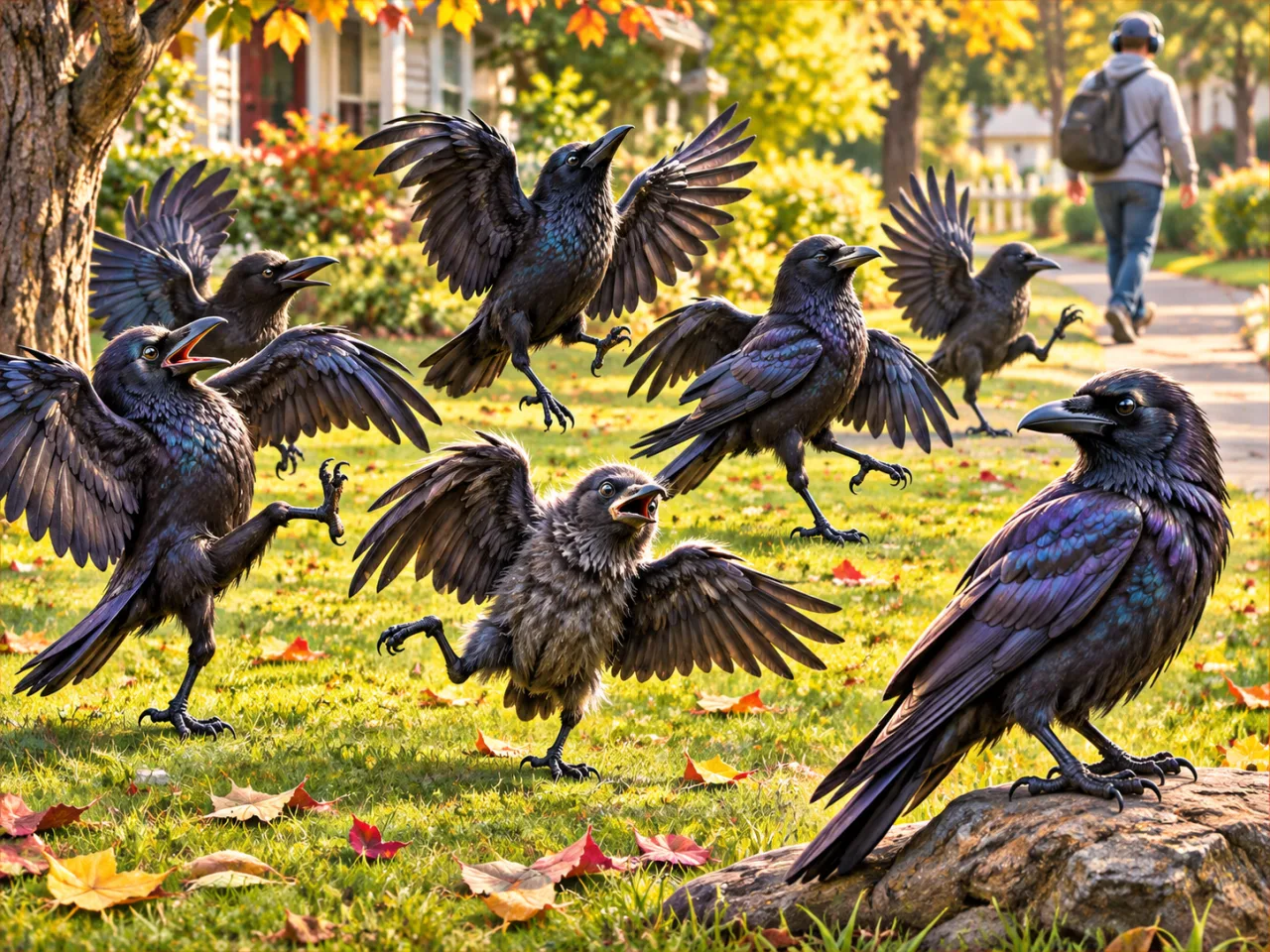
It began as an ordinary afternoon in the neighborhood.
A crow spotted a familiar human face and immediately started dancing.
Within seconds, several other crows joined in. Wings flapped. Heads bobbed. The entire neighborhood erupted into what appeared to be a spontaneous corvid flash mob.
One young crow, who had never seen that particular human before, joined the festivities enthusiastically.
When the performance finally ended, he turned to Carlton.
"What was that all about?"
Carlton stared at him.
"Every time we see THAT face," he said, pointing toward the retreating human, "we dance."
The young crow considered this information.
"Noted. I'll remember that next time."
And just like that, another member of the neighborhood had joined the Crowspiracy.
Of course, actual crows aren't organizing synchronized dance routines whenever a suspicious human walks past. They're doing something rather more practical: responding to potential threats.
Me being me… I heard about a crow mob and immediately pictured a dancing flash mob. 🤣
But the real behavior behind a crow mob has some interesting parallels with our imaginary flash mob.
Some crows join the commotion simply because others are participating. Others learn to recognize the source of the disturbance and respond independently on future occasions.
And apparently, the neighborhood has been passing along these lessons to the children.
Welcome to Carlton's Crowspiracy.
Membership is involuntary. Your reputation precedes you.
The Real Story
American crows (Corvus brachyrhynchos) don't have to experience danger personally to learn which humans might pose a threat. They can acquire that information by observing other crows, and they can even pass learned warnings from one generation to the next.
In our previous Carlton the Crow investigation, we explored research showing that American crows can recognize human faces associated with danger and can remember them for years. Researchers at the University of Washington demonstrated this by wearing distinctive masks while capturing, banding, and releasing wild crows. When people wearing those masks returned, the birds often responded with harsh warning calls known as scolding.
But scientists noticed something curious.
Far more crows were responding to the threatening masks than had ever been captured.
How did birds that had never personally experienced the original trapping event come to recognize the same apparent threat?
A follow-up study, published in Proceedings of the Royal Society B in 2012, investigated how information about dangerous humans spread through crow populations.
First, there was the mob.
When a crow encounters a potential threat, its scolding calls can attract other crows. Several birds may gather, call loudly, and follow the perceived danger. This behavior, known as mobbing, can help discourage threats while alerting other animals nearby.
But here's an important distinction: a crow joining the commotion doesn't necessarily know why everyone else is upset. But they join in anyway.
Scientists call this immediate influence of one animal's behavior on another animal behavioral contagion, or social facilitation. A crow hears alarm calls, notices other birds reacting, and joins in. Its participation does not, by itself, demonstrate that it recognizes the threatening individual.
The researchers wanted to know whether some birds were doing more than simply following the crowd.
And that's where things got interesting.
They observed crows that had never been captured by the masked researchers and recorded their responses when those birds encountered the threatening face alone, without an existing mob to join.
At locations where researchers had previously observed crow mobs scolding the threatening mask, 27.8% of subsequently observed solitary, unbanded crows scolded that same appearance. At locations without recorded mobs, only 3.3% did so.
The difference was striking.
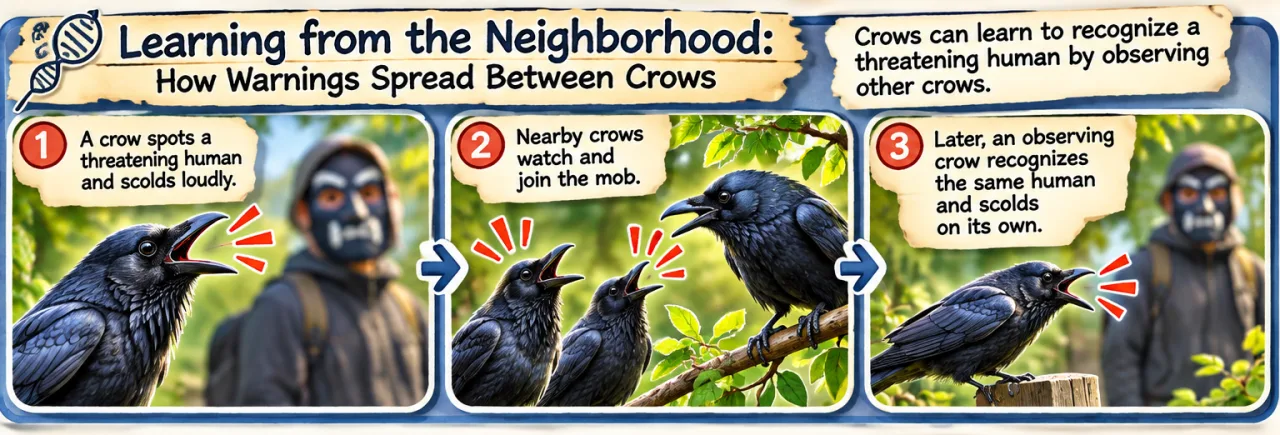
These findings were consistent with horizontal social learning: information passing between individuals, such as neighboring birds or other members of a social group.
In other words, a crow could observe others reacting to a particular human appearance and later respond to that appearance independently.
The researchers couldn't establish the precise learning history of every unbanded bird. Some might have witnessed the original trapping event, while others could have learned from later encounters with scolding crows. Nevertheless, the pattern supported the conclusion that information about danger was spreading socially.
But the Crowspiracy didn't stop with the neighbors. It reached the children.
Researchers also studied young crows that had never witnessed the original trapping events. These youngsters observed their parents scolding people wearing the threatening mask.
As the young birds developed, they began participating in those responses.
Then came the crucial test: what would happen when the youngsters encountered the threatening appearance without their parents present?
Some scolded the mask independently.
In the University of Washington family observations, fledglings from seven of eleven territories scolded the threatening mask when their parents were absent. By comparison, scolding occurred in only one of nine territories during encounters with an unmasked, neutral observer.
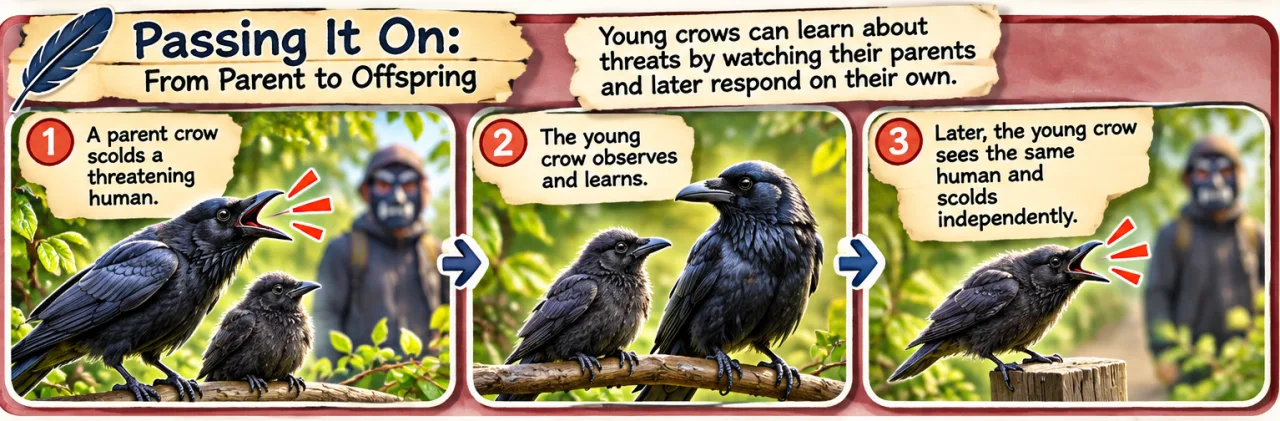
This was evidence of vertical social learning: information passing from parents to offspring through experience and observation rather than through genes.
The young crows hadn't inherited a genetic memory of a particular human face. They had learned which appearance was associated with danger by watching their parents respond.
And this raises an intriguing question: is this a form of animal culture?
Under commonly used scientific definitions, animal culture can include behaviors or information acquired through social learning and maintained within a group or passed between generations.
It doesn't require language, art, or elaborate rituals.
The crow study provides evidence for that kind of cultural transmission. A warning associated with a particular human appearance could spread through social interactions and persist beyond the birds that experienced the original event.
However, learning from others comes with a trade-off.
Crows that had personally experienced capture were more accurate at distinguishing threatening masks from neutral ones than birds that acquired information indirectly. Socially learned warnings were useful, but they were not necessarily as precise as firsthand experience.
That makes biological sense. Learning directly can provide detailed information, but it can also be dangerous. Learning from someone else's experience allows an animal to recognize a potential threat without paying the price of discovering it personally.
Over five years of observations at the University of Washington, scolding of the threatening mask increased in frequency and spread beyond the original trapping locations. The researchers documented responses more than a kilometer away.
The result was a neighborhood in which information about a particular threat extended far beyond the small number of birds originally captured.
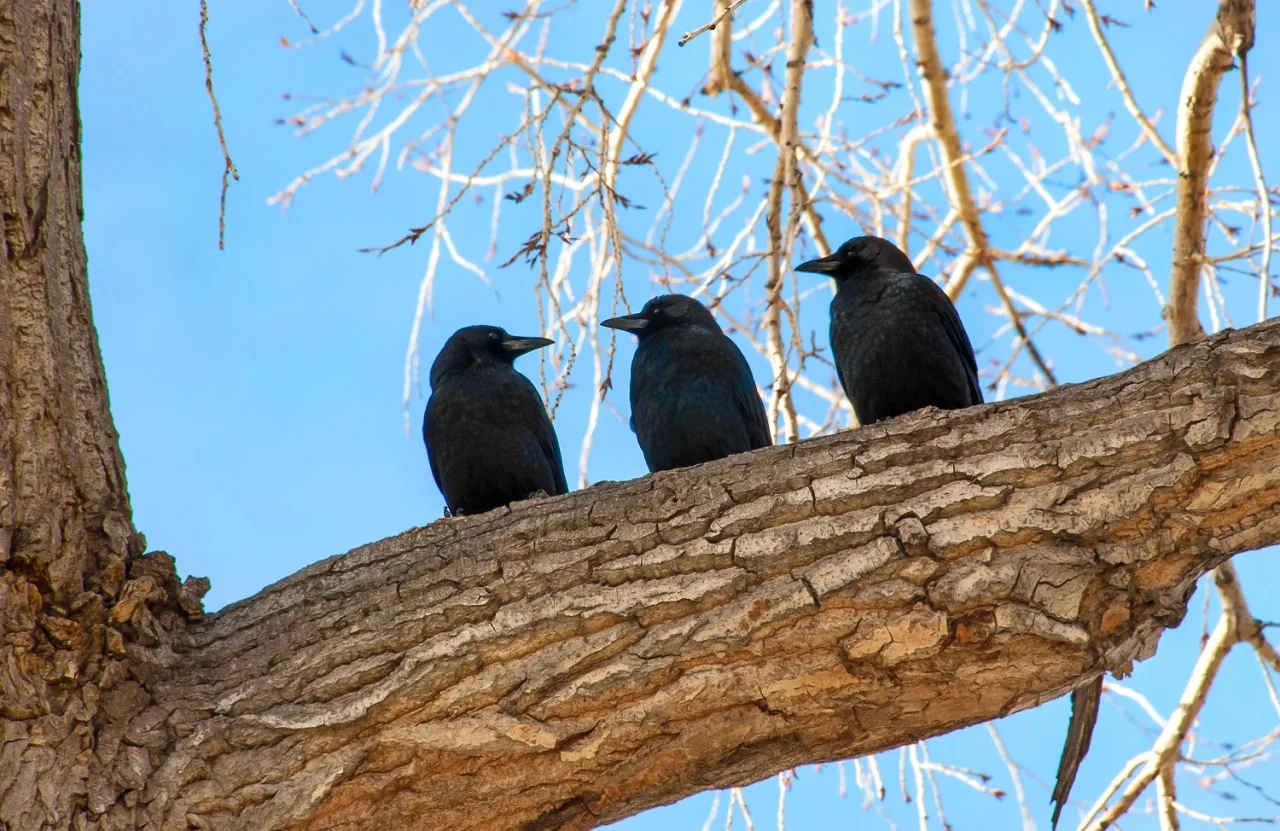
Of course, Carlton isn't literally distributing photographs, maintaining a neighborhood mailing list, or teaching his offspring the names of suspicious humans.
But the underlying science is impressive enough without the fictional paperwork.
A crow can join a mob because other birds are alarmed. It can also learn from that experience, recognize a threatening appearance later, and contribute to passing that information through its social group.
So if a crow you've never encountered seems unusually suspicious of you, there's at least one scientifically plausible explanation.
You may be meeting the bird for the first time.
But your reputation might have arrived ahead of you.
Sources
-
Social learning spreads knowledge about dangerous humans among American crows
Cornell, H. N., Marzluff, J. M., & Pecoraro, S. (2012). Social learning spreads knowledge about dangerous humans among American crows. Proceedings of the Royal Society B: Biological Sciences, 279(1728), 499–508.
Why this source matters: This primary study demonstrates how American crows acquire information about threatening human faces through social learning. Researchers distinguished immediate participation in mobbing from later independent recognition and documented transmission of learned responses from parents to offspring.
-
Lasting recognition of threatening people by wild American crows
Marzluff, J. M., Walls, J., Cornell, H. N., Withey, J. C., & Craig, D. P. (2010). Lasting recognition of threatening people by wild American crows. Animal Behaviour, 79(3), 699–707.
Why this source matters: This foundational experiment demonstrated that American crows could learn to recognize human faces associated with threatening experiences and retain that recognition for years. It provides the experimental background for the subsequent investigation into social learning.