
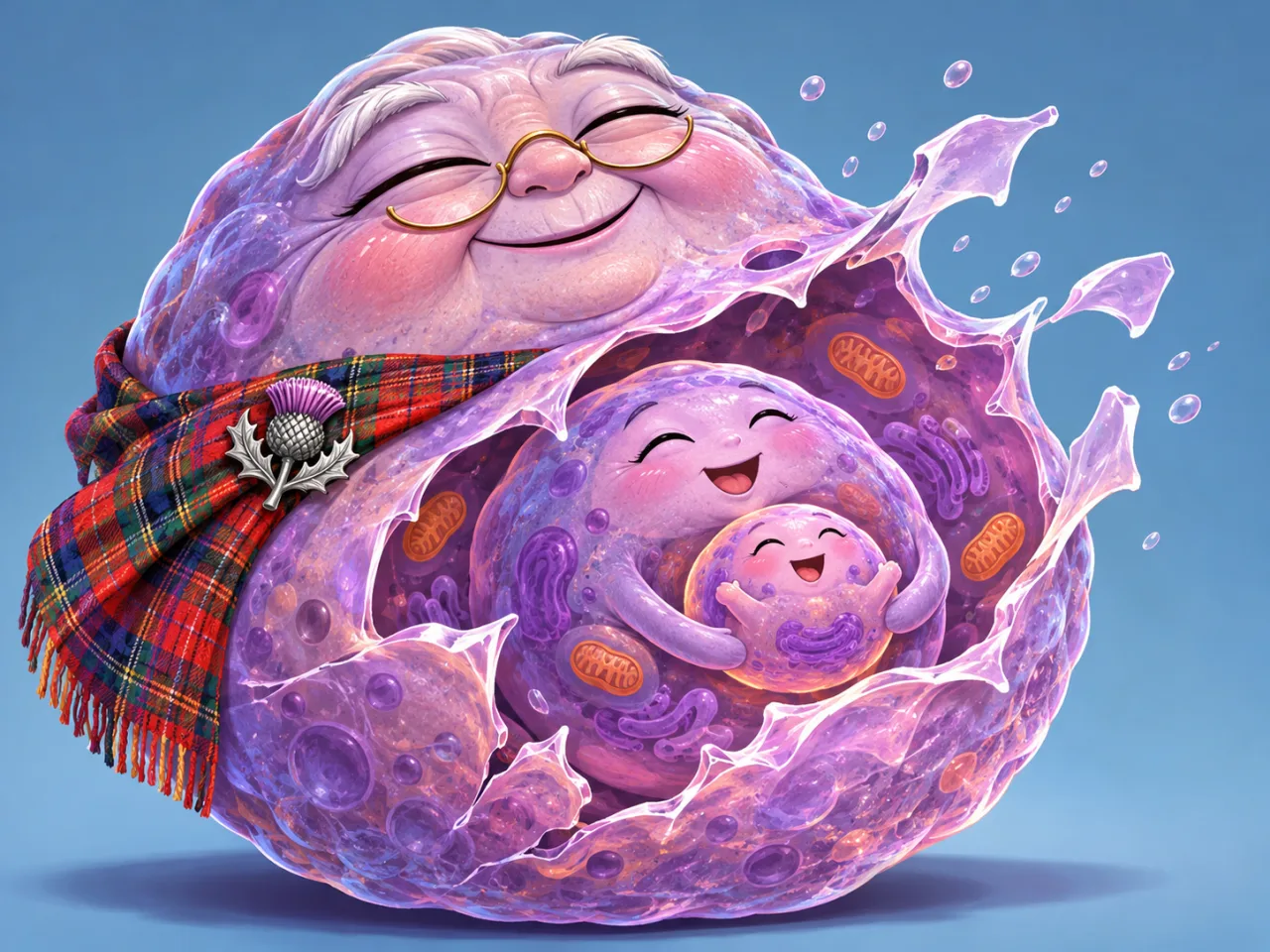
Imagine you're a pregnant woman. In Scotland.
You're carrying a baby in your womb. Nothing unusual there.
Except that your unborn baby is already pregnant, too.
That's right. Your baby is carrying another baby inside its own womb, which is currently inside yours.
Congratulations! You've become a grandmother before you've even given birth.
And apparently, nobody in this family has heard of moving out.
But wait. It gets worse.
Because when the time comes for your children and grandchildren to enter the world, there's no conventional delivery.
No labor.
No pushing.
YOU EXPLODE.
And out come the children and grandchildren, ready to begin their own lives.
Sound like the premise of a particularly disturbing science-fiction movie?
Well, scientists have discovered a microscopic organism that does something remarkably similar.
And unlike the unfortunate woman in our hypothetical scenario, this little creature has apparently been making the arrangement work all along.
The Real Story
Scientists have discovered an extraordinary reproductive strategy in a newly described microscopic organism from Scotland. The organism, named Caledochytrium aldermanii, can develop daughter cells inside its own cell body, and some of those daughters already contain another developing generation before the original mother cell ruptures to release them.
In other words, a single cell can become a microscopic grandmother before its children have even left home.
But first, what exactly is this peculiar little creature?
Caledochytrium aldermanii is a single-celled eukaryote belonging to a group of marine microorganisms called labyrinthulomycetes, specifically the thraustochytrids. Unlike bacteria, eukaryotic cells contain a nucleus and other membrane-bound compartments. Protists are a diverse collection of eukaryotes that don't fit neatly into the familiar categories of animals, plants, or fungi.
Labyrinthulomycetes occur in marine and other saline environments, where many help break down dead organic material and recycle nutrients. Researchers have found C. aldermanii associated with Scottish octopuses and their lairs, rainbow trout, and a salt marsh on Scotland's east coast.
But it's the organism's reproductive behavior that has scientists particularly intrigued.
In the unusual process described in the 2026 study, a mature C. aldermanii cell develops a large internal compartment called a vacuole. Rather than simply splitting into two daughter cells, the mother produces one or more new cells inside this cellular compartment.
And here's where things get really interesting.
Some of those daughter cells already contain another developing cell of their own. That creates three nested generations: the original mother cell, a daughter developing inside her, and a granddaughter developing inside the daughter.
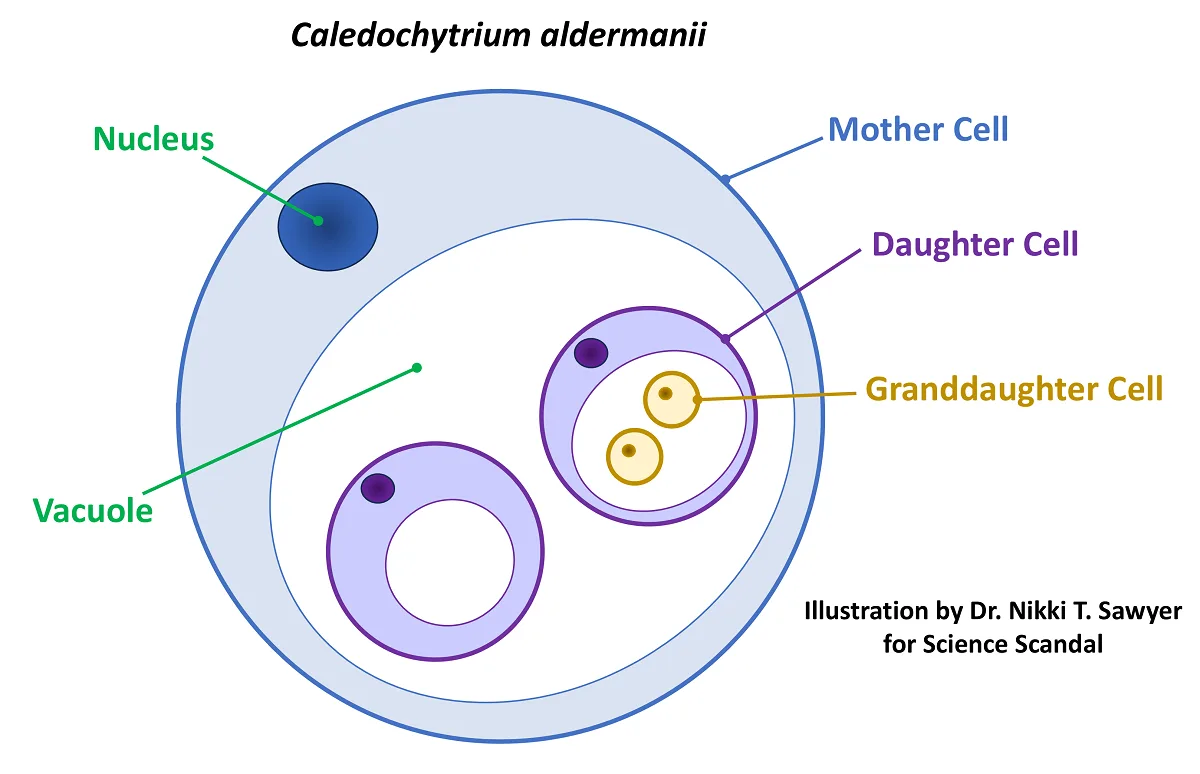
Eventually, the outer mother cell ruptures, releasing its offspring.
Three generations, one microscopic household, and a rather dramatic moving day.
Importantly, this isn't pregnancy or childbirth in the mammalian sense. There are no wombs, placentas, or developing animal embryos. These are generations of single-celled organisms forming within other cells. And the mother's apparent explosion is actually a rupture of the outer cell, not a combustion-driven blast.
Nor is this the organism's only reproductive strategy.
Researchers documented several other reproductive and dispersal forms, including swimming spores equipped with flagella, non-swimming cells that move along specialized external networks called ectoplasmic nets, and even amoeba-like forms under particular culture conditions.
This remarkable flexibility demonstrates that reproduction among single-celled organisms can be far more varied than the familiar textbook example of one cell simply dividing into two.
The discovery is also a reminder that identifying an organism's genes doesn't necessarily reveal everything about how it lives.
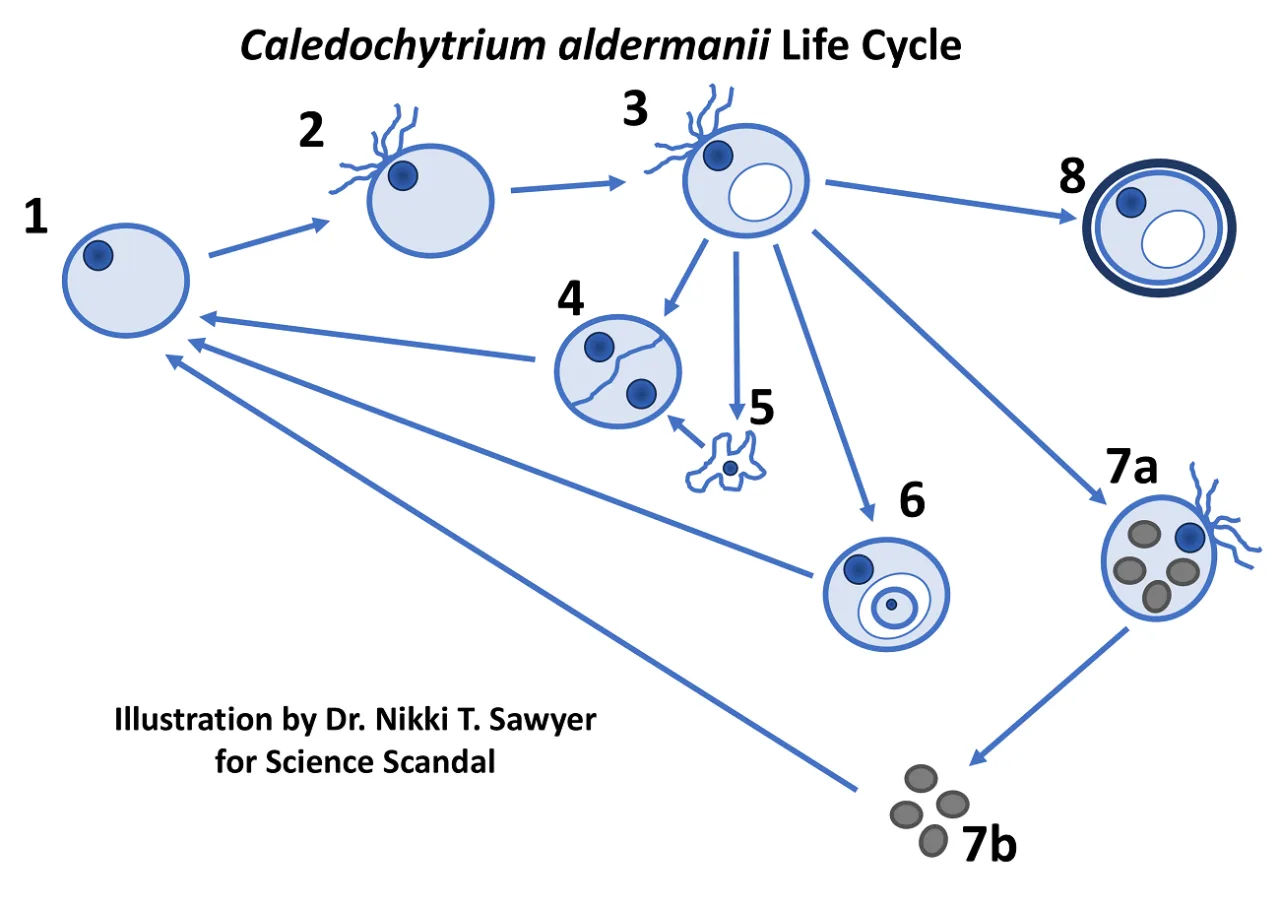
Dr. Jane Polglase and her colleagues spent years studying these microorganisms, examining their physical structures and behavior alongside their molecular biology. Using microscopy, the researchers captured the unusual nested reproductive process and recognized that they were observing something not previously documented in this group.
Their findings, published in the journal Protist in 2026, describe both a new genus and species and an unfamiliar reproductive strategy.
Scientists have documented what happens, but the detailed cellular mechanisms governing this unusual process remain incompletely understood.
And that's what makes the discovery so fascinating. Even in an age of sophisticated genetic sequencing and molecular analysis, researchers are still uncovering extraordinary biological behaviors simply by carefully observing organisms that have received relatively little attention.
As for Caledochytrium aldermanii, the family arrangements may seem unconventional.
But apparently, nobody has to worry about the grandchildren refusing to move out.
Grandmother takes care of the eviction herself.
Sources
-
Caledochytrium aldermanii gen. Et sp. nov.; a new Labyrinthulomycete displaying a novel reproductive strategy
Polglase, J. L., Morris, P. C., Feist, S. W., Mitchell, W. J., Strachan, F., Fraser, K. A., Iremonger, J. R., Dyrynda, E. A., Lyndon, A. R., & Brown, L. A. (2026). Caledochytrium aldermanii gen. et sp. nov.; a new Labyrinthulomycete displaying a novel reproductive strategy. Protist, 182, Article 126166.
Why this source matters: The original peer-reviewed study formally describes Caledochytrium aldermanii and documents its unusual reproductive strategy, including daughter cells developing within a maternal cell and the possibility of a third generation forming before the outer cell ruptures.
-
Scientists discover bizarre 'Alien' microbe that gives birth by bursting open
Heriot-Watt University. (2026, September 2). Scientists discover bizarre 'Alien' microbe that gives birth by bursting open.
Why this source matters: Provides explanations from the researchers about the organism's unusual reproduction, its discovery in Scottish marine environments, and the importance of microscopy and direct observation in revealing unfamiliar biological behavior.