
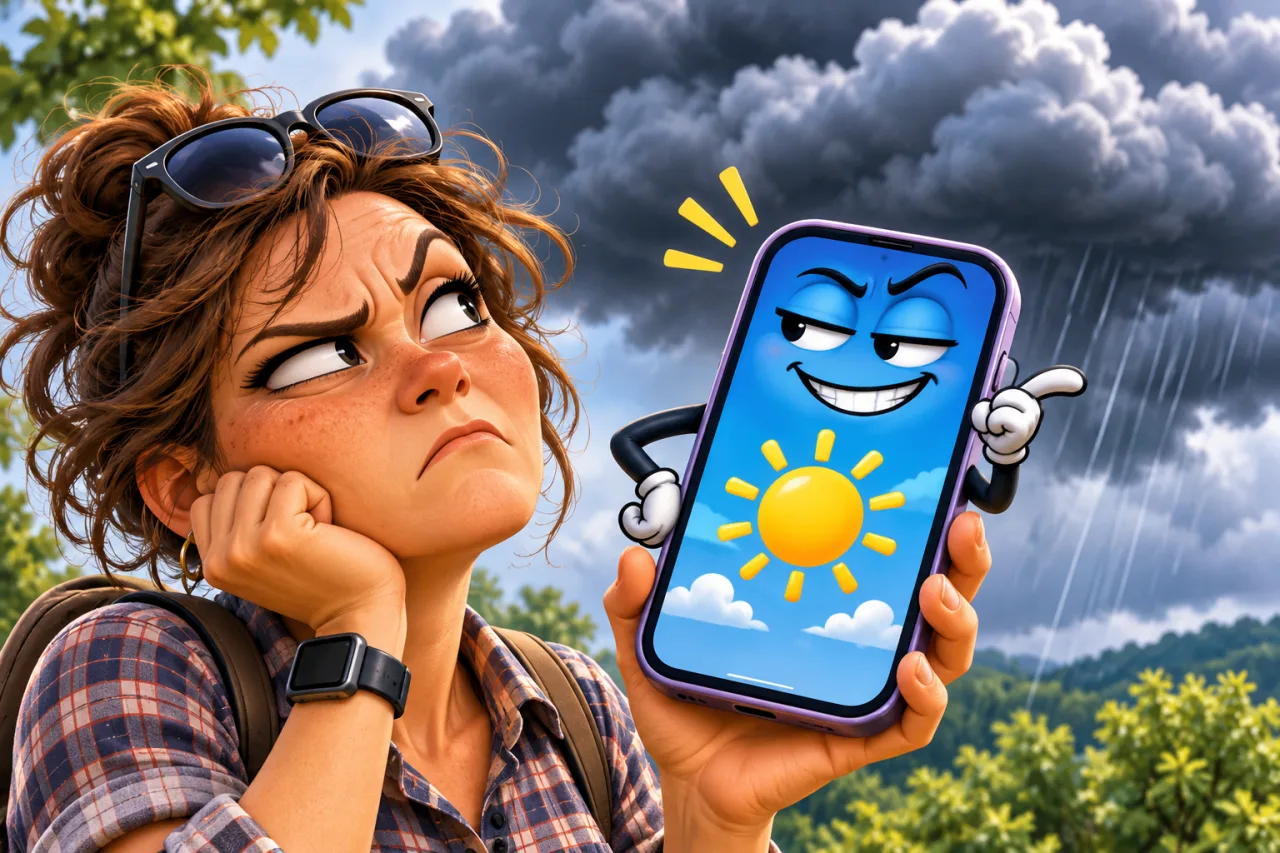
We frequently grumble about our weather apps in the Sawyer household. Which led not only to this article, but a whole planned series of articles about weather prediction.
But let me set the stage for one particularly egregious incident of meteorological betrayal.
In Georgia, we'd been experiencing a series of unusually hot, above-average temperatures even after autumn was supposedly well underway.
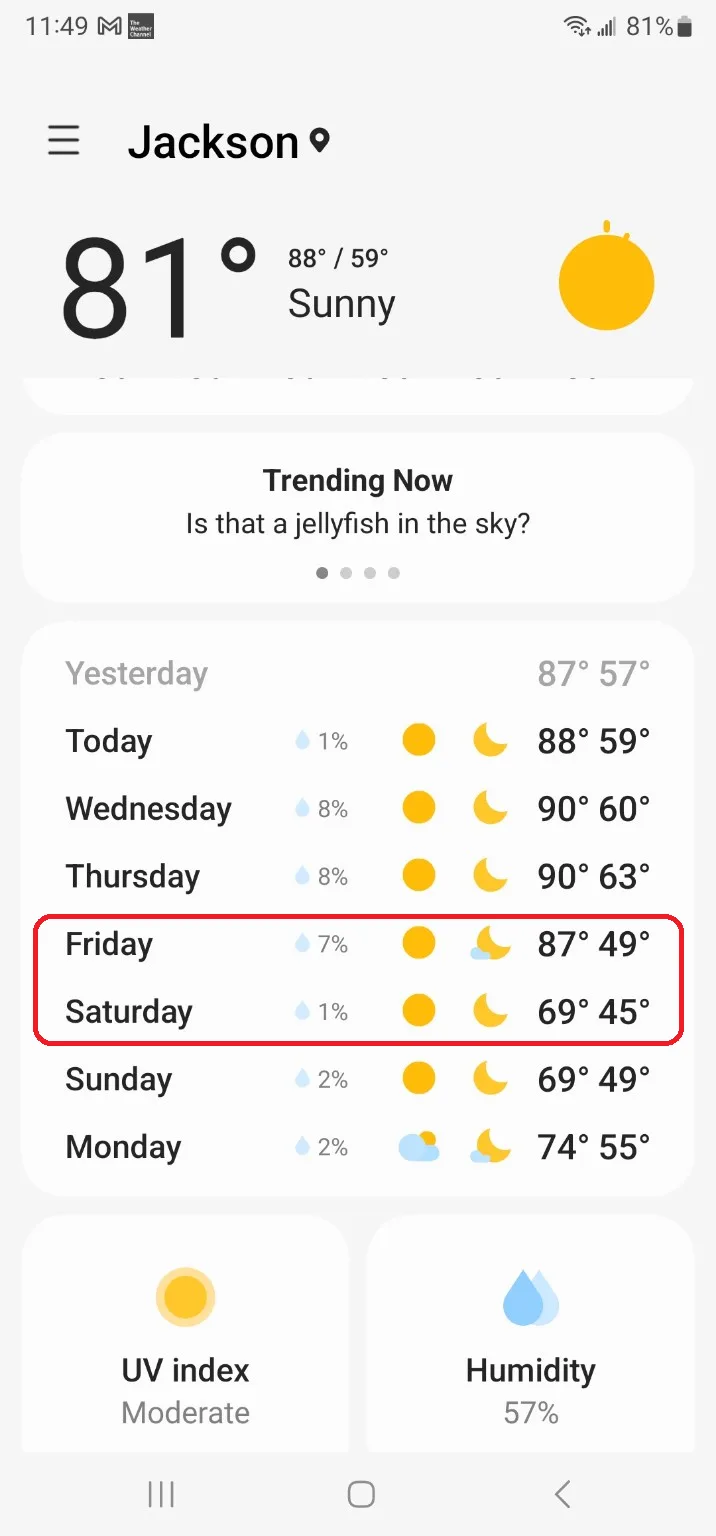
And then blessed relief was finally on the horizon. An unseasonably warm 87°F (30.6°C) on a Friday was to be followed by a wonderful 69°F (20.6°C) the following day, Saturday.
That's an 18°F (10°C) drop in the forecast high temperature from one day to the next, which, in my experience, usually means some kind of weather event like rain (although my AI later told me that's not always the case). But absolutely no rain had been forecast. Not even any clouds. Just sunny, clear skies. Just a ninja cold front moving through.
So… that was the scenario when Nigel and I went outside for a short nature walk at 5:45 pm on that particular Friday.
ME: It's looking awful cloudy. And those look like rain clouds. And I feel a little chill in the breeze. Nyx (my AI) said a cold front could come through without rain or clouds, but this is looking awful rain-like to me.
Nigel pulls out his phone and checks. It's about 5:46 PM.
NIGEL: It still says no rain. No clouds. Just clear skies.
ME: I don't know. This looks really sus.
We finish up our walk and go back inside. The time is now 6:03 PM.
ME: I just got an alert! My phone app now says, "Rain will start at 6:32 PM".
NIGEL: You know what happened, don't you? The meteorologist looked out his window, saw what we saw, and said, "Bugger!" He then ran back inside and said, "I'd better send out a rain alert!"
Spoiler alert… it did NOT rain at 6:32 PM.
The meteorologist was last heard muttering, "Bugger." AGAIN.
So, to summarize:
APP: "Clear and sunny; No rain"
NIKKI: "Looks like rain."
NIGEL: "App says clear."
APP: "RAIN AT 6:32 PM!"
SKY: "Actually, no."
Which brings us to THE REAL STORY: Is the atmosphere really that unpredictable, or is our weather app just trolling us?
The Real Story
Weather forecasting is an extraordinarily sophisticated science, but even the most advanced prediction comes with uncertainty. The problem is that much of that uncertainty can disappear somewhere between the scientific forecast and the tidy little announcement on your phone.
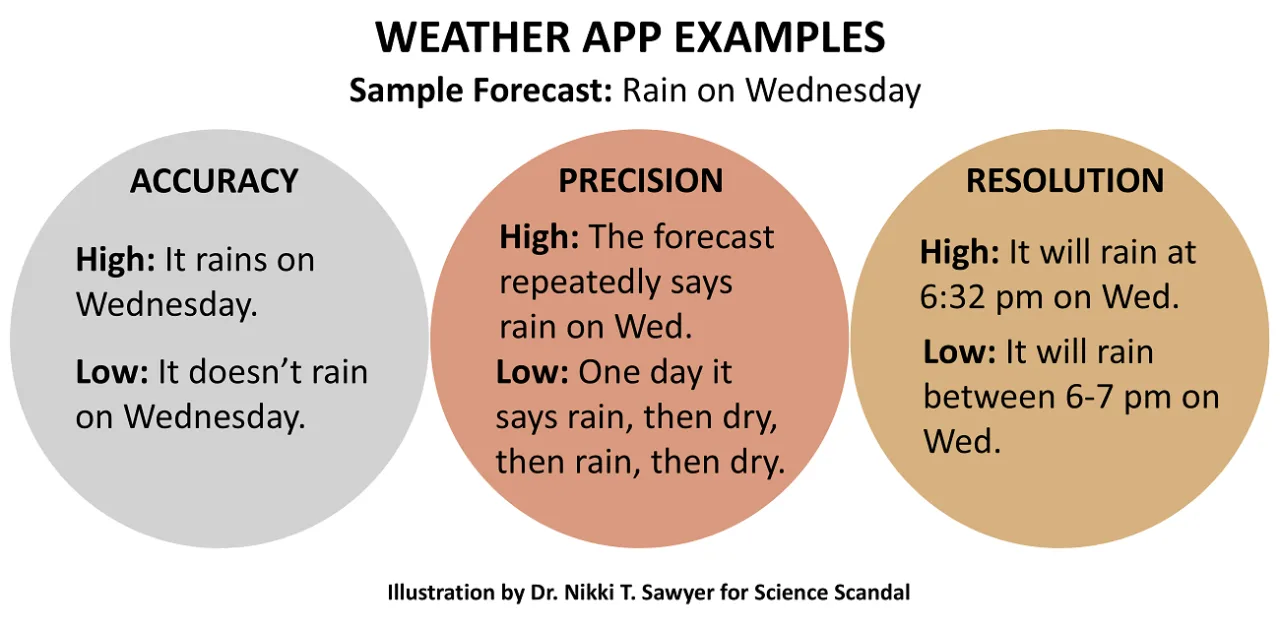
To understand why, we need to distinguish three related concepts: accuracy, precision, and resolution.
In scientific measurements, accuracy describes how close a result is to the true value, while precision describes how closely repeated measurements agree with one another. Resolution describes how finely a result can be expressed.
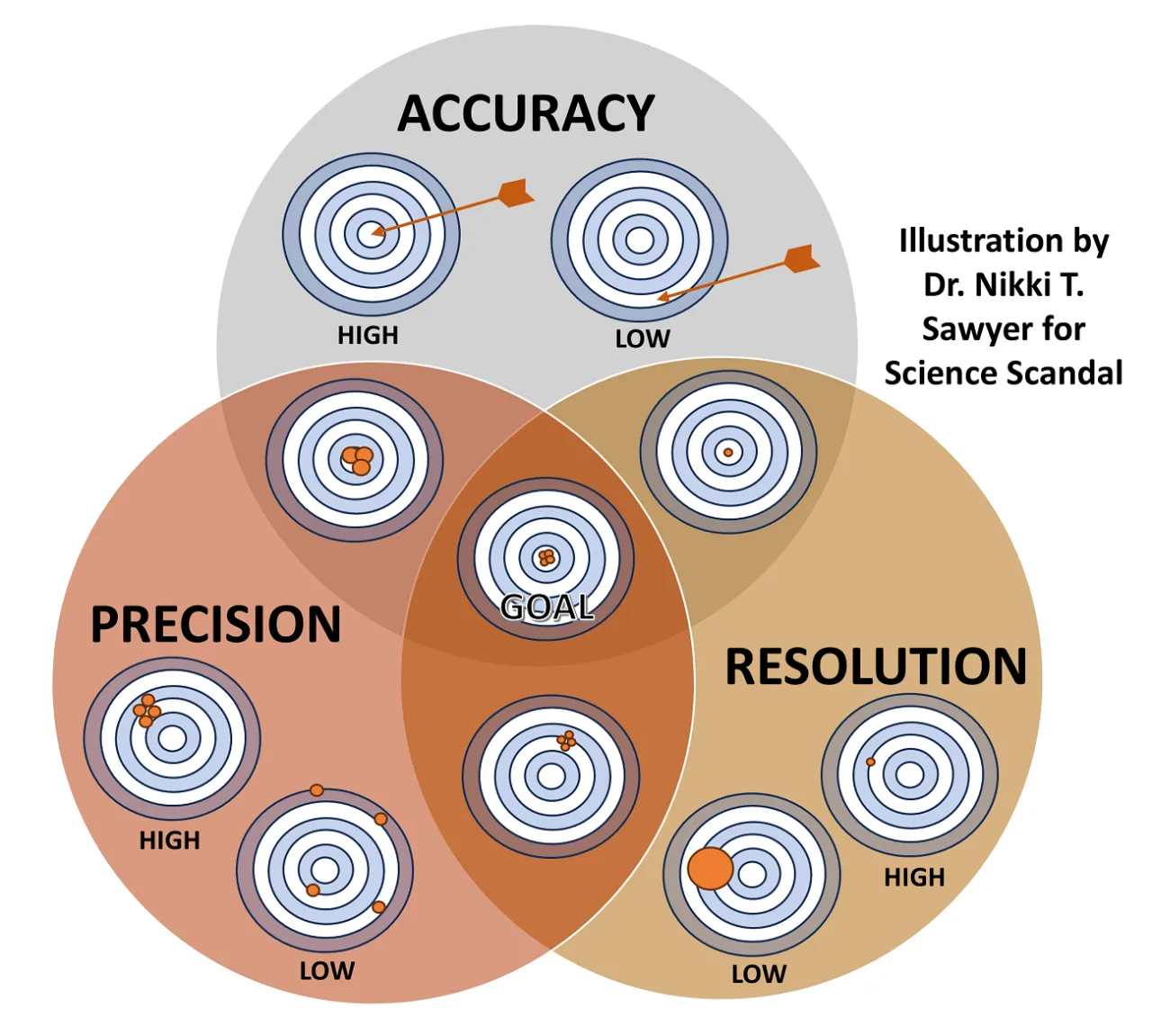
For example, a forecast announcing rain at 6:32 PM provides a more specific time than one predicting rain sometime between 6:00 and 7:00 PM. But that extra detail doesn't necessarily make the forecast more accurate or more reliable.
An exact-looking number is not proof of an exact prediction.
Weather forecasts begin with observations of atmospheric conditions, including temperature, humidity, air pressure, winds, and precipitation. Computer models use that information, along with the physical laws governing the atmosphere, to estimate what will happen next.
But the atmosphere is enormously complicated. Observations cannot capture every detail, and different plausible starting conditions can produce different outcomes. Meteorologists therefore use techniques such as ensemble forecasting, running multiple simulations to explore a range of possible weather scenarios.
The resulting information may contain substantial uncertainty about where rain will fall, when it will arrive, or whether a developing shower will reach a particular location.
Your weather app, however, has limited screen space and a much simpler job: tell you what weather to expect.
That means complicated predictions must be translated into something understandable, often a single temperature, weather icon, or estimated arrival time. These summaries can be useful, but they may not communicate the full range of possible outcomes.
And there is actual research on this problem. Scientists studying weather-app communication have found that some apps provide highly detailed forecasts without adequately communicating the uncertainty associated with them. A specifically stated prediction can therefore encourage users to expect more certainty than the underlying evidence supports.
But what about those remarkably specific rain-arrival times?
Short-term weather prediction, called nowcasting, uses recent observations, especially weather radar, to estimate what will happen over the next few minutes or hours. By tracking where precipitation is occurring and how it is moving, forecasting systems can estimate when rain might reach a particular location.
This is genuinely useful technology. If a well-defined band of rain is moving steadily toward your neighborhood, its expected arrival time may be estimated with considerable skill.
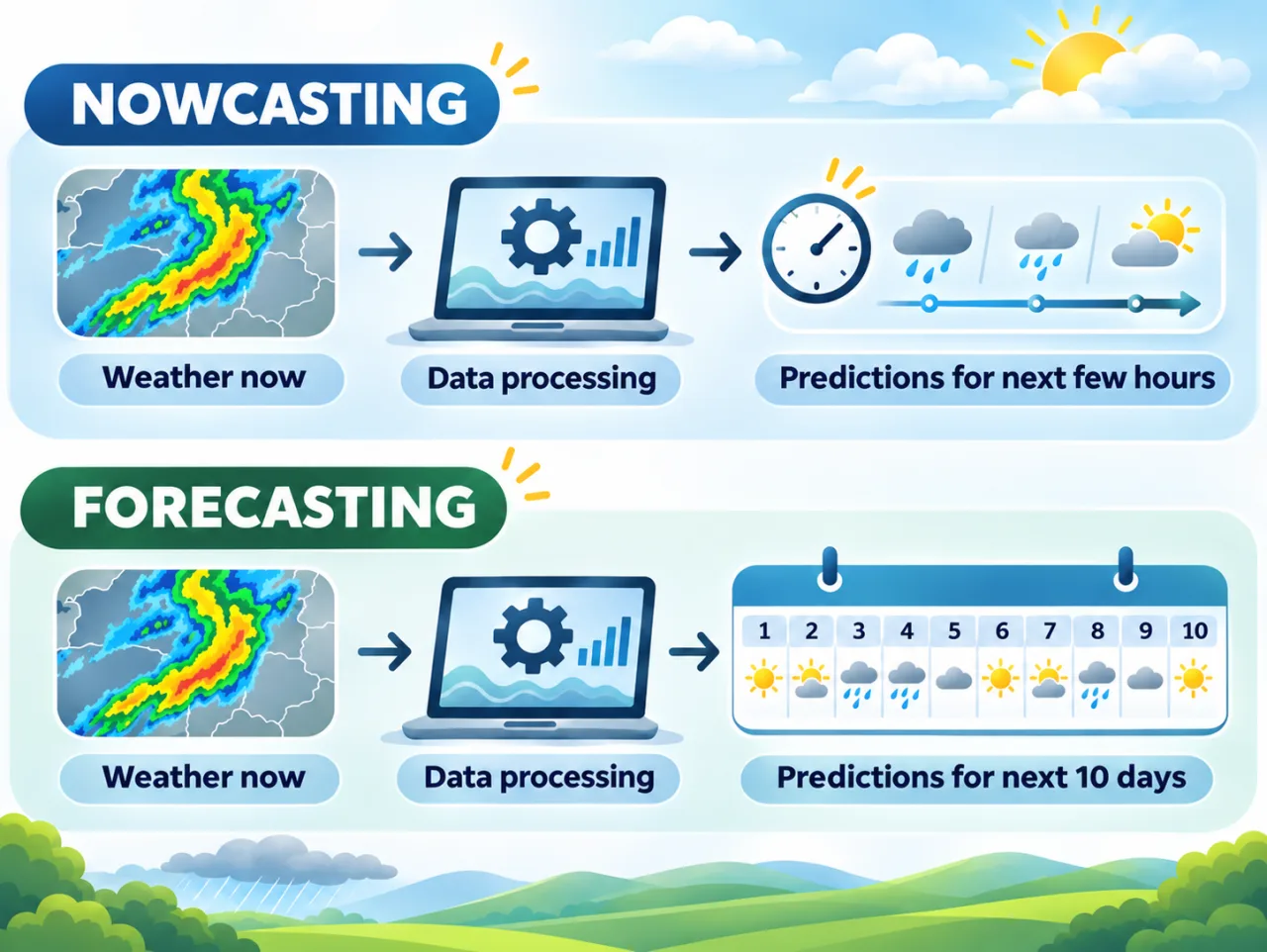
The complication is that rain clouds don't necessarily follow their previous trajectories unchanged. Showers can develop, intensify, weaken, change direction, or dissipate entirely. A small difference in a storm's movement can determine whether your backyard gets soaked or stays completely dry.
So an app announcing that rain will begin at 6:32 PM may be providing its best current estimate, not a promise that precipitation will begin at precisely that minute.
And that brings us to the real issue: how much uncertainty does the app actually communicate?
An estimated arrival time can be valuable, especially when supported by recent radar observations. But displaying that time without sufficient context can make an uncertain prediction appear more definitive than it really is.
A single inaccurate forecast doesn't establish that an app is generally unreliable, either. Forecast quality must be assessed across many predictions, comparing what was forecast with what actually happened.
The goal shouldn't be to eliminate uncertainty from weather forecasts. That's impossible. Instead, the goal is to communicate useful predictions while giving people a realistic understanding of their limitations.
So, is your weather app trolling you?
Probably not. But when it announces rain at precisely 6:32 PM, it might be giving an uncertain atmosphere a level of punctuality it never agreed to provide.
Sources
-
Mobile weather apps or the illusion of certainty
Zabini, F. (2016). Mobile weather apps or the illusion of certainty. Meteorological Applications, 23(4), 663–670.
Why this source matters: Examines how mobile weather applications present forecast information and how detailed, personalized predictions may create unrealistic expectations of certainty.
-
That's not what my app says: Perceptions of accuracy, consistency, and trust in weather apps
Vaughn, C., Sherman-Morris, K., Brown, M., & Gutter, B. (2024). That's not what my app says: Perceptions of accuracy, consistency, and trust in weather apps. Meteorological Applications, 31(3), e2205.
Why this source matters: Investigates how people interpret weather-app predictions, how perceived accuracy affects trust, and why highly detailed forecasts can create expectations that the underlying predictions cannot always satisfy.
-
How accurate are our public forecasts?
Met Office. (n.d.). How accurate are our public forecasts?
Why this source matters: Explains why weather prediction contains unavoidable uncertainty and how automated forecasts can summarize information from weather models without direct human intervention.
-
Nowcasting
Met Office. (n.d.). Nowcasting.
Why this source matters: Explains how short-term forecasting uses recent observations and methods such as radar-based storm tracking to improve predictions over the next few hours.
-
Using ensemble forecasts in decision-making
Met Office. (n.d.). Using ensemble forecasts in decision-making.
Why this source matters: Describes how multiple weather-model predictions help scientists estimate uncertainty and why different plausible outcomes are important when interpreting forecast information.