
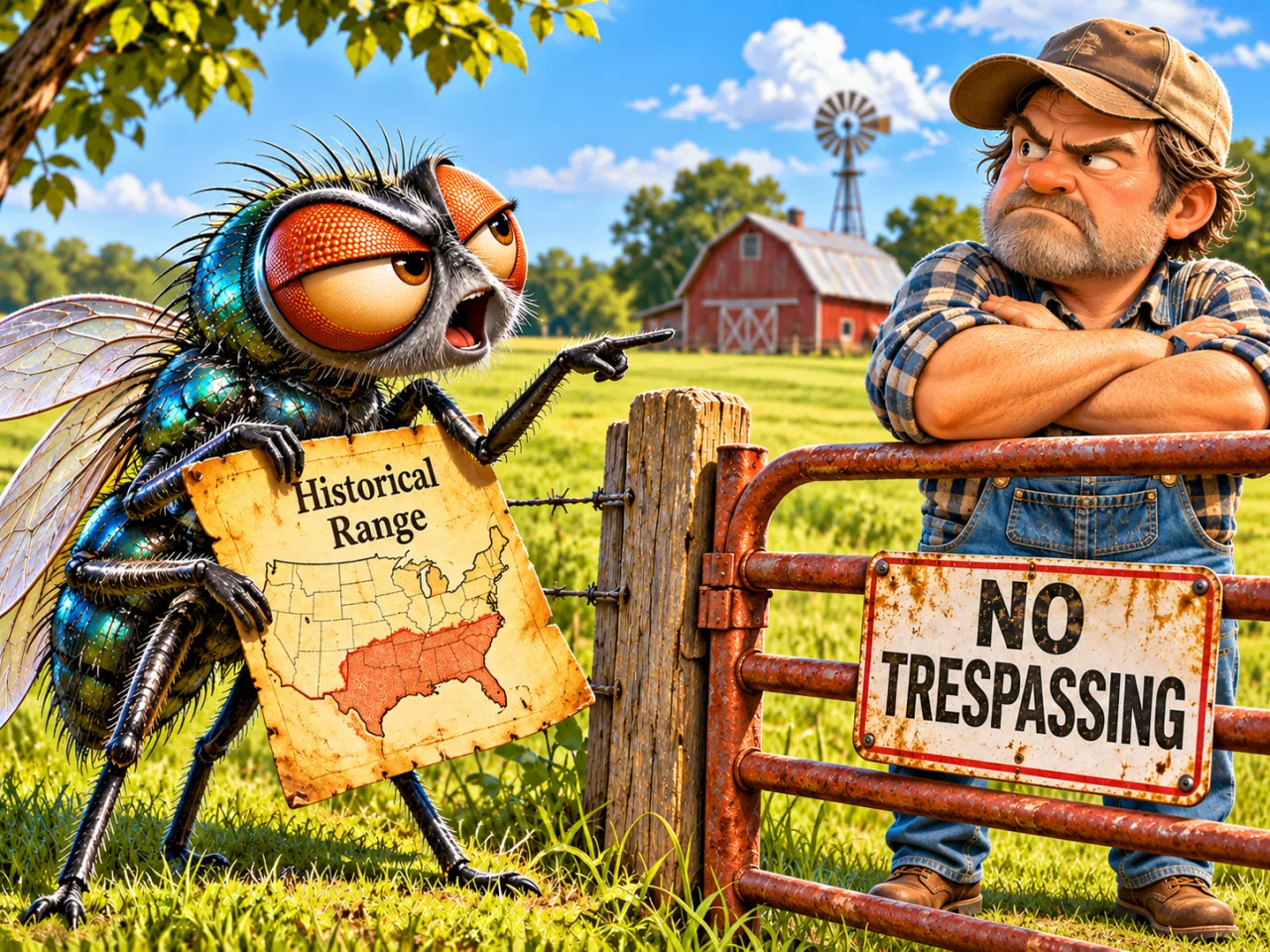
Back in June 2026, a case of New World screwworm infestation was confirmed in a calf in Texas.
Enter the media and a general aura of panic. 😱😱😱
And granted, this fly lays its eggs in wounds on living animals, and its larvae burrow into and eat the host's LIVING flesh, which is neither pleasant nor particularly good news. Unlike many other fly species whose maggots feed on dead or decaying tissue, New World screwworm larvae actually require a living host to develop.
But instead of joining the panic, my curiosity engine started revving up. Especially when I discovered that the New World screwworm fly used to live in the United States as part of its original native range. And especially when some of the news coverage made it sound as though an animal apocalypse was imminent.
My first thought: If we previously "eradicated" this fly from the United States, that means it used to live here. Naturally.
My second thought: If it's so devastating, then why aren't all its hosts extinct?
My third thought, after reading that the white-tailed deer population in Texas had more than tripled following screwworm eradication: Wait a minute… did we accidentally create an artificially high deer population by removing a native source of mortality?
My fourth thought: Wait. Wait. Wait. How much of this concern is ecological versus economic?
My fifth thought: Is this just humans saying, "Don't come here and kill our deer… WE want to be the ones to kill our deer?" 🤔
Of course, the answer is considerably more complicated than that last thought. Ecology is a complicated branch of biology, with countless organisms and environmental factors interacting in ways that can produce some very unexpected consequences.
But at the heart of this story is a fascinating ecological twist.
Instead of dealing with a non-native invasive species arriving in unfamiliar territory (like the Joro spider we recently discussed), we're dealing with a NATIVE species returning to part of its ancestral range after humans spent decades deliberately eliminating it.
And now that it's back, the humans are claiming squatter's rights and want to kick it out again.
The fly, presumably, would like to speak to the landlord.
The Real Story
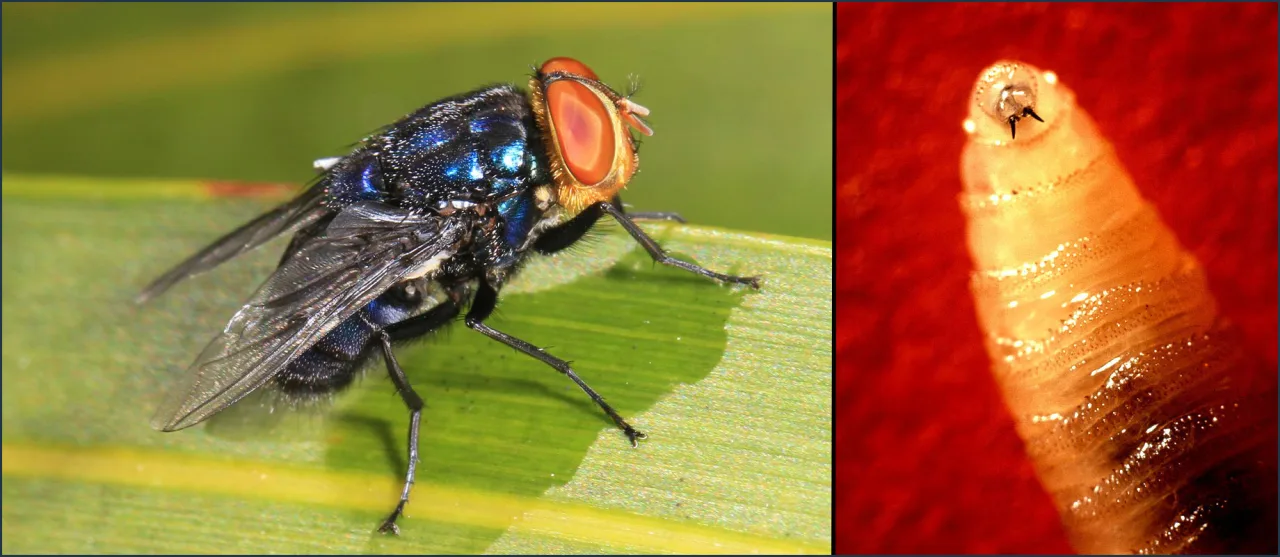
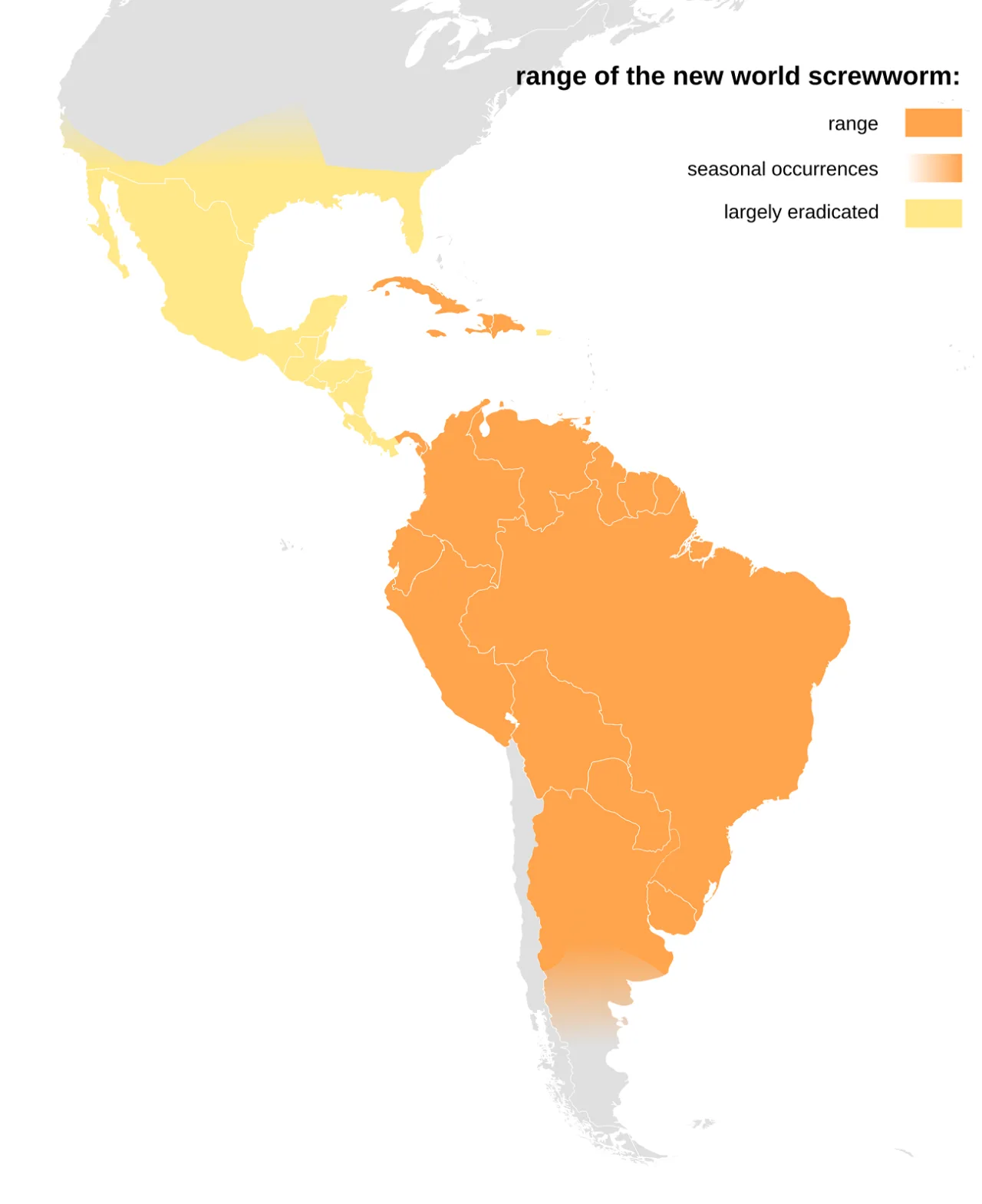
The New World screwworm (Cochliomyia hominivorax) is a parasitic fly native to the Americas, including portions of the southern United States where it once maintained breeding populations. Unlike many flies whose larvae feed on decaying organic material, screwworm larvae are obligate parasites of living animals. They must feed on living tissue to complete their development, causing a parasitic infestation known as myiasis.
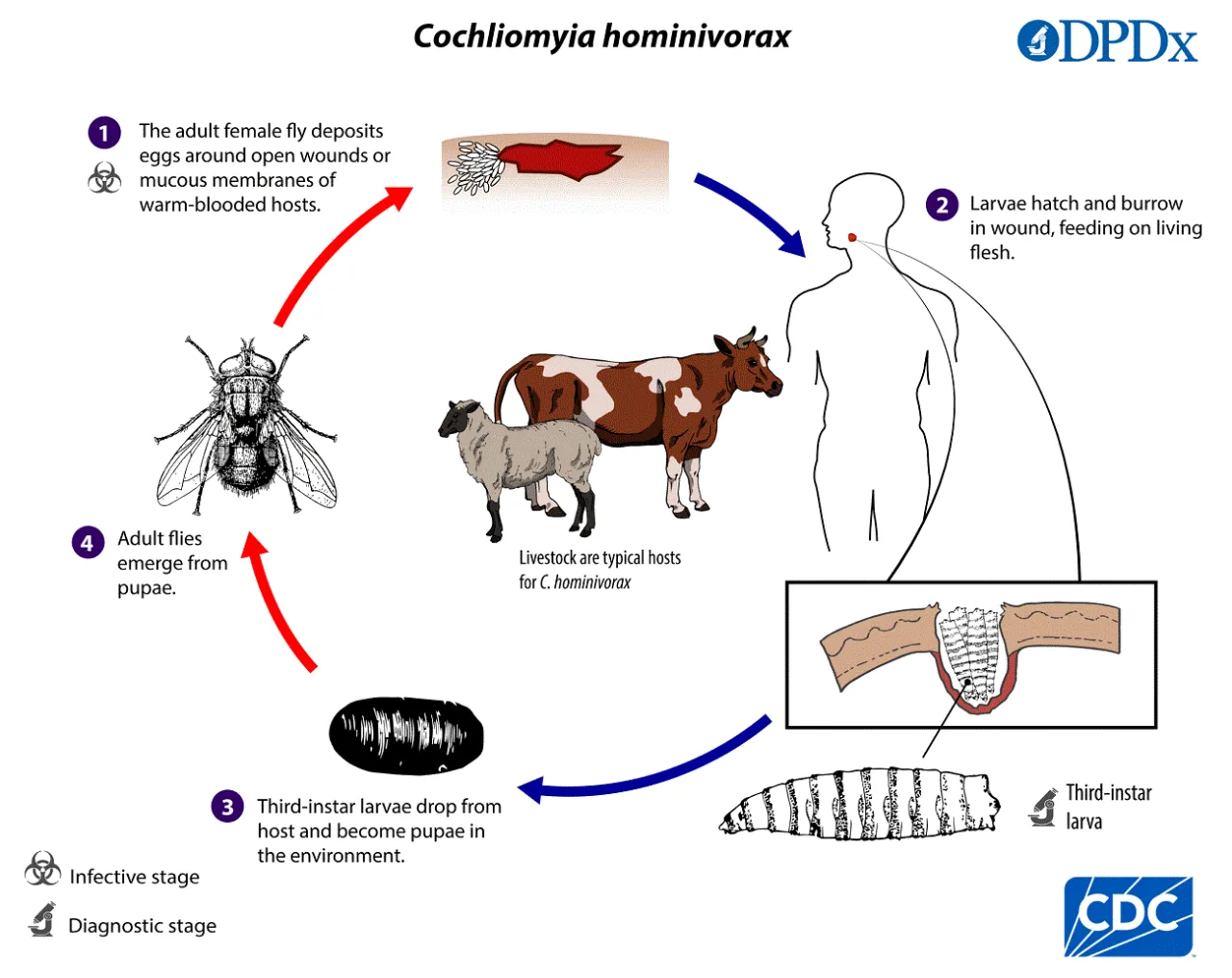
Female screwworm flies are attracted to wounds on warm-blooded animals, including cattle, horses, deer, pets, and occasionally humans. Even a tiny scratch, tick bite, or the exposed umbilicus of a newborn animal can provide an opportunity. A female typically deposits hundreds of eggs along the wound's edge.
When the eggs hatch, the larvae burrow into the surrounding tissue and begin feeding. As the wound enlarges, it can attract additional egg-laying females, potentially producing a severe infestation involving hundreds of larvae. Untreated infestations can cause extensive tissue damage, secondary infections, and death.
But here's the ecological puzzle: If screwworms are so destructive, how did their host species survive alongside them for thousands of years?
The answer lies partly in the distinction between what happens to an individual animal and what happens to an entire population.
A severe infestation can be fatal, but not every infestation kills its host. Animals may survive less extensive infestations, particularly when the larvae are removed and wounds are treated. Meanwhile, host populations continue reproducing, and the flies encounter animals across many different species and habitats.
Parasites also face ecological limitations. Their populations depend on suitable hosts, opportunities to reproduce, environmental conditions, and the survival of their own offspring. Screwworm populations historically expanded northward during warmer months but declined sharply in areas where winter temperatures prevented their survival.
None of this guarantees a peaceful ecological balance. Parasites can cause substantial mortality, and host populations can fluctuate dramatically without disappearing entirely. A species can survive over evolutionary time while individual populations experience devastating losses.
And screwworms were certainly capable of devastating losses.
Historical reports describe serious effects on wildlife, particularly white-tailed deer. One account documented losses of up to 80% of the fawn crop during a heavy infestation year on a southern Texas ranch. That was an extreme local observation, not a mortality rate that applied to every deer population or every year.
Then humans intervened.
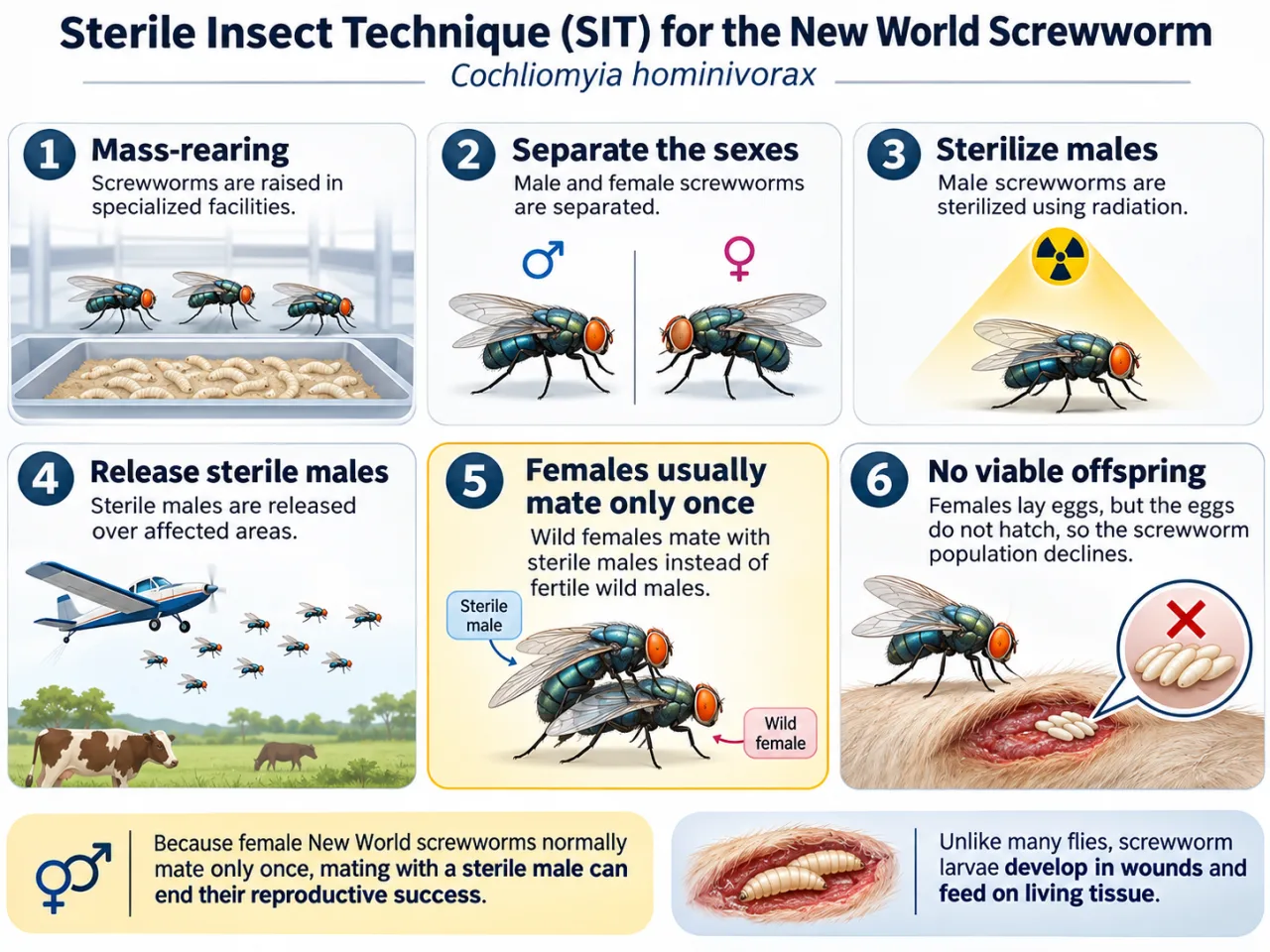
Beginning in the 1950s, scientists developed an extraordinary method for eliminating screwworms from large geographic areas. Rather than relying primarily on pesticides, they exploited a peculiar feature of the fly's reproductive biology: female New World screwworms normally mate only once during their lives.
The technique, known as the sterile insect technique (SIT), involves raising enormous numbers of screwworm flies in specialized facilities and exposing them to radiation that makes them reproductively sterile.
The sterilized flies are then released into areas containing wild screwworm populations. When a wild female mates with a sterile male, the eggs she subsequently lays fail to hatch. Because she normally mates only once, that unsuccessful mating can prevent her from producing viable offspring throughout her life.
By repeatedly releasing enough sterile flies to overwhelm wild males in the mating population, scientists can progressively suppress reproduction until the local population disappears.
The strategy was spectacularly successful. Screwworms were eliminated from the southeastern United States by 1959, and the broader U.S. eradication campaign was declared successful in 1966. Continued outbreaks and reinfestations required additional work, eventually pushing the control effort through Mexico and Central America toward a maintained biological barrier in Panama.
Removing screwworms had consequences beyond healthier livestock and reduced veterinary costs.
Historical accounts report that white-tailed deer populations in Texas increased more than threefold relative to their 1960 levels following eradication. Screwworm elimination helped remove a significant source of mortality, although changes in habitat management, predator control, hunting, and other environmental conditions also influenced deer populations.
This illustrates an important ecological principle: removing a native parasite can change the population dynamics of its hosts.
Fewer deaths from one cause may allow more animals to survive and reproduce, potentially changing population density, competition, vegetation browsing, and other ecological relationships. The effects depend on the many other factors influencing the ecosystem.
And that brings us to the current controversy.
After decades of successful exclusion, New World screwworms began reappearing in the United States in 2026. Confirmed animal cases have been reported in Texas, New Mexico, and Arizona (as of the publication date of this article).
But the fly isn't an entirely foreign species invading an ecosystem it has never encountered. It is returning to portions of its historical geographic range, where its ancestors once participated in natural host-parasite relationships.
That distinction is scientifically important, but it doesn't make the fly's return desirable.
Native does not mean harmless, beneficial, or welcome.
Screwworms threaten livestock, pets, wildlife, and occasionally humans. Their reappearance can cause animal suffering, economic losses, and serious wildlife-management problems. Preventing their establishment protects animals from a dangerous parasite that humans have already demonstrated they can successfully control.
USDA and state officials are responding through surveillance, animal movement restrictions, wound inspections, treatment, and renewed sterile-insect releases. A confirmed infestation in one animal does not necessarily establish that a self-sustaining local fly population exists, which is precisely why rapid detection and control matter.
Ultimately, the New World screwworm story reveals an uncomfortable ecological truth: what is natural and what humans consider desirable are not necessarily the same thing.
The fly's historical presence was part of the region's ecology. Its eradication was a deliberate human intervention that changed that ecology. And its return presents a real threat to animals and to the agricultural and wildlife systems that developed during its absence.
The screwworm may have historical residency.
But humans have very compelling reasons for changing the locks and serving a second eviction notice.
Sources
-
Screwworm control and eradication in the southern United States of America
Novy, J. E. (n.d.). Screwworm control and eradication in the southern United States of America. Food and Agriculture Organization of the United Nations.
Why this source matters: Provides historical documentation of the screwworm's former U.S. range, its effects on livestock and wildlife, and the development of large-scale eradication programs using sterile flies.
-
Clinical Overview of New World Screwworm
Centers for Disease Control and Prevention. (2026, February 24). Clinical overview of New World screwworm.
Why this source matters: Explains how screwworm flies lay eggs on living hosts, how larvae damage tissue, and why the female's single-mating behavior makes sterile-insect control possible.
-
Sterile Insect Technique: A Proven Tool for Fighting New World Screwworm
U.S. Department of Agriculture, Animal and Plant Health Inspection Service. (2026, June). Sterile insect technique: A proven tool for fighting New World screwworm (APHIS 26-012).
Why this source matters: Describes how sterile insect releases prevent successful reproduction and explains why the technique is an important part of screwworm eradication and containment.
-
USDA Confirms Two Additional Cases of New World Screwworm in the United States
U.S. Department of Agriculture, Animal and Plant Health Inspection Service. (2026, June 8). USDA confirms two additional cases of New World screwworm in the United States.
Why this source matters: Documents early confirmed U.S. screwworm detections in 2026 and the federal response, establishing the contemporary outbreak that prompted renewed concern.
-
USDA Confirms New World Screwworm in Arizona
U.S. Department of Agriculture, Animal and Plant Health Inspection Service. (2026, October 28). USDA confirms New World screwworm in Arizona.
Why this source matters: Confirms the first reported Arizona detection in October 2026 and describes the surveillance, movement controls, and sterile-fly releases undertaken in response.
-
Current Status of New World Screwworm
U.S. Department of Agriculture, Animal and Plant Health Inspection Service. (n.d.). Current status of New World screwworm. Retrieved November 6, 2026.
Why this source matters: Provides access to official surveillance information, confirmed detections, geographic updates, and control activities as the screwworm response continues.