

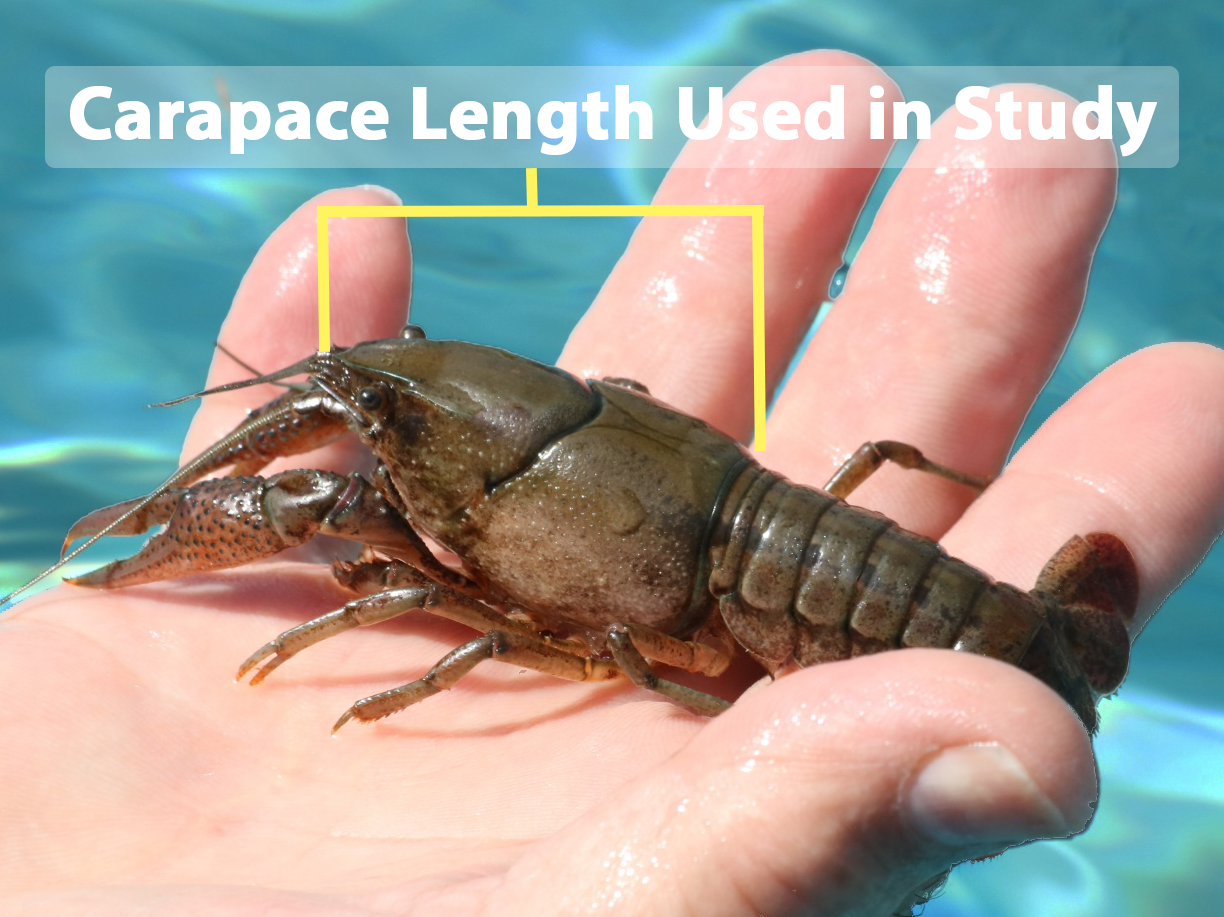
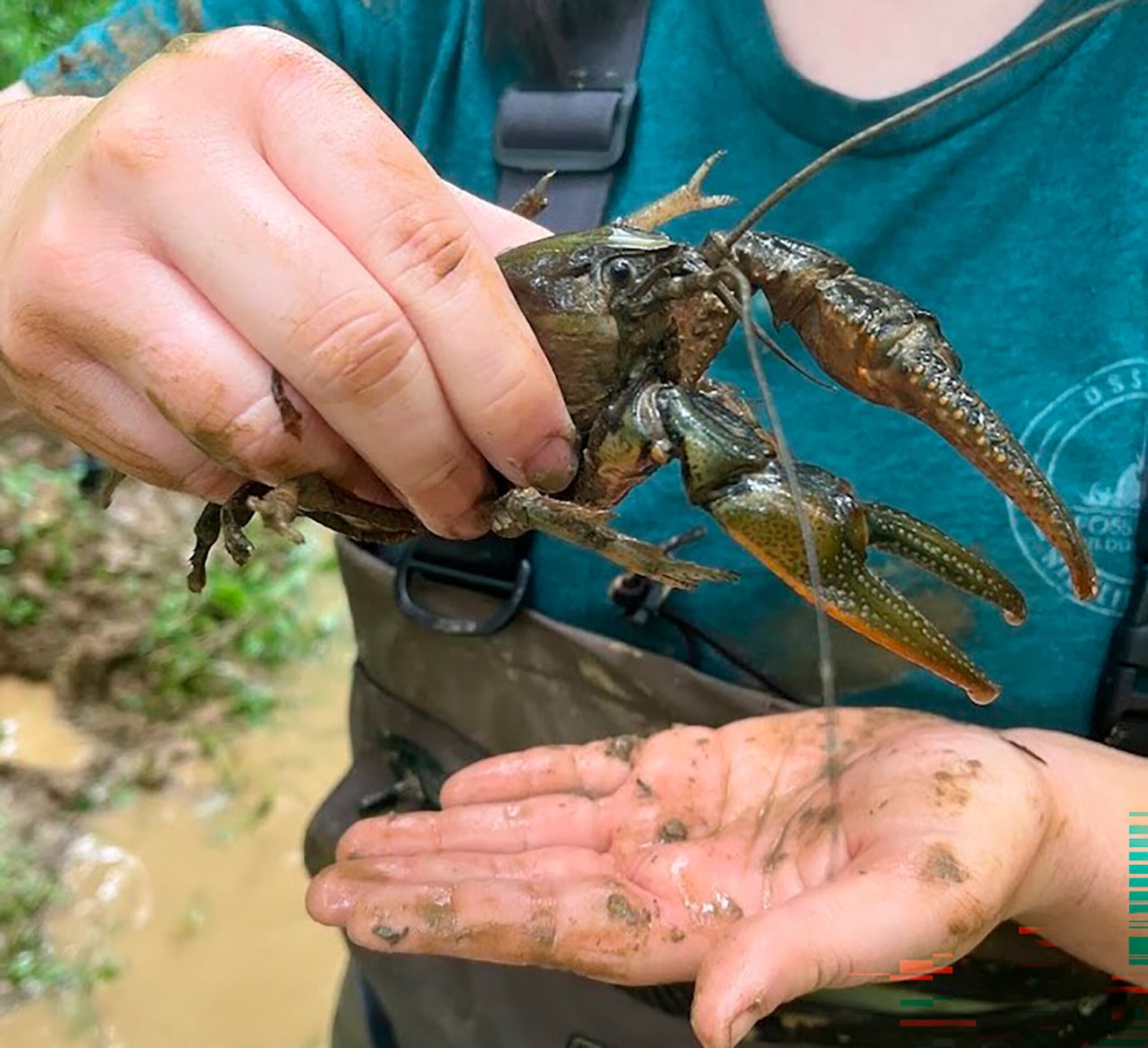
It started in May 2023. Caitlin Bloomer dug an enormous male Crawzilla crawdad out of a burrow in Kentucky. Its total carapace length, measured from the tip of the pointed rostrum to the joint where the abdomen begins, was 77.5 mm, just over 3 inches.
Caitlin held her amazing find aloft and essentially said, “BEHOLD MY MAGNIFICENT CRAYFISH SPECIMEN!”
A colleague responded with the scientific equivalent of, “Pfft. I’ve seen bigger.”
And thus began a continent-wide search for North America’s biggest crayfish.
SPOILER ALERT: Crawzilla didn’t win.
The heavyweight champion was a Tennessee bottlebrush crayfish collected in 2011 and sitting quietly in a university collection, waiting for its moment of glory. Its total carapace length measured 86.6 mm, about 3.4 inches.
And remember - that measurement runs only from the tip of the rostrum to where the abdomen begins. The tail, claws, and antennae were not included.
The whole winning animal, everything included, stretches nearly the width of a sheet of notebook paper.
Poor Crawzilla came in at 10th place, although he was the only burrowing crayfish to make the top 20.
And all this friendly competition led to an interesting question: why do the largest North American crayfish seem to bump up against roughly the same upper size ceiling?
And we’ll investigate that question in more detail in The Real Story below.
So, to sum up:
Scientist A: “I caught the biggest crayfish.”
Scientist B: “No you didn’t.”
Scientist A: “Fine. GET THE MUSEUMS. And the calipers.”
Nine collections later: Ecology, 2026. 🤣
The Real Story
North America is home to more than 400 species of crayfish, the highest crayfish diversity of any region in the world. They occupy streams, rivers, lakes, wetlands, caves, and even terrestrial burrows, and their body sizes vary enormously. Some dwarf crayfish reach only about 15 millimeters in total carapace length, while the continent’s giants can exceed 80 millimeters.
But until recently, nobody had systematically asked a question that apparently becomes irresistible once enough crayfish biologists are gathered in one place:
Which North American crayfish is actually the biggest?
To find out, researchers and curators at nine major crayfish collections searched their museum shelves for unusually large specimens. They either screened collections directly or used curator records and expert knowledge to identify likely contenders. In total, they measured 60 specimens with calipers. Each animal’s total carapace length, or TCL, was measured along the back from the tip of the rostrum to the joint between the thorax and abdomen. Because the differences among the largest animals were small, measurements were recorded to the nearest tenth of a millimeter.
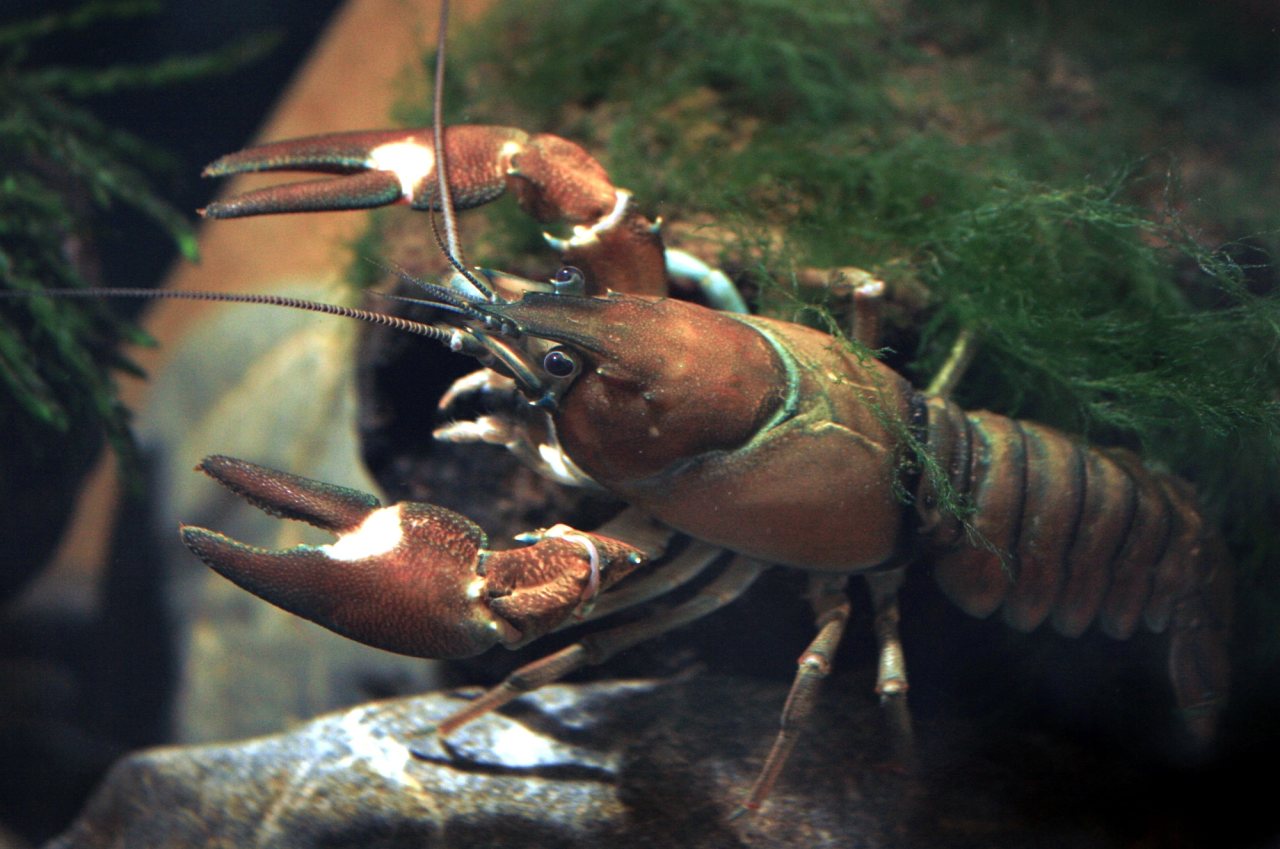
The winner was a Tennessee bottlebrush crayfish, Barbicambarus simmonsi, from the West Liberty University collection. Collected in Lawrence County, Tennessee, in 2011, it measured 86.6 millimeters in total carapace length. The runner-up, Barbicambarus cornutus, measured 85.2 millimeters. Crawzilla, Lacunicambarus chimera, landed in tenth place at 77.5 millimeters.
Crawzilla did retain one consolation prize: it was the only burrowing crayfish among the top 20.
But once the rankings were assembled, the researchers noticed something more interesting than who got bragging rights. Despite representing several different species, habitats, geographic regions, and evolutionary lineages, the biggest North American crayfish seemed to converge on roughly the same size. Very few specimens exceeded about 80 millimeters in carapace length.
So what is keeping them there? Why don't we regularly see larger ones?
One possibility was climate. A biological pattern known as Bergmann’s rule predicts larger body sizes in colder environments in some groups of animals. But the giant crayfish in this study ranged geographically from Louisiana to Washington, and the researchers found no obvious pattern suggesting temperature alone could explain the size ceiling.
Evolutionary history did not provide an obvious answer either. Large-bodied crayfish appeared in both earlier-branching and more recently derived lineages, rather than showing a simple evolutionary trend toward increasing size. Oxygen availability also seemed unlikely to explain everything: the largest specimens came from environments ranging from oxygen-poor burrows to comparatively well-oxygenated lakes.
That leaves an intriguing possibility: the apparent North American size ceiling may reflect physiological constraints shared by those crayfish lineages.
Crayfish, like other arthropods, grow by molting. They periodically shed the rigid exoskeleton surrounding their bodies and replace it with a larger one. Immediately after a molt, however, the new exoskeleton is relatively thin and poorly hardened, leaving the animal temporarily more vulnerable to bending, breakage, and predators. As body size increases, the mechanics of supporting and moving that larger body with muscles working inside an exoskeleton may also become more demanding.
The researchers therefore suggest that muscle performance, exoskeleton mechanics, or the challenges associated with molting could contribute to the apparent upper size limit seen among North American crayfish. For now, though, that remains a hypothesis rather than a demonstrated mechanism. Ecological factors such as habitat, predation, and competition may also contribute.
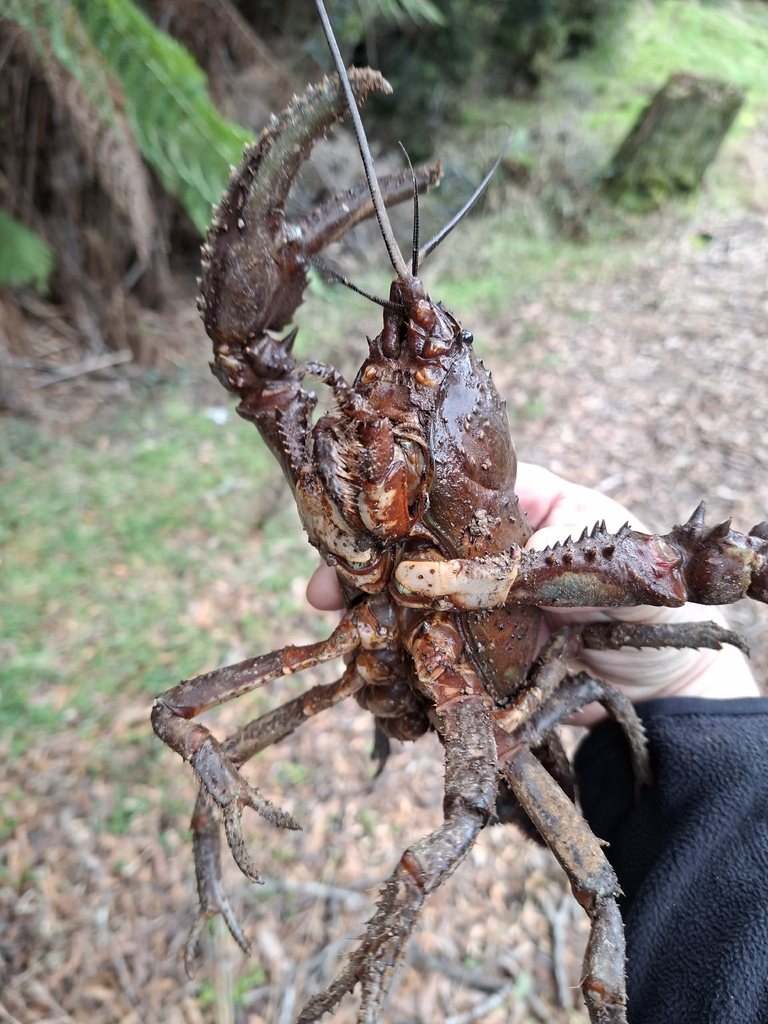
And importantly, this does not appear to be a universal limit for all crayfish. The Tasmanian giant freshwater crayfish, Astacopsis gouldi, belongs to the Southern Hemisphere family Parastacidae, a lineage that is deeply separated from the Northern Hemisphere crayfish groups represented in the study. Phylogenetic work places the split between these major crayfish lineages deep in their evolutionary history, on the order of hundreds of millions of years.
That long independent history matters. Different crayfish lineages can evolve different body proportions, exoskeleton properties, muscle scaling, life histories, and ecological strategies. So a physiological constraint that helps keep many North American crayfish near an apparent ceiling of roughly 80 millimeters in carapace length would not necessarily impose the same ceiling on a distantly related Tasmanian lineage.
And Astacopsis gouldi proves that crayfish, as a whole, are capable of getting much larger. The species has been recorded at a total carapace length of about 147 millimeters, dramatically larger than the North American specimens examined here. That makes the Tasmanian giant less of a problem for the physiological hypothesis and more of an interesting comparison: what evolved differently in that lineage that allows it to grow so much larger?
There is also one important limitation to the study: this was not a random survey of crayfish body sizes. The researchers deliberately went looking for unusually large museum specimens. Their sample is therefore excellent for asking, “What do the record-holders look like?” but not for estimating typical body size or formally testing what causes the apparent ceiling. The authors describe the work as hypothesis-generating, with future studies needed to examine metabolic rates, muscle structure, exoskeleton properties, body mass, claw size, and other possible constraints.
For now, North America has a champion.
Crawzilla has reportedly requested that everyone stop talking about it.
Sources
-
North American crayfish: A quest for the biggest catch
Bloomer, C. C., Adams, S. B., Barnett, Z. C., Graham, Z. A., Delekta, E. M., Hayes, D. M., Loughman, Z. J., MacIntosh, H., Pugh, M. W., Reed, K., Shoobs, N. F., Taylor, C. A., & Larson, E. R. (2026). North American crayfish: A quest for the biggest catch. Ecology, 107(9), e70471.
Why this source matters: Primary source for the study. Supports the museum-collection search, measurement method, 60 measured specimens, top-20 rankings, species identities and sizes, ~80 mm apparent upper ceiling, geographic and evolutionary comparisons, oxygen discussion, physiological-constraint hypothesis, study limitations, and comparison with much larger Southern Hemisphere crayfish.
-
Biologists compete over North America’s largest crayfish
Quinn, L. (2026, September 23). Biologists compete over North America’s largest crayfish. College of Agricultural, Consumer & Environmental Sciences, University of Illinois Urbana-Champaign.
Why this source matters: Institutional release accompanying the Ecology paper. Especially useful for Caitlin Bloomer’s account of finding Crawzilla and bragging to her colleague, her colleague's “I've caught bigger” response, the friendly competition that followed, Crawzilla being the only burrowing crayfish in the top 20, and Zackary Graham’s description of the winning specimen as nearly the width of notebook paper when the tail and claws are included. Also provides researcher commentary on the possible physiological explanation for the size ceiling.
-
The monophyletic origin of freshwater crayfish estimated from nuclear and mitochondrial DNA sequences
Crandall, K. A., Harris, D. J., & Fetzner, J. W., Jr. (2000). The monophyletic origin of freshwater crayfish estimated from nuclear and mitochondrial DNA sequences. Proceedings of the Royal Society B: Biological Sciences, 267(1453), 1679–1686.
Why this source matters: This phylogenetic study supports the deep evolutionary separation between the major Northern Hemisphere and Southern Hemisphere freshwater crayfish groups, providing context for why the much larger Tasmanian giant freshwater crayfish may not share exactly the same size constraints as the North American lineages discussed in this article.
-
Biology of the giant Tasmanian freshwater lobster Astacopsis gouldi (Clark) and its conservation
Walsh, T. S., & Walsh, B. B. (2012). Biology of the giant Tasmanian freshwater lobster Astacopsis gouldi (Clark) and its conservation. Crustacean Research, Special2012(7), 95–104.
Why this source matters: This species-focused paper describes the exceptional size and life history of the Tasmanian giant freshwater crayfish, Astacopsis gouldi. It provides independent evidence that some Southern Hemisphere crayfish can grow far larger than the North American species examined in the 2026 size-comparison study.